
How Long Does a Water Heater Last in Minnesota? 2026 Guide
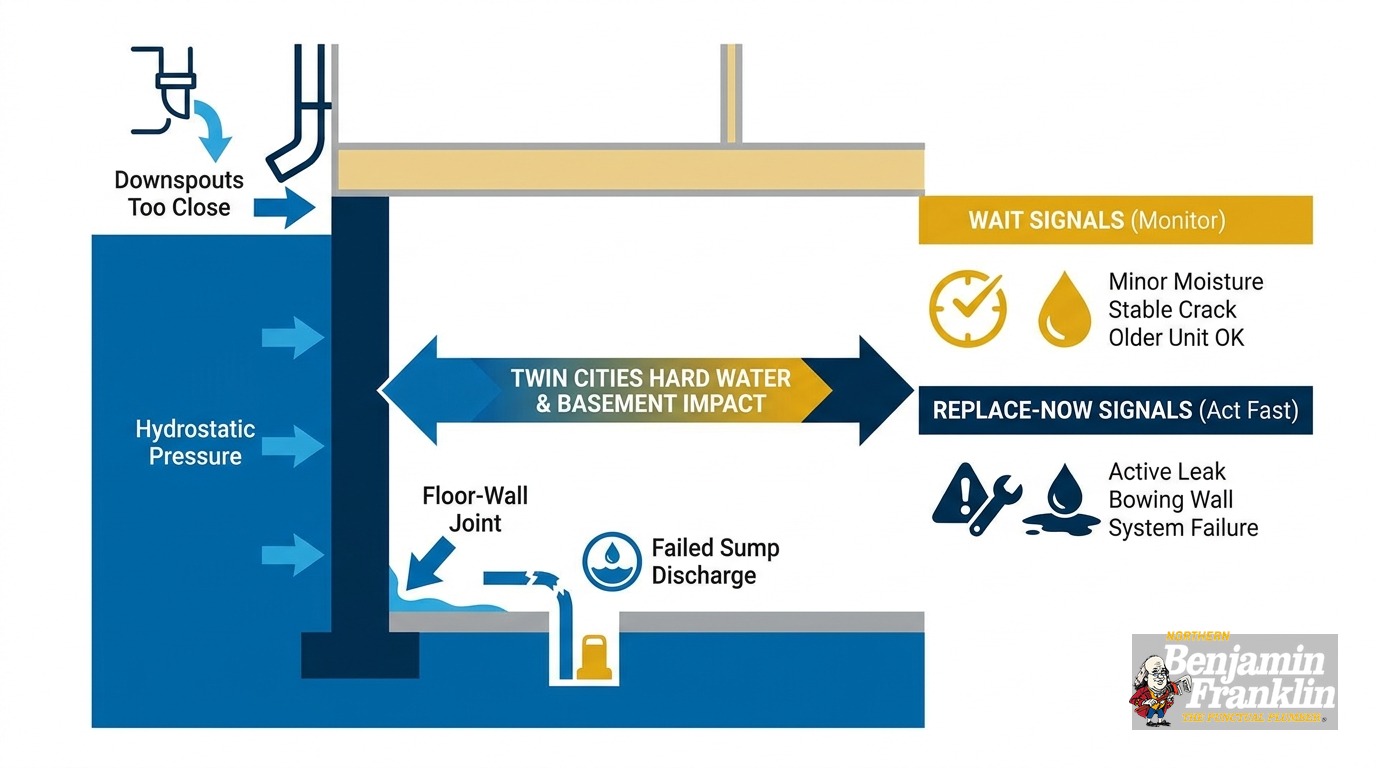
Key Takeaways
- Plan to evaluate any tank water heater once it passes 10 years old.
- Rust in the water, leaks, and corrosion mean the tank is failing. Replace, do not repair.
- Hard water speeds up sediment and wears the anode rod faster.
- Basement installs raise the cost of a surprise failure. Replace before the leak, not after.
- Minnesota code limits where a relief valve may discharge. A good install follows it.
- A planned replacement costs less stress than an emergency one.
- Call (763) 296-1844 or book online to have your unit checked.
How long does a water heater last in Minnesota?
Most tank water heaters in Minnesota need replacing somewhere around the 10 to 15 year mark. Hard water, sediment, and a skipped anode rod check can push that sooner. ENERGY STAR advises that a unit “more than 10 years old” is a time to consider replacing it.
That is a range, not a deadline. Three things set your unit’s real life: the water it heats, the room it sits in, and the care it gets.
We are Northern Benjamin Franklin Plumbing, a locally owned and operated plumbing company serving the Twin Cities. We see water heaters of every age.
How long does each type of water heater last?
Lifespan depends on the design. Here is how the common types compare.
| Type | What to expect |
|---|---|
| Standard tank (gas or electric) | Evaluate at 10 years. ENERGY STAR flags that age as a replacement point. |
| Heat pump water heater | ENERGY STAR’s savings math assumes a 13-year lifespan. |
| Tankless | Often outlasts a tank, but only with regular descaling. |
| Point-of-use tankless | Serves one sink or bath. Lifespan follows the same descaling rule. |
We are not giving a hard number for tankless units. We could not tie one to a source we can cite. Scale is the main enemy. Hard water coats the heat exchanger and cuts its life.
For the full breakdown of types, read our guide to water heater types and how they work. You can also compare options in our tank vs. tankless comparison.
Why do rules of thumb miss Minnesota conditions?
Most lifespan pages give one flat range and treat every home the same.
Yours is different. A tank in a finished basement behaves differently than one in a utility closet. A home on hard municipal water wears a heater differently than one on soft water.
A flat range also hides the real mechanism. A tank does not die of old age. It dies when corrosion beats the protection built into it. Everything below comes back to that.
How does Twin Cities hard water shorten tank life?
Hard water carries dissolved calcium and magnesium. When water heats, those minerals drop out as scale and settle on the tank bottom. The layer makes the burner or element work harder and traps heat against the steel.
The Minnesota Department of Health says that if your water’s hardness is greater than 7 grains per gallon, or 120 mg/L, “then you might need a water softener.” The same page notes there is no requirement to soften your water. It is your call.
Hardness varies a lot across the metro. The city of Otsego, for example, states its municipal supply has “an average hardness level of 15 grains per gallon.” That is one suburb, not a Twin Cities average. Your city, your well, or your neighborhood may differ.
We will not give you a single metro number, because reports from different sources disagree. Your city’s own water quality report is the best place to look. We also cover this in our post on water hardness in Minneapolis and St. Paul.
Not sure what is in your water? A home water test gives you a real answer. If the number is high, a water softener protects more than your heater. It also helps faucets, shower heads, and appliances.
MDH adds one more point: “make sure the softener is set to the hardness of your water supply.” A setting that is too high raises operating costs and wastes water. A softener that is set wrong or never serviced can fail to protect your heater. Our post on water softener maintenance shows what to check.
What is the anode rod, and why does it decide tank life?
Inside every steel tank water heater is a metal rod called the anode rod. It is made of a metal that corrodes more easily than steel. The rod rusts so the tank does not.
It is a sacrificial part. It takes the damage on purpose. Once it is used up, corrosion moves on to the tank wall.
Hard water and hot settings can wear the rod faster. When it is gone, the tank has little time left. A tank without its rod can rust through and leak.
What to do about it:
- Have the rod checked, especially after year five or so.
- Replace it if it is badly worn and the tank is otherwise sound.
- Skip it if the tank already shows rust or leaks. At that point, the tank is the problem.
Our post on the anode rod and water heater life walks through how to tell. A rod swap can add years to a healthy tank. It cannot save one that is already rusting.
Does a basement install change the math?
Yes. Most Twin Cities homes put the water heater in the basement, and that changes what a failure costs.
A leak in an unfinished basement may drain to a floor drain and do little harm. In a finished basement, water can reach carpet, drywall, stored boxes, and furnishings. Slow leaks are worse because no one sees them.
ENERGY STAR makes a related point. Sudden failure can force an emergency replacement that “can be more expensive.” It may also limit you to “inefficient models with high operating costs.” When the unit dies on a Sunday night, you take what you can get.
So we tell basement owners to replace before failure. A planned swap lets you pick the right size, fuel, and venting. It also keeps water off your floor.
A few basement habits help:
- Keep the area around the tank clear so you can spot a puddle.
- Know where your floor drain is and whether it works.
- Learn where your main shutoff is. Our guide to finding and testing your main water shutoff valve shows how.
- Consider a smart water leak detector near the tank.
If your unit is leaking now, see our post on a water heater leaking from the bottom.
What signs say replace now?
Some warning signs mean the tank is breaking down. Do not wait on these.
ENERGY STAR says that “corrosion is a sign that the water heater is breaking down.” Watch for:
- Rust-colored hot water. ENERGY STAR says rust in the water usually means the tank interior is corroding.
- Leaks at joints, seals, or seams. The same page says these signal a problem.
- Water pooling around the base. The tank itself may have a breach.
- Visible corrosion on the tank or fittings. The surface shows what is happening inside.
- Age over 10 years with any of the above. Age plus a symptom is a strong case for replacement.
If a leak comes from the tank body, shut off the water supply to the heater. Then turn off the gas or power. Call us right away.
To learn how old your unit is, see our post on decoding a water heater serial number.
What signs mean you can wait or repair?
Not every symptom means a new tank. Some problems are repair jobs.
These often point to a fixable issue:
- No hot water on a gas unit. A pilot or thermocouple problem is common. See our gas water heater troubleshooting guide.
- A pilot that keeps going out. Our pilot light guide covers the basics.
- A dripping relief valve. The valve may be worn, or pressure may be high. Read about a leaking pressure relief valve.
- Discolored water with sediment. A flush may help. See our post on sediment and discolored hot water.
Noise is a gray area. ENERGY STAR says rumbling often comes from sediment on the tank bottom, and that “any noises should be checked out.” A young tank that rumbles may only need a flush. An old tank with heavy buildup may be near the end. Our post on popping and rumbling noises explains the difference.
The rule is simple. If the tank is sound, repair. If it is leaking, rusting, or past its useful age, replace.
Ask us for an honest read. We will tell you if a repair makes sense. Our water heater repair team looks at the whole picture.
Should you flush a 10-year-old water heater?
A flush can help, but it is not always wise on an old, neglected tank. If the unit has never been flushed, a first flush at year 10 can stir up hardened sediment. That can expose leaks or clog the drain valve.
Flushing removes loose sediment from the bottom of the tank. That sediment causes rumbling and wastes fuel. On a younger tank, a yearly flush is a good habit, especially with hard water.
On a tank at or past 10 years, ask first:
- Has it ever been flushed?
- Does the drain valve work, or is it crusted over?
- Is there any rust, weeping, or corrosion?
If you see rust or leaks, skip the flush and plan a replacement. If the tank looks clean and is only a bit noisy, a careful flush may be fine.
Our guide to flushing sediment from your tank lays out the steps. For an older unit, we suggest having a plumber do it, so a surprise leak does not become your emergency. Our water heater maintenance service covers this.
Do Minnesota rules affect your replacement?
They do. Minnesota’s plumbing code applies statewide, and it shapes how a new heater is set up.
Under Minnesota Rules 4714.0101, the code “applies to all new plumbing installations performed anywhere in the state.” A replacement is a new installation, so these rules apply.
The relief valve rules, in plain terms:
- No discharge into a pan. Rule 4714.0507 says discharge from a relief valve into a water heater pan “shall be prohibited.”
- Safe termination. The same rule says relief valves must discharge “to a safe place of disposal or within 18 inches of the floor.”
- No shutoff valve on the relief line. Rule 4714.0504 says a shutoff valve “shall not be placed between the relief valve and the water heater.”
- Not in a crawl space. Rule 4714.0608 says relief valve drains “shall not terminate in a building’s crawl space.”
These rules protect you. The relief valve is the last defense against pressure buildup. A blocked or badly piped one can turn a small fault into a dangerous one.
Permits are a local matter. Many cities require a plumbing permit for a water heater replacement, but rules vary. We did not confirm each city’s rule for this post. Check with your city, or ask us. We know what is needed in the communities we serve.
Can a rebate change the timing?
Sometimes. A rebate can tip a close call toward replacing now.
Here is one example. Minnesota Power offers a “$300 Rebate on ENERGY STAR Certified Heat Pump Water Heater.” It applies to purchases made Jan. 1 through Dec. 31, 2026. A mailed request “must be postmarked no later than January 15, 2027.” The unit must be installed in the service area of Minnesota Power or a participating municipal utility.
That utility does not serve most of the metro, so treat it as an example only. Your own electric or gas utility may run a different program. Call your provider and ask what is open to you right now.
Heat pump models fit many Twin Cities basements well because they pull heat from the surrounding air. Our post on heat pump water heaters for Minnesota basements covers who they suit and who they do not.
Thinking about going tankless? See our breakdown of the cost to replace a water heater with tankless in Minnesota. Venting, gas line size, and groundwater temperature all play a part.
How can you stretch the life of your water heater?
No tank lasts forever, but you can give yours the best shot.
- Check the anode rod. This is the biggest single factor for a tank.
- Flush on a schedule. Do it yearly if your water is hard.
- Treat the water. A softener cuts scale at the source.
- Check the relief valve. Make sure it works and drains the right way.
- Add an expansion tank when needed. A closed system can spike pressure. See our post on expansion tanks for closed systems.
- Check your water pressure. High pressure strains the tank and fittings. Learn more about pressure reducing valves and expansion tanks.
- Descale tankless units. Do this on a schedule. Our guide to tankless descaling and maintenance shows how.
- Keep the temperature sensible. Our guide on water heater temperature and Legionella explains the balance.
A yearly checkup also catches small trouble early. A slow weep at a fitting is easy to fix. Ignored for months, the same weep can rot a floor.
What does a replacement visit look like with us?
We keep it simple. We tell you what we find, what your options are, and what each one means.
You pick a window that fits your day. If we are late, we pay. That is our On-Time Guarantee(R): we arrive in the window you pick, or we pay you $5 for every minute we are late, up to $300. As we like to say, “If there is any delay, it’s you we pay!”
For a replacement, the usual flow is:
- We inspect the old unit and the surrounding piping.
- We review sizing, fuel type, and venting with you.
- We check your water for hardness and talk through treatment.
- We set the new unit to code, including the relief valve line.
- We test everything and walk you through it before we leave.
Larger jobs may call for financing. Ask us about options when we quote. We will not guess at a price over the phone. A real quote comes from a real look at your home.
You can also browse our water heater services to see the full range. If you are weighing tank styles, see our pages on traditional water heaters and tankless water heaters.
Plan the replacement before the leak
A water heater gives warnings as it ages. It rusts, it rumbles, it weeps. Act on them before it floods the basement.
If your unit is near 10 years old, or you see any of the signs above, get it checked. A short visit can tell you whether to wait, repair, or replace.
Call (763) 296-1844 or book online. We are locally owned and operated, and we show up when we say we will.
Frequently Asked Questions
What does it cost to replace a 40-gallon water heater? +
How much is a tankless water heater? +
What is the maximum temperature for a hot water heater? +
Need a technician now?