
Gas Water Heater Not Heating No Hot Water? 3 Checks
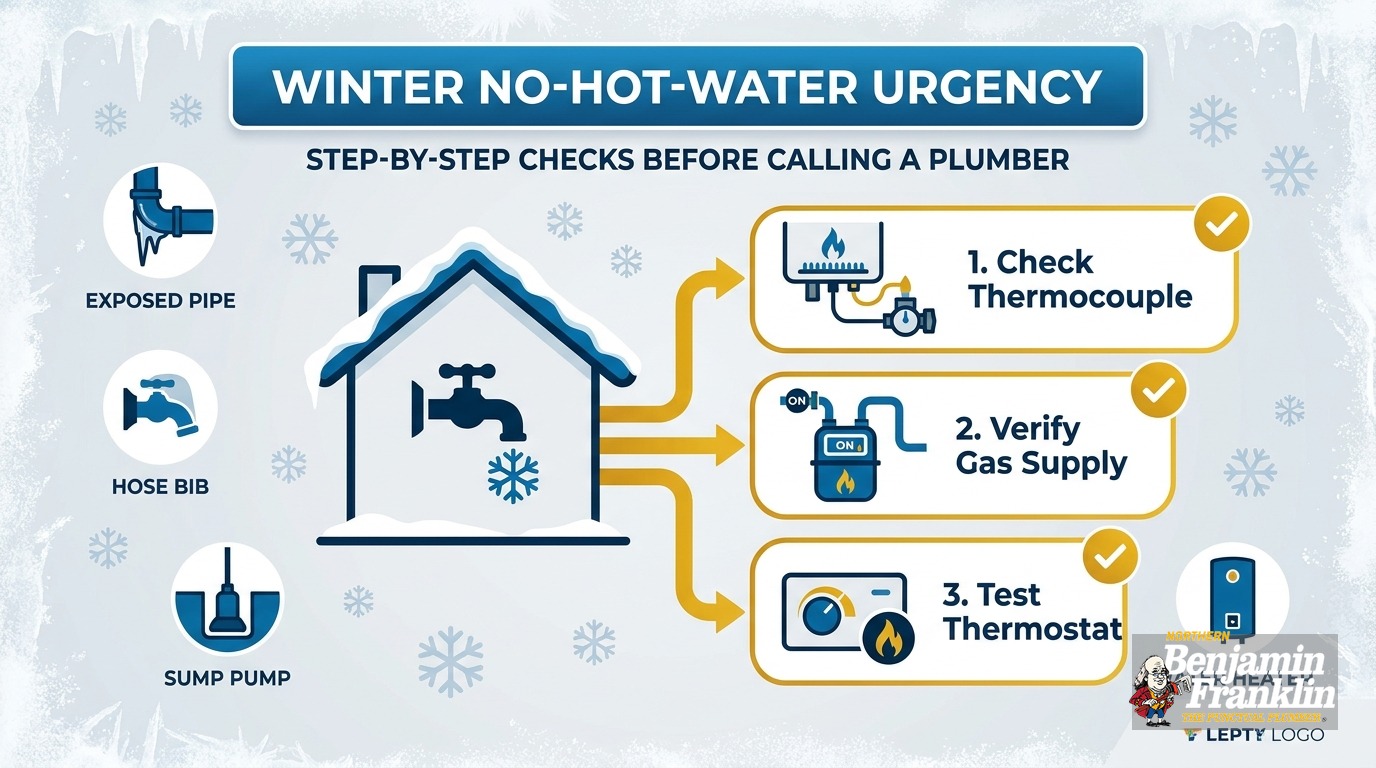
Key Takeaways
- Check three things in order: the gas supply, the pilot and thermocouple, then the thermostat.
- If you smell gas, leave the house and call your gas utility from outside. Do not flip switches or light anything.
- A thermocouple is a small safety sensor. It tells the gas valve that the pilot flame is lit. When it wears out, the heater shuts down.
- A healthy flame burns blue. An orange or yellow flame is a warning sign that needs a professional.
- Never keep relighting a pilot that will not stay lit. Repeated relighting can hide a carbon monoxide problem.
- Closed burner chambers and pilotless heaters are not DIY jobs. Call a licensed plumber.
- In a Minnesota winter, no hot water is more than an annoyance. Plan for the night, and call early.
Why Is My Gas Water Heater Not Heating?
A gas water heater usually stops heating for one of three reasons. The gas supply may be off, the pilot flame may be out because of a worn thermocouple, or the thermostat may be set wrong. You can check all three in a few minutes. If you ever smell gas, stop and leave.
No hot water is a miserable way to start a Minnesota morning. You want a shower and clean dishes. You want an answer, not a lecture.
We are Northern Benjamin Franklin Plumbing, a locally owned and operated plumbing company serving the Twin Cities. We see this problem often, especially when the weather turns cold. Most of the time the cause is small. Sometimes it is not, and we tell you how to spot the difference. At each step below, we say when to stop and call for help.
What Should You Do Before You Touch Anything?
Start with your nose. If you smell gas, do not troubleshoot. Leave the house, then call your gas utility from outside. Do not use light switches, lighters, or anything that could spark. Everything else in this guide can wait.
One DIY guide from Family Handyman advises calling the gas utility if you smell gas. We agree. This rule has no exceptions.
If you smell nothing unusual, take a minute to set up. It makes the checks faster and safer.
- Find the water heater and read the label on the front. Most units print lighting instructions there.
- Grab a flashlight so you can see the burner area.
- Keep kids and pets away from the heater.
- Clear boxes, rags, and anything flammable from around the heater.
- Note the make, model, and any warning lights or codes. A plumber will ask.
Next, work out how widespread the problem is. Is hot water missing everywhere, or only at one faucet? If only one fixture has trouble, the heater may be fine. A bad faucet cartridge or mixing valve can look like a heater failure.
Check the cold side too. If cold water is also weak or missing, you may have a frozen pipe or a closed valve. Our guide on how to tell if pipes are frozen can help with that. If cold water works normally, keep going.
Check 1: Is the Gas Supply On?
Look at the gas valve on the pipe leading to the heater. A handle in line with the pipe usually means open. A handle across the pipe usually means closed. If it is closed and you did not close it, think about who did.
Gas supply problems have a few common causes:
- A valve was bumped during storage or cleaning near the heater.
- Someone closed it during a past repair and forgot to reopen it.
- The utility shut off service at the meter.
- Another gas appliance is also dead, which points to a house-wide supply issue.
Walk to your gas range and turn on a burner. If it clicks and lights, gas is reaching your home. If the range is also dead, the problem is not your water heater. Call your gas utility.
Do not force a stuck valve. Do not put a wrench on a gas fitting unless you know how. A stuck or leaking valve is a job for a licensed pro. Our team handles gas line repair when a shutoff or connector fails, but you do not need that page to continue here.
If the valve is open and the range works, move on. If the valve was closed, you can open it a quarter turn to the open position. Then wait a few minutes before relighting anything, so any built-up gas can clear. If you smell gas at any point, stop and leave.
Do not skip the wait. It is a safety step.
Check 2: Is the Pilot Lit and the Thermocouple Working?
Look at the pilot light. On many older gas heaters, a small flame stays lit all the time. Check through the viewing window or the access panel near the bottom of the tank. You should see a small, steady flame.
If the pilot is out, that explains the cold water. The heater cannot fire the main burner without it. The next question is why it went out.
Common reasons:
- A draft blew it out.
- The thermocouple wore out and cut the gas.
- The pilot opening is clogged with dust or debris.
- The gas supply was interrupted for a moment.
The thermocouple deserves a closer look. It is a small metal probe that sits in the pilot flame. The flame heats it, and it sends a tiny signal to the gas valve. That signal says the flame is lit and gas can keep flowing. If the probe wears out, the valve closes. The pilot goes out, and the heater stops.
The Family Handyman guide says that replacing the thermocouple usually does the trick when a pilot will not stay lit. That fits what we see in the field. It is a common wear item.
The same guide sets a clear limit: closed burner chambers and pilotless gas heaters should go to a pro. Many newer heaters use electronic ignition instead of a standing pilot. If yours has no visible pilot, skip this check and call us.
If you do have a standing pilot, try this once:
- Read the lighting instructions on the heater’s label. Follow them exactly.
- Set the control to the pilot position and hold the button as directed.
- Light the pilot with a long lighter or match, as the label says.
- Keep holding the button for the time the label gives.
- Release slowly and watch the flame.
If the pilot stays lit, turn the control back to the on position. Wait for the burner to fire, then give the tank time to heat. If the pilot goes out again when you release the button, the thermocouple is the likely culprit.
Try only once or twice. Repeated attempts are a bad habit, for a reason we cover below. For a deeper walk-through, read our post on water heater pilot light troubleshooting.
How Do You Reset a Gas Hot Water Heater?
To reset a gas hot water heater, follow the lighting instructions printed on the unit. That usually means turning the control to off, waiting, then setting it to pilot and relighting. Models differ, so use your label. If it will not stay lit after two tries, stop and call a pro.
“Reset” means different things on different heaters. Some have a standing pilot. Some have electronic ignition and a control board. Some show a status light that blinks a code when something is wrong.
A safe general approach:
- Turn the temperature control to its lowest or off position.
- Wait the time your label requires so any gas can clear.
- Open the gas valve if it was closed.
- Relight the pilot or restart the unit per the label.
- Set the temperature back to your chosen setting.
Do not bypass a safety device. Do not tape down a button. Do not jam anything into the burner area. These controls protect your home.
If your heater has electronic ignition, a reset might be as simple as power cycling. A blinking code on the control can help a plumber narrow the problem. Write it down before you call.
If the heater fails to restart after one clean attempt, a part is failing or the venting is not working. Either way, you need a licensed plumber.
Check 3: Is the Thermostat Set Correctly?
The last check is the thermostat dial on the gas control valve. It is easy to bump. Someone trying to save energy may also have turned it down on purpose. A heater set too low can give you lukewarm water that feels like a failure.
Look at the dial. It may show numbers, or words like warm, hot, and very hot. Many dials are not precise. If yours sits near the lowest mark, that may be your answer.
The U.S. Department of Energy suggests turning the water heater down to the warm setting, 120°F. That is a sensible target for most homes. It balances comfort, safety, and energy use.
The same DOE page notes that water heating can account for 14%-25% of the energy consumed in your home. Higher settings cost more to run, so avoid cranking the dial to the top.
What should you look for?
- Is the dial set to a very low mark or the vacation setting?
- Did a family member or house guest change it?
- Is the dial loose, cracked, or hard to turn?
- Does the burner fire after you raise the setting slightly?
Raise the setting a small amount and wait for the burner to come on. Then give the tank time to heat before you judge the result. A full tank takes a while to reheat.
If the burner never fires, even with the pilot lit and the dial raised, the thermostat or gas control valve may have failed. That is not a DIY repair, because it involves gas components. Call a licensed plumber.
For background on safe settings and scald risk, see our post on water heater temperature and Legionella. It is a separate topic, so read it only if you want the detail.
What Does Flame Color Tell You About Carbon Monoxide?
A healthy gas flame burns blue. An orange or yellow flame is a warning sign. It can mean the burner is not getting enough air or the appliance is not venting well. If you see a yellow flame, shut the heater down and call a licensed pro.
Many troubleshooting guides skip this part. Carbon monoxide, or CO, is a gas you cannot see or smell. Fuel-burning appliances can produce it when something goes wrong. The Minnesota Department of Health lists water heaters among common home CO sources.
MDH also lists orange or yellow flame in combustion appliances as a warning sign, and notes that the flame should be blue. Two other signs on its list are no upward draft in your chimney and rust on flue pipes or appliance jacks.
Look for these when you open the access panel. Check the flue pipe above the heater for rust, loose joints, or soot staining. If anything looks off, do not run the heater.
The CDC lists the symptoms of CO exposure. They include headache, dizziness, weakness, upset stomach, vomiting, chest pain, and confusion. People often describe them as flu-like. The CDC also warns that people who are asleep or intoxicated can die before showing symptoms.
That is why detectors matter. The CDC advises installing battery-operated or battery back-up CO detectors near every sleeping area. It also says to check the batteries when you change your clocks each spring and fall.
Minnesota has a rule too. MDH says state law requires that every home have at least one operational CO alarm within 10 feet of every room legally used for sleeping. Check yours today.
CO alarms wear out. MDH says the typical lifespan of a CO alarm is between 5 and 7 years, but it varies by manufacturer. Check the date on yours.
Now connect this to your cold shower. If your pilot keeps going out, a venting problem is possible. Relighting a heater over and over could hide a draft or flue issue. So relight once or twice, then stop.
Act right away on any of these signs:
- Yellow or orange burner flame
- Soot or scorch marks around the heater
- Rust on the flue pipe
- A CO alarm that sounds
- Headaches or dizziness that ease when you leave the house
If a CO alarm sounds, get everyone outside. Call 911 from outside. Do not go back in to troubleshoot.
How Urgent Is No Hot Water in a Minnesota Winter?
In a Minnesota winter, no hot water is urgent for comfort and for safety. You still need to bathe, wash dishes, and keep the house running. The heater problem may also point to a gas or venting issue. Call early rather than waiting for the coldest night.
In the Twin Cities, a cold snap makes everything work harder. Your furnace runs more. Your family takes longer showers. Your water heater has to warm colder incoming water.
That is why weak parts tend to fail on the coldest mornings. Cold weather does not usually break a good heater. It exposes one that was already near the end of its life.
If your heater goes out in winter, plan for the night:
- Keep the house warm. Open interior doors so heat can move around.
- Let faucets drip on exterior walls if a hard freeze is forecast and your pipes are at risk.
- Heat water on the stove for dishes and a quick wash.
- Do not use your oven or a gas range to heat the house.
- Check on anyone who is elderly, ill, or very young.
Never use a grill, camp stove, or generator indoors to make up for lost heat or hot water. These are major CO hazards.
If your house also feels cold, you may have two problems at once. Heating is outside our plumbing scope, so call a licensed heating company for that. We focus on plumbing, including water heaters, gas lines, and frozen or burst pipes.
Frozen pipes are the other winter worry. If the lost hot water comes with lost cold flow or odd noises, read our guide on what temperature pipes freeze in Minnesota. If a pipe has already burst, our team handles burst and frozen pipe repair.
A note on timing. If your problem is a failed part, a prompt repair often costs less than waiting. A heater left in a bad state can lead to bigger damage. Winter is also when plumbers stay busy, so call early.
When Should You Stop and Call a Plumber?
Stop and call a licensed plumber when you smell gas, see a yellow flame, find rust or soot, or the pilot will not stay lit after two tries. Also call if your heater has a closed burner chamber or no pilot. These problems involve gas and venting, and they are not DIY work.
Think of each check as a gate. You pass through only if everything looks normal. Here is the full decision list.
Gas supply gate
- Gas smell: leave the house and call your gas utility.
- Valve will not turn, or it leaks: call a licensed plumber.
- Range is also dead: call your gas utility.
Pilot and thermocouple gate
- Pilot will not stay lit after two tries: call a plumber.
- No visible pilot or a closed burner chamber: call a plumber.
- Yellow or orange flame: shut it down and call a plumber.
- Rust or soot near the flue: call a plumber.
Thermostat gate
- Burner never fires with the pilot lit and the dial raised: call a plumber.
- Dial is broken or loose: call a plumber.
- Water stays lukewarm after hours: call a plumber.
Safety gate
- CO alarm sounds: get outside and call 911.
- Anyone feels dizzy or sick: get outside and call 911.
Other signs point to a failing unit overall. Rumbling, leaks at the base, rust-colored water, and a tank that cannot keep up all matter. Our post on signs your water heater needs service or replacement covers those in detail.
You can also book a visit through our water heater repair team. We diagnose first. If a repair makes sense, we say so. If replacement makes more sense, we say that too.
How Long Do Gas Water Heaters Last?
Gas water heaters do not last forever, and the lifespan varies by model, water quality, and maintenance. A unit that is old and failing often needs replacement rather than another repair. Check the serial number for the age. Then ask a licensed plumber for a straight answer.
We do not quote a single number here because we do not want to guess. Hard water, sediment buildup, a worn anode rod, and how hard the unit works all play a role.
The CDC advises that gas, oil, or coal-burning water heaters be serviced by a qualified technician every year. MDH gives similar advice, saying fuel-burning appliances should be checked by a qualified heating contractor every year. Regular service helps catch problems early.
How do you know your heater’s age? Most have a serial number that encodes the build date. Our post on how to decode your water heater serial number walks you through it.
Signs of an aging unit:
- Frequent pilot or ignition trouble
- Rusty or discolored hot water
- Rumbling or popping from the tank
- Moisture or puddles near the base
- Hot water that runs out faster than it used to
If you see several of these, repair may only buy you time. A plumber can weigh the repair cost against the age of the tank.
How Much Does It Cost to Fix or Replace a Gas Water Heater?
The cost depends on the problem and the unit. A small repair costs far less than a full replacement. We do not quote prices in a blog post because every home is different. Call us for a real quote based on your heater, your venting, and your home.
Many articles list cost ranges as if they apply to everyone, often using national averages. A national average is not a quote, and it is not our price. We would rather give you a real number after we see your setup.
What drives the cost?
- Whether the fix is a small part or a major component
- The size and type of the tank
- Venting needs and any code updates
- Access to the heater and the gas line
- Removal and disposal of the old unit
- Permit and inspection needs
If your heater needs replacement, we can walk you through the choices. Our post on gas water heater replacement cost in Minnesota explains what to expect. Financing is available for larger jobs, so a replacement does not have to strain your budget.
The best way to get a number is to call. We look at your system, explain your options, and give you a clear quote. No guessing and no surprises.
How Do You Find a Licensed Plumber for a Water Heater Job?
Look for a plumber who holds a Minnesota license and pulls permits when required. The Minnesota Department of Labor and Industry says all inspection permits must be applied for by a licensed plumbing contractor. Ask for proof of license, and ask who handles the permit.
On its plumbing permit page, the DLI states that all inspection permits must be applied for by a licensed plumbing contractor. Licensed water conditioning contractors and authorized license holders doing the work can also apply.
That page does not say whether a water heater replacement needs a permit, so we do not claim it does. To confirm the rules for your project, DLI lists a phone number, 651-284-5063, and an email, iMS.bldplb.dli@state.mn.us.
When you vet a plumber, ask these questions:
- Are you licensed in Minnesota?
- Will you pull the permit if one is needed?
- Will you give me a written quote before work begins?
- Do you offer a satisfaction guarantee?
- Will you arrive in the window you promise?
The last question matters more than people think. Waiting all day for a plumber when you have no hot water is its own kind of misery. For more tips, see our guide on choosing a local plumber in the Twin Cities.
What Happens When You Call Northern Benjamin Franklin Plumbing?
When you call us, you get a locally owned and operated team that shows up in the window you pick. Our On-Time Guarantee(R) backs that promise. If we are late, we pay you.
Here is how it works. You choose an arrival window. If we are late, we pay you $5 for every minute we are late, up to $300. Those are the published On-Time Guarantee amounts, and we stand behind them.
We also back our work with a 100% satisfaction guarantee. We are a Twin Cities company with Minnesota homes in mind. We know the older housing stock, the cold winters, and how a failed heater disrupts a family.
A typical visit goes like this:
- You call (763) 296-1844 or book online and pick a window.
- Your plumber arrives on time and checks the gas supply, pilot, thermocouple, and thermostat.
- The plumber checks the venting and combustion for safety.
- You get a clear explanation of the problem and your options.
- You approve the work before it starts.
You do not need to have run every check first. If the heater is cold and you are unsure, call. We would rather come out early than have you struggle through a freezing night.
Your Next Step
Run the three checks in order: the gas supply, then the pilot and thermocouple, then the thermostat. Stop at any gate that says to call. Keep your CO alarms current, and never ignore a gas smell or a yellow flame.
If your gas water heater is not heating, call (763) 296-1844 or book online. We serve Minneapolis, St. Paul, and the surrounding Twin Cities suburbs.
Frequently Asked Questions
Is it safe to keep relighting the pilot light? +
Can I replace a thermocouple myself? +
Why did my hot water stop right after a cold snap? +
Should I turn the gas off if the water heater is not working? +
Need a technician now?