
Gas Water Heater Replacement Cost: Twin Cities Breakdown
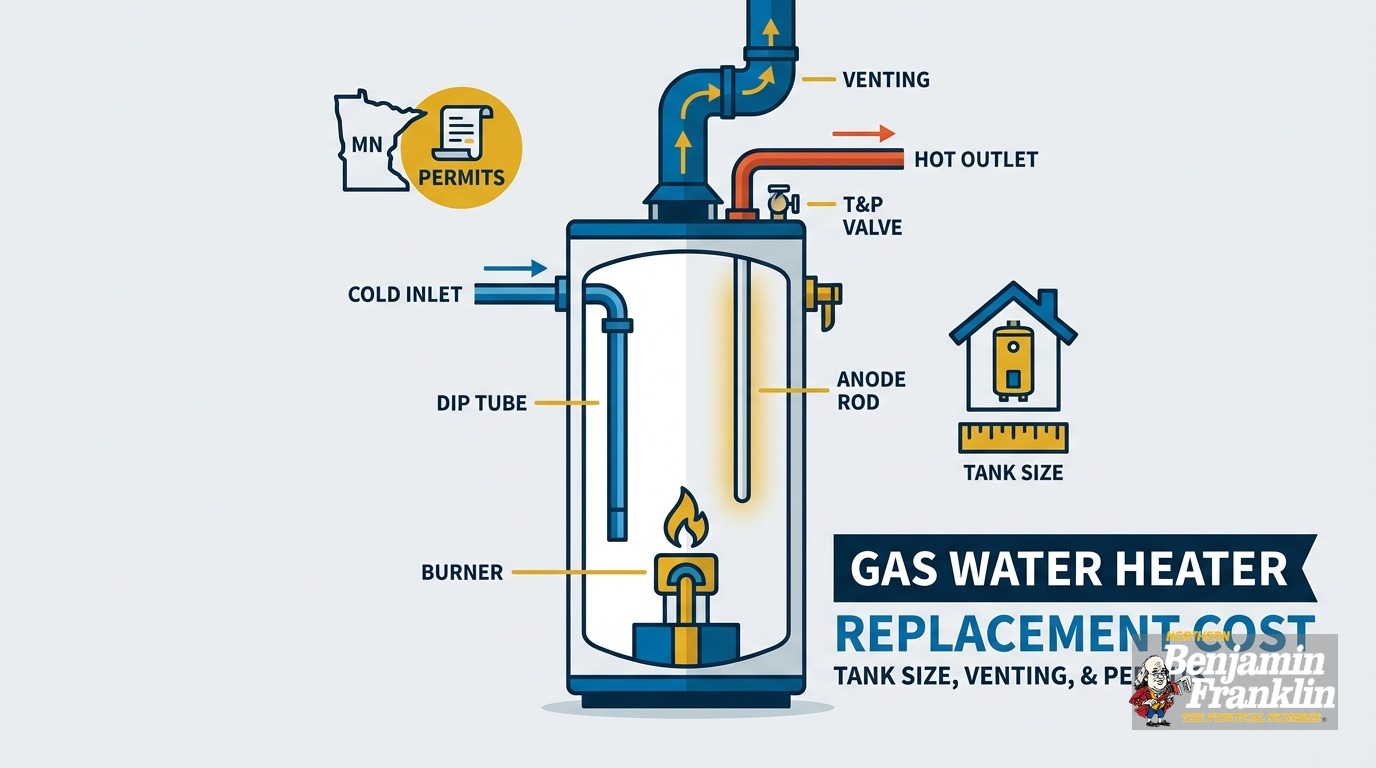
Key Takeaways
- A gas tank water heater installed in the Minneapolis-St. Paul metro typically carries a significant installed cost, according to a Twin Cities water heater cost guide.
- Venting type is the biggest cost variable after the unit itself. Switching from atmospheric to power vent adds $200-$600 or more. A full power-vent installation can reach approximately $4,500.
- Permits are required in Minnesota. Budget $150-$325 for the combined plumbing and gas permit stack, depending on your city.
- CenterPoint Energy customers can claim a $250 rebate on a qualifying gas tank or $500 on a qualifying tankless unit, through December 31, 2026.
- Xcel Energy customers can claim $75 on a qualifying gas tank or $250 on a qualifying tankless unit.
- Skipping the permit can void your homeowners insurance and must be disclosed when you sell your home.
- Our team is locally owned and operated in the Twin Cities. Call (763) 296-1844 or book your water heater replacement online.
Gas Water Heater Replacement Cost: What Twin Cities Homeowners Pay
Replacing a gas water heater in the Twin Cities costs more than most homeowners expect the first time they look it up. The unit itself is only part of the bill. Venting type, permits, and any code items the inspector requires all stack on top of the base price.
This post breaks down each cost component and shows you how to use available utility rebates to bring the net total down. By the end, you will know what drives the gas water heater replacement cost in Minnesota, what the permits actually require, and where the real savings opportunities are.
What Is the Gas Water Heater Replacement Cost in the Twin Cities?
The short answer: A standard gas tank water heater, fully installed in the Minneapolis-St. Paul metro, carries a notable installed cost according to a Twin Cities water heater cost guide. That range covers the unit, labor, and standard connections on a like-for-like replacement. New venting, permits, and code-required upgrades are additional.
For national context, the same source puts the installed range across all U.S. markets at $1,100-$3,200. The Twin Cities range sits in the upper portion of that national spread, which reflects regional labor rates and the permit costs Minnesota jurisdictions charge.
One number that surprises a lot of homeowners: a power-vent gas water heater, fully installed, runs approximately $4,500 according to the same guide. That is not a premium for a premium brand. It is the cost of switching to a fan-assisted venting setup, plus the materials and labor for the PVC vent run. The venting section below explains when that switch is optional and when it is required.
These are third-party figures from a regional market analysis. They are not quotes from our team. What you actually pay depends on your specific venting configuration, the unit you choose, your city’s permit fee schedule, and any code work the installation triggers. Call (763) 296-1844 for a number based on your home.
What Drives the Total Gas Water Heater Replacement Cost?
The short answer: Four factors move the final number: the size and type of unit, whether the existing venting can be reused or must be changed, the labor scope of your specific installation, and the permit fees your city or county charges. Understanding each one lets you read any estimate with more confidence.
Unit size and type. A 40-gallon gas tank costs less to buy than a 50-gallon, which costs less than a 75-gallon or 80-gallon. For most Twin Cities households of two to four people, a 50-gallon unit is the standard starting point. Larger households generally need more capacity. Higher-efficiency units carry a higher upfront price but lower annual fuel costs. The trade-off is covered in the operating costs section below.
Labor. A Twin Cities water heater cost guide notes that labor on a straight gas-to-gas tank replacement is a meaningful portion of the total installed cost. That assumes the existing vent, gas line, and water connections stay in place and pass inspection. When they do not, whether because of a venting change or a code item that was never addressed on the original installation, the labor scope expands and so does the cost.
Venting. If the replacement requires a new vent run, that is $200-$600 in additional labor and materials on top of the base swap, according to the same source. A full new vent run from the unit to the exterior can reach $500-$1,000 according to A.O. Smith’s water heater replacement cost guide. Venting is the most variable line item on a water heater estimate, and the next section explains why.
Permits. Every Minnesota water heater replacement requires at least one permit. Most also require a separate gas appliance permit. These are covered in detail below. Budget $150-$325 for the combined permit stack across Twin Cities jurisdictions.
What Are the Three Gas Venting Types, and How Much Does Each Add?
The short answer: Gas water heaters vent combustion gases in one of three ways: atmospheric (natural draft), power vent (fan-assisted through PVC pipe), or direct vent (sealed combustion drawing outside air). Which type your home uses determines whether a replacement is a straight swap or a more involved project. The difference can be several hundred dollars.
Atmospheric vent (natural draft). The most common type in older Twin Cities homes. Combustion gases rise naturally through a metal flue that connects to a chimney or shared vent stack. No electricity, no fan. Replacing a unit like-for-like in an atmospheric-vent setup is typically the simplest scenario, and the $1,800-$2,800 installed range applies here when nothing else needs to change.
Many homes in Minneapolis, St. Paul, and the inner-ring suburbs have atmospheric-vent water heaters sharing a chimney flue with a gas furnace. When you replace the water heater, the flue sizing may need to be recalculated, especially if the new unit has a different exhaust volume than the old one.
Power vent. Uses an electric fan to push exhaust gases out through PVC piping, typically run horizontally through an exterior wall. Power-vent units work well when a chimney is not available or when the water heater sits in a closet, utility room, or other enclosed space without a vertical flue run. They require a nearby electrical outlet. The all-in installed cost runs higher for this type of installation, per a Twin Cities water heater cost guide. That covers the higher-cost unit, the fan assembly, and the PVC vent run to the exterior.
Direct vent. A sealed-combustion system that draws fresh air from outside through a concentric two-pipe set, rather than pulling conditioned air from inside the home. Direct vent suits tight or semi-conditioned spaces well. Installation requires a two-pipe exterior wall penetration, which adds labor and materials beyond a basic vent swap.
When does a switch become required? If the water heater is moving into an enclosed space that cannot support a natural-draft atmospheric flue, code may require a power-vent or direct-vent unit. If you are upgrading from a 40-gallon to a 50-gallon or larger, the existing flue may need resizing. A licensed plumber can assess your specific setup before you select a model. A venting mismatch can fail inspection and require a return visit to correct.
For a longer-term look at how gas tank and tankless options compare on efficiency and cost, the guide to tank versus tankless water heaters covers the trade-offs in detail.
Do You Need a Permit to Replace a Water Heater in Minnesota?
The short answer: Yes. A plumbing permit is required for any water heater replacement in Minnesota, and most cities also require a separate gas appliance connection permit. Your licensed plumbing contractor pulls both. You do not pull them yourself.
The City of Minneapolis permit office explicitly includes “replace or install a water heater” in the scope of work requiring a plumbing permit. This is not a gray area in the metro. The same requirement applies across Twin Cities suburbs.
Permit fees by jurisdiction, according to a Minnesota water heater permit guide:
- Minneapolis plumbing permit: $75-$150
- St. Paul plumbing permit: $70-$140
- Most Twin Cities suburbs: $75-$140
- Gas appliance connection permit (separate): $75-$175
Combined, plan for $150-$325 in permit fees depending on your city. These are third-party figures. Permit fees are set by the municipality, not by your plumber.
The Minnesota Department of Labor and Industry requires that licensed plumbing contractors pull permits for covered plumbing work. This is not something homeowners can typically do on their own behalf.
Why skipping the permit is a serious risk. According to the same Minnesota permit guide, bypassing a required permit can void your homeowners insurance coverage for any claim related to that appliance. It is also a mandatory disclosure item in a real estate transaction. If the next buyer’s inspector finds unpermitted work, it becomes a negotiating issue or a required fix before closing. The permit cost is a small fraction of the total job. It is not a place to cut corners.
What Code Requirements Apply to a New Gas Water Heater?
The short answer: Minnesota requires a gas shutoff valve within 6 feet of the unit, a T&P discharge port within 18 inches of the floor, a drip pan with a drain line for above-basement installations, and dielectric unions where copper supply lines meet steel fittings. Any of these missing from the existing setup become part of the replacement scope.
These are not optional upgrades. They are inspection items required under state code. Per a Minnesota code and permit reference, the specific requirements are:
- Gas shutoff valve within 6 feet of the unit (MNFGC 409.5.1). If the existing shutoff is farther away or missing, a new one goes in as part of the job.
- T&P relief valve discharge port within 18 inches of the floor (MNPC 608.5). This ensures that steam and hot water discharge safely in a pressure event rather than spraying into the living space.
- Drip pan required for any unit installed above the basement floor. Minimum 1.5 inches deep with a 3/4-inch drain line (MNPC 507.5).
- Dielectric unions where copper supply lines meet steel fittings on the unit. These prevent galvanic corrosion at the connection point, which is one of the more common sources of slow leaks on aging water heaters.
When you receive a quote, ask specifically whether these items are included. A complete, code-compliant quote accounts for all of them. A quote that seems unusually low may be leaving one or more out.
How Do CenterPoint and Xcel Rebates Lower the Bill?
The short answer: Twin Cities homeowners can reduce the installed cost by $75-$500 depending on their natural gas utility and the unit they choose. CenterPoint Energy and Xcel Energy both offer 2026 rebates on qualifying gas water heaters. The bar to qualify is not as high as most homeowners assume.
CenterPoint Energy rebates (through December 31, 2026):
According to CenterPoint Energy’s water heater rebate page:
- $250 rebate on a qualifying gas tank water heater (UEF 0.64 or higher, medium draw)
- $500 rebate on a qualifying gas tankless water heater (UEF 0.87 or higher)
Xcel Energy rebates:
According to the Xcel Energy MN Residential Rebate Summary:
- $75 rebate on a qualifying gas tank water heater (UEF 0.64 or higher)
- $250 rebate on a qualifying gas tankless water heater (UEF 0.87 or higher)
- Rebates are issued as checks, not bill credits
- Applications must be postmarked by July 31 of the year following the purchase
Understanding the UEF threshold. The Uniform Energy Factor is the current efficiency rating for water heaters. It measures how much of the gas you burn ends up as usable hot water. The rebate minimums set by both utilities are lower than the current ENERGY STAR Version 5.0 threshold for a gas storage water heater 55 gallons or under, which is UEF 0.81 for a medium draw unit. In practical terms: any gas tank unit that carries an ENERGY STAR certification will comfortably qualify for the utility rebate.
Running the numbers. Using the $1,800-$2,800 Twin Cities installed range and a $250 CenterPoint rebate, a qualifying 50-gallon replacement nets out to $1,550-$2,550. These are third-party benchmarks, not quotes from our team. Surface the rebate question when you call. We can confirm which units qualify as part of the estimate process.
Financing is available for larger jobs. If the scope expands to a tankless upgrade or includes significant venting work, ask about financing options when you book.
Does the Cold Climate Affect Water Heater Sizing in Minnesota?
The short answer: Yes. Minnesota groundwater is significantly colder than the inlet temperature manufacturers use to calculate first-hour delivery ratings. That gap reduces real-world output, especially during peak demand in January, and it matters when you are sizing a replacement.
Most manufacturer first-hour delivery ratings are calculated at a cold water inlet temperature of 58 degrees Fahrenheit. Minnesota groundwater runs approximately 40-44 degrees Fahrenheit year-round. When cold water enters the tank 15-18 degrees colder than the rating assumption, the heater works harder and longer to reach your target temperature. A household that sized for a southern climate, or one that replaced a unit without accounting for Minnesota winters, may find the new tank consistently runs short during peak morning demand in deep winter.
This is not a universal argument for always buying the largest available tank. Oversizing a gas water heater wastes fuel through standby heat loss when demand is low. It is an argument for sizing based on your actual household demand adjusted for cold inlet conditions, not just the nominal gallon capacity.
If your current water heater consistently ran out of hot water in January but performed fine in July, cold inlet temperature may be part of the explanation, alongside the unit’s age and sediment accumulation. Our post on how to flush sediment from your water heater covers the maintenance steps that directly affect how well an aging unit delivers during cold months. A licensed plumber can walk through the sizing calculation during your estimate. Ask specifically about first-hour delivery at Minnesota inlet temperatures.
What Are the Annual Operating Costs for a Gas Water Heater?
The short answer: A standard atmospheric-vent gas unit (UEF 0.55) costs approximately $315 per year in energy costs. A high-efficiency condensing gas unit (UEF 0.88) costs approximately $202 per year. Both figures come from A.O. Smith’s operating cost analysis, which uses U.S. Bureau of Labor Statistics fuel prices from October 2023.
That is a $113 annual difference between the least and most efficient gas tank options available. Over a 12-year water heater lifespan, that gap accumulates to roughly $1,350 in energy savings. Whether a higher-efficiency unit earns back the additional upfront cost depends on the specific price difference between models, your local natural gas rate, and how long you plan to stay in the home.
The operating cost math also connects to the rebate opportunity. A higher-UEF unit is more likely to qualify for CenterPoint and Xcel rebates and delivers lower fuel costs from day one. When you are already replacing a unit at the end of its life, the incremental cost to step up in efficiency often makes financial sense. Your plumber can show you the specific UEF ratings on the units they recommend so you can do the calculation for your situation.
For early warning signs that your current unit may be losing efficiency before it fully fails, our post on signs your water heater needs service covers what to watch for.
Get an Accurate Quote for Your Home
Every number in this post is a third-party benchmark or a published government figure. Your actual cost depends on the specifics of your home: the venting type already in place, where the unit sits, your city’s permit fee schedule, and any code items the inspector will flag.
Northern Benjamin Franklin Plumbing is locally owned and operated, serving Minneapolis, St. Paul, Blaine, Bloomington, Brooklyn Park, Coon Rapids, Maple Grove, and communities across the Twin Cities metro. Our team pulls the permits, handles the venting, and meets Minnesota code requirements as part of the job.
We back every appointment with our On-Time Guarantee(R). If there is any delay, it’s you we pay. Call (763) 296-1844 or schedule your water heater replacement online today for an estimate based on your home.
Frequently Asked Questions
How much does it cost to replace a gas water heater in the Twin Cities? +
Do you need a permit to replace a water heater in Minnesota? +
What utility rebates are available for gas water heaters in the Twin Cities? +
What is the difference between atmospheric, power vent, and direct vent water heaters? +
Need a technician now?