
How to Flush Water Heater Sediment in the Twin Cities
Key Takeaways
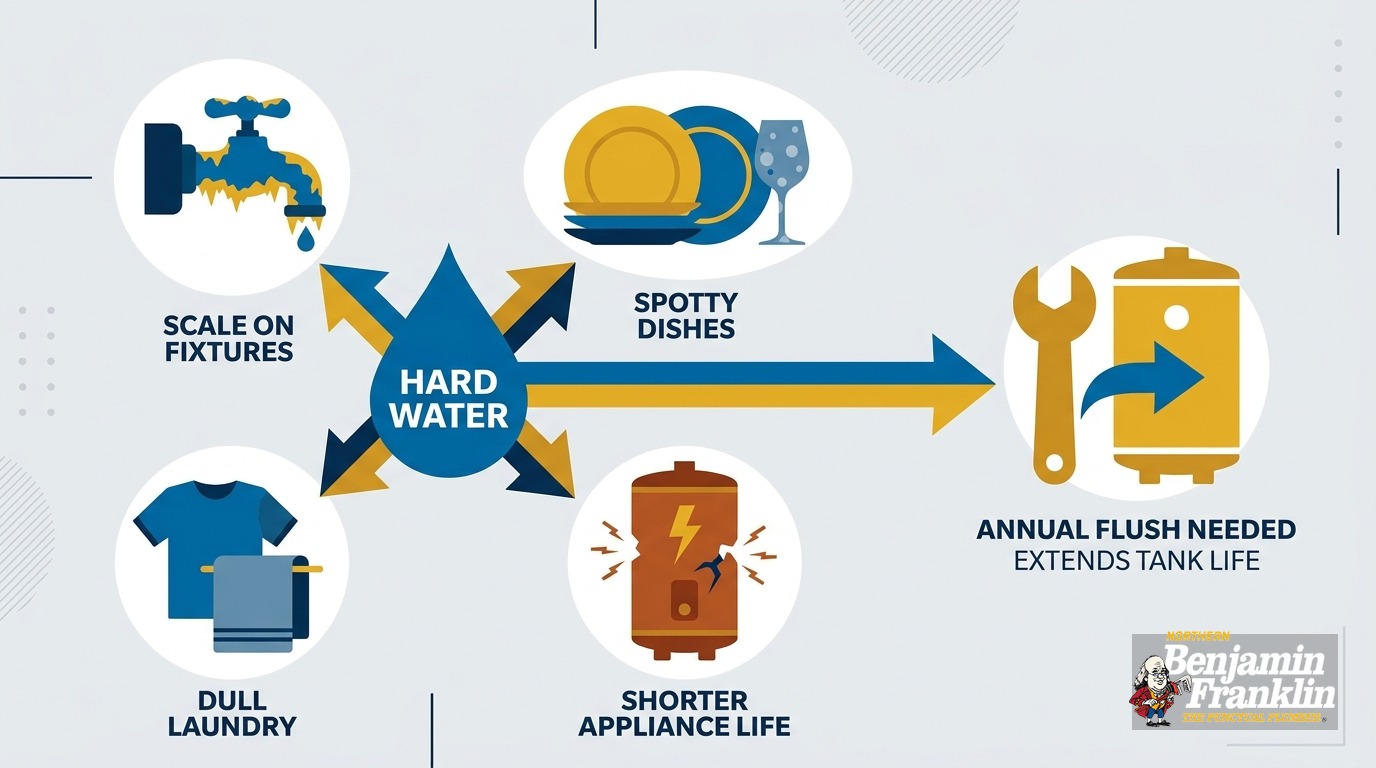
- Hard water deposits calcium and magnesium scale on the floor of your tank, insulating the burner and raising energy costs.
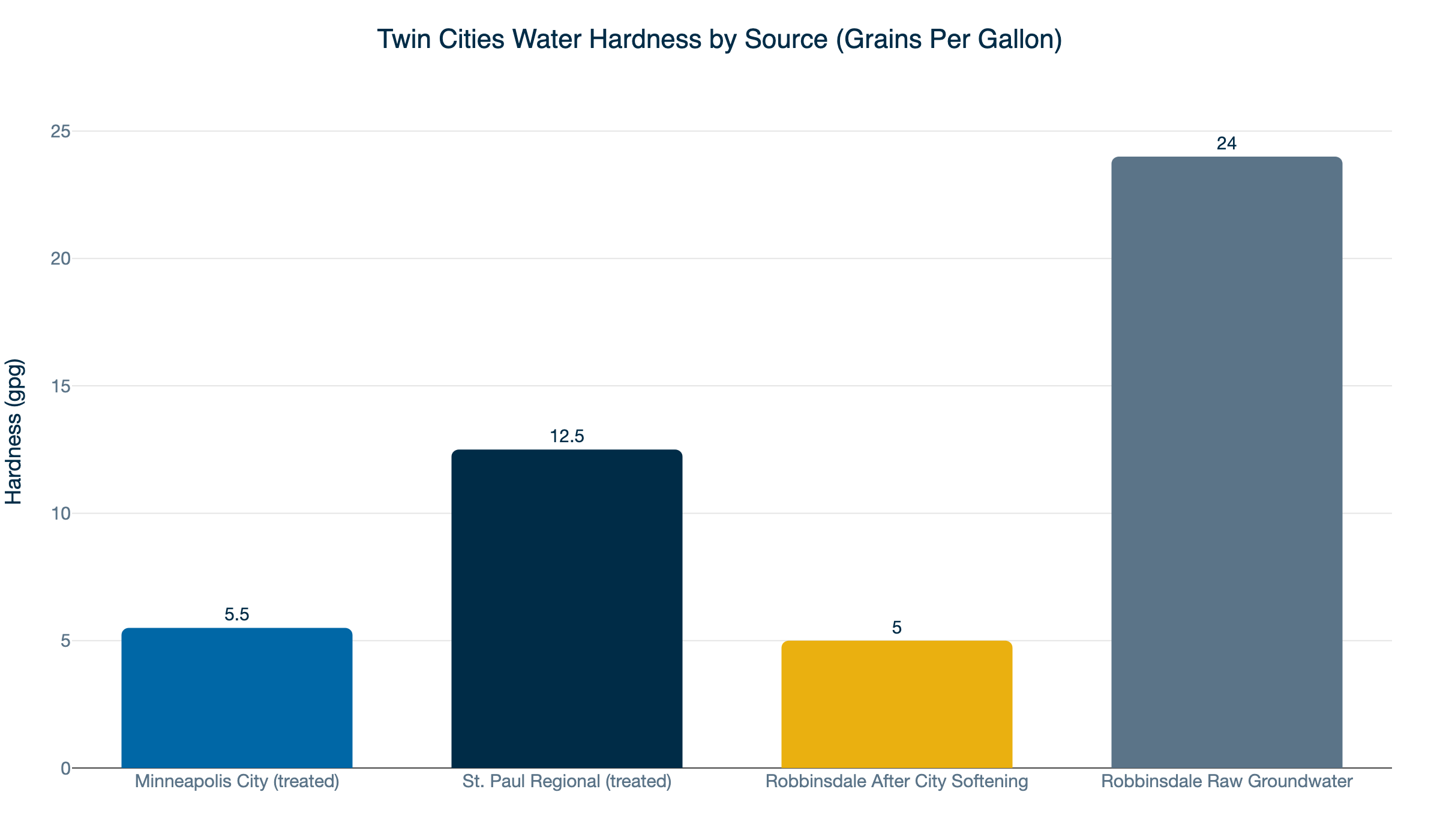
- Minneapolis city water runs about 5.5 grains per gallon (gpg) after treatment. St. Paul Regional Water Services delivers 12.5 gpg, classified “very hard.” Many suburban groundwater supplies run even higher.
- A quarter-inch of sediment raises water heating energy costs by 10-15%.
- Water heating accounts for roughly 17.7% of residential energy use, the second-largest home energy expense after heating and cooling.
- In Minnesota, tanks commonly fail at 8-10 years rather than the 12-year design life when sediment maintenance is skipped.
- Sediment buildup voids most manufacturer warranties.
- Flush annually on Minneapolis city water. Flush every six months on St. Paul water or groundwater above 10 gpg.
- If the drain valve is seized or drips after closing, call a plumber - do not force it.
Before You Flush Water Heater Sediment: The Twin Cities Hard Water Problem
Most guides on how to flush water heater sediment give the same advice: do it once a year, especially in hard water areas. They stop there. They do not tell you what hard water means for your zip code. They do not account for what Minnesota winters add to the problem.
That gap matters here. Twin Cities water hardness ranges from moderate at Minneapolis city taps to very hard on St. Paul’s system. Many suburbs draw from groundwater that is harder still. “Once a year” is right for some supplies. It is not enough for others.
This guide uses actual local water data to help you choose the right schedule. It also walks you through the flush from start to finish.
Why Is Twin Cities Water Harder Than Generic Advice Assumes?
Quick answer: The metro spans supplies ranging from moderate (Minneapolis, 5.5 gpg) to very hard (St. Paul, 12.5 gpg) to raw groundwater above 20 gpg in some suburbs. Most maintenance guides treat “hard water” as a single category. In the Twin Cities, your number varies by municipality.
Minneapolis Public Works operates one of the largest lime-softening plants in the country. It removes roughly 65,000 pounds of hardness minerals from the supply every day. Even so, Minneapolis finished water averaged 94 mg/L, or about 5.5 gpg, in 2025. That is moderate hardness, above the 3.5 gpg threshold where scale forms in heated equipment.
There is a complicating factor. Analysis of Minneapolis Public Works data shows the city’s finished water carries an average pH near 9.0. Elevated pH raises the calcium carbonate scaling potential in heated equipment, even when absolute hardness is only moderate. Minneapolis water works harder on your tank than the grains-per-gallon figure alone suggests.
St. Paul is a different story. Saint Paul Regional Water Services delivers water at 213 ppm, or 12.5 gpg, classified “very hard.” That is more than twice the Minneapolis figure, and that classification carries a recommendation for a water softener in virtually every reference source.
Suburban communities on groundwater can be harder still. The Minnesota Department of Health documented Robbinsdale’s raw groundwater at 24 gpg before the city’s softening plant reduces it to approximately 5 gpg. Communities without centralized softening receive raw groundwater hardness at the tap. Many first-ring and second-ring suburbs do.
The practical read: where you live in the metro determines how fast sediment is forming in your tank right now.
What Does Sediment Actually Do to My Water Heater?
Quick answer: Sediment acts as an insulating layer between the burner and the water. The burner runs longer, uses more energy, and stresses the tank lining from the inside. Some of that damage is permanent. Flushing prevents accumulation, but it does not fully undo what has already built up.
The Pacific Northwest National Laboratory studied water quality impacts on residential water heaters for the Department of Energy. Their finding: hard water “has the propensity to precipitate mineral deposits on surfaces and build up sediment in the bottom of the tank, which can decrease efficiency as well as impact lifetime and increase maintenance requirements.” Water heating accounts for approximately 17.7% of residential energy use, the second-largest home energy expense.
The energy penalty is measurable. Energy Trust of Oregon, citing DOE guidance, puts the cost at 10-15% higher energy bills for every quarter-inch of sediment in the tank. That is a real number on a real utility bill.
Sediment also creates hot spots on the tank floor and the burner plate above it. The burner fires repeatedly against a layer that holds heat in rather than distributing it. Over time, that thermal stress can crack the glass lining or cause the heat exchanger in gas units to overheat and fail earlier than it should.
Minnesota adds a seasonal multiplier. January and February bring near-freezing inlet water to every tank in the metro. A heater laboring through a sediment layer has to move more BTUs to reach set temperature on cold inlet water than it does in summer. The sediment penalty compounds on the hardest days of the year.
The PNNL study found that for gas storage heaters, flushing did NOT restore full efficiency once scale had already formed. Some of the loss is permanent. That shifts the calculus toward prevention: flush before the sediment accumulates, not after you feel the efficiency hit.
Plumbers in the Twin Cities market routinely see sediment buildup void manufacturer warranties. An un-flushed tank is not just inefficient. It may have no warranty coverage when it fails.
In Minneapolis, traditional tank water heaters commonly fail at 8-10 years rather than the 12-year design life. Hard water sediment and cold inlet temperatures compound each other. A decade of skipped flushes can cut the useful life of a tank in half.
How Often Should I Flush My Water Heater in Minnesota?
Quick answer: At least annually for Minneapolis city water. Every six months for St. Paul city water or any groundwater supply above 10 gpg. If you do not know your water hardness, treat it as hard and flush twice a year.
The City of Blaine Public Works Division recommends flushing “every one to three years depending on the model and water source.” They note that sediment reduces energy efficiency and can clog water lines. For the harder supplies in the metro, the low end of that range is the right target, not the high end.
A practical schedule by hardness level:
- Below 7 gpg (Minneapolis city water, some treated suburban systems): flush once a year
- 7-15 gpg (St. Paul and many first-ring suburbs): flush every six months
- Above 15 gpg (untreated or partially treated groundwater): flush every three to four months and evaluate a whole-home water softener
If you have a softener installed, check what hardness it outputs rather than what the municipal supply carries. A well-maintained softener may bring your effective hardness near zero. Annual flushing is likely fine in that case, but the softener itself needs regular salt and service attention.
Not sure of your hardness? Your municipality’s annual water quality report is one source. Minneapolis and St. Paul publish current data online. Our team can also test your water directly. That gives you a number for your specific tap, not a system average. The difference matters: a home at the edge of a service area may receive blended water that reads differently than the published municipal average.
What Supplies Do I Need?
Quick answer: A garden hose, a screwdriver or hose-bib key, work gloves, and a bucket. Most homeowners already have everything on this list. The critical step before gathering anything is confirming your cold-water shutoff valve actually turns.
Here is the full list:
- A garden hose long enough to reach a floor drain or exterior discharge point
- A flathead screwdriver or hose-bib key to open the drain valve
- Work gloves (the tank and the first water out will both be hot)
- A bucket for the initial flush check, to see sediment color and volume before routing the flow
- Needle-nose pliers if the valve handle is corroded
Locate the cold-water supply shutoff for the heater before you do anything else. It sits on the cold-inlet pipe above the tank. Confirm it turns. If it is corroded shut, call a plumber before you start. You need to be able to isolate the tank quickly if something goes wrong during the flush.
How to Flush Water Heater Sediment: Step-by-Step
This procedure covers a standard gas or electric tank-style water heater. Tankless units use a different descaling process. If you have a tankless system, see our water heater maintenance service page or call us directly.
Step 1: Turn off the heat source.
For a gas heater, set the thermostat dial to “pilot.” Do not shut the gas off entirely. For an electric heater, flip the breaker at the panel. Never run a flush with a live electric heater. The elements must stay submerged or they burn out immediately.
Step 2: Connect the hose and route it.
Attach a garden hose to the drain valve at the base of the tank. Route it to a floor drain, a utility sink, or outside. Check the temperature before routing onto a lawn or garden bed. Hot water kills plants.
Step 3: Open a hot-water tap in the house.
Find a nearby faucet and leave it open. This breaks the vacuum in the plumbing system and lets the tank drain freely. Without it, you get a slow trickle instead of a steady flow.
Step 4: Open the drain valve.
Turn the valve counterclockwise. The first water out will be hot and may be discolored - brown, cloudy, or carrying white and tan particles. That is the sediment you came to remove. Rumbling or popping as the tank drains is normal. That is steam moving through the sediment layer. Let everything drain until the water runs clear. On a tank not flushed in several years, this can take 20-30 minutes.
Step 5: Flush with fresh cold water.
Once the tank is mostly empty or the flow slows, briefly open the cold-water supply valve. This stirs up remaining sediment and pushes it out. Close the supply valve, let it drain, then repeat once or twice until the outflow runs clear.
Step 6: Close the valve and refill.
Close the drain valve firmly. Remove the hose. Open the cold-water supply and let the tank refill completely. Keep the hot-water tap open until water flows steadily. That means the tank is full and the air pocket has cleared. Close the tap.
Step 7: Restore heat.
For gas: return the thermostat to your normal setting. 120 degrees F is standard. Our post on water heater temperature and Legionella risk covers why 120 is the right number. For electric: flip the breaker back on. Give the tank 45-60 minutes to fully recover before drawing hot water.
In the day or two after the flush, monitor the area around the drain valve. A valve that held for years can develop a slow drip after being opened for the first time. Catch it early, before it becomes a floor-damage problem.
When Should I Call a Plumber Instead?
Quick answer: Call when the drain valve is seized, drips after you close it, or the flush water stays rust-colored after 30 minutes. These are signs of damage a DIY flush cannot fix.
Specific triggers to watch for:
-
The drain valve is seized. Forcing a corroded valve can snap it or strip the threads. A plumber can assess whether replacing the valve is worth it or whether the tank’s overall condition points toward replacement.
-
The valve drips after closing. Drain valves on older tanks can fail once they are opened after years of inactivity. A leaking valve needs replacement. It will not seal itself.
-
The flush water stays rust-colored after 30 minutes. Sediment should flush clear. Persistent rust color means internal corrosion is past the stage where flushing helps. Our team can assess whether repair or replacement is the better call.
-
The tank is 10 years or older and has never been serviced. In the Twin Cities hard-water environment, tanks commonly reach the end of their useful life at or before 10 years when maintenance has been skipped. We can walk you through a service-versus-replace conversation before you commit to either path.
-
You are not sure what type of unit you have. Tankless heaters, heat pump water heaters, and indirect-fired units all need different procedures. Do not apply these steps without confirming your unit type first.
What About Anode Rods?
Quick answer: An anode rod is a sacrificial magnesium or aluminum rod that protects the tank lining from internal corrosion. It corrodes so the tank does not. In hard water, rods deplete faster. A flush is a good time to check it and replace it if it is more than half consumed.
The rod screws into the top of the tank, usually under a plastic cap. Inspecting it requires a socket wrench and sometimes significant torque on an older rod. If you can access it while the tank is partly empty, look for a rod reduced to mostly bare wire core. That rod has done its job and needs to come out.
Our post on anode rods and hard water covers the inspection and replacement in detail. If the inspection is more than you want to handle yourself, schedule it alongside a professional flush. Together, the two tasks take less than an hour of professional time and can add years to a tank’s service life.
Signs Your Water Heater Needs Attention Now
Flushing addresses sediment. It does not fix structural or mechanical problems. Call (763) 296-1844 or book online if you notice any of these:
- Hot water runs out faster than it used to
- Rumbling, popping, or banging during heating cycles
- Visible rust or corrosion on the tank exterior or at pipe connections
- Water pooling around the base of the tank (any leak from the tank body means replacement - tanks do not self-seal)
- Inconsistent temperature or noticeably slower hot water recovery
- The unit is 10 years or older and has never had professional service
Our team serves Minneapolis, St. Paul, Blaine, Bloomington, Brooklyn Park, Coon Rapids, Maple Grove, and the rest of the Twin Cities metro. We are locally owned and operated. Every appointment is backed by our On-Time Guarantee(R): we arrive in the window you choose, or we pay you $5 for every minute we are late, up to $300. “If there is any delay, it’s you we pay!”
For larger jobs - a full tank replacement, a tankless conversion, or a whole-home water treatment system - ask about financing options when you call.
Frequently Asked Questions
How often should I flush my water heater if I'm on St. Paul city water? +
What does water heater sediment look like when it drains out? +
Will flushing my water heater restore its efficiency? +
Need a technician now?