Why Hot Water Runs Out Too Fast: 4 Causes and Fixes
Key Takeaways
- A short hot water supply almost always traces back to one of four causes: a broken dip tube, sediment, a failed heating element, or a tank that is too small for your household.
- The timing of the problem points to the cause. Hot at first, then suddenly cold, means the dip tube. A steady decline over months means sediment.
- Judge tank size by first hour rating (FHR), not by gallons alone. FHR is the amount of hot water the heater can deliver in one hour.
- Low incoming water pressure can make hot water feel weak, but it does not shorten the supply the way a tank problem does.
- Flushing the tank and checking your city’s water quality report are the two best habits for Twin Cities homes.
- Turn off power or gas before you inspect anything. If you are unsure, call (763) 296-1844 or book online.
Why Does My Hot Water Run Out Too Fast?
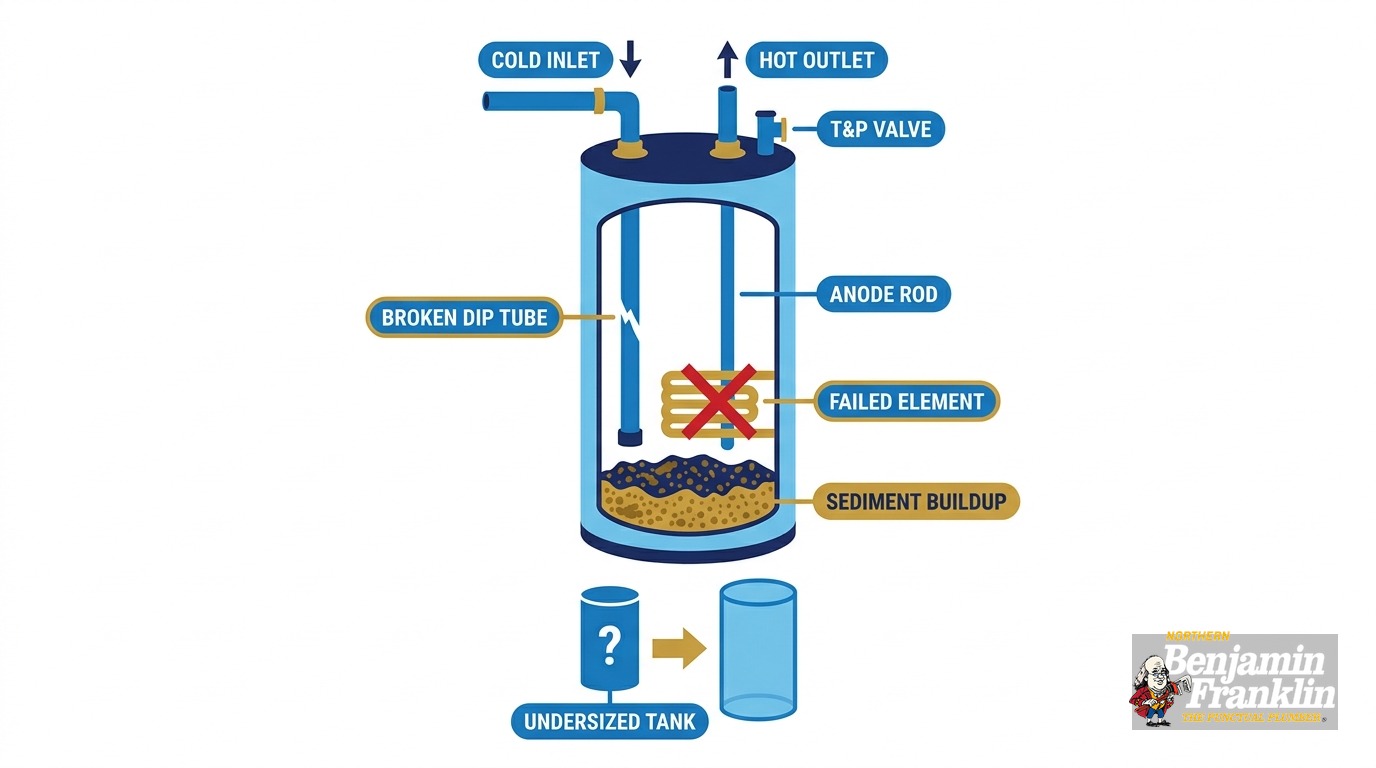
Hot water runs out too fast for one of four reasons. A dip tube may be broken, sediment may fill the tank, a heating element may have failed, or the tank may be too small for your household. Each cause leaves a different pattern, so you can often tell them apart at home.
Most of these problems are fixable, and many do not call for a new water heater.
We are Northern Benjamin Franklin Plumbing, a locally owned and operated plumbing company serving the Twin Cities. We hear this complaint all year, but it spikes in winter. Incoming water is colder then, so your heater works harder to reach the set temperature. A tank that coped fine in August can feel short in January.
How Can You Tell Which Cause Is Behind It?
Match your symptom to its timing. The pattern is the best clue you have, and it costs nothing to check.
- Hot at first, then cold within minutes: This points to a broken dip tube. Cold water mixes with hot at the top of the tank.
- A short supply that is still warm, not hot: This points to a failed heating element or a bad thermostat on an electric unit.
- A supply that has shrunk slowly over months: This points to sediment. It builds up gradually and takes up room in the tank.
- A supply that changed after a household change: This points to sizing. Think new baby, teenagers, a new soaker tub, or a second shower in use.
Ask yourself a few questions before you pick up a tool. Did the change happen overnight or over a year? Is the water scalding at first, or only warm? Did anything change in your home recently?
Your answers narrow the list fast. They also help the technician if you call for service.
What Does a Broken Dip Tube Do?
A dip tube is a plastic pipe inside the tank. It carries incoming cold water to the bottom, where the heater warms it. When the tube breaks, cold water spills in near the top, right where hot water leaves the tank.
The result is easy to spot. Your shower starts hot, then turns lukewarm or cold in a few minutes. The tank is full of hot water, but you cannot reach it.
Signs of a broken dip tube:
- Hot water lasts only a few minutes, even though the heater is on.
- Water temperature at the faucet drops quickly, then stays lukewarm.
- Tiny white or gray plastic bits clog faucet aerators or showerheads.
- The problem showed up suddenly, not gradually.
Those plastic bits are a strong clue. If you find flakes in an aerator, the tube may be breaking apart. Our post on cleaning faucet aerators in hard water areas shows how to check yours safely.
The fix is a new dip tube. A technician drains the tank, removes the cold inlet fitting, and swaps in a new tube. It is a small repair when the rest of the heater is healthy. If the tank is old and rusty, replacement may make more sense. We will tell you which one fits.
Can Sediment Cause Hot Water to Run Out Quickly?
Yes. Sediment settles at the bottom of the tank and takes up space that hot water should fill. A tank holding several inches of sediment holds less hot water than its label says. The layer also makes the burner or lower element work harder to heat what remains.
Sediment comes from minerals in your water. As water heats, minerals separate out and drop to the bottom. Over months and years, they form a hard layer.
Signs of a sediment problem:
- Your hot water supply has shrunk gradually over a long period.
- The tank makes popping or rumbling noises as it heats.
- Hot water looks cloudy, rusty, or gritty.
- Energy use creeps up for no clear reason.
Noise is a big tell. Water trapped under the sediment boils and bursts through the layer. If you hear that, read our guide to popping and rumbling water heater noises. Discolored water has its own causes, covered in our post on sediment and discolored hot water.
Minnesota’s health department treats scale as a real concern. The Minnesota Department of Health says softening can prevent build-up of minerals (scale) on the inside of pipes, fixtures, and hot water heaters. That scale is the same material that settles in your tank.
A light layer can often be flushed out. A heavy, hardened layer may not come out at all. At that point, the tank may be near the end of its life.
How Often Should You Flush Your Water Heater?
Most homes benefit from flushing the tank about once a year. Hard water, older tanks, and heavy use call for more frequent flushes. Flushing drains sediment before it hardens into a layer you cannot remove. If you have never flushed yours, ask a plumber to look first.
We do not quote one schedule for every home. Water hardness, tank age, and usage all change the answer. If you see cloudy water or hear popping, flush sooner.
Take care with older tanks. If a tank has gone many years without a flush, the sediment may be packed hard. Opening the drain valve can then clog it or cause a leak. A technician can test the valve before you try.
Our step-by-step guide on how to flush water heater sediment covers the process in detail. It also explains when to stop and call for help.
What Happens When a Heating Element Fails?
Most electric tanks have two heating elements. The upper one heats the top of the tank, and the lower one heats the rest. When the lower element fails, the upper one still heats a small amount of water. You get a short supply that runs out fast.
This is the classic “enough for half a shower” pattern. The water you do get is usually fully hot, because the upper element works. Then it runs out, and the rest of the tank stays cold.
Signs of a failed element or thermostat:
- A short burst of hot water, then cold, with no plastic flakes in your aerators.
- Water that never gets as hot as it used to.
- A tripped breaker or a heater that seems to cycle strangely.
- Hot water that takes a very long time to recover after use.
An element can fail on its own. Sediment also speeds up failure, because a buried lower element overheats under the layer and burns out sooner.
Testing an element takes a multimeter and the right safety steps, so it is a poor fit for most homeowners. A technician tests the elements and thermostats, then replaces only what failed.
A gas-fired unit has no elements. The matching problems are a weak burner, a dirty burner, or a faulty gas control. Gas work is not a DIY job. Call us.
What Size Water Heater Do I Need?
Size depends on how much hot water your household uses at the busiest hour, not just on tank gallons. The best measure is the first hour rating (FHR), which tells you how much hot water the heater can supply in one hour. Match the FHR to your peak-hour demand.
ENERGY STAR defines FHR as an estimate of the maximum volume of hot water in gallons that a storage water heater can supply within an hour. It assumes the tank starts fully heated. It also measures output at 125°F.
That definition matters. A 50-gallon tank with a low FHR can run out sooner than a 40-gallon tank with a high one. Burner or element power, plus recovery speed, drive the number.
ENERGY STAR also sets minimums. Its criteria call for an FHR of at least 45 gallons per hour for electric storage heaters and at least 51 gallons per hour for gas-fired storage heaters. Those are floors for certified models, not a sizing target for your home.
To gauge your own peak hour:
- Count how many people shower in the morning rush.
- Note whether the dishwasher and washing machine run at the same time.
- Think about large fixtures, like a soaker tub, that fill from the heater.
- Ask whether the household has grown since the heater was installed.
If your supply changed after the household changed, sizing is the likely cause. A larger tank, a higher-FHR model, or a different type of heater may solve it. Our comparison of tank and tankless water heaters can help you weigh the choices. We can also go over your peak-hour use and recommend a size on a visit.
Can Low Water Pressure Affect Hot Water?
Low pressure does not shrink your hot water supply, but it can make the supply feel weak. A trickle from the hot side suggests a pressure or flow problem, not an empty tank. The cause may be a clogged aerator, a partly closed valve, or a supply line issue.
A tank problem gives you full flow that turns cold. A pressure problem gives you weak flow, hot or cold.
Check these quickly:
- Compare hot and cold flow at the same faucet. If only hot is weak, look at the heater’s shutoff valve.
- Check more than one fixture. If every tap is weak, the issue is likely supply-side.
- Look at aerators and showerheads for mineral buildup.
- Open the heater’s cold inlet valve all the way.
A valve that is only partly open can mimic a short supply. So can a failing pressure reducing valve. Our post on diagnosing low water pressure in the Twin Cities walks through the checks in order.
Could a Mixing Valve Be the Problem?
Yes. A mixing valve blends hot and cold water to a safer temperature before it reaches your taps. If it fails or sticks, you can get too much cold water in the mix. Your hot water seems to vanish, even though the tank is still hot.
Mixing valves are common on newer systems and some homes with scald protection. They sit on the heater outlet or at a fixture. When one wears out, temperatures swing or stay lukewarm.
A valve problem looks different from a tank problem. The water may be lukewarm from the first second, and it may not turn cold in a clear wave.
We explain how these valves work in our guide to anti-scald mixing valves on water heaters. If you suspect one, have it checked. Do not bypass it. It protects your family from scalding.
What Should You Do Before Inspecting the Heater?
Shut off power or gas first, and shut off the cold supply if you plan to open anything. Hot water and electrical power are a dangerous mix. Five minutes of safety steps prevents burns, shocks, and flooding.
Use these steps before you look inside any panel or open any valve:
- Electric heaters: Turn off the breaker at the main panel. Confirm the power is off before you touch wiring.
- Gas heaters: Set the gas control to its off or pilot position. If you smell gas, leave the house and call your gas utility.
- Cold supply: Close the cold water shutoff above the heater if you plan to drain it.
- Let it cool: Wait for the water to cool or run a hot tap until it is comfortable.
- Protect the floor: Set a hose to a floor drain or a bucket, and keep towels nearby.
A tank under pressure can also surprise you. If the relief valve drips or the tank leaks, stop and call us. Our post on a leaking pressure relief valve explains what that sign means.
Never test a heating element with the power on. If you are not comfortable with any step, stop. Our water heater repair team can take it from there, and you can learn more on our water heater repair page.
Does Minnesota Hard Water Make This Worse?
Yes. Hard water speeds up sediment and scale, so it can shorten your hot water supply sooner. The harder your water, the faster minerals settle in the tank. Your own city’s water quality report is the best place to see where you stand.
The Minnesota Department of Health gives a useful threshold. It says that if your water’s hardness is greater than 7 grains per gallon or 120 mg/L, then you might need a water softener. It also notes that there is no requirement to soften your water.
A softener is a choice, not a mandate. Whether it is worth it depends on your water and your heater.
Hardness varies by city and by source. Minneapolis publishes water quality reports you can read for your own supply. Other cities post theirs too. Find the hardness figure in your report and compare it to the MDH threshold. We also cover local numbers in our post on water hardness in Minneapolis and St. Paul.
If your hardness is high, a softener protects the heater, fixtures, and pipes. See our water softener options for how it works. Even without a softener, regular flushing helps.
How Can You Make Hot Water Last Longer?
Fix the cause first, then trim demand. Flush the tank, repair or replace failed parts, and spread out heavy use. Small habits help too, like shorter showers and staggered laundry. These steps work even in a cold Minnesota January.
Try these in order:
- Fix the cause: Habits cannot repair a broken dip tube or a dead element. Repair it first.
- Flush the tank: Removing sediment frees up the room that hot water needs.
- Stagger heavy use: Run the dishwasher and washer at different times from the morning showers.
- Install low-flow fixtures: Efficient showerheads use less hot water per minute.
- Insulate exposed hot pipes: This cuts heat loss between the heater and the tap.
- Consider a recirculation pump: It sends hot water to the tap faster, so you waste less waiting.
Waiting for hot water is a different problem than running out. If it takes a long time to arrive, see our guide to a hot water recirculation pump.
If the heater is failing, these habits only delay the problem.
When Should You Call a Plumber?
Call a plumber if your tests point to a failed part, if the tank is old, or if you see leaks, rust, or strange noises. Also call if you are unsure about electrical or gas work. A quick diagnosis costs less than a flooded basement.
Clear signs it is time to call:
- Water pooling around the base of the tank.
- Rusty water from the hot side only.
- A tank that is well past a decade of service.
- A repeat problem after you already flushed the tank.
- Any gas smell, scorched wiring, or tripped breaker you cannot explain.
Permits can matter for some work. Minnesota’s Department of Labor and Industry states that all inspection permits must be applied for by a licensed plumbing contractor, licensed water conditioning contractor, or an authorized license holder doing the work. That page does not spell out water heaters. Ask your plumber what your city requires before any replacement.
Repair or replace? Our team weighs the age, the condition, and the cost of the fix. We explain both choices, and you decide. If replacement is the better path, ask us about financing for the larger job.
Our post on signs your water heater needs service lists more warning signs.
Call Northern Benjamin Franklin Plumbing
A short hot water supply is frustrating, but it is rarely a mystery. Match the timing of your symptom to the cause and check the safe, simple things first. Then let a licensed pro handle the rest.
We are locally owned and operated, and we know Twin Cities homes. We know the hard water, the cold incoming temperatures, and the older heaters in basements across Minneapolis, St. Paul, and the suburbs.
We also stand behind our timing. Our On-Time Guarantee(R) means we arrive in the window you pick. If we do not, we pay you $5 for every minute we are late, up to $300. In plain words: “If there is any delay, it’s you we pay!”
Ready to get your hot water back? Call (763) 296-1844 or book online. We will find the cause, explain your options, and fix it right.
Frequently Asked Questions
Is it safe to keep using a water heater with a broken dip tube? +
Why does my electric water heater give only a few minutes of hot water? +
Does a tankless water heater run out of hot water? +
Need a technician now?