
Hot Water Recirculation Pump Install: The Minnesota Energy Math
Key Takeaways
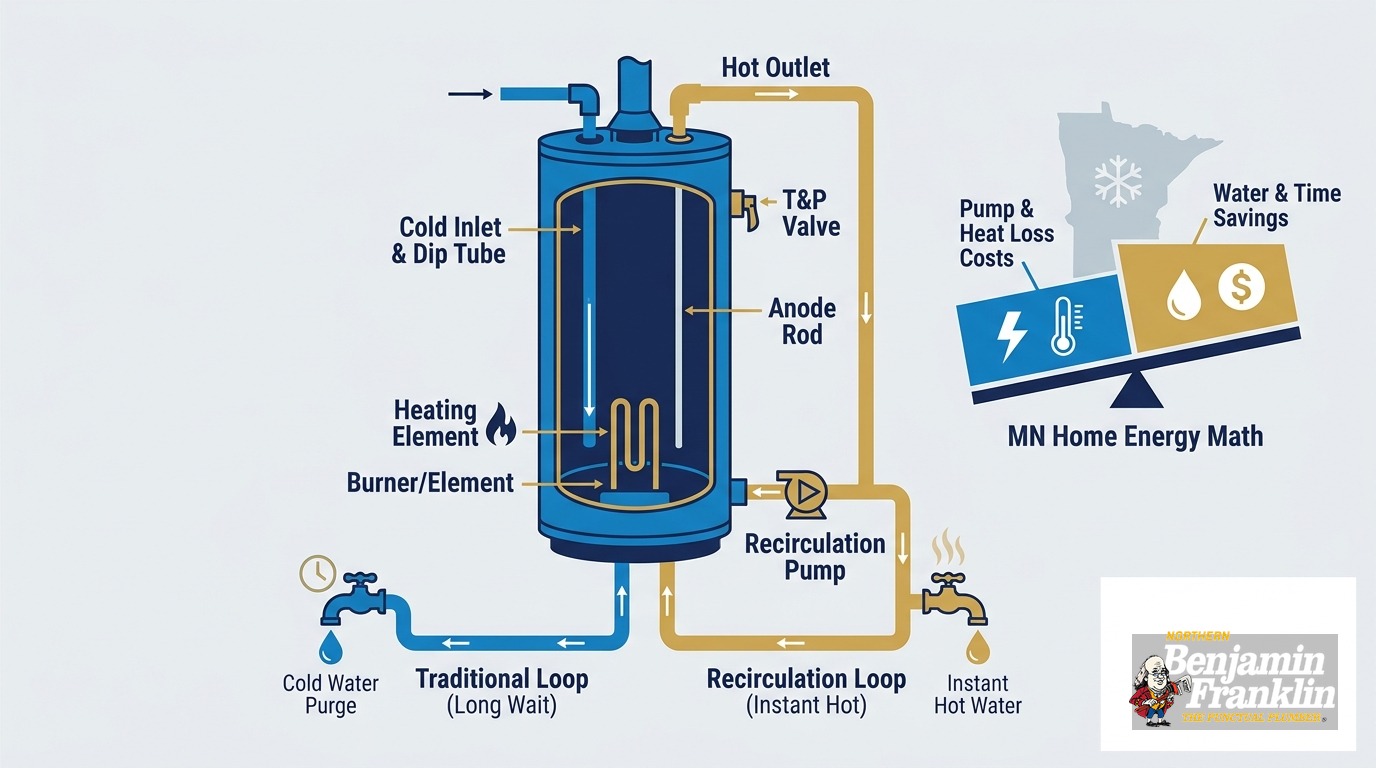
- Minnesota Plumbing Code §601.2.2 requires a recirculation loop when the hot water pipe run to the farthest fixture exceeds 100 feet. Many Twin Cities two-story homes with a basement water heater meet this threshold.
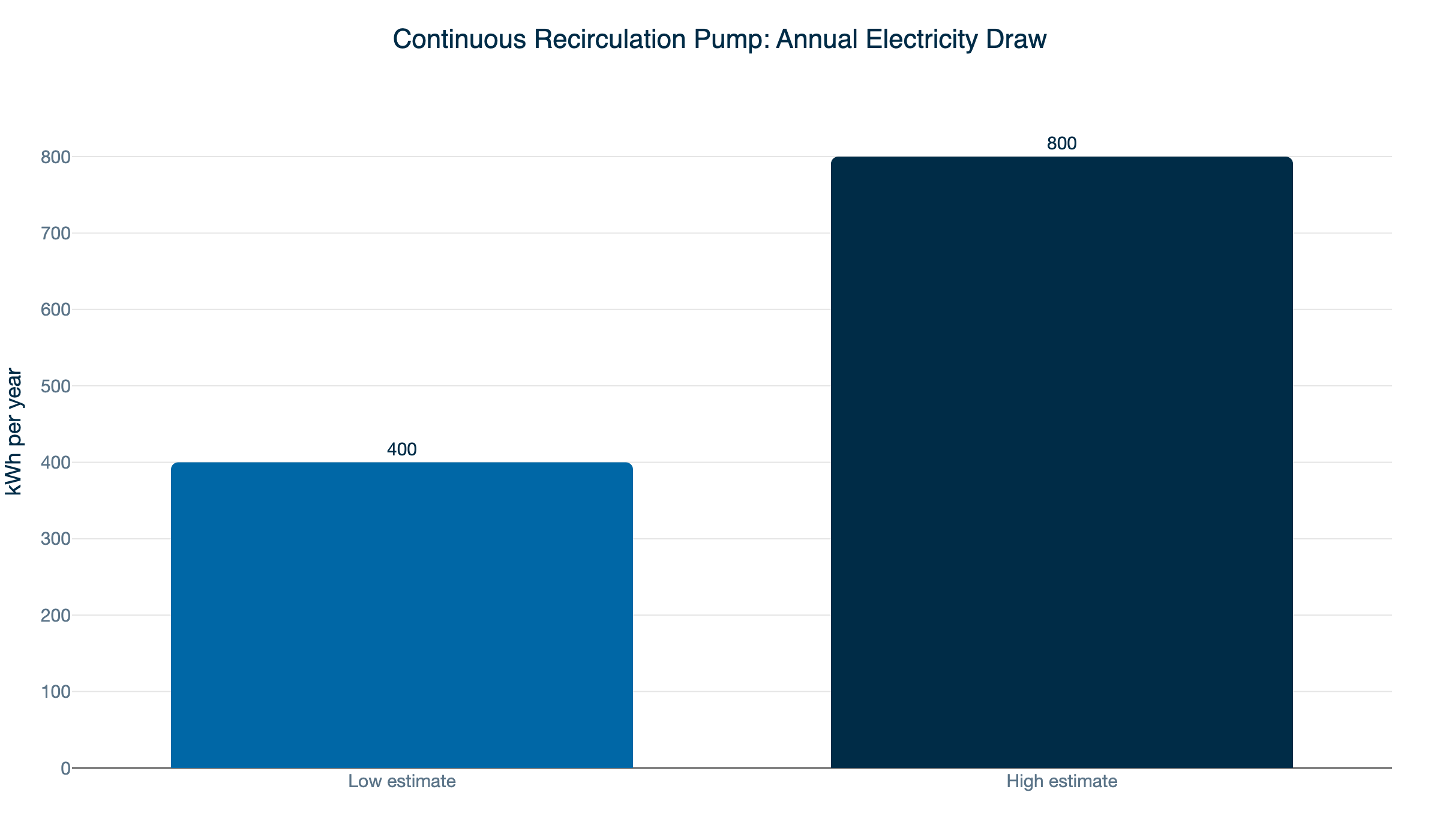
- A continuously running pump can add 400-800 kWh per year to your electricity draw. A demand-controlled pump with a timer costs roughly $3-12 per year. The wrong setup costs more than it saves.
- Minneapolis water runs about 5.8 grains per gallon. Warm water moving through a continuous loop accelerates scale in the pump and crossover valve. Annual flushing is part of owning this system.
- If you have a tankless water heater, most standard recirculation pumps cannot trigger the burner. A buffer tank is typically required and adds cost.
- This is a permitted install in Minnesota. A licensed plumber is required.
What Is a Hot Water Recirculation System?
A recirculation system keeps hot water close to every tap by circulating water through the supply line continuously or on demand. You are not waiting for cold water in the pipe to push through before the hot water arrives.
Most homes use a simple one-way layout. The water heater sits in one location. Hot water pipes run from it to each fixture. When you open a tap, cold water sitting in the line has to push out before the hot water arrives. In a larger home, that pipe run can be 60, 80, or more than 100 feet. You are not just waiting. You are watching water go down the drain while you do.
A recirculation system adds a loop. In a dedicated-loop setup, a separate return pipe runs from the farthest fixture back to the water heater. Hot water moves through the supply line and returns before it cools. The pipe stays warm. This is the cleaner installation. It requires wall access, so it suits new construction or a gut remodel better than a finished existing home.
The retrofit setup is more common in existing homes. It is also called a cold-water bypass or crossover-valve system. A small pump mounts at or near the water heater. A thermostatic bypass valve installs under the sink at the farthest fixture. When the hot line drops below the valve’s set temperature, the valve opens. Return flow uses the cold-water pipe as the path back to the heater. Installation takes a few hours without opening walls.
The tradeoff: the cold line near the bypass valve briefly carries warm return water. The tap nearest the valve may run lukewarm for a few seconds before cold water clears. For most households, that is a minor inconvenience compared to waiting a minute for a warm shower.
The control device, whether a timer, temperature sensor, or on-demand button, determines how efficiently the system runs. That turns out to be the most consequential choice in the whole install.
Does Minnesota Code Require a Recirculation Pump?
For many Twin Cities homes, yes. Minnesota Plumbing Code §601.2.2 says hot water systems where the pipe run to the farthest fixture exceeds 100 feet “shall” be of the return circulation type. That is a requirement, not a suggestion.
A two-story home with the water heater in the basement is a common candidate. Trace the pipe run from the heater through the mechanical room. Follow it up a chase to the first floor. Cross the ceiling, climb to the second floor, and run out to a master bath at the far end of the hall. That path adds up fast in a larger or older Twin Cities home.
The 2020 Minnesota Plumbing Code, effective December 17, 2021, governs all plumbing additions and alterations statewide. It incorporates the 2018 Uniform Plumbing Code with Minnesota-specific amendments. Adding a recirculation pump is a plumbing alteration. It requires a permit and must be done by a licensed plumber.
If your home was built or remodeled before the current code took effect, and no one measured the pipe run at the time, you may be out of compliance today. A plumber can measure the run during a site visit. If you are already over 100 feet, a recirculation loop is not optional.
This also matters when you sell. A home inspection can flag plumbing code compliance issues. Getting the loop in now, on your own schedule, is better than negotiating a repair credit at closing.
How Does a Hot Water Recirculation Pump Install Work?
A licensed plumber mounts the pump at the water heater, installs a crossover valve at the farthest fixture, insulates all pipe runs to spec, and connects a control device. A retrofit install typically takes a few hours. A dedicated return-line install takes longer and requires opening walls.
Here is the sequence for a cold-water bypass install, the most common setup in an existing Twin Cities home:
- Mount the pump. The pump attaches at or near the water heater’s cold-water inlet.
- Install the crossover valve. A thermostatic bypass valve goes under the sink at the farthest fixture from the water heater.
- Insulate the pipes. All hot water pipes, including the return run, require minimum 1-inch wall insulation with an R-7.7 value. Bare copper in an unconditioned basement loses heat fast. Without this step, the water heater runs harder to compensate and any efficiency gains disappear.
- Connect the controls. A timer, aquastat, or button-activated demand system controls when the pump operates.
- Permit and inspect. The inspector confirms proper installation before the work is closed out.
A dedicated return-line install follows the same steps but adds a full return pipe run back to the water heater. This requires opening walls or running pipe through an accessible basement ceiling. The hardware cost is higher, and so is the performance: there is no cold-water crossover effect, and the system works cleanly with high-flow fixtures. If you are already renovating, it is worth pricing both options before committing.
Inadequate insulation is the most common reason a recirculation system underperforms. Heat bleeds through bare copper fast, especially in a cold Minnesota basement. A well-insulated return run holds heat far longer. If a past installer skipped this step, the pump is running overtime trying to compensate.
The permit is not optional. Work done without one creates a disclosure issue when you sell. It may also affect your homeowner’s insurance coverage if something goes wrong.
Does a Recirculation Pump Actually Save Energy? The Numbers Matter.
It depends on how the pump is controlled. A demand pump with a timer saves both water and energy. A continuously running pump can add 400-800 kWh per year to your bill, potentially wiping out all savings. The control package is the decision.
ENERGY STAR data shows a continuously operating recirculation pump can add 400-800 kWh per year in pump motor electricity and pipe heat loss. For context, 600 kWh is roughly what a chest freezer consumes in a year. Demand-controlled systems with timers or temperature sensors cost roughly $3-12 per year in electricity. The same ENERGY STAR data shows demand controls save 0.5-9.2 MBtu per unit per year compared to continuous operation. That is a large gap.
Most marketing for recirculation systems leads with water savings. What it skips is the electricity cost of running the pump around the clock. For a Minnesota home where the water heater is already working against basement temperatures that fall well below 60 degrees in winter, a continuously running loop adds meaningful heat loss on top of the pump’s motor draw. Cold basements and long uninsulated pipe runs make the continuous-pump math worse, not better.
The water savings are real. A household that waits a full minute for hot water at a distant fixture can waste 1-2 gallons per use. Across multiple family members over a year, that adds up. But water savings alone do not justify a system that simultaneously adds hundreds of kWh to your electricity bill. Demand controls are what make the full equation work.
These are the control options that make the math pencil out:
- Timer only. Programs the pump for your household’s active hours. A common Twin Cities setting: 5 a.m. to 9 a.m. and 4 p.m. to 10 p.m.
- Aquastat (temperature-triggered). Runs the pump only when return-water temperature drops below a set threshold. More responsive to actual use patterns than a fixed schedule.
- Timer plus aquastat. The most efficient combination. The pump fires only within programmed hours and only when temperature drops.
- On-demand button. Press a button before heading to the shower. The pump runs until hot water arrives, then stops.
When you ask for a hot water recirculation pump install quote, confirm which control package is included. An always-on pump in a cold Minnesota basement almost always costs more than it saves.
How Does Twin Cities Water Hardness Affect Your Pump?
Minneapolis water runs about 5.8 grains per gallon with a pH near 9.04. St. Paul water is similar, around 5-6 GPG after lime softening treatment. Moderate hardness plus elevated pH, in warm water circulating continuously through a loop, accelerates calcium carbonate scale inside the pump and crossover valve.
Hard water and sustained heat are a scale-generating combination. A fixture that carries hot water only occasionally deposits scale slowly. A recirculation loop keeps that same warm water moving for extended periods. Scale builds faster on the pump impeller and inside the bypass valve. Flow rate drops. Eventually the pump works harder, the crossover valve sticks, or the equipment fails early.
The maintenance step that prevents this is an annual flush. A plumber circulates a mild descaling solution through the loop to dissolve calcium deposits before they harden into a restriction. This is routine, predictable work. It belongs in your annual plumbing check.
If your home already has a water softener, scale is much less of a concern. If it does not, a recirculation install is a good time to ask about adding one. Our hard water page covers how Twin Cities hardness levels affect plumbing equipment over time and what treatment options are available.
What If You Have a Tankless Water Heater?
A standard retrofit recirculation pump likely will not work with your tankless unit without modification. Most small recirculation pumps cannot generate enough flow to trigger the burner. Tankless units require a minimum flow rate (typically 0.5-0.75 GPM or more) to fire. If the pump runs below that rate, the burner never activates and the return water never reheats.
This is a growing issue in the Twin Cities. More homeowners have added tankless units in recent years, drawn by space savings and long-term efficiency. Adding a recirculation system afterward creates a compatibility problem that not every plumber flags upfront.
The standard solution is a buffer tank, typically around 20 gallons. It installs between the tankless unit and the recirculation loop. The tankless heater fires to keep the buffer tank at temperature. The recirculation pump circulates water from the buffer tank. The flow-rate mismatch goes away. The tradeoff is additional hardware cost and more space in the mechanical room.
If you have a tankless water heater and want a recirculation system, make sure the plumber you hire has worked through this configuration before. It is a well-established solution, but not every generalist plumber reaches for it first. Our tankless water heater page covers how these units operate and what to know before adding equipment to the system.
Will a Recirculation Pump Keep Your Pipes from Freezing?
No. Moving water is marginally harder to freeze than still water, but a recirculation pump is not a freeze-prevention device. Do not rely on one to protect pipes in a Minnesota winter.
This comes up because moving water does resist freezing slightly better than standing water. That is true. But “slightly better” is not meaningful protection when pipes run through an unheated crawl space, an exterior wall cavity, or an attached garage during a Minnesota cold snap.
Those pipes will freeze regardless of whether water is moving through them. What prevents frozen pipes is insulation, heat tape on exposed runs, and keeping adequate temperature in the spaces where pipes live. The recirculation pump has no effect on any of those conditions.
If a plumber or a product pitch suggests adding a recirculation pump as a freeze-prevention measure, that claim is not accurate. Our guide to winterizing your plumbing covers the full prevention checklist for Minnesota homes, including the locations and pipe types most at risk before the temperature drops.
What Does a Hot Water Recirculation Pump Install Cost?
The cost depends on your home’s layout, water heater type, control package, and how much pipe needs insulation. A retrofit install takes a few hours of labor. A dedicated return-line install takes longer. A tankless water heater adds the buffer tank and its connections.
We do not publish price ranges for this work. The job varies too much to quote without seeing the home. What drives the cost: pump model, control package, whether the return run requires wall access, the extent of insulation work, permit fees, and any complications from the existing water heater setup.
One figure that is ours to put on the table: under the On-Time Guarantee(R), we arrive in the window you pick or we pay you $5 for every minute we are late, up to $300. If there is any delay, it’s you we pay! That commitment covers your time before the first wrench turns.
For a real number on your home, call us at (763) 296-1844 or book online at our water heater services page. We will measure the pipe run, check code compliance, and tell you exactly what the install involves before any work starts.
Why Use a Licensed Plumber for This Job?
A hot water recirculation pump install connects to several systems at once: the water heater, the supply lines, the cold-water pipe in a retrofit, the pump controls, and the drain valve used for annual flushing. Minnesota requires a permit for this work and requires a licensed plumber to pull it. That requirement exists for good reason.
A bad install has real consequences. An incorrectly placed crossover valve delivers lukewarm cold water throughout the house. Insufficient pipe insulation keeps the water heater cycling near-constantly. A pump added to a tankless unit without a buffer tank runs the motor continuously while the burner never fires. These are not hypothetical failures. They happen on unplanned or DIY installs.
At Northern Benjamin Franklin Plumbing, we are locally owned and operated in the Twin Cities. We know Minnesota plumbing code, Twin Cities water chemistry, and the pipe configurations common in older metro homes. When we schedule an appointment, we keep it. That is what the On-Time Guarantee(R) means: arrive in your window, or pay you $5 per late minute, up to $300.
If the wait at your tap has gotten old, or if you are not sure whether your current plumbing meets code, call us at (763) 296-1844 or book online. We will give you a straight answer on what your home needs.
Frequently Asked Questions
Does Minnesota code require a hot water recirculation pump? +
How much electricity does a recirculation pump use per year? +
Will a recirculation pump prevent my pipes from freezing? +
Need a technician now?