
Shutoff Valve Under Sink Not Working: A Twin Cities Risk
Key Takeaways
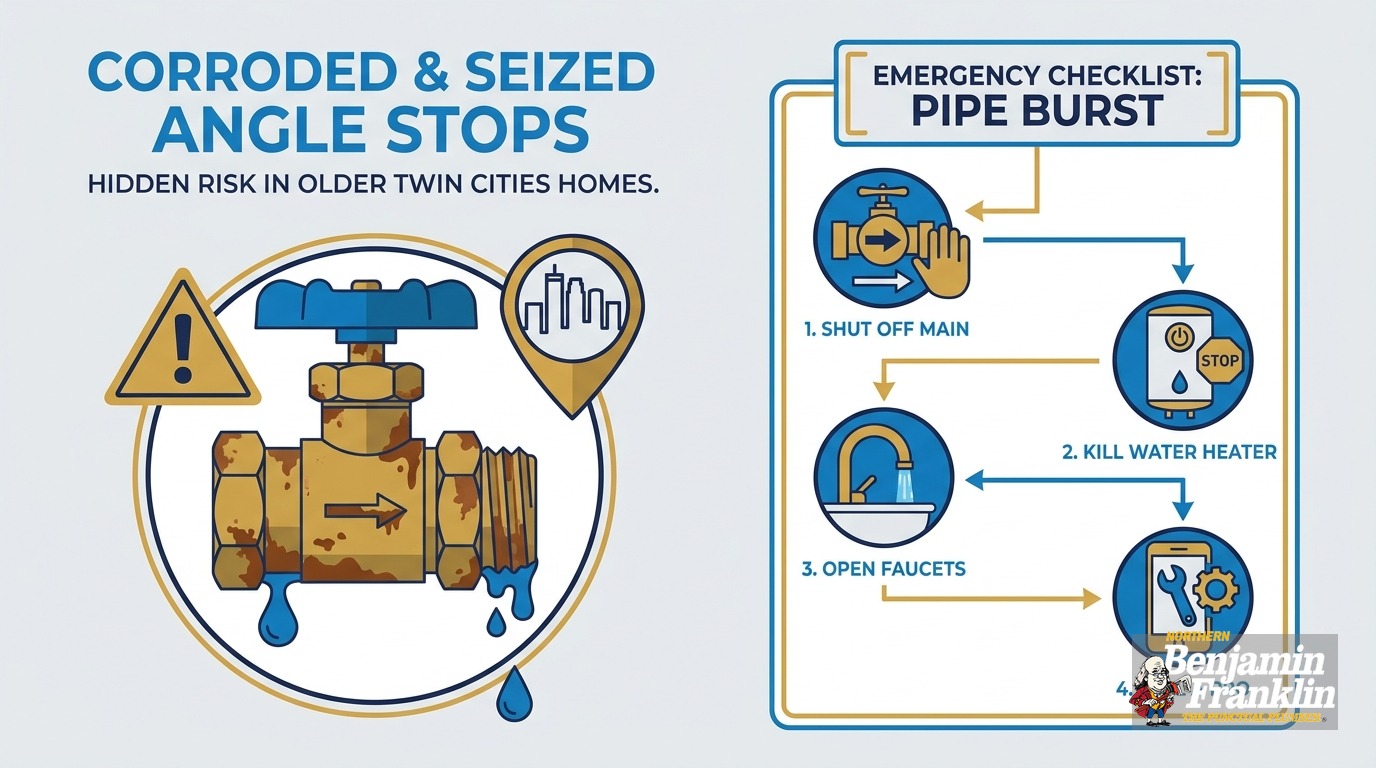
- Most under-sink shutoff valves in older Twin Cities homes are multi-turn compression stops. They seize from mineral scale and stem corrosion over time.
- 80% of Minneapolis homes were built before 1978. Many have never had their angle stops replaced.
- Minneapolis and Saint Paul finished water runs at pH 9.0-9.1 with 5-6 grains per gallon of hardness. That mineral load scales valve seats and corrodes stems.
- Forcing a seized valve can snap the stem or crack the body. That eliminates local control and creates a full-pressure flood with no immediate shutoff.
- A seized angle stop can pass a home inspection. Inspectors are not required to operate shutoff valves.
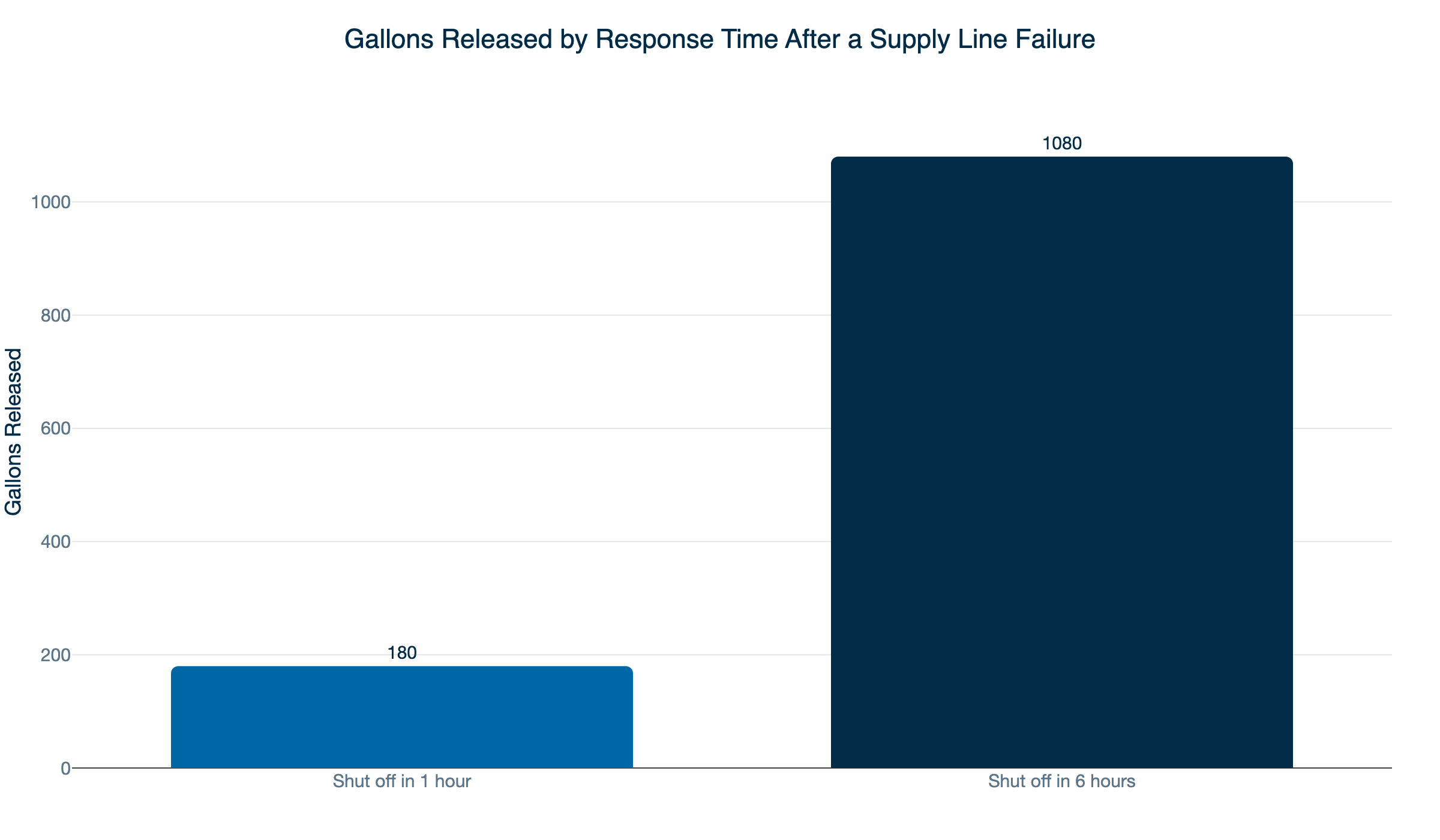
- A supply line shut off in one hour releases roughly 180 gallons. Left running six hours, it deposits about 1,080 gallons. That gap separates drying in place from gut demolition.
- Quarter-turn ball valves use a stainless steel ball and PTFE seats that resist seizing. Swapping them in during a routine visit is the practical fix.
The Valve Nobody Tests Until the Day They Need It
If the shutoff valve under your sink is not working, the problem starts before you pick up a wrench. That small valve under the cabinet is the first line of defense against water damage during any plumbing repair. In older Twin Cities homes, it is also one of the most likely components to seize at the wrong moment.
Most homeowners never open that cabinet until a faucet drips or a supply hose fails. By then, the valve may have sat unused for ten, twenty, or thirty years. It looks fine from the outside. Turning the handle is the natural instinct. Forcing it is the mistake that turns a stuck valve into a flood.
This guide covers what causes angle stops to fail, why Twin Cities homes face elevated risk, and what proactive replacement looks like before anything breaks.
What Is a Shutoff Valve Under a Sink, and What Does It Do?
An angle stop connects the water supply line in the wall to the supply tube running up to the faucet or toilet. It lets you cut water to one fixture without shutting off the whole house. When it works, you never think about it. When the shutoff valve under the sink is not working, every repair at that fixture stops until you find another path.
The term “angle stop” describes the valve’s shape: water enters horizontally from the wall and exits at 90 degrees toward the fixture above. Most angle stops installed before the mid-2000s are multi-turn compression valves. They have a small oval handle that requires several full rotations to close. The mechanism inside is a rubber washer pressing against a brass seat to block flow.
That design is simple and reliable when new. It becomes failure-prone after years of sitting still. A homeowner swapping a kitchen faucet does not want to shut down the whole house. The angle stop handles the job locally - but only when it actually turns.
There is an important distinction between the under-sink stop and the main water shutoff for the whole house. If the angle stop fails or is absent, the main becomes the only backup. Knowing where the main is and that it functions is a separate task - one worth completing before any repair begins.
Why Does a Shutoff Valve Under the Sink Stop Working?
Two internal processes happen simultaneously over years of disuse. The rubber washer dries and hardens against a mineral-scaled seat. The steel stem corrodes into the brass packing nut. Together, those two changes lock the valve in place. Applying more force then risks breaking the stem or cracking the body rather than closing the valve.
The failure develops slowly. Each time water flows past the valve, trace minerals deposit on the seat. The rubber washer loses flexibility between infrequent uses. The stem oxidizes against the packing nut. After a decade or more, nothing visible has changed on the outside. But the internal components have fused enough that normal hand pressure will not turn the valve. Abnormal pressure will break it.
This is why the correct response to a valve that resists hand pressure is to stop immediately. Locate the main water shutoff. Call a plumber. Do not apply more force.
Why Twin Cities Homeowners Face Higher Risk
Three local factors combine to accelerate angle stop failure here more than in most markets.
Old housing stock. 80% of Minneapolis homes were built before 1978, according to Minnesota House Research data. Many owner-occupied Minnesota homes predate 1980. A home built decades ago in Coon Rapids or Bloomington may still have its original compression stops under every sink. Those valves are sixty years old. They have never been replaced. In many cases, they have never been turned.
Mineral-heavy, high-pH water. Minneapolis finished water hardness averages 92-104 ppm, or 5.4-6.1 grains per gallon, at a finished pH of 9.02-9.06. Minneapolis removes approximately 65,000 pounds of hardness from its water supply every day, according to Minneapolis Water Treatment and Delivery - before any water reaches a tap. Even after that treatment, the finished water is hard enough to scale an unexercised valve seat over years of use.
Homes without a whole-house softener send the full municipal hardness through every angle stop under every sink. Our guide on water hardness in Minneapolis and Saint Paul explains what those numbers mean for fixtures and pipes throughout the home.
Freeze-thaw stress. Minnesota code sets a frost depth of 42-48 inches in the Twin Cities metro. Actual frost penetration in extreme winters can reach 60 inches. Minneapolis averages 22 days per year below 0°F. Under-sink cabinets on exterior walls rank among the highest freeze-risk spots in a Minnesota home. In older bungalows and ramblers across Minneapolis and Saint Paul, the kitchen sink often sits directly under a window on an outside wall. That placement cycles the supply connections and the angle stop through temperature swings every winter. Fifty cycles of that adds real mechanical stress to components never designed for it.
Stack these three factors together: a valve from 1968, scaled by hard water at pH 9.0+, and cycled through fifty Minnesota winters. A shutoff valve under the sink not working in that home is not bad luck. It is a predictable outcome.
What Happens If You Force a Seized Shutoff Valve?
The stem snaps or the valve body cracks. There is no longer any local control over that fixture’s water supply. Water runs at full line pressure through the break. The only shutoff is the main - and in a panicked moment, reaching the main takes time that costs real damage.
Response time shapes how bad the outcome gets. A supply line releasing 3 gallons per minute for 6 hours deposits roughly 1,080 gallons into a home. The same line shut off within 1 hour releases only about 180 gallons - the difference between drying in place and full gut demolition. Mold begins growing within 48 hours of water damage, which means the structural and air quality clock starts fast.
A nine-hundred-gallon gap between “found it in an hour” and “found it six hours later” illustrates why knowing where the main shutoff is - and knowing it works - is not optional preparation. It is the only backup when a local valve fails.
Why Can a Seized Shutoff Valve Under a Sink Pass a Home Inspection?
Home inspectors are not required to operate shutoff valves. Under the ASHI Standard of Practice, turning a valve falls outside the scope of a general residential inspection. A seized compression stop can pass inspection and sit undiscovered until a homeowner reaches for it during a repair.
This surprises most buyers in older Twin Cities homes. A clean inspection report does not confirm that every valve was tested. The inspector verifies a valve is present and accessible. They do not verify it turns.
The scenario plays out predictably. A buyer purchases a 1958 rambler in Brooklyn Park. The inspection is clean. Four years later, a slow drip at the kitchen faucet supply connection prompts a repair. They reach under the sink, grab the oval handle, feel it resist, apply more force, and snap the stem.
This is the standard failure path for a decades-old, untested compression stop. The valve was never going to announce itself as seized. It waited for the moment someone needed it.
A plumbing evaluation that includes valve testing - done proactively, before any repair is scheduled - is the way to find this problem without creating a worse one.
What Are the Warning Signs That a Shutoff Valve Under the Sink Is Failing?
The clearest warning is any resistance to hand pressure. A valve that requires a wrench to move is already at risk of stem damage if forced. Visible mineral deposits on the body, corrosion on the stem, and a drip at the packing nut are each additional signals that the valve’s service life is over.
Here is what to look for during a check under the sink:
- Stiff or immovable handle. Any valve requiring a tool to operate has already reached the point where forcing it is likely to cause a break.
- White or gray mineral crust on the valve body or packing nut. Scale on the outside of the valve almost always means scale on the internal seat.
- A slow drip at the packing nut or along the stem. Degraded packing allows water past the stem under pressure. A visible drip there means the valve needs replacement, not adjustment.
- Green or dark brown surface corrosion on a brass body. External oxidation is a leading indicator of internal corrosion in the stem housing.
- An old oval handle rather than a lever. Oval handles identify multi-turn compression stops - the design prone to this failure mode. If the home is older than 20 years and the handles have never been swapped, treat every one as suspect until a plumber evaluates it.
A quick audit takes ten minutes. Open every cabinet under every sink and look at each valve. Check the shutoffs behind each toilet as well. Note anything stiff, corroded, or dripping. That list becomes the work order for a proactive service call.
Do not test any suspect valve by forcing it. Have a plumber assess it first. For main shutoff guidance, our post on finding and testing your main water shutoff valve covers what to check before any plumbing work is scheduled.
The Quarter-Turn Ball Valve Upgrade
If your home’s angle stops are original compression valves, replacing them with quarter-turn ball valves is one of the highest-value preventive steps available in an older Twin Cities home. The cost is contained. The risk reduction is measurable.
The difference comes down to mechanics. Quarter-turn ball valves use a stainless steel ball and PTFE seats that resist seizing. The lever handle provides a clear open/closed visual indicator. There is no rubber washer to harden against a scaled seat. There is no steel stem corroding into brass packing. Closing the valve is a single 90-degree turn.
The lever handle removes a common DIY error. An oval handle on a compression stop gives no visual cue about whether the valve is open or closed. The homeowner has to remember how many turns they made. A lever parallel to the pipe means open. Perpendicular means closed. That clarity matters when a supply hose is spraying and there is no time to guess.
A plumber can replace a compression angle stop with a quarter-turn ball valve during any routine service visit. The main is shut, the old valve comes out, the new one goes in, the main comes back on. For most under-sink fixtures, the swap takes minutes. Done proactively during a scheduled call, there is no emergency, no water running, and no premium for urgency.
Water damage and freezing account for a significant share of all homeowner insurance claims. The real cost does not include the deductible, the disruption, or a temporary living expense while the kitchen dries out. Replacing an aging compression stop before it fails costs a fraction of that. Replacing it after a stem snap - while water runs into the cabinet - is that cost plus an emergency service call.
What If the Shutoff Valve Under Sink Is Not Working and the Main Is Also Seized?
If both the under-sink angle stop and the main shutoff are inoperable, there is no way to cut water to the house without utility involvement. That is the situation to discover before a repair, not during one.
This is not a hypothetical scenario in the Twin Cities. The same conditions that seize an angle stop - mineral-scale water, infrequent exercise, aging packing - apply to a main shutoff that has never been turned. The gate valves and early ball valves installed as mains in pre-1970s homes are subject to the same failure modes. A homeowner in a 1940s home in Northeast Minneapolis or the Mac-Groveland neighborhood of Saint Paul may face two seized valves in sequence with no intermediate shutoff.
A plumber who arrives at that situation has options a homeowner does not. Curb stop access, coordination with the municipal utility for a service interruption, or bypass valve installation while the main is replaced - none of those are available to someone turning a handle harder.
If you suspect the main has not been exercised in years, say so when you schedule a plumbing visit. A plumber can evaluate the main and all fixture shutoffs in a single call. Our guide on what to do when a shutoff valve is stuck and won’t turn covers both main and fixture shutoffs together.
When to Call Northern Benjamin Franklin Plumbing
You do not need an active failure to justify a service call. The right time to check and replace aged shutoff valves is before you need them.
Call (763) 296-1844 or book a plumbing repair visit online when:
- You are planning a faucet replacement, toilet swap, or supply hose change in a pre-1980 Twin Cities home.
- You are buying or selling a home built before 1980 and want valve testing as part of a plumbing evaluation.
- Any handle under a sink or behind a toilet feels stiff, shows visible mineral scale, or has a drip at the packing.
- Your home’s plumbing has not had a professional evaluation in more than five years.
- You already know the main shutoff has not been tested in years - that conversation belongs before the next repair, not during it.
Northern Benjamin Franklin Plumbing is locally owned and operated in the Twin Cities. Our team knows this housing stock, the municipal water quality, and the valve failure patterns that show up in homes built between the 1940s and the 1970s. We back every visit with our On-Time Guarantee(R): arrive in the window you choose, or you receive $5 for every late minute, up to $300. If there is any delay, it’s you we pay!
For faucet and fixture work that includes shutoff valve assessment, see our faucet and fixture services.
Frequently Asked Questions
What should I do if the shutoff valve under my sink is not working? +
Can a seized shutoff valve pass a home inspection? +
Why do under-sink shutoff valves seize in Twin Cities homes? +
What is a quarter-turn ball valve and why is it better than a compression stop? +
Need a technician now?