
Water Heater Anode Rod Replacement: A Twin Cities Guide
Key Takeaways
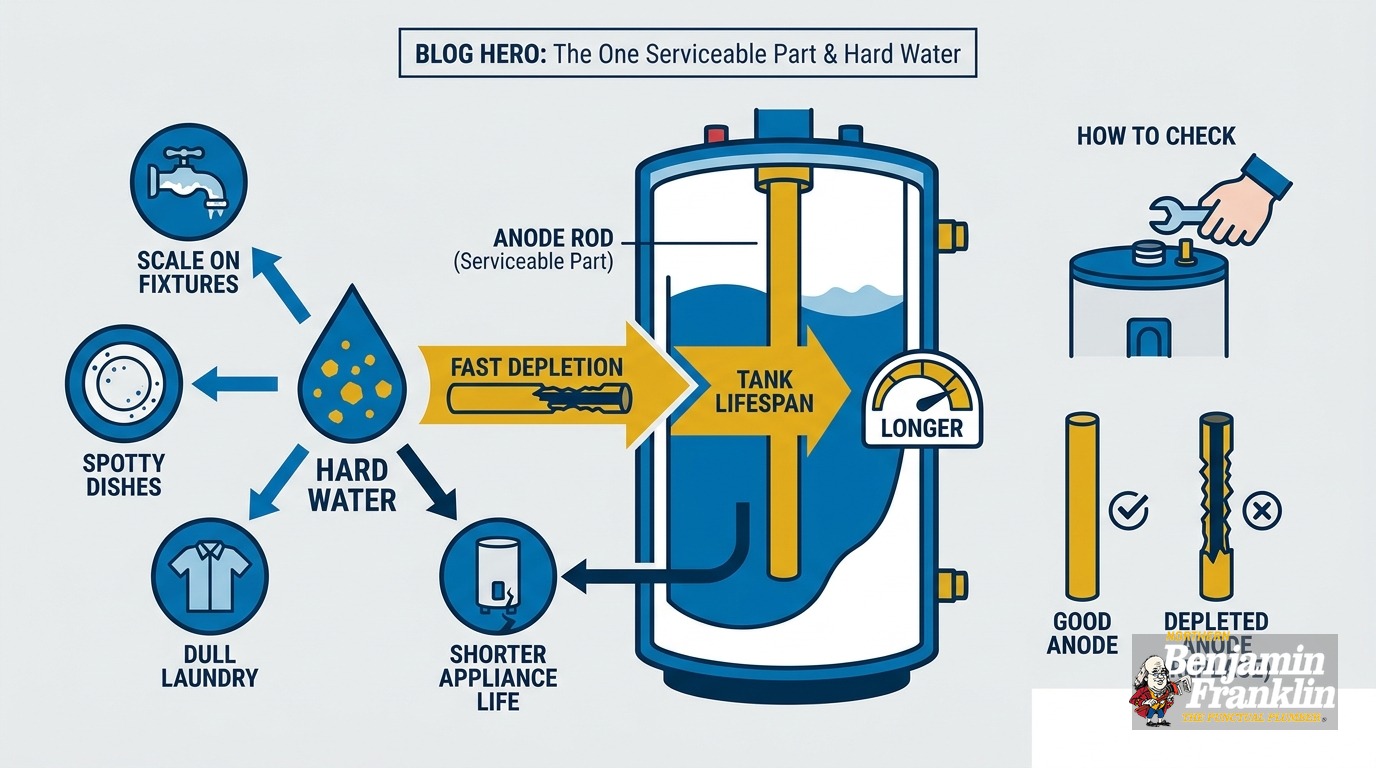
- The anode rod is the only consumable inside a tank water heater. Replacing it on schedule is the difference between a heater that lasts 15 or more years and one that rusts out in 8.
- Inspect the rod annually in hard-water areas. Replace it when more than 6 inches of steel core wire is exposed or the diameter drops below 1/2 inch.
- Your city determines your service interval. Eagan and Blaine sit near 20 grains per gallon (GPG). Bloomington and Eden Prairie receive pre-softened municipal supply near 5 GPG. Those are not the same maintenance schedule.
- Water softeners do not protect the anode rod. Softened water is electrically more aggressive and can deplete a magnesium rod up to 300% faster than untreated water.
- Some newer water heaters hide the anode rod inside the hot water outlet nipple. If you see no hex fitting on top of the tank, that is where to look.
- Call (763) 296-1844 or book online to schedule a water heater service visit. Catching a spent rod early costs far less than replacing the tank.
What is an anode rod, and why does your water heater need one?
The anode rod is a metal rod threaded into your water heater tank. It is more chemically reactive than the steel tank walls, so water corrodes the rod first and leaves the tank alone. When the rod is fully consumed, the tank becomes the sacrificial material and rust follows.
Steel corrodes in water. Water heater manufacturers have addressed this from the start: suspend a reactive metal rod inside the tank. Magnesium and aluminum are both more reactive than steel. Water attacks the rod through a process called galvanic corrosion, consuming it gradually over years. The tank walls stay intact.
This protection works as long as there is rod material left. A new rod might be 3-4 feet long and roughly an inch in diameter. Over time, corrosion thins it down to a bare strand of steel core wire with pitted metal clinging to the surface. At that point, the rod provides no protection. The electrochemical process shifts to the tank walls.
The failure does not happen overnight. You may see rusty water, hear strange noises, or smell sulfur from the hot tap before the tank actually leaks. But by the time those symptoms appear, corrosion is already underway. The time to act is before symptoms, not after.
A proactive rod inspection and replacement takes less than an hour on most water heaters. Skipping it risks shortening the heater’s life by years and turning a scheduled maintenance visit into an emergency replacement call.
How do I know when to replace the anode rod?
Replace it when more than 6 inches of bare steel core wire is exposed, the diameter drops below 1/2 inch, or the rod is sealed in a thick calcium crust. Standard interval is every 2-5 years, but hard water and water softeners both shorten that window considerably.
Family Handyman’s water heater maintenance guide lays out the visual pass/fail criteria clearly. When the rod comes out, you are looking for three specific signs:
- Core wire exposure. The rod has a steel wire running through its center. Corrosion eats the outer metal first. When more than 6 inches of that center wire is bare, that stretch no longer protects the tank.
- Diameter. A rod worn below 1/2 inch in diameter has little sacrificial material remaining. Replace it even if the rest looks intact.
- Calcium lockdown. In very hard water, a thick mineral crust can form on the rod’s surface. The rod may look solid from outside, but the active metal is sealed off and is no longer sacrificing effectively. This buildup also bonds the rod to the tank threads. The longer you wait past this point, the harder removal becomes and the higher the risk of damaging the tank nipple.
Getting the rod out is often the harder part of this job. You need a breaker bar and a 1-1/16-inch socket, and you should drain a few gallons from the tank first. On a heater that has never had its rod pulled, the fitting can be extremely tight. Years of heat cycling and mineral deposits bond it to the tank threads. Applying force at the wrong angle cracks the nipple and turns a maintenance job into a repair call.
Why does your zip code determine how fast the rod wears out?
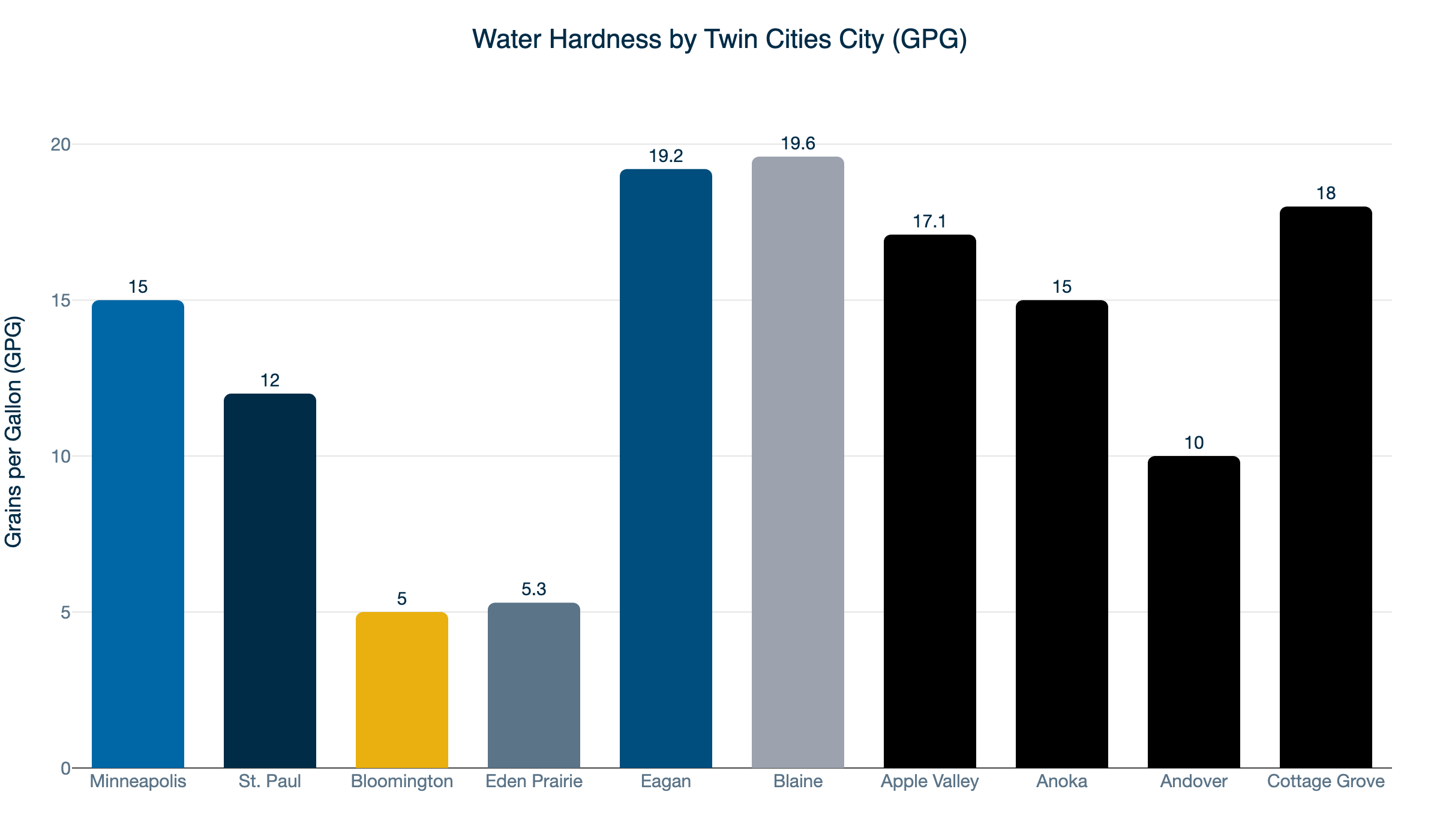
Water hardness varies more across the Twin Cities metro than most homeowners realize. Eagan and Blaine run close to 20 GPG. Bloomington and Eden Prairie receive pre-softened municipal supply near 5 GPG. Those cities need completely different anode rod maintenance schedules.
Minnesota ranks consistently among the top 10 hardest-water states. About 85% of households deal with some degree of hard water, and metro averages run 12-18 GPG. The spread within the metro is wide because different cities draw from different aquifers and some utilities pre-treat their supply before it reaches your tap.
Verified water hardness data for Twin Cities communities shows the range:
- Blaine: ~19.6 GPG
- Eagan: ~19.2 GPG
- Cottage Grove: ~18 GPG
- Apple Valley: ~17.1 GPG
- Minneapolis: ~15 GPG
- Anoka: ~15 GPG
- St. Paul: ~12 GPG
- Andover: ~10 GPG
- Eden Prairie: ~5.3 GPG
- Bloomington: ~5 GPG
A Battelle Memorial Institute study, reported by Premier Water Minnesota, found that every 5 GPG of water hardness deposits about 0.4 lbs of scale inside a water heater per year with a corresponding 8% efficiency loss. At Minneapolis’s 15 GPG, that is roughly 1.2 lbs of scale annually. An unmaintained heater at that hardness level can lose up to 24% of its efficiency. At Eagan’s near-20 GPG, the numbers are worse.
Scale buildup and anode depletion compound each other. Hard water both deposits scale on tank walls, cutting efficiency, and accelerates anode consumption, cutting protection. Neither effect is visible from outside the tank. The hardness chart in this article shows the metro spread by city. Find yours and let it guide your inspection cadence.
If you are in a high-hardness suburb, annual inspection is not overcautious. It is the correct baseline.
The water softener paradox
Most homeowners who run a water softener assume their plumbing equipment is better protected. Soft water leaves less scale. Fixtures look cleaner. The water heater seems fine. But the anode rod tells a different story.
Research on anode rod maintenance shows that water softeners can deplete a magnesium anode rod up to 300% faster than untreated water. The reason is electrochemical. A softener removes calcium and magnesium ions and replaces them with sodium ions. Sodium is electrically more aggressive. The rod sacrifices itself faster in softened water than in hard water.
This catches homeowners off guard because the visible signs of hard water disappear. Fixtures are clean. The showerhead does not clog with mineral buildup. It feels like the equipment is protected. Inside the tank, the anode rod is burning through at nearly triple the normal rate.
The homeowner most at risk lives in Bloomington or Eden Prairie, already on pre-softened 5 GPG city supply, and has added a home water softener on top of that. They have the least visible scale of anyone in the metro. They also have the fastest anode depletion. And because nothing looks wrong on the outside, they are often the last to schedule a water heater inspection.
If your home has a water softener, treat anode rod inspection as annual maintenance. Do not wait for a smell or a change in water color. Our water softener service page has more on how softener chemistry interacts with your plumbing equipment over time.
Where is the anode rod on my water heater?
On most tank water heaters, the rod threads into the top of the tank with a 1-1/16-inch hex fitting. On some newer Bradford White, Rheem, and A.O. Smith models, the rod is built into the hot water outlet nipple and there is no hex port visible on top of the tank.
This Old House’s water heater service guide confirms that every anode rod uses the same 1-1/16-inch hex socket regardless of brand. On a standard heater, the hex fitting sits on top of the tank, sometimes under a plastic cover or insulation cap. A breaker bar and the right socket remove it.
The combo or nipple-mounted rod is less obvious. Some manufacturers build the sacrificial rod directly into the hot water outlet nipple, the port where hot water leaves the tank. If the top of your heater has no hex port at all, that is likely what you have. Accessing it requires disconnecting the hot water supply line from the outlet.
Forcing the wrong fitting onto a combo rod can crack the nipple and cause a leak. If you are not certain which type of installation your heater has, a service call is the right first step. A plumber identifies the rod location in minutes and removes it safely, even on a heater where the fitting has been in place for a decade or more.
What happens if the rod is never replaced?
Once the rod is consumed, the tank walls begin to corrode. The early signs are rust-colored water, a sulfur smell from the hot tap, and popping or rumbling sounds from scale buildup. Left untreated, the tank eventually fails and needs full replacement.
The signals tend to come gradually. Rust-colored water appears first, often most noticeable after water has sat overnight in the tank. A sulfur or rotten-egg smell from the hot tap comes from hydrogen sulfide gas, produced when sulfur bacteria react with a depleted or aluminum anode rod. Loud popping and rumbling sounds are scale layers cracking on the heating element and tank floor as the unit cycles on and off.
By the time these symptoms appear, corrosion is already underway. A plumber can pull the rod, shine a light inside the tank, and tell you whether the wall condition is still serviceable or whether rust and scale have progressed too far to justify another rod replacement.
Efficiency declines the whole time. Scale is an insulator. A heater with years of accumulated scale on the heating element and tank walls works harder and runs longer to reach temperature. The Battelle data cited above puts real numbers on this: at Minneapolis hardness, scale buildup can drive a 24% efficiency loss on an unmaintained tank. That loss shows up on every utility bill.
The cost comparison between a proactive rod replacement and an emergency tank replacement is not close. Per Family Handyman’s plumbing cost data, a plumber’s service fee for a rod swap runs $200-300. A new tank water heater installation, with labor, permits, and disposal, costs many times that. Catching the rod before the tank corrodes is one of the highest-return maintenance decisions in a home.
If your heater is already showing symptoms, our guide to water heater warning signs covers what to watch for and when to call.
Should you replace the anode rod yourself or call a plumber?
A homeowner with basic tools and a mechanically simple install can handle a standard rod replacement. Call a plumber when the heater is in a tight space, when you cannot locate the rod, when the fitting has never been removed, or when you find corrosion inside the tank once the rod comes out.
The DIY path is straightforward when the heater has adequate ceiling clearance, a visible hex fitting on top, and a fitting that has not been in place for more than 4-5 years. Drain a few gallons from the tank, remove the rod with a 1-1/16-inch socket and breaker bar, thread in the new rod with fresh Teflon tape, and refill.
In the Twin Cities, a few factors complicate this regularly.
Low-clearance installs. Older Minneapolis, St. Paul, and inner-ring suburb homes often have water heaters tucked into corners with minimal overhead clearance. Standard rods are 3-4 feet long. A flexible segmented rod exists for tight spaces, but it costs more and requires care on installation to avoid kinking at the joints.
Bonded fittings. A heater that has never had its rod removed in 10 or more years often has a fitting that is effectively bonded in place by mineral scale and heat cycles. Applying force at the wrong angle cracks the nipple.
Hidden corrosion. Once the rod is out, you can see the inside of the tank by shining a flashlight into the opening. If the walls show significant rust or heavy sediment, a rod replacement may be a short-term fix. A plumber can assess whether the tank is worth maintaining or whether you are closer to a replacement than you knew.
Our water heater maintenance page covers what a professional inspection includes and what questions to ask before committing to a repair versus a replacement.
Anode rod types: magnesium, aluminum, and aluminum/zinc
Not all rods are the same material, and the choice matters in a metro where water chemistry varies as much as it does across the Twin Cities.
Magnesium rods provide stronger sacrificial protection. They are more reactive than the tank walls, which is exactly what the design calls for. They work best in soft or moderately hard water. In very hard water or softened water, that same reactivity means they deplete faster.
Aluminum rods corrode more slowly. In a high-hardness suburb like Eagan or Blaine, an aluminum rod survives a longer interval between inspections. The tradeoff is slightly lower per-year protection compared to magnesium.
Aluminum/zinc rods address sulfur odor. If your hot water smells like rotten eggs, the cause is hydrogen sulfide gas, produced when sulfur bacteria react with the rod inside the tank. An aluminum/zinc rod inhibits that reaction. It does not fix the underlying water chemistry, but it eliminates the smell.
Family Handyman recommends consulting a water treatment specialist before switching rod material, especially if you have a softener. The right rod depends on your specific water chemistry, not just your zip code.
Schedule water heater service with Northern Benjamin Franklin Plumbing
Water heater anode rod replacement is the highest-return maintenance item most Twin Cities homeowners are not doing. One service call, one affordable part, and your tank gets years of added life.
If you have not had the rod inspected in more than two years, or if your home has a water softener and the rod has never been checked, this is the right time to schedule. We serve homeowners across the metro, from Blaine and Anoka down to Eagan and Apple Valley.
During a water heater service visit, we pull the anode rod, inspect the tank interior, flush sediment from the bottom, and give you a straight assessment of whether the heater is in good shape or approaching end of life. No invented problems, no pressure to replace something that has years of service left.
We are locally owned and operated, and our On-Time Guarantee(R) backs every visit: we arrive in the window you choose, or we pay you $5 for every minute we are late, up to $300. “If there is any delay, it’s you we pay!” That is a written commitment, not a slogan.
Call (763) 296-1844 or schedule a water heater maintenance visit online. For more on how heater type affects long-term maintenance needs, see our complete guide to water heater types for Twin Cities homeowners.
Frequently Asked Questions
How often should I replace my water heater anode rod? +
What does a bad anode rod look like? +
Does a water softener protect my water heater anode rod? +
What is a combo anode rod and do I have one? +
Need a technician now?