
Hot Water Smells Like Rotten Eggs? Here's the Fix
Key Takeaways
- Hot water that smells like rotten eggs is almost always hydrogen sulfide gas produced inside the water heater tank.
- The source is a reaction between the magnesium anode rod, sulfate-reducing bacteria, and sulfate already present in the water.
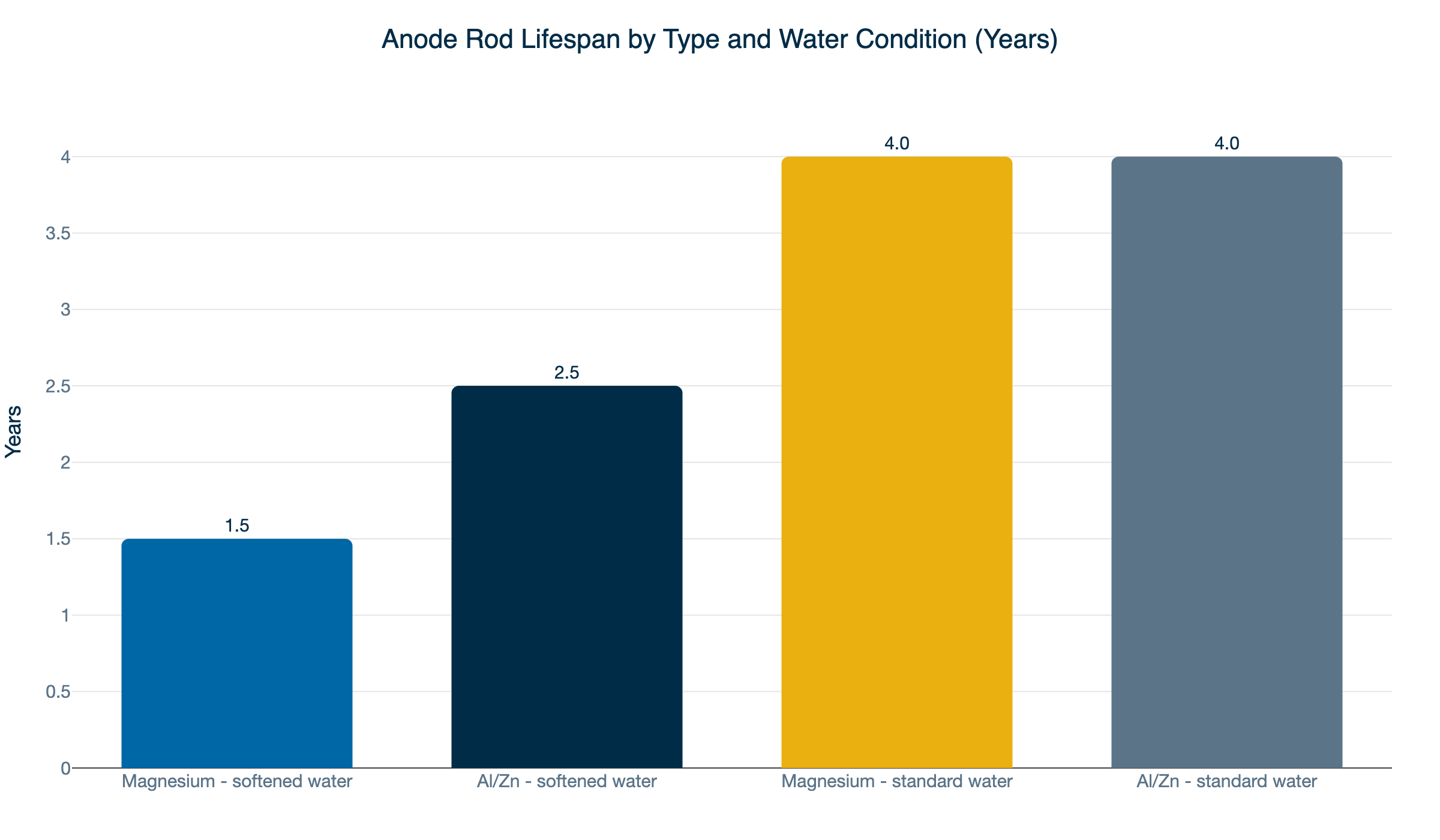
- Softened water depletes magnesium anode rods 2-3 times faster than standard municipal water.
- Minneapolis and St. Paul both pre-soften municipal water before distribution. Many metro homeowners add whole-home softeners on top. That layered softening makes this problem more common here than in most of the country.
- The fix is replacing the magnesium rod with an aluminum/zinc rod. You do not need a new water heater.
- Zinc in the rod actively suppresses the bacteria that produce hydrogen sulfide. The smell stops because the bacteria cannot function, not just because the galvanic reaction slowed.
- Annual anode rod inspection is the right cadence for any home running a whole-home water softener.
Hot water smells like rotten eggs? Here is what is happening.
If your hot water smells like rotten eggs, you are dealing with hydrogen sulfide gas. It is sharp, sulfurous, and impossible to ignore once you notice it. The smell comes from inside your water heater - not from the water main, not from your pipes. One specific component inside the tank is producing it. That component can be swapped without replacing the heater.
In Twin Cities homes, this problem is more common - and shows up faster - than national figures suggest. If you have a water softener, that is not a coincidence. The chemistry of softened water and the chemistry of a magnesium anode rod work directly against each other. Understanding that connection is the fastest path to a permanent fix.
Why does my hot water smell like rotten eggs?
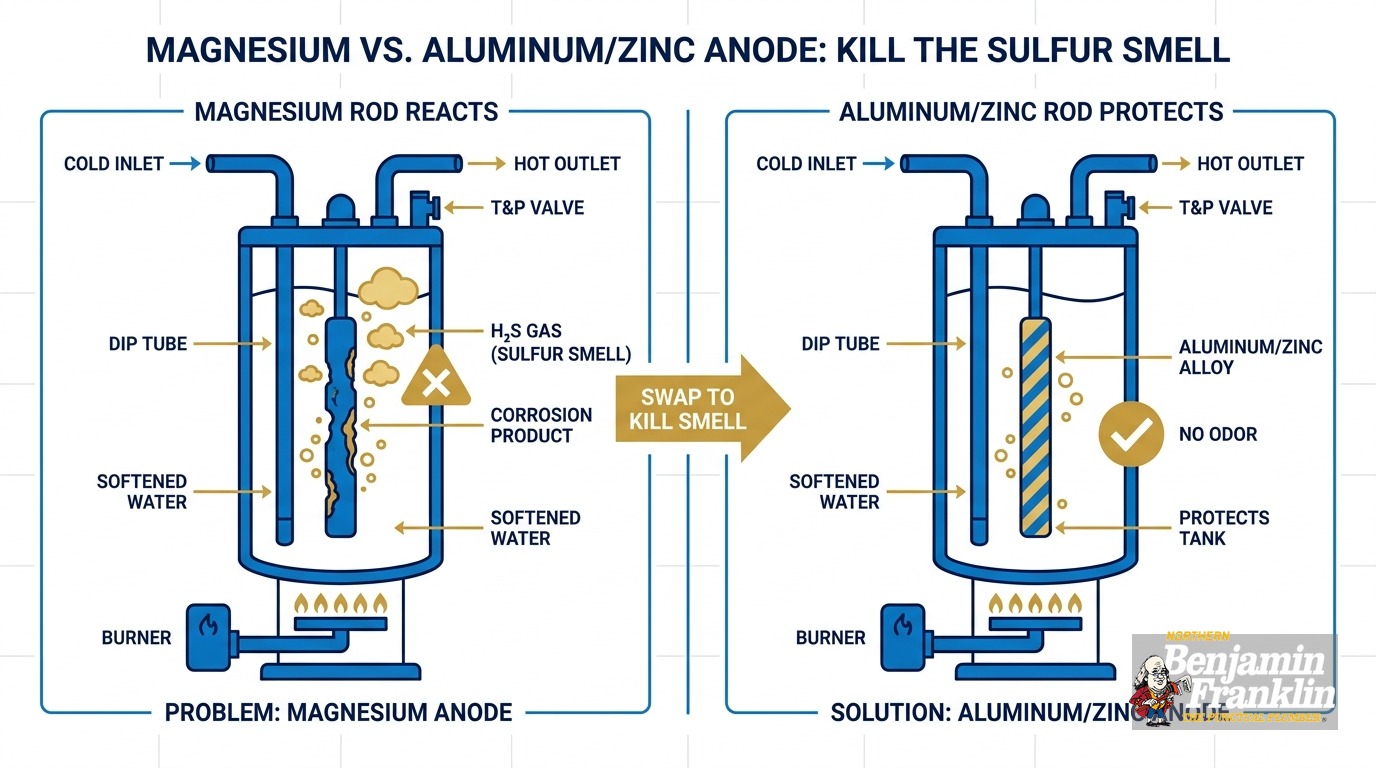
The short answer: Inside your water heater, a sacrificial component called the anode rod corrodes so the steel tank walls do not. When a magnesium rod breaks down in water containing sulfate, it produces free hydrogen. Sulfate-reducing bacteria use that hydrogen to convert sulfate into hydrogen sulfide gas. That gas smells exactly like rotten eggs.
The anode rod is a long metal rod threaded into the top of the tank. It is there to protect the steel. The rod corrodes intentionally over time, drawing the electrochemical reaction away from the tank walls. Most water heaters leave the factory with a magnesium rod installed. Magnesium provides strong electrochemical protection for many water conditions.
In softened water, it is the wrong material.
Here is the chain of events that produces the smell:
- The magnesium rod corrodes, releasing electrons and magnesium ions into the water.
- Sulfate-reducing bacteria (SRB) living in the warm, low-oxygen water inside the tank use those electrons as fuel.
- They combine the electrons with sulfate already present in the water and produce hydrogen sulfide.
- That gas dissolves into the hot water and escapes when you open the tap.
Your cold water does not carry the smell because cold water does not pass through the anode rod environment the same way. The reaction is localized to the inside of the tank. That is why turning on the cold tap at the same fixture is a reliable diagnostic: if only the hot side smells, the heater is the source.
What makes the Twin Cities different from the national average?
The short answer: Minneapolis and St. Paul both pre-soften municipal water before distribution. A large share of metro homeowners add whole-home ion-exchange softeners on top of already-softened city water. The result is very-low-mineral, high-sodium water that depletes magnesium anode rods much faster than standard municipal water. It also creates near-ideal conditions for sulfate-reducing bacteria.
Minneapolis removes approximately 65,000 pounds of hardness per day before water reaches the distribution system. After treatment, Minneapolis water averages 94 ppm of hardness, or 5.5 grains per gallon, at a pH of 9.06, with sulfate averaging 29 ppm. St. Paul’s treated water runs around 100 ppm, or 5.85 grains per gallon based on Saint Paul Regional Water Services data.
Both cities have done significant softening work before the water reaches your tap. But sulfate is still present. At 29 ppm in Minneapolis tap water, there is enough sulfate to support active H2S production in any tank with a fast-depleting magnesium rod.
Suburb residents face an even more extreme version of this chemistry. Well water in Brooklyn Park runs between 24 and 34 grains per gallon. Champlin runs 18 to 26. Chanhassen runs 22 to 26. Nearly every homeowner on well water in those suburbs runs a whole-home softener to prevent scaling on pipes and appliances. The water that enters their water heater is highly softened, sodium-rich, and still carries sulfate. That is the exact profile that makes the anode rod problem both predictable and severe.
Most national content about rotten egg smell in hot water treats it as a generic water heater issue. In the Twin Cities, it is a predictable outcome of local water chemistry. No national advice source makes that connection because no national source has reason to know it.
Why does softened water make the smell worse?
The short answer: Ion-exchange softeners replace calcium and magnesium with sodium ions. Sodium raises water conductivity significantly. Higher conductivity accelerates the electrochemical reaction that depletes the anode rod. A magnesium rod that would last 3-5 years in standard water burns out in 1-2 years in softened water. A faster-depleting rod produces more free hydrogen, which is exactly what sulfate-reducing bacteria need to make H2S.
The mechanism is electrochemical. The anode rod protects the tank because it has a stronger electrochemical potential than steel. It corrodes preferentially, keeping the reaction off the tank walls. The speed of that corrosion depends directly on how conductive the water is.
Softened water, with its high sodium content, is significantly more conductive than hard water. The galvanic reaction runs faster. A magnesium rod may be fully depleted in 1-2 years instead of 3-5. As it depletes, it generates more free hydrogen. Sulfate-reducing bacteria use that hydrogen, combined with sulfate ions in the water, to produce H2S.
The Minnesota Department of Health identifies the water heater anode rod as a primary source of hydrogen sulfide and notes that removing it may significantly decrease the life of the water heater. That is the tension this problem creates: the rod is producing the smell, but you cannot simply pull it out.
Minneapolis 2025 water data shows sulfate averaging 29 ppm, with a range of 24.4 to 33.5 ppm across the year. That is not an extreme concentration on its own. But 29 ppm of sulfate in a tank with a fast-depleting magnesium rod and an active population of sulfate-reducing bacteria is enough to produce persistent H2S. The combination of conditions is what creates the smell, not any single factor alone.
Can I just remove the anode rod to stop the smell?
The short answer: You can remove it, and the smell will stop. But removing the anode rod removes the primary corrosion protection for the steel tank. Without it, the tank corrodes from the inside. The Minnesota Department of Health flags this risk directly. The better approach: swap the rod for a material that protects the tank without producing the reaction.
Removing the anode rod is a common suggestion online. It works in the narrowest sense. The magnesium is gone, the reaction stops, the water smells fine.
The problem is everything that follows. The rod is not optional equipment - it is the reason a steel water heater can last 10-15 years without corroding through. Without it, the tank walls become the sacrificial material. Rust develops on the inside lining. The tank fails from corrosion rather than from normal wear.
Internal corrosion is also a common reason warranty claims are denied. Visible rust damage inside the tank indicates that the anode rod was neglected. Removing the rod intentionally puts you in that position from day one.
There is a better path. Change the rod to a material that protects the tank and suppresses the bacteria at the same time.
How do I fix hot water that smells like rotten eggs?
The short answer: Replace the magnesium anode rod with an aluminum/zinc rod. Zinc suppresses the sulfate-reducing bacteria at the enzyme level. Aluminum continues to protect the tank. The smell typically clears within 24-48 hours as the bacteria population declines.
Here is what that looks like in practice:
1. Confirm the smell is only in hot water. Run the cold tap at the same fixture. If cold water smells too, the source is in the water supply or a drain, not the heater. If only the hot side smells, you have an anode rod problem.
2. Locate the anode rod. Most tank-style heaters have the rod on top, as either a standalone hex-head fitting or a rod installed through the hot outlet port. Some older tanks have a side port. Your owner’s manual will confirm the location.
3. Drain a few gallons before removal. Shut off the cold supply. Attach a garden hose to the drain valve and release 2-3 gallons. This relieves pressure and makes the rod easier to remove without a mess.
4. Remove the old rod. A 1-1/16-inch socket and a breaker bar handle most rods. Rods are often seized from years of heat cycling. Penetrating oil and steady torque work better than force.
5. Install the aluminum/zinc replacement. Apply thread tape to the threads. Thread the new rod in by hand first, then torque to roughly 150 foot-pounds.
6. Flush the tank. Restore the cold supply. Run the hot tap at a nearby fixture for several minutes to move residual H2S out of the tank and lines.
The smell typically clears within a day or two as the zinc suppresses the bacterial activity. A licensed plumber can handle the full swap in under an hour for most tanks.
For a broader picture of keeping your water heater healthy, see our water heater maintenance page.
What is an aluminum/zinc anode rod, and why does it work?
The short answer: An aluminum/zinc rod provides the same electrochemical tank protection as a magnesium rod, but the zinc component actively kills sulfate-reducing bacteria. Zinc disrupts the enzyme pathways the bacteria need to convert sulfate into hydrogen sulfide. The smell stops because the bacteria stop producing H2S - not just because the galvanic reaction slowed down.
Most explanations focus on aluminum corroding more slowly than magnesium in high-conductivity water. That is true and it matters. But it is not the primary reason the fix works.
Zinc in the anode rod acts as an antibacterial agent in the tank environment. Sulfate-reducing bacteria are sensitive to zinc at the enzyme level. Zinc disrupts the metabolic pathways those bacteria rely on to convert sulfate into hydrogen sulfide. With those pathways blocked, H2S production stops - even when sulfate is still present in the water and the tank is still warm.
This is why aluminum-only rods are not the standard recommendation for this problem. Aluminum alone slows the galvanic reaction. Aluminum plus zinc stops the bacteria. The correct specification is aluminum/zinc.
The zinc is doing two jobs: it remains part of the galvanic protection system for the tank, and it actively suppresses the organisms causing the smell. Both functions are necessary. Neither works without the other.
How long does an aluminum/zinc anode rod last in softened water?
The short answer: Typically 2-3 years in a softened-water home, compared to 3-5 years in standard municipal water. That is still 2-3 times longer than a magnesium rod in the same softened conditions. In any home running a whole-home water softener, annual inspection is the right maintenance cadence.
Softened water still drives the galvanic reaction faster than standard water. The aluminum/zinc rod handles that acceleration far better than magnesium does, but it does not make your water chemistry irrelevant.
An aluminum/zinc rod in softened water typically lasts 2-3 years, compared to 1-2 years for a magnesium rod in the same conditions. A 2-3 year service life is manageable with routine maintenance. A fully depleted rod that goes unchecked leaves the tank unprotected.
Annual inspection is the right cadence. A practical approach: schedule the anode rod check at the same time as your regular water heater maintenance visit, or pair it with your softener’s brine tank cleaning each year.
For a deeper look at how hard water and water treatment affect water heater lifespan over time, see our post on anode rods, hard water, and water heater life.
Does replacing the anode rod void the water heater warranty?
The short answer: No. Anode rod replacement is classified as standard maintenance. Manufacturers expect it over the heater’s service life. What voids warranties is the opposite: neglecting the rod until the tank corrodes. Internal rust damage from a depleted rod is a common reason warranty claims are denied - not the swap itself.
This concern keeps some homeowners from acting, and it should not. Manufacturers install the rod knowing it will need replacement. It is a consumable maintenance component, not a sealed system element that signals tampering.
Anode rod replacement is standard maintenance and does not void the manufacturer warranty. What triggers denial is visible corrosion inside the tank - the kind that develops when the rod fully depletes and the steel walls take over as the sacrificial material. That is the outcome of neglect, not of maintenance.
Replacing the rod annually is exactly what responsible water heater ownership looks like under manufacturer guidelines. A warranty inspector seeing a clean, well-maintained tank with a recently replaced rod sees exactly what they want to see.
When should I call a plumber?
The short answer: Call when you first notice the smell. An early call gets you a rod swap on a healthy tank. Waiting risks a more depleted rod, more sediment, and closer scrutiny of whether the tank is worth continued maintenance investment.
The rod swap itself is straightforward. But having a plumber handle it gives you more than a swap. A technician with access to the heater can also:
- Confirm the correct rod specification for your tank model
- Inspect the pressure relief valve and test that it opens correctly
- Check the expansion tank and incoming water pressure
- Assess sediment levels and whether a flush makes sense while the access is open
- Evaluate the tank’s overall condition relative to its age
We see a lot of Twin Cities water heaters that have been running without anode rod attention for five to ten years. The owners assumed the tank was fine because the hot water still worked. By the time the smell appeared, the rod was close to fully depleted. Some of those tanks were already showing early corrosion inside.
An anode rod inspection is a low-cost visit. It pays off in extended tank life and avoided emergency replacements. If you are not sure when your current rod was last checked - or whether your heater came from the factory with a magnesium rod that was wrong for your softened water from the start - that is worth finding out.
If you have not checked how old your water heater is, do that first. Tank-style units typically last 10-15 years. A tank in its second decade with a rotten egg smell may be giving you multiple signals at once. A rod swap on a tank nearing the end of its service life is money spent on borrowed time.
For a tank within its first 8 years of service and otherwise functioning well, the rod swap is the right call.
We are locally owned and operated, and we service the full Twin Cities metro: Minneapolis, St. Paul, Blaine, Bloomington, Brooklyn Park, Coon Rapids, Maple Grove, and the surrounding area.
What about the broader water chemistry picture?
The short answer: The anode rod swap fixes the smell. If you run a whole-home softener, understanding your full water chemistry can extend the fix and inform long-term maintenance decisions. A professional water test and a conversation with a water treatment specialist gives you better information than a guess.
The rod swap is step one. Depending on how aggressively your softener is set and the hardness of your source water, there may be additional steps worth considering once the smell is resolved.
Some homeowners with very high softener output find that reducing the sodium exchange slightly - not eliminating softening, just dialing back how completely it strips hardness - extends anode rod life without allowing meaningful scaling. Others add a sediment pre-filter upstream of the softener to reduce the mineral load entering the heater. Neither step replaces the rod swap. Both extend the benefit once the correct rod is in place.
If you want a full picture of what your water contains, our water treatment team can walk you through testing and options specific to your service area. Minneapolis and Saint Paul both publish monthly mineral reports. Suburban well water homeowners benefit most from a professional water test before deciding on a treatment setup.
The bottom line
Hot water that smells like rotten eggs is a solvable problem. In most Twin Cities homes, it comes down to a magnesium anode rod that was designed for standard water but is wrong for the softened, sulfate-carrying water that actually reaches your heater here. The chemistry is predictable. The fix is specific: swap the magnesium rod for an aluminum/zinc rod and inspect it annually.
You do not need a new water heater. You need the right rod for your water.
We are locally owned and operated, and we back every appointment with our On-Time Guarantee(R): if we give you a service window and we are not there on time, you collect $5 for every minute we are late, up to $300. “If there is any delay, it’s you we pay!”
Call (763) 296-1844 or book online to schedule your water heater inspection.
Frequently Asked Questions
Why does my hot water smell like rotten eggs but cold water does not? +
Can I fix rotten egg smell in hot water without replacing the water heater? +
How do I fix hot water that smells like rotten eggs? +
Does replacing the anode rod void the water heater warranty? +
Need a technician now?