
Water Heater Leaking From the Bottom: Causes and Fixes
Key Takeaways
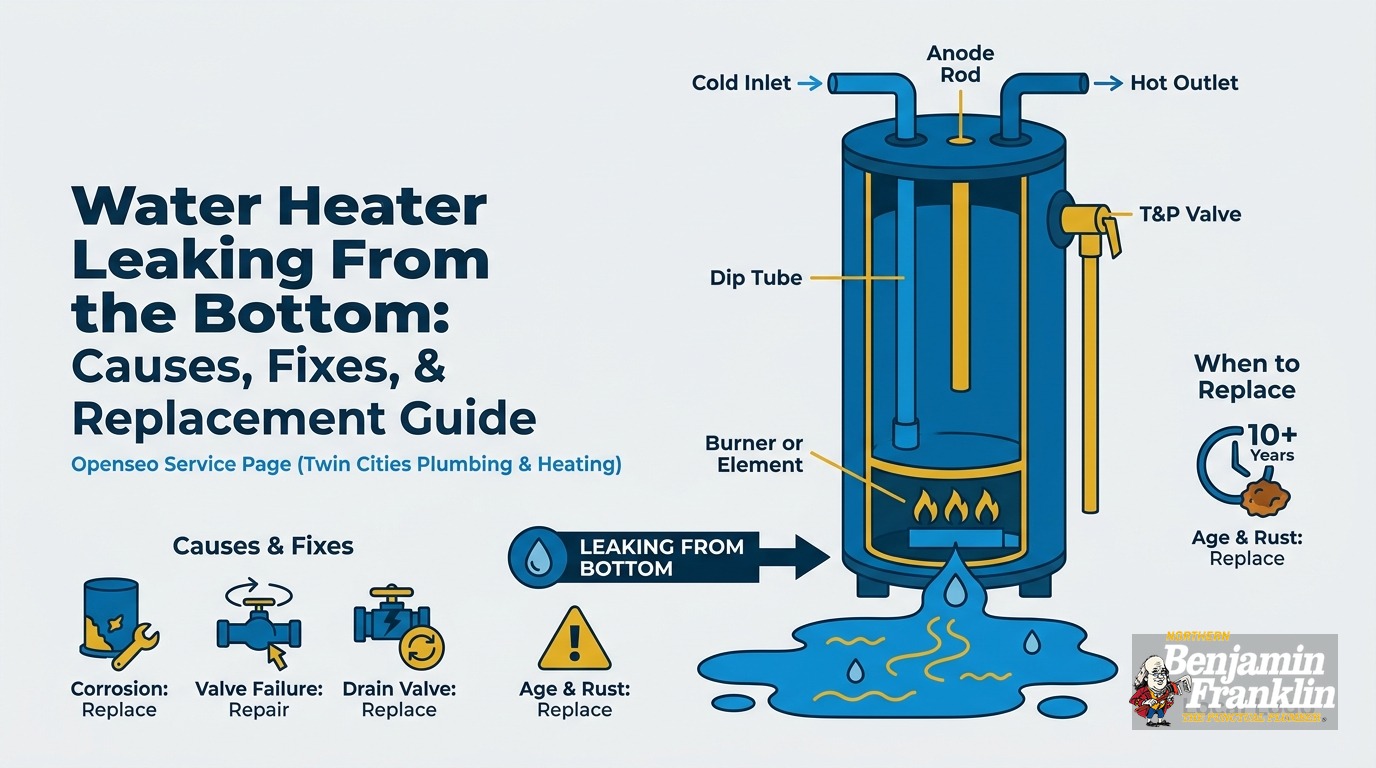
- A water heater leaking from the bottom has four main causes: a failing drain valve, a T&P valve discharge pipe dripping to the floor, sediment and anode rod failure corroding the tank from inside, or full internal tank corrosion.
- A drain valve or T&P valve issue is often repairable. Water at the tank seams or base is not - that is a replacement.
- If a repair quote exceeds 50% of the full installed cost of a new unit, replacing it is the better financial call.
- Every water heater replacement in Minnesota requires a plumbing permit under MN Rules Chapter 4714. Skipping it can void your homeowners insurance and create title problems at resale.
- Twin Cities suburbs with hard groundwater - Brooklyn Park at 32 GPG, Plymouth at 24 GPG, Bloomington at 22 GPG - see faster sediment buildup and anode rod depletion than national maintenance guides account for.
- Xcel Energy customers can get $75-$500 back on a qualifying replacement unit, depending on type.
- Call Northern Benjamin Franklin Plumbing at (763) 296-1844 or book your appointment online for a same-day diagnosis.
Why Is Your Water Heater Leaking From the Bottom?
The four most common causes are a failing drain valve, a T&P valve discharge pipe dripping to the floor, sediment and anode rod depletion driving internal corrosion, and full tank failure. The source tells you whether you need a contained repair or a full replacement - and narrowing it down takes about five minutes.
Before you do anything else, get down and look carefully at where the water is actually coming from. Is it pooling directly below the drain valve - the spigot-style fitting near the very base of the tank? Is there a drip running down the side of the unit along the T&P discharge pipe? Or is water appearing at the tank body itself, at a seam or weld with no fitting nearby? Each of those answers points to a different problem with a different cost and a different urgency.
A water heater leaking from the bottom is not always an emergency, but it is never something to watch and wait on. A slow drip from a drain valve today can be sediment-driven corrosion eating through the tank bottom six months from now. Work through the four causes below in order, starting with the least expensive fix.
Cause 1: A Failing Drain Valve
The drain valve is the spigot-style fitting attached at the very base of your water heater. Its job is to let you empty the tank when flushing sediment during routine maintenance. Most residential units ship with a plastic drain valve, and plastic does not hold up indefinitely. After eight to ten years, the valve stem and seat wear out and the valve begins to drip even when fully closed.
The first thing to try is tightening the valve a quarter-turn with a wrench. A valve that has vibrated loose over years of service will sometimes seat properly with a small adjustment and stop dripping entirely. Be careful not to overtighten - plastic threads strip easily, and a stripped valve connection becomes a more serious problem than a slow drip.
If tightening does not stop the leak, the valve needs to be replaced. According to Summers PHC, a drain valve swap on a unit that is otherwise in good condition typically takes under an hour: drain the tank, remove the old valve, thread in a new one, refill. The parts cost is low and the repair is contained.
One thing to check before committing to a repair: if the valve has been dripping for months and scale has built up around the threads at the tank connection, removing the old valve without damaging the fitting takes care. A licensed plumber can assess whether the tank connection is sound before you invest in a new valve on a unit that may be near the end of its life anyway.
Is the T&P Valve Causing the Leak?
The temperature and pressure relief valve - the T&P valve - is mounted on the side of the tank, usually toward the upper third of the unit. A discharge pipe runs straight down from it to the floor. When that pipe weeps or drips, the water lands at the base of the heater and looks exactly like a bottom leak originating from the tank itself.
A T&P valve that drips or weeps is not operating normally. Plumbing industry guidance on this point is consistent: a faulty T&P valve must be replaced entirely, not repaired, and not addressed by turning down the thermostat. It is a safety device. A compromised T&P valve offers no protection if tank pressure spikes to a dangerous level.
Several conditions can trigger a T&P valve to open repeatedly. Water pressure in the home running too high is one. A thermostat setting above 120°F - which causes the valve to cycle more often than it should - is another. Thermal expansion in a closed plumbing system without a properly sized expansion tank is a third. The DOE recommends 120°F as the thermostat set point, partly because temperatures above that accelerate both sediment buildup and T&P valve cycling.
If you replace the T&P valve and the new one begins dripping within a few weeks, one of those upstream conditions is forcing it open. That is a separate diagnosis - a plumber needs to look at system pressure and check whether an expansion tank is needed on your water supply.
How Does Sediment and a Depleted Anode Rod Cause a Water Heater Leak?
Once the anode rod is depleted, the tank’s steel walls begin corroding from the inside. Sediment on the tank floor traps moisture against the steel and accelerates that process. In Twin Cities suburbs with hard groundwater, both happen significantly faster than national maintenance guides assume - often shortening heater life by three to five years.
Every tank water heater has an anode rod - a magnesium or aluminum rod suspended inside the tank that sacrificially corrodes to protect the steel walls. As the rod corrodes, it is doing exactly what it is supposed to do. The problem comes when the rod is fully depleted and nothing stands between the incoming water and the steel tank. Bob Vila, citing manufacturer specifications, notes that even a premium water heater can fail in under six years once the anode rod is exhausted. The rod should be inspected every one to three years and replaced when it is thinner than half an inch or heavily coated with calcium.
Sediment compounds the timeline. Hard water deposits calcium and magnesium on the tank floor with every heating cycle. That layer insulates the burner from the water, forces the unit to run longer and hotter to reach temperature, and traps moisture directly against the steel bottom. Bradford White’s maintenance guide at hotwater.com recommends flushing the tank every six to twelve months, with more frequent flushes in hard-water homes.
Here is where Twin Cities geography matters. Minneapolis city water measures about 5.4 GPG (92 ppm) after treatment at the municipal plant. St. Paul is similar, at roughly five to six GPG after lime softening. For homeowners drawing from those city systems, the national maintenance timelines are a fair baseline.
The suburbs are a different story. Brooklyn Park groundwater tests at 32 GPG. Plymouth is at 24 GPG. Bloomington is at 22 GPG. Hopkins is at 21 GPG. These figures come from Bethel Plumbing’s Minnesota water hardness table and Range Water’s city-by-city guide. At 32 GPG, scale builds up at a rate that national guides simply do not account for. A heater that might last twelve years in Minneapolis may be leaking by year seven in Brooklyn Park.
Our post on flushing water heater sediment walks through the process in detail. And if you want a deeper look at how anode rod depletion and hard water interact over a heater’s lifespan, see Anode Rod, Hard Water, and Water Heater Life.
Does a Leaking Tank Mean Full Replacement?
Yes. Water appearing at the tank seams, welds, or base - not from a valve, not running down from a pipe, but from the tank body itself - means the steel has corroded through. A corroded steel tank cannot be patched. Replacement is the only option, and the situation should be treated as urgent.
The signs that point to tank failure rather than a valve problem:
- Water appears directly at the seams or bottom of the tank body, not at any fitting
- Your hot water runs rust-colored or smells metallic, especially first thing in the morning
- The heater makes a rumbling, popping, or knocking sound when heating - sediment boiling under the burner plate
- The unit is ten years old or older and has not been flushed or had the anode rod inspected regularly
The U.S. Department of Energy puts the expected lifespan of a tank water heater at 10-15 years. A unit at the upper end of that range, in a suburb with 20-plus GPG groundwater, showing any of these symptoms has likely reached end of serviceable life. Delaying replacement raises the risk of a sudden full failure - which means water on the floor and an emergency call instead of a scheduled replacement at your convenience.
If you are not sure whether you are looking at a valve issue or tank corrosion, water heater repair and replacement is exactly what our team diagnoses daily. One call and we can tell you which situation you are in.
Should You Repair or Replace a Water Heater Leaking From the Bottom?
If the repair quote exceeds 50% of the full installed cost of a new unit, replace. For a unit under eight years old with an isolated valve issue, repair is usually the right call. For a unit over ten with sediment buildup, a depleted anode rod, or any corrosion at the tank body, the math almost always favors replacement.
Waterheatingauthority.com applies the same 50% threshold: once a single repair approaches half the cost of a new installation, the older unit is on borrowed time. You are paying to extend the life of a system that is already past its maintenance window, and the next failure is often not far behind.
Age also shapes the decision in a second way. A unit running hot for years - thermostat above 120°F, T&P valve cycling frequently - accumulates wear faster than the calendar age suggests. A ten-year-old heater that has run at 140°F is not in the same condition as a ten-year-old heater set correctly.
When replacement makes sense, consider what unit type to move to next. ENERGY STAR data shows heat pump water heaters last 13-15 years compared to 10-12 for a standard tank. The upfront cost is higher, but Xcel Energy rebates - detailed in the section below - reduce the gap, and the longer lifespan changes the cost-per-year calculation.
For a detailed breakdown of what replacement costs look like in the Twin Cities, see gas water heater replacement cost in Minnesota.
What Are Minnesota’s Permit Requirements for Water Heater Replacement?
Every water heater replacement in Minnesota requires a plumbing permit under MN Rules Chapter 4714, the Minnesota Plumbing Code, and the work must be done by a licensed plumber. Skipping the permit can void your homeowners insurance if a water-related claim is tied to the unpermitted installation, and it creates a title disclosure problem when you sell the home.
A gas water heater replacement requires a second permit for the gas connection under MN Rules Chapter 1346. Trueplumbingsolutionsmn.com summarizes both requirements and notes that emergency replacements done after hours must have the permit in hand the next business day - after-hours work is allowed under that rule, but it does not waive the permit requirement.
One technical detail that catches homeowners off guard: PEX piping cannot be installed within 18 inches of the water heater under Minnesota code. Many Twin Cities homes have PEX supply lines, and if the installer does not use a code-compliant transition at the required distance, the inspection fails and the work has to be redone. A properly licensed plumber handles this as part of the standard job, and you will not find out about it at the inspection.
Northern Benjamin Franklin Plumbing is locally owned and operated here in the Twin Cities. We pull the permits, schedule the inspections, and document everything so your installation is on record. Our On-Time Guarantee(R) backs every visit: we arrive in the window you pick, or we pay $5 for every minute we are late, up to $300. As we say: “If there is any delay, it’s you we pay!”
How Twin Cities Water Hardness Accelerates Water Heater Failures
Water chemistry in the Twin Cities metro varies sharply between the core cities and the surrounding suburbs - and that difference has a direct effect on how long a water heater lasts and what causes it to fail.
Minneapolis draws from the Mississippi River. After treatment at the municipal plant, finished water measures about 5.4 GPG (92 ppm), with a pH averaging around 9.0. That elevated pH raises calcium carbonate scaling potential in heated equipment even at moderate hardness. St. Paul uses the same river source and lands at roughly five to six GPG after lime softening at the McCarrons plant. For homeowners on either of those city systems, the national maintenance guidance - flush annually, inspect the anode rod every few years - is a reasonable baseline.
The suburbs present a different picture entirely. Much of the greater metro draws from groundwater rather than surface water, and groundwater in this region runs hard. Brooklyn Park tests at 32 GPG. Plymouth at 24 GPG. Bloomington at 22 GPG. Hopkins at 21 GPG. At 32 GPG, calcium and magnesium deposits accumulate on the tank floor and heating element at a rate that standard national guides - calibrated to a 10-15 GPG “hard water” midpoint - do not account for. Anode rods deplete faster. Sediment layers build faster. The corrosion timeline compresses.
A heater installed in Brooklyn Park by the book, with no softener in place and maintenance performed on the national schedule, can start leaking years before a comparable unit in South Minneapolis would show any symptoms. If you live in a suburb and have not had your water tested recently, understanding your exact hardness number changes the maintenance schedule, the replacement decision, and whether a water softener makes sense for your home.
Our team can test your water and walk through softener options. More on that at [/water-treatment/common-water-problems/hard-water/].
Which Xcel Energy Rebates Apply to Water Heater Replacement in Minnesota?
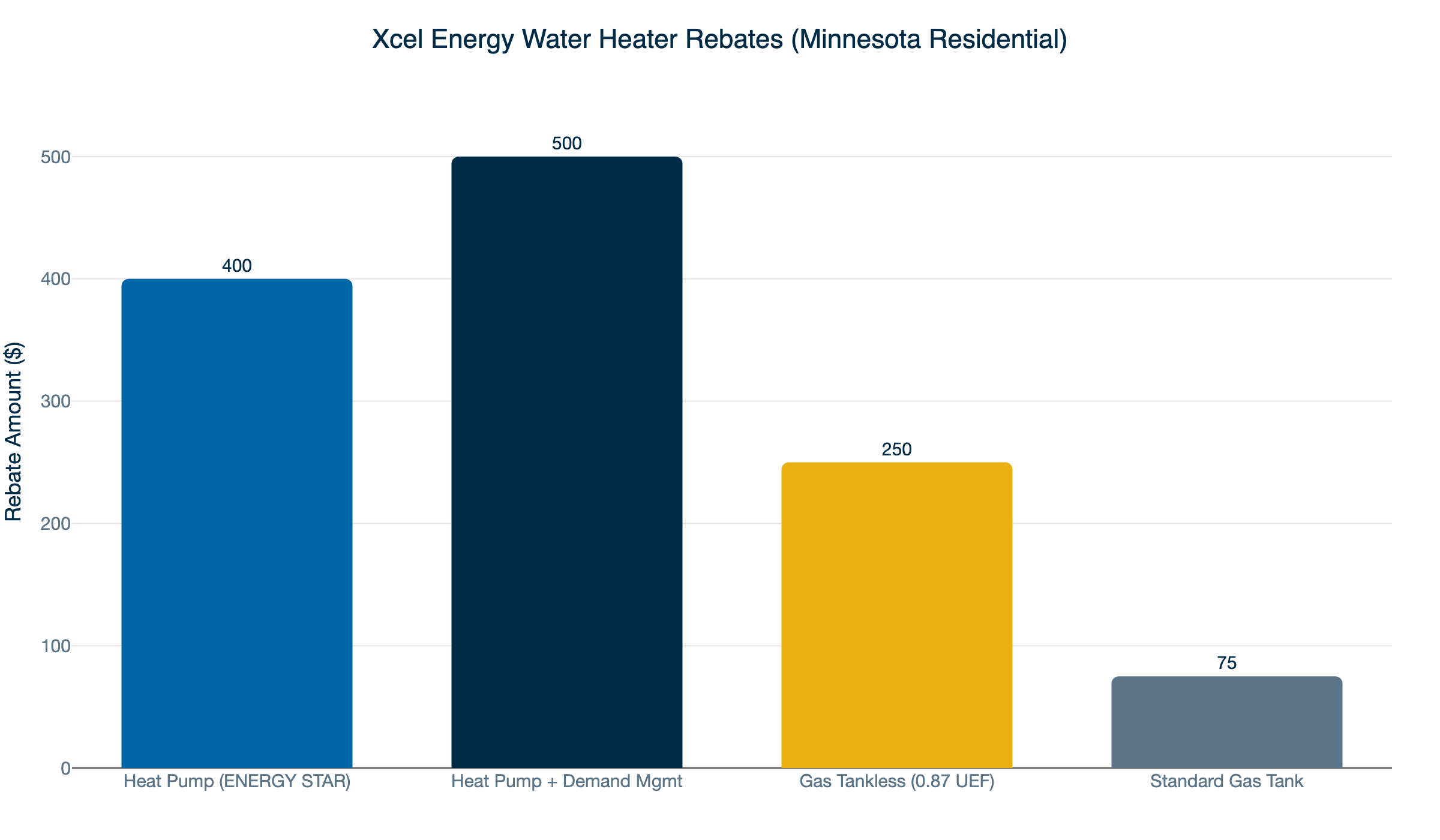
Xcel Energy offers $75 on a standard gas tank, $250 on a qualifying gas tankless unit at 0.87 UEF, $400 on an ENERGY STAR heat pump water heater, and $500 if you also enroll in demand management. The federal Section 25C tax credit expired December 31, 2025, and is not available for 2026 installations.
These figures come directly from the Xcel Energy Minnesota residential water heater rebate application. The chart above shows the full breakdown by unit type.
On the federal side: the Section 25C heat pump water heater tax credit was worth 30% of the installed cost up to $2,000. Watt Wallet’s 2026 guide confirms it expired December 31, 2025, and is not available for work done in 2026. The Xcel rebate program remains in place.
The rebate math matters most when you are weighing a standard tank against a heat pump unit. The heat pump unit costs more upfront, but a $325-$425 difference in Xcel rebates narrows that gap. Add the 13-15 year lifespan for a heat pump unit versus 10-12 for a standard tank, and the long-term cost comparison often tilts toward the heat pump, especially in a home with high hot-water demand.
Financing is available on qualifying installations. Call (763) 296-1844 for details.
What to Do Right Now If Your Water Heater Is Leaking From the Bottom
If you have water at the base of the heater, work through this in order:
- Turn off the cold-water supply. The shutoff valve is on the cold-water inlet pipe, usually directly above the unit. Turn it clockwise until it stops.
- Check the drain valve. If it is dripping, try tightening it a quarter-turn with a wrench. Gentle pressure only - do not force it.
- Follow the T&P discharge pipe. Trace it from the valve on the side of the tank down to where it terminates. A drip anywhere along that pipe, or at the valve itself, points to the T&P valve as the cause.
- Look at the tank body directly. Put your hand along the tank seams and the base. Water appearing from the tank surface - not from any valve or fitting - is internal corrosion. This is a replacement.
- If the leak is active and from the tank body, shut off the heat source. For a gas unit, turn the gas valve to “pilot.” For electric, flip the circuit breaker. Cold-water supply off, heat source off, then call a plumber.
A slow drip from the drain valve is lower urgency than water running from a tank seam. But neither one resolves on its own. Left alone, both situations grow - and a leak that points to sediment buildup becomes a sudden floor-flooding failure on a timeline no one can predict.
Northern Benjamin Franklin Plumbing is locally owned and operated right here in the Twin Cities. Our team handles water heater repair and replacement from first diagnosis through permit, installation, and inspection. Call (763) 296-1844 or book online to get your visit on the schedule.
Frequently Asked Questions
Can I still use my water heater if it is leaking from the bottom? +
Do I need a permit to replace a water heater in Minnesota? +
How does hard water in the Twin Cities affect my water heater? +
What Xcel Energy rebates are available for a new water heater in Minnesota? +
Need a technician now?