
Water Heater Pressure Relief Valve Leaking? Causes and Fixes
Key Takeaways
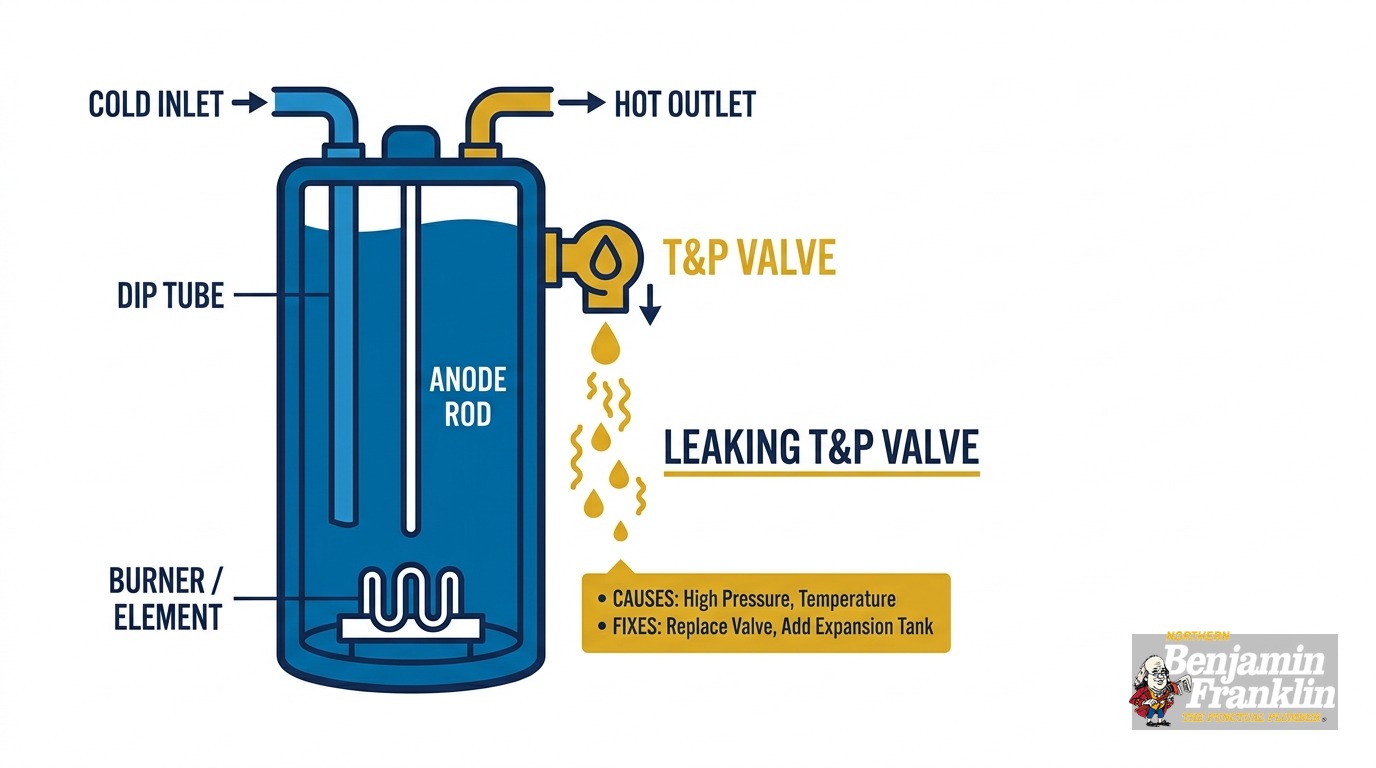
- A slow drip that follows the heater’s heating cycle almost always signals thermal expansion in a closed plumbing system, not a faulty valve. The fix is an expansion tank.
- A large sudden discharge from the discharge pipe points to a failed thermostat. Shut the heater off and call a plumber tonight.
- Minnesota Code 4714.0608 requires the T&P discharge pipe to terminate through an air gap within 18 inches of the floor. Capping or plugging it is a code violation and removes your water heater’s only pressure relief path.
- Most Twin Cities metro homes need an expansion tank under Minnesota code. A missing or failed expansion tank is the most common root cause of T&P valve weeping.
- Water seeping from the threaded fitting where the valve meets the tank wall means the water heater must be replaced. No repair fixes a compromised tank spud.
- Test your T&P valve once a year. A valve that weeps after testing needs to be replaced before the heater’s next heating cycle.
A water heater pressure relief valve leaking is easy to ignore. There is a small puddle near the discharge pipe. The drip is occasional. It does not feel urgent. But the T&P valve is your water heater’s only automatic safety device. What it does when it drips is worth understanding.
The shape of the leak is the diagnosis. A slow intermittent drip, a steady weep that never stops, and a sudden heavy surge of hot water each point to a different cause. They also carry very different levels of urgency. This guide walks through each pattern, explains the Minnesota-specific code rules that govern the discharge pipe, and tells you when to call tonight versus when to schedule for next week.
What Does a T&P Valve Actually Do?
The temperature and pressure relief valve has one job: open automatically if the water inside the tank gets too hot or too pressurized. Per A.O. Smith’s Technical Bulletin #52, the valve is rated to open at 150 psi or 210°F, whichever threshold the system hits first. The valve’s temperature probe must sit within the top 6 inches of the tank to read accurately. An incorrectly sized replacement valve voids the manufacturer’s warranty.
In normal operation, the valve stays closed and you never notice it. When temperature or pressure climbs past the rated threshold, the valve opens and discharges water through the pipe running toward the floor. That discharge is the system doing exactly what it is designed to do. The concern arises when the valve discharges repeatedly, or when it opens and then fails to fully reseat.
Why Is My Water Heater Pressure Relief Valve Leaking?
The leak pattern tells you the cause. A slow drip during the heating cycle points to thermal expansion in a closed system. A continuous weep that runs all day points to a worn valve seat. A large sudden surge from the discharge pipe points to a failed thermostat. Matching the pattern to the cause determines what actually needs to be fixed.
A Slow Drip During the Heating Cycle
This is the most common call we receive. The valve drips when the heater runs, stops when it rests, and the floor near the discharge pipe stays damp. A.O. Smith’s Technical Bulletin #52 is direct on this point: intermittent weeping is caused by thermal expansion in a closed plumbing system, not a faulty valve.
Here is the mechanism. Water expands when it heats up. In an open plumbing system, that expansion pushes a small amount of water back toward the municipal supply main. In a closed system - with a pressure reducing valve, check valve, or backflow preventer installed between the heater and the incoming supply - there is nowhere for that expanded water to go. Pressure builds inside the tank. The T&P valve opens briefly to relieve it.
Minnesota Rules Chapter 4714 requires a thermal expansion control device on any water heater connected through a check valve, pressure reducing valve, or backflow preventer. That describes most Twin Cities homes built in the past 20-plus years. If your home has no expansion tank, or if an existing one has become waterlogged and lost its air charge, a weeping T&P valve is the expected result. Replacing the T&P valve without addressing the closed-system pressure solves nothing. A new valve will weep for the same reason the old one did.
Our post on high water pressure, PRVs, and expansion tanks explains how these systems interact and what a properly functioning expansion tank looks like.
A Continuous Weep That Does Not Follow Any Cycle
The valve drips all day. The heater is not running. It does not stop. This points to mineral deposits on the valve seat. The valve opened at some point, discharged a small amount of water, and did not reseat cleanly. A bit of scale is preventing the full seal from re-forming.
Minneapolis finished water runs at roughly 6.1 grains per gallon, placing it in the moderately hard range. Saint Paul treats its supply at the McCarrons Water Treatment Plant through lime softening, delivering water at approximately 5-6 grains per gallon. Neither reading represents aggressive scale. But scale is cumulative, and on a heater running for 10-plus years, the buildup on valve seats and inside the tank is real.
A continuously weeping valve needs to be replaced. A valve that cannot fully close is not a valve you can rely on when actual overpressure occurs.
A Large Sudden Surge from the Discharge Pipe
A heavy volume of hot water discharges from the pipe. It may happen once, then again. The discharge is large, not a drip. A.O. Smith’s Technical Bulletin #52 identifies exactly one cause for this pattern: a malfunctioning thermostat. The thermostat is allowing the water temperature to climb past its setpoint. The tank is overheating. The T&P valve is opening before the tank reaches a critical condition.
Do not monitor this one. Shut the heater off. Call a plumber tonight.
What If Water Is Seeping from the Tank Fitting Itself?
Not every leak near the T&P valve is coming from the valve. If water is seeping from the threaded fitting in the tank wall where the valve threads in, that is a different problem entirely. Per A.O. Smith’s Technical Bulletin #52, if water seeps at the tank spud, the spud cannot be repaired. The water heater must be replaced. The tank wall at that weld is compromised, and there is no patch or re-thread that addresses it.
If you see water tracking down the side of the tank from that fitting, you are looking at a water heater replacement, not a valve swap. Our post on a water heater leaking from the bottom covers the full range of leaks that originate near the tank base and how to tell them apart.
What Does Minnesota Code Require for the Discharge Pipe?
The T&P discharge pipe must point downward, terminate through an air gap within 18 inches of the floor, and have no valve, cap, or plug installed anywhere on the line. Under Minnesota Code 4714.0608, capping or obstructing the pipe is a code violation. It also removes the only pressure relief path from your water heater if the valve activates during an actual event.
Most competing guides skip the discharge pipe entirely. The rules are specific and they apply to every residential water heater in Minnesota.
Minnesota Rules Chapter 4714, Section 4714.0608 requires all of the following:
- The pipe must point downward and discharge by gravity.
- It must terminate through an air gap to within 18 inches of the floor.
- The terminal end must have no threads.
- No valve or obstruction may be installed on the discharge line.
- The pipe must not drain into a crawl space or into a water heater drip pan.
- No trapped or freezable pipe sections are permitted.
Section 4714.0504 adds that no shutoff valve may be placed between the T&P valve and the water heater, or anywhere on the discharge pipe.
Capping the pipe is dangerous in practice, not just on paper. If the valve activates and the discharge path is blocked, there is no way for the system to relieve pressure. Previous owners and well-intentioned DIY repairs sometimes cap the pipe to stop a drip. If that has happened in your home, correcting the discharge pipe routing is the first priority before any other work on the heater.
Can I Test My T&P Valve Myself?
Yes, with care. Lift the test lever briefly to allow a small burst of water to discharge through the pipe, then release it. If the valve continues to drip after you release the lever, it likely needs replacement. The water discharged is very hot, so stay clear of the pipe opening and the floor below it.
The test lever is the small metal tab on the valve body. Lifting it briefly confirms the valve has not seized shut from mineral buildup. A valve stuck completely closed provides no protection during an actual overpressure event.
One common outcome on older heaters: if the valve has never been tested on a heater more than 6 years old, the valve may weep for a period after testing. Mineral deposits on the seat can prevent a full reseat after the first time the lever is exercised. If the valve weeps for more than a few hours after the test, replace it. It has told you it is past its serviceable life.
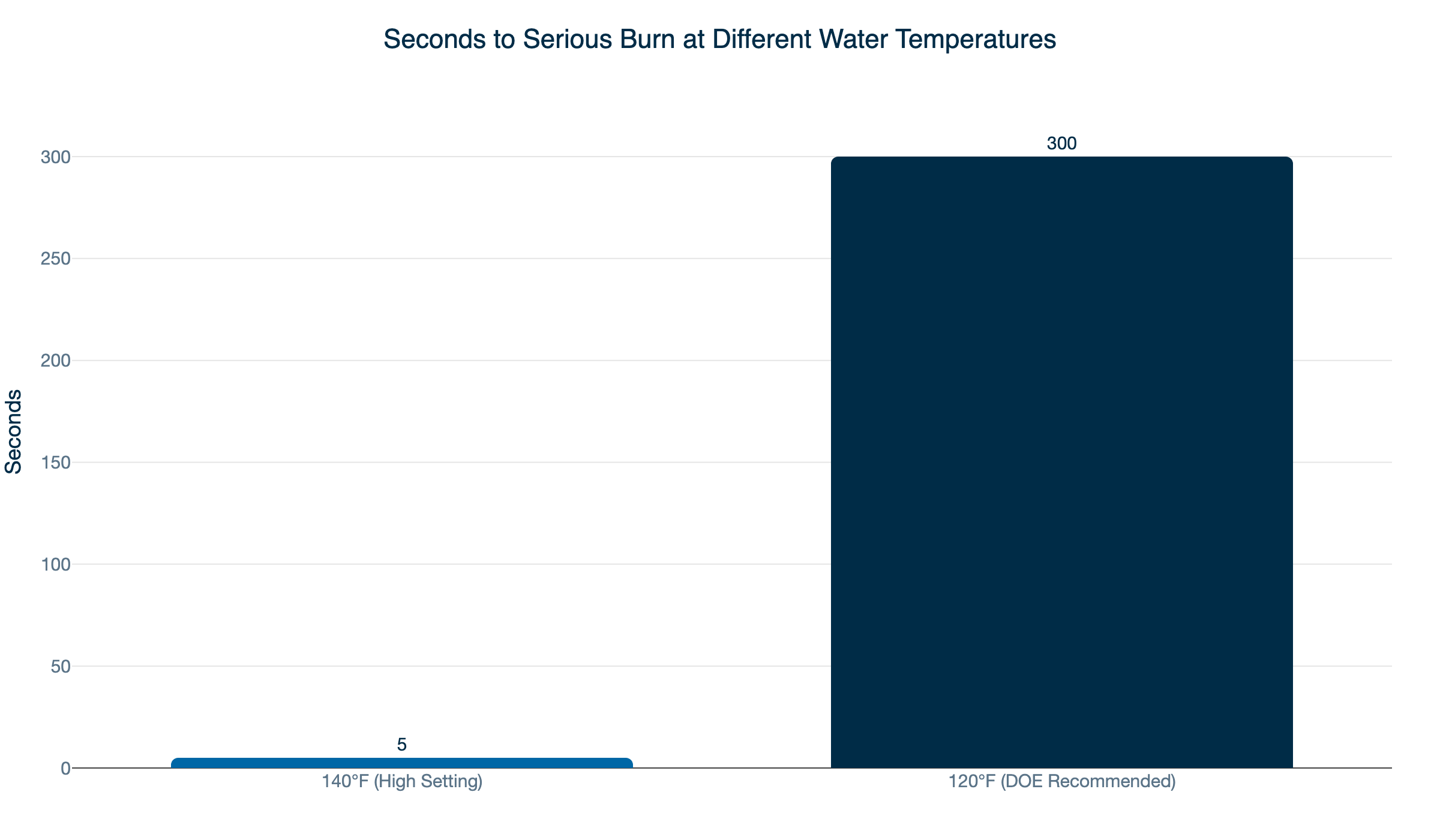
The U.S. Department of Energy recommends keeping residential water heaters at 120°F as the standard setting. At 140°F, serious burns can occur in 5 seconds. At 120°F, the same injury takes more than 5 minutes. That gap matters when you are working near the discharge pipe during a test. Keeping the heater at 120°F also slows the sediment buildup that wears on valve seat performance over time. Our post on flushing water heater sediment walks through the annual maintenance routine that extends both valve and tank life.
When Should I Replace the T&P Valve?
Replace the valve if it weeps after testing, if visible mineral deposits have built up on the valve body, if the heater is more than 6 years old and the valve has never been exercised, or if the water heater itself is being replaced. The T&P valve is a routine maintenance item, not a specialized component.
A licensed plumber matches the replacement valve to the water heater’s BTU or kilowatt input rating. That information is on the old valve’s label and on the heater’s rating plate. A valve rated below the heater’s input cannot fully protect the system in an overpressure event. The sizing is not a guess.
Under Minnesota Rules Chapter 4714, a plumbing permit is required for water heater replacement in Minnesota. A licensed contractor pulls the permit. The city inspector then verifies T&P valve installation, discharge pipe routing, expansion tank, and venting before signing off. That inspection step confirms the installation meets code, and it is part of what you receive when you hire a licensed plumber rather than an unlicensed repair service.
How Does Twin Cities Water Affect the T&P Valve?
Twin Cities water is moderately hard, which means slow but steady mineral buildup on valve seats and inside the tank. Over a heater’s full service life, that buildup matters for how reliably the valve reseats after a discharge.
Minneapolis finished water runs at approximately 6.1 grains per gallon. Saint Paul delivers approximately 5-6 grains per gallon after lime softening treatment at the McCarrons Water Treatment Plant. Neither figure represents aggressive scaling. But on a heater running for a decade, the cumulative deposit on the valve seat is real. Most T&P valve seats that fail to reseat cleanly have never been tested on a tank that has not been flushed annually.
Water pressure in the metro adds a second local variable. Saint Paul’s distribution system operates up to 100 PSI at the lowest elevation point in the distribution area. Typical residential pressure in Minneapolis-Saint Paul runs 40-60 PSI. At the higher end of that range, a failing pressure reducing valve alone can push household pressure high enough to trigger T&P weeping. If your valve started weeping after water main work or a pressure event in the neighborhood, have the PRV checked before replacing the T&P valve. The valve may be responding correctly to a pressure problem that originated elsewhere.
Is a Water Heater Pressure Relief Valve Leaking an Emergency?
The pattern determines the urgency. A slow drip that follows the heating cycle is not an emergency, but it needs a diagnosis and a fix within the week. A sudden large discharge of hot water from the pipe is an emergency. Shut the heater off and call a plumber tonight.
Use this guide:
Call tonight if:
- The discharge pipe releases a large volume of water, repeatedly or continuously.
- The water coming out is extremely hot.
- The T&P valve is open and will not close.
- You hear unusual sounds from the heater alongside the discharge.
- Water is seeping from the threaded fitting where the valve meets the tank wall, not the pipe.
Schedule within the week if:
- The valve drips slowly and only while the heater is running.
- The valve wept slightly after a test but has not flooded.
- Your home has no expansion tank and you have confirmed the system is closed.
Never ignore:
- Any T&P leak that has been present for months without attention.
- Discharge pipe modifications made by a previous owner or an unlicensed repair.
- A heater older than 10-12 years showing any T&P valve symptoms at all.
Northern Benjamin Franklin Plumbing is locally owned and operated, serving Minneapolis, St. Paul, Blaine, Bloomington, Brooklyn Park, Coon Rapids, Maple Grove, and the rest of the Twin Cities metro. Our On-Time Guarantee(R) means we arrive in the window you pick, or we pay you $5 for every minute we are late, up to $300. If there is any delay, it’s you we pay!
To schedule a T&P valve inspection, an expansion tank assessment, or a full water heater service, call (763) 296-1844 or book online with our water heater repair team.
Frequently Asked Questions
Why is my water heater pressure relief valve leaking? +
Is it safe to cap the discharge pipe on a water heater T&P valve? +
How do I test a water heater T&P valve? +
Does my Twin Cities home need an expansion tank? +
What should I do if my T&P valve is discharging large amounts of hot water? +
Need a technician now?