
Water Pressure Too High in House: The Two-Device Fix
Key Takeaways
- Water pressure above 80 psi violates both the IRC and Minnesota plumbing code. It also quietly destroys fixtures, appliances, and pipe joints.
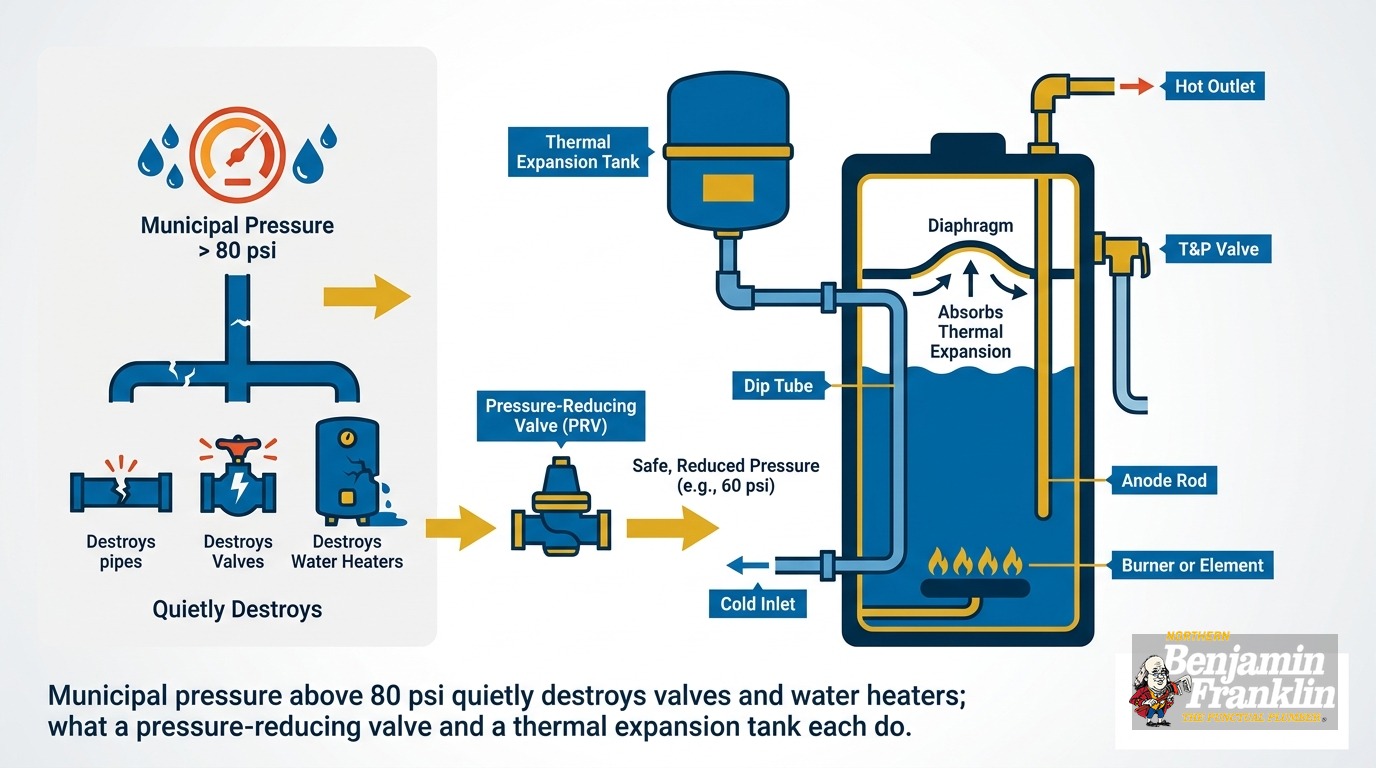
- A pressure-reducing valve (PRV) is the code-required fix when street pressure exceeds 80 psi. It is not optional.
- Installing a PRV creates a closed system. A closed system without a thermal expansion tank is a second code violation.
- These two devices are always installed as a pair. Treating them as separate, optional upgrades leads to a half-fix that wrecks water heaters.
- A permit is required in Minnesota for PRV and expansion tank work. The permit must be issued before work begins.
- A dripping T&P valve is usually doing its job correctly. The fix is an expansion tank, not a new T&P valve.
What Does “Too High” Actually Mean?
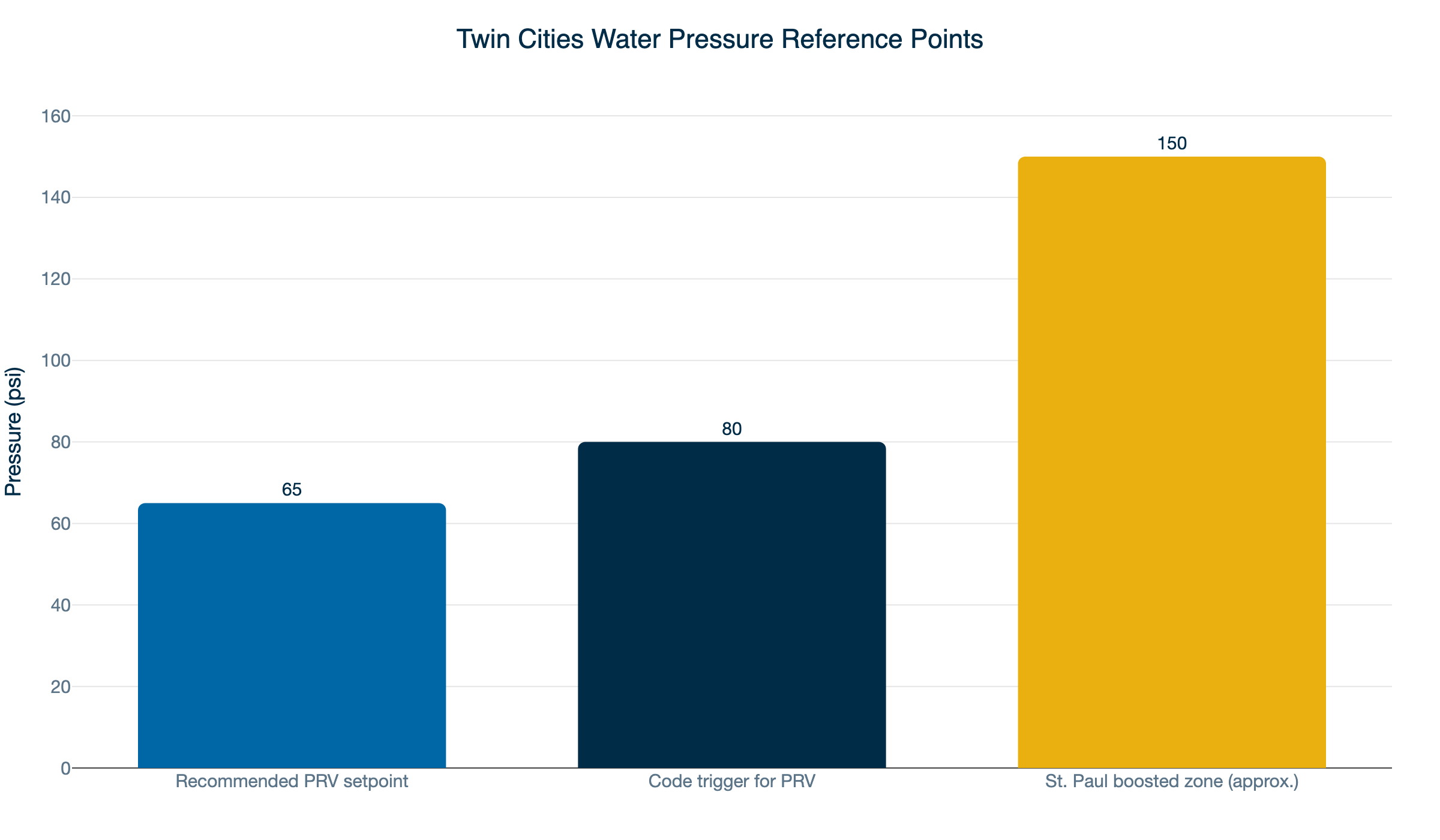
The short answer: Under both the IRC and Minnesota plumbing rules, 80 psi is the trigger point. When street pressure exceeds 80 psi, a pressure-reducing valve is required by law. Most plumbers set the PRV to 60-70 psi to stay well below that ceiling.
That 80 psi number comes from two places. IRC 2024 Section P2903.3.1 requires an approved, ASSE 1003-conforming PRV whenever street pressure exceeds 80 psi. Minnesota Rules 4715.1740 mirrors that language exactly: when street main pressure exceeds 80 psi, an approved PRV must be installed near where the water service enters the building.
The code ceiling is 80 psi. But hitting the ceiling is not the goal. Most licensed plumbers set a new PRV to 60-70 psi. That buffer matters because street pressure is not constant. A system that reads 82 psi during the afternoon can spike well above 95 psi overnight when neighborhood demand drops, or spike again during a fire hydrant test on your block. The PRV protects against worst-case pressure, not the daily average.
The human body can often detect the difference above roughly 60 psi at the showerhead. That strong, almost aggressive spray is easy to enjoy. It is also often the first signal that the incoming pressure is worth checking.
What Are the Signs That Water Pressure Is Too High in Your House?
The short answer: Banging pipes when you close a faucet, faucets that start dripping again soon after repair, short appliance lifespans, and a T&P valve that opens repeatedly are the clearest signals. High pressure accelerates wear on every component it touches.
Here are the symptoms to watch for:
- Water hammer. That hard bang when you close a tap quickly is pressure energy with nowhere to go. Our post on banging pipes and water hammer covers the full picture - but in many cases the root cause starts at the street, not inside the wall.
- Faucets that drip again shortly after repair. Excess pressure forces washers, cartridges, and valve seats to fail faster than normal use would.
- Short appliance life. Dishwashers, washing machines, ice makers, and refrigerator water lines are rated for a pressure ceiling. Running above that ceiling voids some manufacturer warranties.
- Running toilets. Fill valves struggle to seat properly against high incoming pressure.
- A T&P valve that weeps or drips. If your water heater’s temperature and pressure relief valve is releasing water, that is usually not a sign the heater is failing. It is a sign system pressure is hitting the valve’s trip point on every heating cycle. More on this below.
- Aggressive flow at every fixture. If every faucet in the house feels like a fire hose, that is worth measuring before something fails.
None of these symptoms alone confirms high pressure. A gauge is the only way to know for certain.
How a Pressure-Reducing Valve Works
A PRV is a spring-loaded mechanical device installed on the water service line, usually close to where the service enters the building. It senses downstream pressure and throttles incoming water until that pressure stabilizes at the setpoint.
The critical distinction is this: a PRV regulates pressure under all conditions, including zero flow in the middle of the night. A partially closed shut-off valve does not. A shut-off reduces flow. It does not hold a steady downstream pressure when demand changes. That is why the code specifies an approved PRV, not a workaround.
PRVs are not permanent. IRC guidance puts the typical lifespan at 10-15 years. Charlotte Water’s published FAQ cites 7-12 years. Signs of a failing PRV include pressure that shifts unexpectedly, water hammer that was not there before, and a T&P valve that starts opening more often.
A PRV that fails open lets full street pressure into the house. One that fails closed drops household pressure to near zero. Both conditions show up clearly on a gauge at the hose bib - which is why a simple annual pressure check is worth doing.
Does Installing a PRV Require an Expansion Tank?
The short answer: Yes, always. A PRV seals your distribution system from the city main. Once that connection is blocked, heated water has no path back to the main and nowhere to expand except into the T&P valve. IRC 2024 Section P2903.4 makes an expansion tank mandatory whenever a closed system exists. A PRV without one is a code violation.
Here is the sequence that plays out without an expansion tank. The water heater fires. The water inside heats up. Water expands - roughly 0.5 percent by volume - as it gains temperature. In an open system, that expansion pushes harmlessly back toward the city main. With a PRV in place, the path back is blocked. Pressure has only one direction to travel: up. It climbs until the T&P valve trips and releases a small amount of water.
One trip, the valve resets. That is normal operation. But if the valve trips on every single heating cycle - which is what happens in a closed system with no expansion tank - the valve wears out faster than it should. Homeowners replace it. The new one wears out. The underlying problem never gets fixed.
The expansion tank is the fix. It is always installed when a PRV is installed or replaced.
What Happens to Your Water Heater Without an Expansion Tank?
The pressure-cycling described above does more than wear out the T&P valve. It stresses the water heater tank itself.
Each time the T&P valve trips, a small volume of hot water discharges. Cold water rushes in to replace it. The heating element fires again to bring the temperature back up. That thermal cycling - heat, expand, trip, refill, reheat - puts repeated mechanical stress on the tank walls, the welds, and the internal glass lining.
There is a warranty consequence too. Manufacturers categorize leaking tanks from closed-system installations as “excessive pressure damage” rather than a manufacturing defect. The warranty claim is denied. It does not matter how new the tank is or how well it was installed otherwise. An expansion tank is a warranty condition, not an accessory.
If your water heater is in a closed system and there is no expansion tank, the tank is running outside its designed operating parameters every time it fires. The fix is straightforward. A licensed plumber installs a properly sized and pre-charged expansion tank, and the T&P valve goes back to doing nothing - which is exactly what a healthy system looks like.
What Is a Thermal Expansion Tank?
The short answer: A small pressurized tank, usually mounted on the cold-water line above the water heater, with a rubber bladder inside. One side of the bladder holds pressurized air. The other side absorbs expanding water when the heater fires. The air compresses, pressure stays stable, and the T&P valve stays closed.
The expansion tank arrives from the factory pre-charged with air. That air pressure must match the PRV setpoint to work correctly. If the pre-charge is too low, the bladder is already compressed when the tank is installed and it cannot absorb anything useful. If the pre-charge is too high, the bladder never opens. The DOE confirms that expansion tanks paired with PRVs prevent T&P valves from discharging water and wasting energy.
A correctly sized and charged expansion tank is invisible in daily operation. It absorbs the pressure spike, the T&P valve stays seated, and the water heater runs a full service life.
Expansion tanks do have a failure mode. The bladder can rupture or the tank can become waterlogged, meaning the air side has lost pressure and the tank is completely filled with water. A waterlogged expansion tank offers no buffering at all. The symptom is the T&P valve starting to drip again after a period of silence. A plumber can diagnose this quickly by checking the air pre-charge on the Schrader valve on top of the tank.
Does My Home Already Have a PRV?
The short answer: Many Twin Cities homes do. Look for a bell-shaped or dome-shaped brass fitting on the water service line inside the house, usually near the main shut-off. If you are not sure where to start, our guide to finding and testing your main water shutoff valve walks through where service lines typically enter a Minnesota home.
If your home was built before the current code cycle, it may have a PRV that is 15 or 20 years old. Older PRVs often fail gradually. The internal spring weakens and pressure creeps up slowly. Homeowners do not notice until a fixture starts failing or a water bill spikes.
If you find a PRV, also check whether there is an expansion tank on the cold-water inlet line above the water heater. Many homes had PRVs installed without expansion tanks - either because the expansion tank requirement was not enforced on that job, or because the PRV was replaced later without adding one. If a PRV exists but no expansion tank is visible, a plumber should assess the setup before the next repair call becomes an emergency.
What Minnesota Code Requires
Minnesota’s current plumbing code is Chapter 4714, based on the 2015 Uniform Plumbing Code with Minnesota amendments. It is administered by the Minnesota Department of Labor and Industry. The pressure mandate from the older Chapter 4715.1740 carries forward: street pressure above 80 psi requires a PRV installed near where the service enters the building.
The permit requirement comes from a separate statute. Minnesota Statutes 326B.43 requires a permit for any installation, alteration, or replacement of a PRV or expansion tank. A licensed journeyman plumber must do the work. The permit must be issued before work begins - not applied for after the fact.
Homeowners may do plumbing work on their own single-family home under a permit. But the sizing, pre-charging, and code-compliance decisions involved in a PRV and expansion tank installation are not guesswork. A permit pulled by a licensed plumber also protects you at resale. Inspectors and buyers check whether major plumbing work was permitted. Unpermitted plumbing work is a negotiating problem at closing and sometimes a deal-breaker.
The St. Paul Pressure Zone Factor
If you live in St. Paul or the east metro, this is not a generic concern. It applies directly to your street.
Saint Paul Regional Water Services serves over 450,000 residents across St. Paul and neighboring communities including Maplewood, West St. Paul, Mendota Heights, and Roseville. The system operates five pressure zones: Low Service, High Service, Boosted, Secondary Boosted, and Reduced Pressure. The Boosted and Secondary Boosted zones - covering Highland Park, the east side, Maplewood, and West St. Paul - operate at higher delivery pressures than the rest of the system. Some areas in these zones reach approximately 150 psi. That is roughly three times what a standard residential plumbing system is designed to run at continuously.
A home in a Boosted zone with no PRV is almost certainly running above code. If the PRV is there but aging, it may no longer be holding at its setpoint.
Minneapolis homeowners face a different but related issue. Minneapolis water comes from the Mississippi River and averages about 94 mg/L hardness (5.5 grains per gallon) with a pH near 9.0. That elevated pH accelerates calcium carbonate scaling inside water heaters. A water heater that is already cycling under pressure stress is also collecting scale faster than usual. The two problems compound: pressure damage weakens the tank, scale insulates the element and causes it to overheat, and both shorten the service life. Our post on water hardness in Minneapolis and St. Paul covers what the hardness numbers mean for appliance life and when softening makes sense.
How Do I Check My Home’s Water Pressure?
The short answer: Buy a screw-on pressure gauge at any hardware store. Thread it onto a hose bib, open the bib fully with no other water running in the house, and read the static pressure. Above 80 psi means a plumber should evaluate your PRV. Below 40 psi means a different problem needs attention.
Here are the steps:
- Pick an outdoor hose bib or a laundry room bib - any threaded faucet with a standard hose fitting.
- Turn off everything else: dishwasher, laundry, ice maker, all running fixtures.
- Screw the gauge onto the bib and open it fully.
- Read the static pressure. That is your baseline.
- Check again at a different time of day - especially overnight or early morning. Street pressure often rises when neighborhood demand drops. The overnight reading is frequently higher than the midday reading.
If you find pressure above 80 psi, note the number and call a licensed plumber. If you already have a PRV and pressure reads above 80 psi, the PRV may be failing or was set too high.
If pressure reads low - below 40 psi is the threshold where fixtures start to underperform - that is a separate diagnosis. Our post on low water pressure in Twin Cities homes covers that side of the range and what causes it.
The Right Fix Is a Two-Device System
Most articles on water pressure too high in a house land on the PRV and stop there. The problem with stopping there is that a PRV alone is half a system, and half a system creates a new code violation while quietly destroying the water heater.
The correct repair has three parts:
- A PRV installed on the water service line, set to 60-70 psi.
- A correctly sized and pre-charged thermal expansion tank installed on the cold-water inlet to the water heater.
- A permit pulled before the work begins.
These three things are done together by a licensed plumber on a single job. After the work is complete, a pressure check at the hose bib confirms the PRV setpoint. The expansion tank is maintenance-free from that point, unless a waterlogged bladder eventually needs attention - a plumber can diagnose that in a few minutes if the T&P valve starts dripping again.
Northern Benjamin Franklin Plumbing is locally owned and operated in the Twin Cities. Our team handles PRV and expansion tank installations throughout Minneapolis, St. Paul, Blaine, Bloomington, Brooklyn Park, Coon Rapids, Maple Grove, and the surrounding metro. We back every appointment with the On-Time Guarantee(R): we arrive in the window you choose, or we pay you $5 for every minute we are late, up to $300. As we say, “If there is any delay, it’s you we pay!”
If your T&P valve is dripping, your fixtures are failing faster than they should, or you have not had your PRV tested in over a decade, now is the right time to have a licensed plumber take a look. Call us at (763) 296-1844 or book a plumbing maintenance visit online. If your water heater may have already taken pressure damage, our water heater repair team can assess the situation and tell you exactly where things stand.
Frequently Asked Questions
What is considered too high water pressure in a house? +
Do I need an expansion tank if I install a pressure-reducing valve? +
Why is my T&P valve dripping? +
Does replacing a PRV or expansion tank require a permit in Minnesota? +
Need a technician now?