
Water Heater Expansion Tank: Why Closed Systems Need One
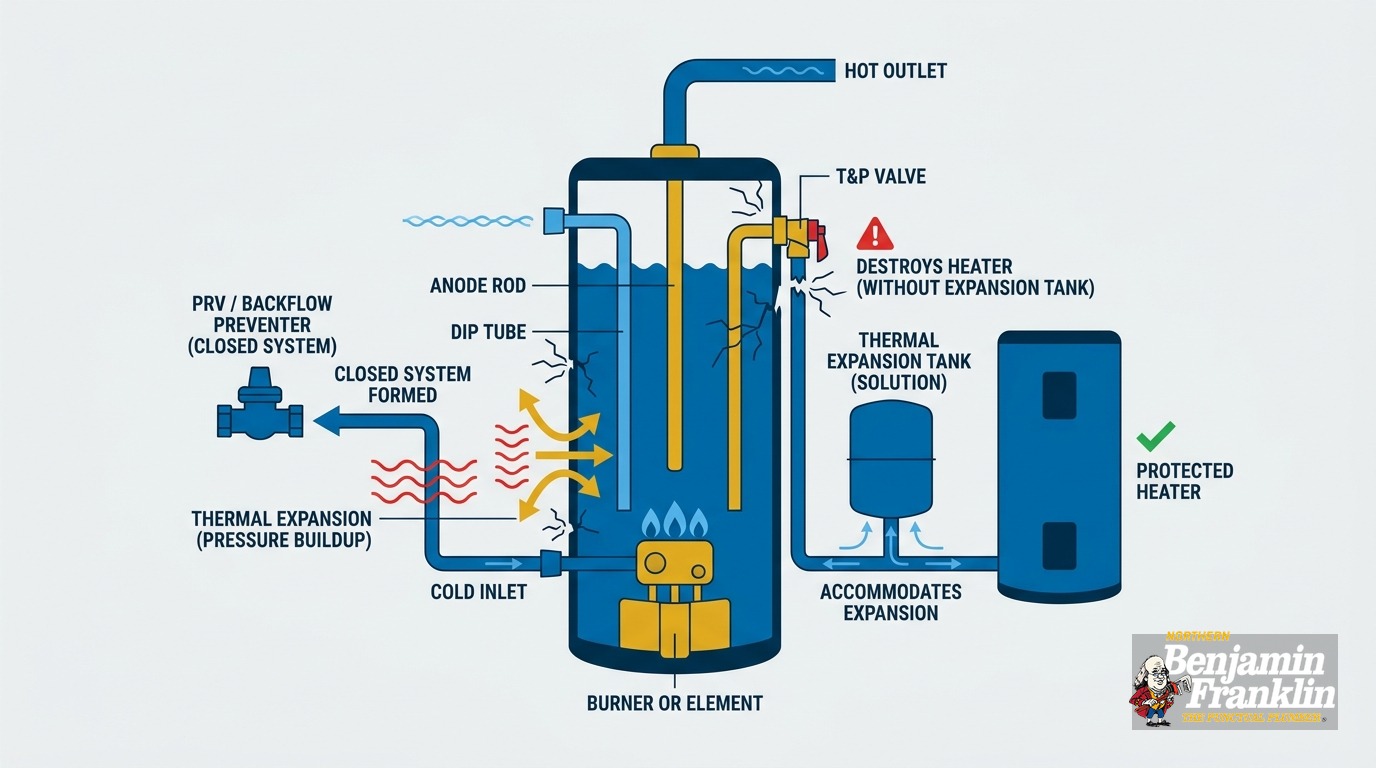
Key Takeaways
- A water heater expansion tank protects your plumbing by absorbing the pressure spike that builds when heated water expands inside a sealed system.
- Any home with a pressure-reducing valve (PRV), backflow preventer, or supply-line check valve is a closed system. Water cannot push back toward the municipal main when it expands.
- In a closed 50-gallon system, a single heat cycle can push pressure past the T&P valve’s 150 psi limit. That leads to a dripping valve, fatigue damage to tank welds, and voided manufacturer warranties.
- Many Twin Cities homeowners are unknowingly in a closed system. Saint Paul Regional Water Services runs a mandatory backflow preventer program covering most of the eastern metro, and that device closes the system.
- Minnesota Plumbing Code Sections 608.2 and 608.3 require an expansion tank on closed systems. A permit inspector will flag a missing one on every water heater replacement job.
- Expansion tank bladders fail after 10-15 years. A waterlogged tank sounds solid when tapped and provides zero pressure relief. If yours is older than a decade, have it inspected.
What Makes a Plumbing System “Closed”?
A closed system is one where water cannot flow back toward the municipal supply main. A PRV, backflow preventer, or meter check valve creates that blockage. When the water heater runs, expanded water has nowhere to go and pressure rises.
In an open plumbing system, water can move in both directions along the supply line. When your water heater heats water and pressure builds, the expanded water pushes back toward the main and the system equalizes naturally. Pressure stays stable.
A closed plumbing system blocks that return path. The blockage usually comes from one of three sources: a pressure-reducing valve (PRV) on the main supply line, a backflow preventer on the service line, or a check valve built into the water meter. All three allow water to flow in only one direction.
When your water heater fires in a closed system, the water expands and has nowhere to go. Pressure rises until something opens - either the T&P relief valve doing its job, or, over time, a weld seam that was not designed to cycle at those pressures.
Understanding that distinction matters before any water heater work. A system that looks and runs normally on a cool day may be hitting dangerous pressure spikes every time the burner fires.
Does Your Twin Cities Home Have a Closed System?
If your home has a PRV on the main supply line or a backflow preventer on the service line, yes - it is a closed system. Most Twin Cities homeowners with either device have one.
PRVs are common throughout the metro. Municipal supply pressure varies by neighborhood and elevation. Some areas served by Saint Paul Regional Water Services see supply pressure high enough that a PRV is installed to bring it down to a safe operating range. That PRV closes your system.
Backflow preventers are increasingly common because SPRWS actively enforces their installation. The program operates under Saint Paul City Code Sec. 94.18. Properties enrolled pay $35 per year for the required annual test and face a $250 fine for non-compliance, per SPRWS Contractor Resources. Many homeowners had a preventer installed to meet that requirement years ago and moved on. They may not know the device also converted their plumbing to a closed system.
Built-in check valves on water meters are another common source. Many utility meters include a check valve by design. You may have one without ever requesting it.
Not sure what is on your supply line? A plumber can assess your main entry point in about ten minutes. Knowing your system type before a water heater replacement prevents a failed permit inspection.
How Does Thermal Expansion Damage Your Water Heater?
Water heated from 40°F to 120°F expands roughly 2% in volume. In a closed 50-gallon system, that expansion can push pressure past 150 psi in a single heat cycle - which is the T&P relief valve’s rated limit.
Here is the sequence in an unprotected closed system.
Your water heater fills with cold water, typically around 50°F. The burner fires and heats it to 120°F or higher. According to IRC 2024 P2903.4, that heating process expands the water approximately 2% in volume. In an open system, the expanded water moves back against the supply main. Pressure stays in its normal range.
In a closed system, there is no exit. Pressure climbs until something releases.
Residential T&P relief valves are rated to specific pressure and temperature limits per ANSI/CSA standards. When thermal expansion pushes pressure past that threshold, the valve opens and water drips into the discharge pipe. That drip is the valve doing its job. The problem is what happens next.
Roughly 20% of T&P valves older than three years fail to reseat cleanly after opening. The valve weeps. A homeowner notices the drip and replaces the valve. The new one starts dripping within a few weeks. The root cause was never addressed.
Meanwhile, each pressure spike accumulates damage that is not visible from the outside:
- Glass-lined tank welds fatigue under repeated stress cycles.
- Sediment at the tank base compacts tighter with each spike, reducing heat transfer and forcing the burner to run longer.
- The dip tube and anode rod connections loosen over years of cycling.
- Most major manufacturers void the water heater warranty when a closed system without an expansion tank is documented. A heater that fails prematurely becomes the homeowner’s cost.
If your T&P valve has been dripping, read more about water heater pressure relief valve leaking for the diagnostic steps. But trace the closed-system question first - a new valve will not fix a thermal expansion problem.
What Does a Water Heater Expansion Tank Do?
A water heater expansion tank provides a small pressurized buffer. When heated water expands, it pushes into the tank and compresses an air cushion. System pressure stays in the normal range. The T&P valve stays closed.
The tank is a steel vessel, roughly football-sized, installed on the cold-water supply line near the heater. Inside, a rubber bladder separates two chambers. One side holds air, precharged to match your home’s static supply pressure. The other side connects to the plumbing system. When hot water expands, it moves into the tank and compresses the air. Pressure stays stable. Nothing drips.
One installation detail matters more than any other. The factory precharge on expansion tanks is typically around 12 psi, per the JasPector IRC 2024 P2903.4 summary. That number must be adjusted to match your home’s actual static supply pressure before the tank is installed. A tank set at 12 psi on a system running at 60 psi supply pressure will not work correctly. The air side gets overpowered before the expansion volume can move in, and the protection you paid for does nothing.
The tank must also be ASME-listed. Generic pressure vessels and well-pressure tanks do not qualify under Minnesota code.
Does Minnesota Code Require a Water Heater Expansion Tank?
Yes. Minnesota Plumbing Code Sections 608.2 and 608.3 require an expansion tank on any closed system - covering homes with a PRV, check valve, or backflow preventer on the supply line.
Minnesota Plumbing Code Section 608.2 requires an expansion tank downstream of each pressure regulator to prevent excessive pressure from developing through thermal expansion. Section 608.3 extends the requirement to any check valve, backflow preventer, or similar normally-closed device on the supply line.
The IRC has required expansion control on closed systems since its 2006 edition. IRC 2024 P2903.4 confirms that the tank must be ASME-listed. Generic pressure tanks do not qualify.
This matters for a practical reason: Minnesota Plumbing Code requires a permit for any water heater replacement. A permit means an inspection. A licensed inspector will review the installation. A missing expansion tank on a closed system is a failed inspection. Planning for the expansion tank at the time of the heater replacement - not as an afterthought - makes the job go cleanly the first time and eliminates a re-inspection.
How Does Minneapolis Hard Water Compound the Problem?
Moderately hard Minneapolis water (91 ppm) leaves sediment at the tank base. Combined with repeated thermal expansion pressure spikes, that sediment compacts tighter each cycle - reducing heat transfer and shortening heater life faster than either problem alone.
Minneapolis water has a pH of 9. The source is the Mississippi River. That puts it in the moderately hard range.
Hard water leaves scale on tank walls and drops sediment at the base of a storage heater. That sediment layer cuts heat transfer and forces the burner to run longer. Water heating already accounts for a significant share of a home’s total energy use, making it the second-largest household energy expense after HVAC. An inefficient heater in a closed system pushes that share higher.
The hard water and expansion problems interact in a specific way. Each pressure spike compresses the sediment layer tighter. Heat transfer through compacted sediment is worse than through loose sediment. The heater cycles longer. Scale deposits on the anode rod reduce its corrosion protection and shorten service life.
Flushing your tank regularly helps manage sediment. See how to flush a water heater for sediment buildup for the steps. But flushing does not solve the expansion pressure problem. Both issues need to be addressed directly.
How Do You Know If the Expansion Tank Has Failed?
Tap the tank. A working expansion tank sounds hollow on the air side. A failed, waterlogged tank sounds solid throughout - the bladder has ruptured and the air cushion is gone.
Expansion tank bladders typically last 10-15 years, per the JasPector IRC 2024 P2903.4 summary. Bladder failure accelerates when the tank is undersized for the system volume, when supply pressure runs consistently high, or when the precharge was never correctly set at installation.
A waterlogged tank is connected to your system and doing nothing. Water has filled both chambers. There is no air cushion to absorb expansion. System pressure spikes just as it would with no tank at all. The heater is fully unprotected.
Watch for these symptoms:
- A T&P valve that was quiet for years starts dripping after heat cycles.
- Banging or knocking in the pipes when the heater shuts off. That is water hammer from unabsorbed pressure spikes.
- Water visible at the T&P discharge pipe without an overheat condition present.
If your expansion tank is older than 10 years, or if the tap test comes back solid, have a plumber evaluate it. A failed tank is indistinguishable from a working one by sight. The tap test is the quick field check that catches it.
What Happens to Your Manufacturer Warranty?
Most major manufacturers void the water heater warranty when a closed system without an expansion tank is documented. A heater that fails prematurely in that situation is the homeowner’s cost, not the manufacturer’s.
When a heater fails in year four and the investigation reveals a closed system with no expansion tank, the manufacturer has clear grounds to deny the claim. The damage pathway - fatigue stress on welds, sediment compaction from pressure spikes, loosened connections - is predictable and measurable. The homeowner replaces the heater at full cost.
The permit process works in your favor here. When the expansion tank is installed, the precharge is set to match supply pressure, and a licensed inspector signs off on the job, you have documentation that the installation met code. That paper trail supports a warranty claim if the heater later develops an unrelated defect.
A properly installed, code-compliant water heater job is the only kind worth doing. On a closed system, the expansion tank is part of that job - not an optional add-on.
The SPRWS Backflow Program: More Twin Cities Homes Are Closed Systems Than Homeowners Realize
Saint Paul Regional Water Services serves most of the eastern Twin Cities metro. Its mandatory annual backflow preventer testing program is one of the more active enforcement efforts in the region. Properties enrolled pay $35 per year for the required annual test and face a $250 fine for non-compliance under Saint Paul City Code Sec. 94.18.
The program exists for good reason. Cross-connections and backflow are a serious public health concern. Cross-connections and backflow caused 78% of community distribution system outbreaks through 1980, per EPA cross-connection research. They also drove 95% of illness cases attributed to those systems in the same period. Backflow preventers protect the municipal water supply from contamination. They belong there.
The side effect is that a large share of SPRWS-served properties are now closed plumbing systems. Many homeowners had a preventer installed to stay in compliance, paid the annual fee, and moved on. They did not come home thinking their plumbing was now a sealed vessel. But it is. Without an expansion tank, the water heater in that home has been absorbing thermal expansion pressure on every heat cycle - potentially for years.
If you are in St. Paul or any SPRWS-served area and have not confirmed your expansion tank status, add it to your next service call. For more detail on how the backflow testing and compliance process works, see our post on backflow preventer testing in Minnesota.
Ready to Get Your System Checked?
Northern Benjamin Franklin Plumbing is locally owned and operated in the Twin Cities. When you schedule with us, you are covered by the On-Time Guarantee(R): we arrive in the window you select, or we pay $5 for every minute we are late, up to $300. If there is any delay, it’s you we pay!
Whether your T&P valve has been dripping, you are planning a water heater replacement, or you simply want to know whether your home is a closed system - call (763) 296-1844 or book online. We will check your supply line, set the expansion tank precharge to match your actual supply pressure, and make sure the permit inspection closes without a callback.
For a broader look at water heater service and what affects long-term performance, visit our water heater maintenance page.
Frequently Asked Questions
Does my Twin Cities home have a closed plumbing system? +
Is a water heater expansion tank required by Minnesota code? +
How do I know if my expansion tank has failed? +
Need a technician now?