
Backflow Preventer Testing Minnesota: Homeowner's Guide
Key Takeaways
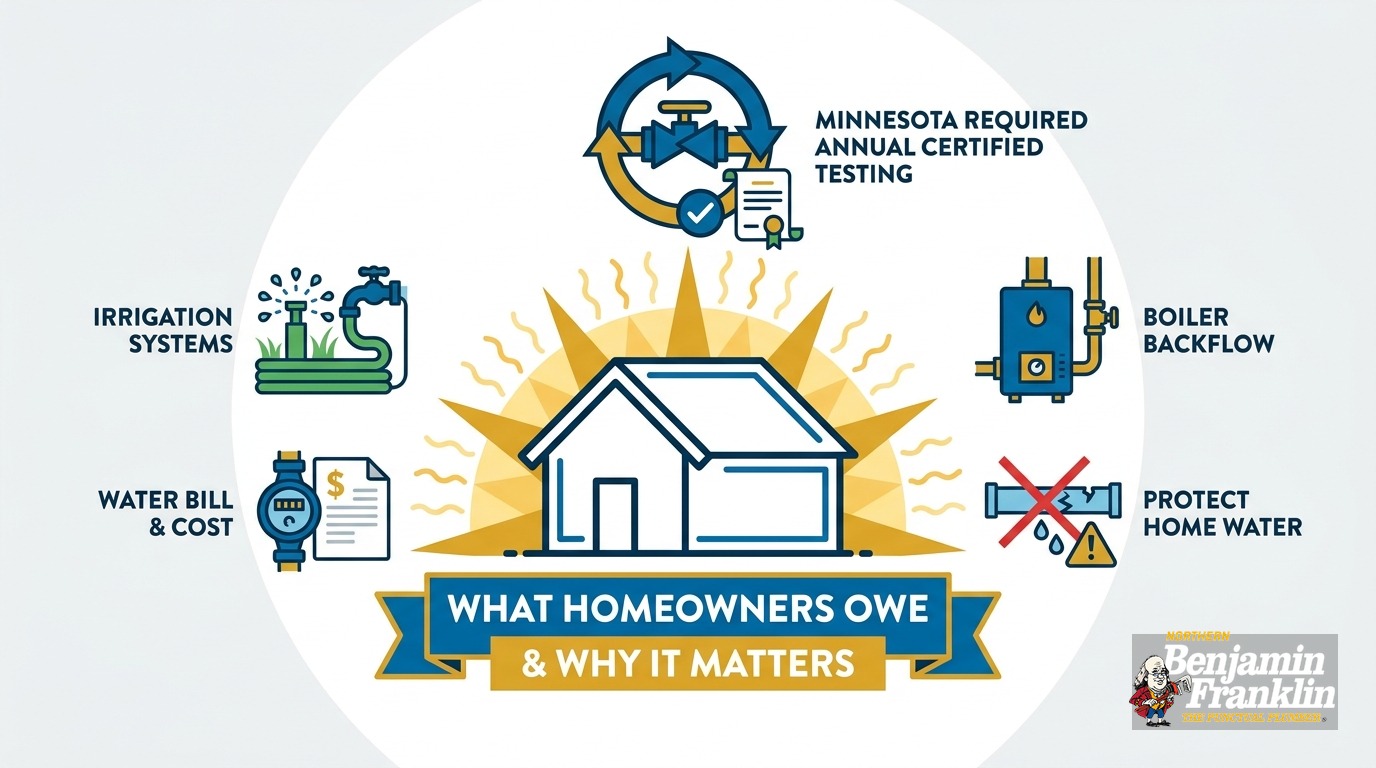
- Backflow preventer testing in Minnesota is required annually for all testable devices installed on or after January 23, 2016.
- Covered device types: RPZ, PVB (pressure vacuum breaker), SVB (spill-proof vacuum breaker), and DCVA (double check valve assembly).
- The property owner - not the tester or the city - is the responsible party. Compliance notices come to your address.
- Testing and reporting are two separate obligations. Test results must be submitted to your city’s public water purveyor.
- Fall is the practical scheduling window for PVBs on irrigation systems. Test before or during the annual blowout, before the late-October freeze.
- A failed device requires a licensed plumber with rebuilder certification. The tester cannot do the repair.
- Minneapolis homeowners with boilers: the city has a local exception for legacy non-testable dual check valves. Confirm which device you have before assuming no test is required.
- DIY testing is prohibited. The tester must be state-licensed with ASSE 5110 certification.
What Does Backflow Preventer Testing in Minnesota Actually Require?
Minnesota Plumbing Code Section 603.4.2 requires all testable backflow prevention devices to be tested not less than annually. That applies to any RPZ, PVB, SVB, or DCVA installed on or after January 23, 2016. Testing must be performed by a state-licensed professional, and results must be reported to your community’s public water system.
Backflow happens when pressure drops on the supply side of your plumbing and water is pulled backward into the municipal main. Under normal conditions, water flows one direction - from the main into your home. A main break, heavy firefighting demand nearby, or a failing pump can reverse that flow. The concern is what the water carries back with it.
An unprotected irrigation system can siphon fertilizer, pesticides, or standing line water into the public supply. A boiler with rust inhibitors or glycol poses the same risk. A backflow prevention device sits between your home’s connection and the public system, creating a physical barrier. It is not a one-time installation. It is a mechanical device with springs, elastomer seals, and check valves - all of which wear over time.
A failed device looks identical to a working one from the outside. Worn seals, a spring that has lost tension, or a check valve that no longer seats properly cannot be diagnosed visually. Annual testing confirms the pressure differential holds and the check valves seat correctly under controlled conditions. That is the only way to verify the protection is real.
Which Devices Need Annual Testing Under the Code?
The four testable device types covered by Minnesota’s annual requirement are RPZ (reduced pressure zone), PVB (pressure vacuum breaker), SVB (spill-proof vacuum breaker), and DCVA (double check valve assembly). If your home has a lawn irrigation system, there is a good chance you have a PVB installed outside near where the irrigation line branches off your main supply. It looks like a brass assembly mounted on a short vertical pipe, set above ground level.
Minnesota Plumbing Code Section 608 hazard classifications determine which device type is appropriate for each connection. High-hazard connections - irrigation with fertilizer injection, boilers with chemical additives, anything involving a direct chemical risk - require an RPZ or an air gap. Standard lawn irrigation with no chemical injection typically uses a PVB installed at least 12 inches above the highest downstream outlet.
Older non-testable devices installed before the 2016 code change are generally not subject to the annual schedule. However, device type is what governs the obligation - not installation date alone. If you are not sure which device type you have, do not assume. A licensed plumber can identify it during a service visit, and the stakes for guessing wrong are a missed compliance window and a fine.
Why Does Minnesota Require Annual Testing?
Annual testing is required because a device that passes a visual inspection can fail mechanically without showing it. The Minnesota Department of Health classifies an unprotected high-hazard cross-connection as a Significant Deficiency for any community public water system. When a sanitary surveyor identifies one, the water purveyor must correct it within 120 days.
The authority behind this requirement runs to the federal level. The MDH’s cross-connection control program derives from the federal Safe Drinking Water Act Ground Water Rule. That is not a state code technicality - it is a public-health mandate with federal backing. It means the compliance chain runs from your backflow device up through the city’s water department, up to the state, and up to federal drinking-water law.
Cities run backflow compliance programs because their own standing with MDH depends on documented protection across their coverage area. A Significant Deficiency finding in a sanitary survey puts the water purveyor on a correction schedule. Your annual test result, submitted to the purveyor’s tracking system, is part of that documentation chain. Untested devices represent a gap the purveyor must address, which is why many suburbs have moved to active compliance tracking systems that flag overdue addresses automatically.
Who Is Responsible for Getting the Test Done?
The property owner is the responsible party. MDH is clear on this point: the obligation rests with the person who owns the connection - not the tester, not the irrigation contractor who installed the system, and not the city. You can delegate the scheduling, but the compliance responsibility stays at your address.
This surprises homeowners who assume the city or their service contractor handles it automatically. Some cities do send annual reminders. That notice is a courtesy, not a transfer of responsibility. If the notice arrives, the window passes, and no test has been completed, the fines and enforcement steps that follow are directed at the property owner.
Most municipalities give a 30-day compliance window after a notice before fines begin. In extreme cases, cities have authority to interrupt water service until compliance is documented. That makes annual testing a straightforward cost-of-ownership item rather than an optional line item.
Keep your test reports. If you sell your home, a buyer’s inspector may ask whether the device is current. A licensed tester can reissue a copy if you lose the original, but the simpler habit is keeping a folder with your other home maintenance records when the report comes in.
When Should You Schedule Backflow Preventer Testing in Minnesota?
For irrigation systems, fall is the practical window - and it is the scheduling angle that most coverage on this topic misses entirely. Your PVB must be drained before the first hard freeze. That arrives in late October in the Twin Cities. A PVB that holds water into November will crack. Testing during the fall blowout handles both the annual compliance requirement and winterization in a single visit.
Minnesota’s frost depth runs 42 to 60 inches in the Twin Cities. That is why above-ground irrigation components - PVBs, hose bibs, exposed pipe runs - need to be completely clear of water before the ground freezes deep. The test takes place while the system is still pressurized and operational. The blowout follows immediately. One technician, one trip, two obligations handled.
Spring startup is a valid alternative if you missed the fall window. Test when you first pressurize the system in April or May. The code says annually - not fall-specifically. But fall is the smarter choice for most homeowners. You beat the spring service rush, and you clear the annual obligation before the device sits dormant for five months. If something is wrong with the device, you find out in October when there is time to schedule a repair before winter - not in May after you have been out of compliance all season.
Our guide to winterizing your outdoor irrigation system covers the full fall shutdown sequence, including timing and what to inspect before you drain. The fall plumbing prep checklist covers the broader set of seasonal items worth handling before the freeze sets in.
What Happens If Your Backflow Device Fails the Test?
A failed test means the device did not maintain the required pressure differential or one or more check valves did not seat properly under test conditions. The tester documents the failure and submits the result. At that point, repair or replacement requires a licensed plumber with separate rebuilder certification - the tester who found the failure cannot do the repair work themselves.
Here is the detail that trips people up. Testing and rebuilding are two separate license tiers under Minnesota DLI rules. A Backflow Prevention Tester (BT) holds ASSE 5110 certification. Repairing or overhauling a device requires a plumbing license plus both ASSE 5110 and ASSE 5130 - the Backflow Prevention Rebuilder (BF) designation. A tester who does not also hold a plumbing license and rebuilder certification is not authorized to do the repair. These are different credentials issued through different DLI pathways.
If your device fails, the path forward is either an overhaul - replacing the internal components while keeping the body in place - or a full device replacement. An overhaul does not require a plumbing permit. Replacement does require one, and so does a new installation. Your licensed plumber handles the permit when it applies.
After any repair or replacement, the device gets retested. The city’s compliance system does not mark a failed device as compliant until a passing result is on file. That post-repair test is part of the job, not an optional add-on.
The Boiler Exception in Minneapolis: What to Check First
Twin Cities homeowners with hydronic or steam boilers need to verify one thing before drawing any conclusions about their testing obligation.
Current state code requires a testable DCVA or RPZ on boiler connections. The old non-testable 9D dual check valve does not appear in the current code as an acceptable device for new installations. However, the City of Minneapolis issued a memo allowing legacy non-testable valves to remain on one- and two-family residential buildings within city limits. That exception is specific to Minneapolis. It does not extend elsewhere.
If you are in St. Paul, Blaine, Maple Grove, Brooklyn Park, Bloomington, Coon Rapids, or anywhere else in the metro, the state code governs without a local carve-out. A boiler with a legacy non-testable valve in those cities may be out of compliance and may need to be updated.
If you are inside Minneapolis, look at what is actually installed on your boiler. A non-testable dual check valve means no annual test is required under the current memo. A testable DCVA or RPZ means the annual schedule applies. If you cannot identify the device type by looking at it, a licensed plumber can confirm during a service call.
The Twin Cities has a large stock of older homes. Many were built with boiler systems that have had their original components in place for decades. Knowing how long plumbing components typically last is useful context when evaluating whether aging devices need updating or replacement. When there is any doubt about your boiler’s backflow device, get eyes on the hardware before assuming an exemption applies.
Testing and Reporting Are Two Separate Steps
This is the part the online coverage consistently glosses over - and the detail that catches the most homeowners off guard.
Completing the test is not the same as satisfying the requirement. MDH requires that test results be reported to the community’s public water system purveyor. That is a mandatory step on top of the test itself, and both obligations rest with the property owner.
In practice, most licensed testers submit results to the city’s compliance system on your behalf. Many Twin Cities suburbs use a platform called BSI Online for this. The tester generates a certified report, the report goes into the purveyor’s database, and you receive a copy for your records. That is the smooth path.
But verify this with whoever you hire. Ask directly: “Do you submit results to the city, or do I need to do that myself?” If the tester hands you a paper report and nothing else, the reporting step may still be open. A completed test with no submitted result does not close the annual compliance cycle. The city’s tracking system records the test only when the result has been received.
If you are ever unsure about your city’s specific process, call your public works or water department. They can confirm what submission system they use and tell you whether your most recent test result is in their records.
How Cities Track Compliance Across the Twin Cities
Twin Cities municipalities do not rely on the honor system. Blaine tracks all known addresses with testable devices using BSI Online, flagging due and past-due accounts and sending notices automatically. Similar programs operate in Apple Valley, Forest Lake, and Andover. Minneapolis and St. Paul run their own programs with their own notice processes.
The practical implication is simple: your city likely already knows you have a testable device. If that device has not been tested in the past 12 months, a notice may already be in motion. Getting ahead of the schedule costs less - in time and money - than responding to a compliance deadline with a service call that has to be scheduled in days instead of weeks.
Most municipalities give a 30-day window after the initial notice before fines begin. The annual test is the far simpler path.
Can You Test Your Own Backflow Preventer?
No. Minnesota explicitly prohibits homeowner DIY testing. The tester must hold a DLI Backflow Prevention Tester (BT) license and ASSE 5110 certification. Results signed by anyone other than a licensed tester do not satisfy the code, and a city’s compliance tracking system will not accept them.
Backflow testing requires calibrated gauge equipment to measure pressure differentials across the device’s check valves under controlled conditions. It is not a visual check. A homeowner cannot generate the certified test report that the water purveyor’s compliance system accepts, regardless of how careful or mechanically experienced they are.
What you can do ahead of the call: locate your backflow preventer, note its position and any labels on the device, and check your records to see when it was last tested. Having that information ready shortens the scheduling conversation and helps the tester plan the visit.
Schedule Your Test with Northern Benjamin Franklin Plumbing
We are locally owned and operated in the Twin Cities. Our team is familiar with the backflow requirements across Minneapolis, St. Paul, Blaine, Bloomington, Maple Grove, Coon Rapids, and the surrounding metro - including the Minneapolis boiler exception, the BSI Online submission process most suburbs use, and the fall timing that fits Minnesota’s freeze schedule.
Every appointment is backed by the On-Time Guarantee(R). We arrive in the window you choose. If there is any delay, it’s you we pay - $5 for every minute we are late, up to $300.
Call (763) 296-1844 or book online to schedule your annual test. If your device fails and needs repair or replacement, our licensed plumbers carry the Backflow Prevention Rebuilder certification to handle the full sequence - test, repair, permit when required, and final confirmation - without coordinating a second vendor.
For broader plumbing maintenance needs or a seasonal checkup, we handle those too.
Frequently Asked Questions
Does my irrigation system require annual backflow preventer testing in Minnesota? +
Who is responsible for scheduling the annual backflow test? +
Can I test my own backflow preventer in Minnesota? +
What happens if my backflow preventer fails the annual test? +
Need a technician now?