
How Long Do Pipes Last in a House? A Twin Cities Guide
Key Takeaways
- The answer to “how long do pipes last in a house” depends on the material, your water chemistry, and where you are in the Twin Cities.
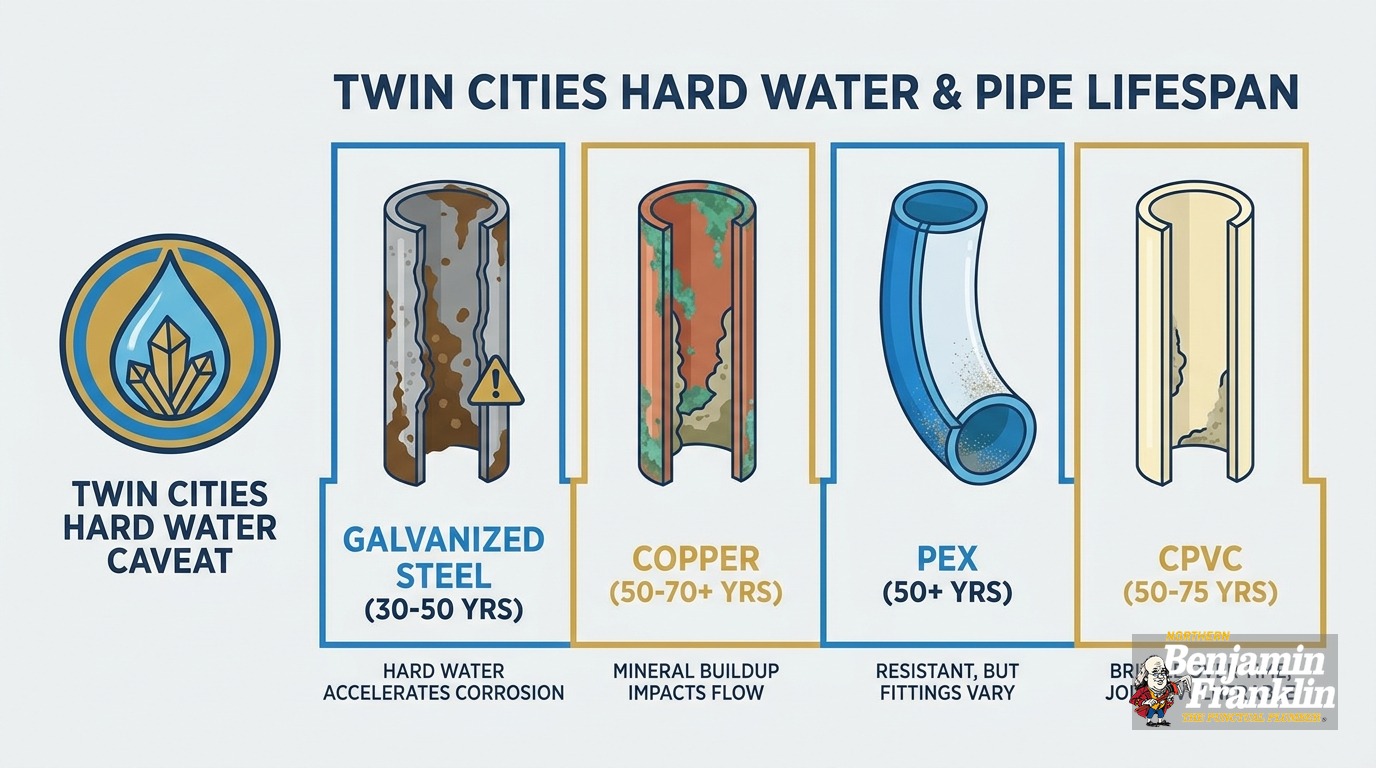
- Galvanized steel is the most urgent concern in pre-1960 homes. Its realistic lifespan is 20-50 years, and hard suburban or well water accelerates that clock considerably.
- Cast iron sewer pipes can reach 75-100 years, but Minneapolis’s sewer system averages 80-100 years old, with many lines never replaced as homes above them were renovated.
- Copper supply lines last 50-80 years. Minneapolis’s alkaline water (pH 9.06) raises calcium carbonate scaling risk in heated equipment even at moderate hardness.
- PEX is the newest supply line material in widespread use and handles Minnesota freeze conditions better than copper: it flexes under ice pressure where copper bursts.
- Any pipe replacement in Minnesota requires a permit pulled by a licensed plumbing contractor under MN Rules Chapter 4714.
- Call (763) 296-1844 or book online to schedule a pipe inspection with Northern Benjamin Franklin Plumbing, locally owned and operated in the Twin Cities.
How Long Do Pipes Last in a House?
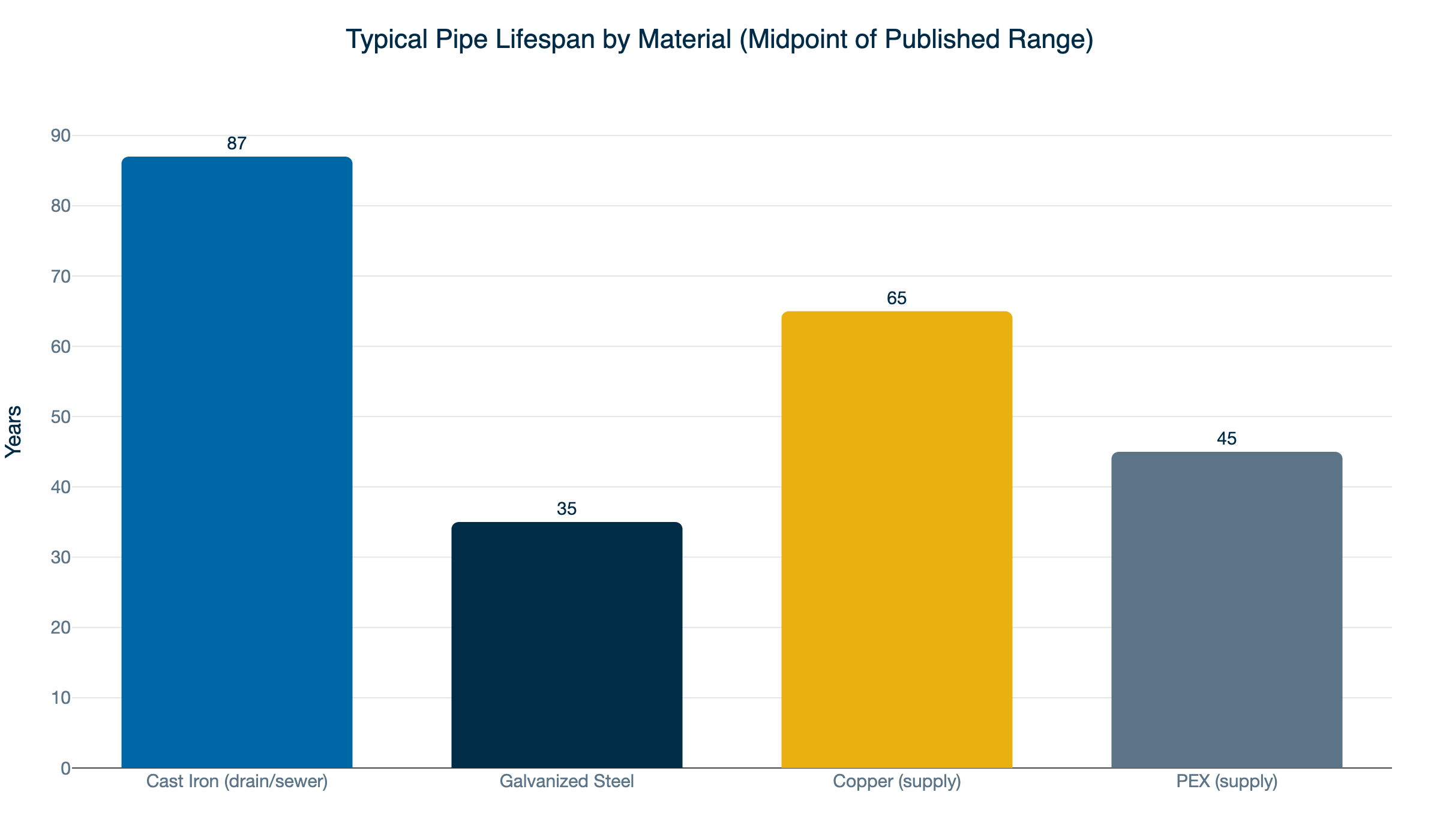
The short answer: Cast iron drain and sewer pipes last 75-100 years. Copper supply lines run 50-80 years. Galvanized steel supply lines are realistic at 20-50 years. PEX, the newest material in widespread use, is rated for 40-50+ years.
Those are national baseline numbers. In the Twin Cities, your actual lifespan depends on what your water chemistry does to the pipe interior, how deep Minnesota’s frost pushes into the soil around underground lines, and how old the municipal sewer infrastructure under your street is. City water and suburban or well water tell completely different stories for the same pipe material. This guide runs through each material with that local context built in.
What Kind of Pipes Are in Older Twin Cities Homes?
The short answer: Pre-1960 homes almost always have galvanized steel supply lines and cast iron or clay sewer laterals. Homes built from the 1960s through the 1990s typically have copper supply lines. Post-2000 homes are most likely plumbed with PEX. The build year is your starting point for knowing what you have.
The pipe material in your home is largely a function of when it was built and what was code at the time.
- Pre-1960 homes: Galvanized steel supply lines and cast iron or clay sewer laterals. This covers most of Minneapolis’s older neighborhoods: Powderhorn, Longfellow, Como, Seward, Whittier, and Standish. In St. Paul, it covers Cathedral Hill, Irvine Park, Hamline-Midway, and Dayton’s Bluff.
- 1960s through the 1990s: Copper supply lines replaced galvanized steel starting in the mid-20th century and became the default for new construction for several decades.
- Post-2000 homes: PEX (cross-linked polyethylene) became the standard supply line material as its freeze-flex properties and lower installation cost pulled ahead of copper.
Not sure what you have? Check the lines coming off your water meter or out of your water heater. Copper is orange-brown, rigid, and joined by solder or press fittings. Galvanized is dull gray and threaded at the joints, with a corroded look where it has been exposed for years. PEX is flexible plastic tubing, typically red for hot runs and blue for cold, connected with metal crimp or expansion fittings.
How Long Do Galvanized Steel Pipes Last?
The direct answer: Galvanized steel pipes have a published lifespan of 20-50 years, though some sources cite up to 100. The upper end applies under conditions most Twin Cities homes do not have. Galvanized corrodes from the inside out, building rust and mineral deposits that narrow the pipe’s interior diameter over time. A pipe that looks intact on the outside can be a fraction of its original diameter on the inside.
In hard-water areas of the Twin Cities, that narrowing happens faster. Research from St. Paul Pipe Works documents measurable interior diameter reduction in galvanized pipes in neighborhoods like Ramsey Hill and Irvine Park within just 5-7 years under elevated hardness conditions. City-treated Minneapolis and St. Paul water runs 5-6 GPG after treatment, which is moderate. Many suburbs and private wells in the metro run 15-35 GPG, and homes on that water see the scaling happen much faster.
The failure is gradual until it is not. Whole-home pressure drops slowly enough that many homeowners adapt without realizing anything is wrong. Then a joint gives out. Signs that your galvanized supply lines are in trouble:
- Whole-home water pressure that has dropped steadily over the years, not tied to any single fixture
- Orange or brown water at the tap, particularly first thing in the morning or after an extended period with the tap off
- Visible rust, dark scale, or white mineral buildup on exposed pipes in the basement or utility room
- Frequent pinhole leaks at joints and threaded fittings
- A plumber who notices reduced flow during an unrelated service call
If your home was built before 1960 and has never been repiped, your galvanized lines are somewhere in their failure window right now. An inspection tells you how close to the edge you are. Our post on galvanized pipe replacement in older Twin Cities homes walks through what an inspection and a full repipe involve so you know what to expect.
How Long Does Cast Iron Last?
The direct answer: Cast iron drain and sewer pipes carry a published lifespan of 75-100 years. In Minnesota, the lower end of that range is the more realistic target. Freeze-thaw soil movement, root intrusion, and decades of drainage load all stress cast iron lines in ways the national average does not capture.
Here is the local context that should concern Twin Cities homeowners: Minneapolis’s sewer system has an average pipe age of 80-100 years, and many lines have never been replaced even as the homes above them were completely renovated. If your home is in an older Minneapolis or St. Paul neighborhood, the sewer lateral running from your house to the city main has likely been in the ground as long as the house itself.
Cast iron and clay laterals fail in predictable patterns. Joints crack from soil movement and freeze-thaw stress. Low spots, called bellies, develop where the line has settled unevenly. Water slows in a belly, solids drop out of suspension, and the gradual buildup causes recurring backups that look like a clog but are a structural problem in the line. Roots from mature trees, which are everywhere in older Twin Cities neighborhoods, find every gap in a joint and grow inward over years. By the time a root mass causes a visible backup, it has usually been building for a long time.
A sewer camera inspection is the only reliable way to assess your lateral’s condition without digging. We recommend one for any home over 50 years old and for any buyer making an offer on an older property in the metro.
How Long Does Copper Pipe Last?
The direct answer: Copper supply lines are rated for 50-80 years. In the Twin Cities, two local factors are worth understanding: water hardness and pH.
Minneapolis’s finished water runs at 5.4 GPG total hardness and a pH of 9.06, according to the city’s May 2025 monthly analysis. The hardness is moderate: Minneapolis removes 65,000 pounds of hardness per day at its treatment plants, and the finished water does not leave visible deposits at the faucet. But the alkaline pH (9.06) raises the calcium carbonate scaling potential in any heated equipment. Water heaters and boilers in Minneapolis homes scale faster than the hardness number alone would suggest. That scaling affects equipment lifespan and can affect copper fittings on the hot water side over time.
In the suburbs and on private wells, the picture changes significantly. Many Twin Cities suburbs run 15-20 GPG; private wells in parts of the metro reach 35 GPG. At those levels, mineral deposits concentrate corrosion on the pipe wall, and pinhole leaks become likely before the 50-year mark. Copper develops pinhole leaks in both highly acidic and high-mineral water. Hard water is one of the two primary accelerators of that failure mode.
Pinhole leaks are a specific and common problem in Minnesota copper systems. For a detailed look at what causes them and how they are repaired, see our post on copper pipe pinhole leaks in Minnesota.
How Long Does PEX Last?
The direct answer: PEX is rated for 40-50+ years, with widespread US residential adoption only beginning in the late 1990s and early 2000s. The long-term field record is still accumulating. What is well established is that PEX handles Minnesota winters differently and better than copper does in vulnerable locations.
Copper is rigid. When water freezes inside a copper supply line, the wall has nowhere to go. The pipe cracks or bursts. PEX can flex slightly and expand under ice pressure before the line fails. That is a real advantage for supply lines running through exterior walls, unheated crawl spaces, or additions built before current insulation standards: conditions that are not rare in older Twin Cities homes.
PEX is not without limits. UV exposure degrades it before installation, so it must stay out of direct sunlight on the job site. It is not approved for gas line work. Some older fitting designs had corrosion issues that current product lines have since corrected. But for whole-home repiping, PEX is now the standard choice in most Minnesota plumbing work. If you are weighing a full repipe and want to compare both materials in detail, our post on PEX vs. copper for a whole-house repipe covers the decision point by point.
Does Hard Water Shorten Pipe Life in Minneapolis and St. Paul?
The direct answer: Yes, and the degree depends on where your water comes from. City-treated Minneapolis and St. Paul water runs 5-6 GPG after treatment: moderate hardness. Suburban and well water in the metro commonly reaches 15-35 GPG. At the higher levels, mineral buildup inside pipes, fixtures, and equipment accelerates measurably and shortens effective service life across every material type.
The hardness divide within the Twin Cities is significant and practical:
- Minneapolis finished water: 5.4 GPG, pH 9.06 (May 2025 monthly analysis)
- St. Paul Regional Water Services: lime softening brings hardness to 5-6 GPG
- Suburbs and private wells: commonly 15-20 GPG, with some metro well water reaching 35 GPG
A galvanized supply pipe in a Minneapolis city home has considerably more service life ahead of it than the same vintage pipe in a Rogers or Chaska home on a private well. Copper pinhole leaks, water heater anode rod depletion, and fixture scale buildup all run ahead of schedule at higher hardness levels. If you are in a suburb or on a well, apply a meaningful discount to every lifespan estimate in this article.
For more on what hard water does to your home’s plumbing and what can be done about it, visit our page on hard water problems and solutions.
How Does Minnesota’s Frost Depth Affect Underground Pipes?
The direct answer: The Twin Cities metro has a design frost depth of 48 inches. That freeze-thaw cycle stresses rigid underground sewer laterals every winter, causing joint cracks, pipe bellying, and root entry points to develop over time. In an older home, this can shorten the practical life of a cast iron or clay lateral well below the published range.
Water service lines are typically buried 7+ feet to stay safely below that frost depth. Sewer laterals often run shallower. Every winter, the soil around your sewer lateral freezes and expands, then thaws and settles. Rigid cast iron and clay lines transfer that movement directly to their joints. Over decades, joints crack or separate. Lines develop bellies where the ground has settled unevenly. A belly slows drainage, lets solids drop out of suspension, and creates a spot where the line will eventually back up on its own. Roots find every gap or crack and grow inward year after year.
A lateral that passed a visual inspection at year 30 can have a developing belly or cracked joint by year 50 that worsens every season. Only a camera scope tells you what you are actually dealing with underground. This is why sewer inspections matter more in Minnesota than they do in warmer climates with stable soil.
What Are the Warning Signs That Your Pipes Are Failing?
The direct answer: Watch for discolored water, whole-home low pressure, unexplained wet spots, sewage odors, multiple slow drains at once, or climbing water bills with no change in usage. Any of these signals warrants a call to a licensed plumber before a slow problem becomes a sudden one.
Each of those signals tells a different story:
Discolored water. Orange or brown water at the tap, especially first thing in the morning or after the water has been off for an extended period, is the classic sign of corroding galvanized steel. The corrosion products flake off the interior wall and travel with the water flow.
Whole-home low pressure. One slow fixture points to a local problem: a clogged aerator, a partially closed valve, or a failed cartridge. If every fixture in the house is weaker than it used to be, the supply line itself has likely narrowed from mineral buildup or internal corrosion.
Wet spots with no obvious source. Damp walls, ceilings, or floors that do not trace back to a visible fixture leak may be pinhole leaks in copper lines. Pinhole leaks weep slowly over weeks before they become visible from the outside. By the time you see the stain, there is often hidden water damage behind it.
Sewage smell in the basement or yard. A cracked sewer lateral, a failed joint, or a dry trap lets sewer gas migrate back toward the home. The smell is unpleasant and, at concentration, a health concern that needs attention quickly.
Multiple slow drains at once. One slow drain is typically a local clog at that fixture’s trap or branch line. Two or three slow drains across different parts of the house at the same time point toward the main sewer line.
Higher water bills with no usage change. A hidden supply leak routes water to waste before it reaches a fixture. Even a slow steady leak adds up significantly over a month and points to a supply line problem somewhere in the system.
A pre-1970 home that has never been repiped. That fact alone, independent of any symptoms, puts you in the galvanized failure window. An inspection will tell you how much margin you have left.
Do You Need a Permit to Replace Pipes in Minnesota?
The direct answer: Yes. Any pipe replacement in Minnesota requires a permit under MN Rules Chapter 4714, and permits must be pulled by a licensed plumbing contractor. The 2020 Minnesota Plumbing Code, effective December 17, 2021, is the current applicable standard.
Homeowners may do limited plumbing work on their own primary residence in Minnesota, but they must still apply for a permit and pass a subsequent inspection. In practice, most homeowners hire a licensed contractor for both the permit and the work itself. The inspection is the point of the process: it confirms the work was done to code before the walls close back up, and it protects you at the time of sale.
If a plumber ever suggests skipping the permit to lower the cost, treat that as a warning sign. A licensed contractor pulls permits without being asked. That is part of what you are paying for.
Schedule a Pipe Inspection With Northern Benjamin Franklin Plumbing
If your home is in the pre-1960 galvanized window, if your copper supply lines are approaching 40 years old on hard suburban or well water, or if your sewer lateral has never been scoped, the right next step is an inspection. A camera scope on the sewer line and a pressure and flow check on the supply side give you a clear picture of your home’s plumbing health before anything fails on its own schedule.
Northern Benjamin Franklin Plumbing is locally owned and operated in the Twin Cities. We back every appointment with the On-Time Guarantee(R): we arrive in the window you choose, or we pay you $5 for every minute we are late, up to $300. If there is any delay, it’s you we pay!
Call (763) 296-1844 or book online to schedule your inspection.
Frequently Asked Questions
How long do galvanized steel pipes last in a Twin Cities home? +
Does Minneapolis hard water shorten pipe lifespan? +
What pipes last the longest in a house? +
Do I need a permit to replace pipes in Minnesota? +
Need a technician now?