
Cast Iron Drain Pipe Replacement Minnesota: Know the Signs
Key Takeaways
- Cast iron drain pipes last 50-75 years. Homes built in the 1940s-1970s are at or past that window.
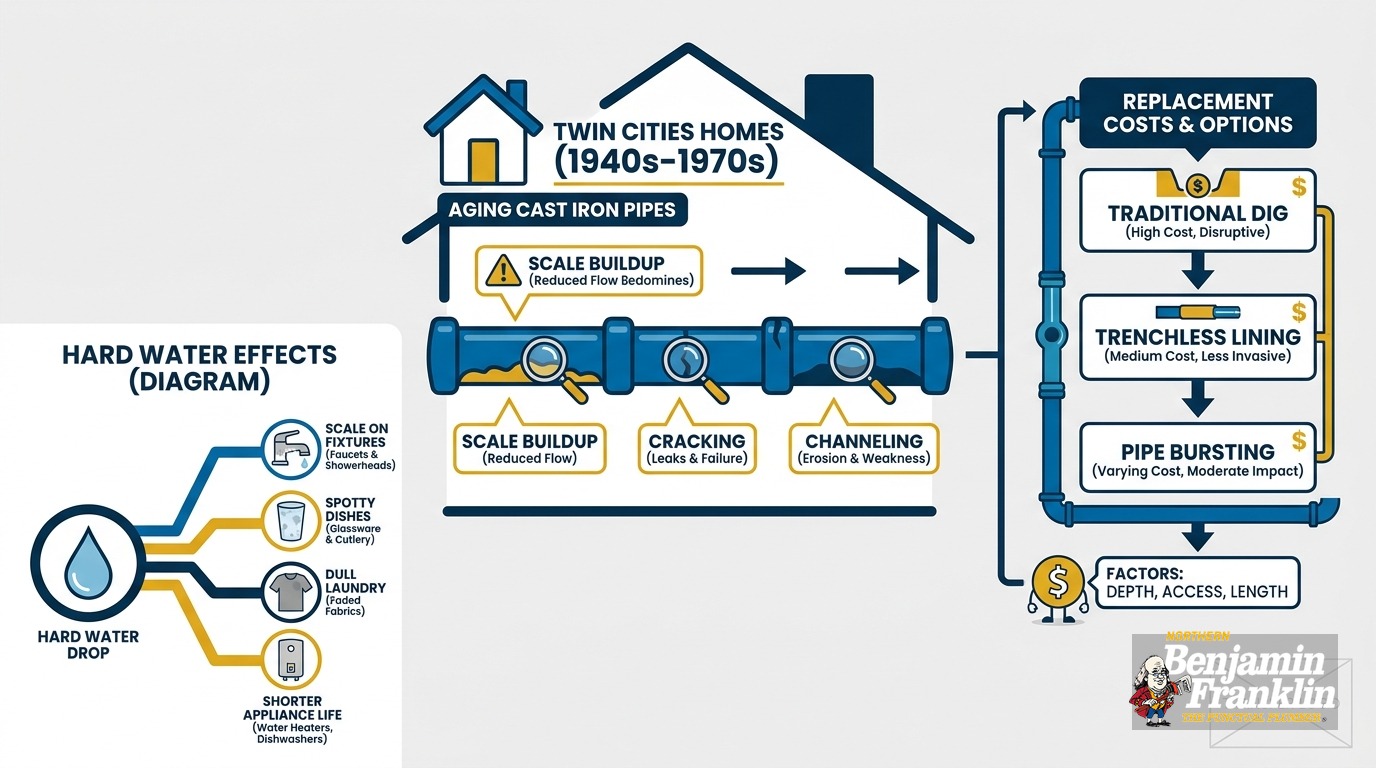
- Three failure modes: channeling (the pipe floor erodes away), tuberculation (scale narrows the interior), and graphitization (the iron dissolves, leaving a fragile shell).
- A channeled pipe cannot be lined. Full replacement is the only option.
- In Minneapolis and St. Paul, the property owner owns the sewer lateral from the house to the city main in the street.
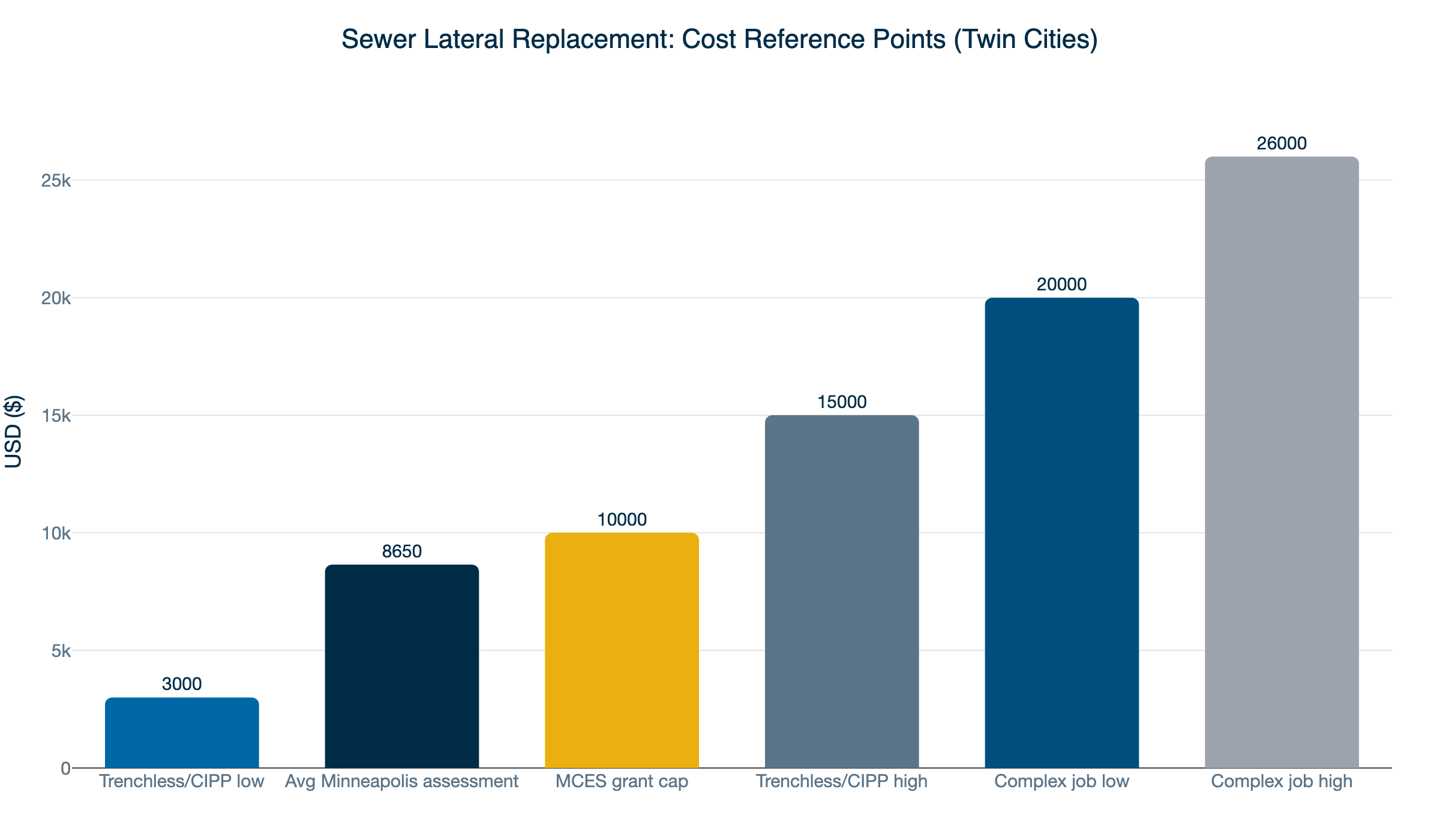
- MCES grants can cover 50-100% of repair costs up to $10,000 for qualifying Minneapolis and St. Paul homeowners.
- Minneapolis also offers assessment financing: the repair cost goes on your property tax bill at low interest.
- All drain replacement work in Minnesota requires a permit and a licensed plumber under Minnesota Plumbing Code Chapter 4714.
Cast Iron Drain Pipe Replacement in Minnesota: Is Your Home at Risk?
Cast iron drain pipe replacement in Minnesota is the right conversation to have if your home was built between the 1940s and the 1970s. The drain lines running beneath your slab are almost certainly cast iron. It was the standard drain material for that era. Durable, widely available, and the right choice for its time.
But cast iron sewer pipe has a finite functional lifespan. A home built in 1955 has pipes that are now 70 years old. That puts a large share of Minneapolis, St. Paul, Blaine, Bloomington, and the first-ring suburbs squarely in the replacement window right now.
These pipes do not fail suddenly in most cases. They degrade slowly and silently for years. The gap between when a pipe starts failing and when a homeowner notices is exactly where the damage accumulates.
This post explains how cast iron pipes fail, what warning signs you can read from inside the house before anything collapses, who owns the sewer lateral in the Twin Cities, and what replacement realistically costs. It also covers two programs most homeowners have never heard of that can cut that cost significantly.
How Long Do Cast Iron Drain Pipes Last?
Cast iron sewer pipe has a finite functional lifespan. If your home was built between 1945 and 1975, those pipes are now 50 to 80 years old. Recurring slow drains, gurgling, or sewage odor in a home that age is a strong signal to schedule a camera inspection.
The Twin Cities has a dense concentration of homes from this exact era. South Minneapolis, Highland Park in St. Paul, and many first-ring suburbs were built during the postwar decades. Homeowners in those neighborhoods are not waiting for a problem to develop. They are dealing with pipes that have already been degrading quietly for years.
Cast iron does not blow out like a burst copper pipe. It loses capacity slowly. A pipe that is channeled, scaled, or graphitized will keep draining for a while. The failure shows up first as slow drains, then as backups, then as collapse. Catching it before that last stage is the difference between a planned replacement and an emergency one.
The Three Ways Cast Iron Pipes Fail
Not all cast iron failure looks the same on a camera. A licensed plumber will identify one or more of three distinct patterns:
Channeling
Channeling is the terminal failure mode for horizontal cast iron runs. The constant flow of wastewater erodes the floor of the pipe over decades. The top half can look completely intact on camera while the bottom is gone. Raw sewage soaks into the soil beneath your slab. Channeling is described as the defining end-of-life failure mode for horizontal cast iron. A channeled pipe cannot be lined. There is no floor left to support a liner. Full replacement is the only option.
Tuberculation (Scale Buildup)
Tuberculation is the buildup of iron oxide scale on the interior pipe walls. It narrows the pipe’s opening and roughens the surface. That rough interior catches debris and causes chronic clogs years before any visible leak develops. A four-inch pipe can be substantially narrowed by heavy scale buildup. Descaling can sometimes restore a structurally sound pipe. But it must happen before any lining attempt, because a liner laid over scale will not bond correctly and will not last.
Graphitization
Graphitization is the subtlest of the three failure modes. The iron in the pipe dissolves slowly over time and leaves behind a soft graphite shell that looks intact visually. You can push a probe through it under moderate pressure. On camera, the sign is a dull gray, patchy appearance at joints and along the pipe wall. Flaking at the joints confirms that graphitization has advanced. A pipe that looks whole may crumble under a crew working above it.
What Warning Signs Can You Spot from Inside the House?
Three symptoms point most reliably to a failing cast iron system: recurring slow drains across multiple fixtures, gurgling sounds when you flush, and rust-colored grit in backup water. Any one of these in a home older than 50 years warrants a camera inspection. All three together means schedule it this week.
Recurring slow drains are the earliest warning. Tuberculation reduces the pipe’s internal diameter gradually, year after year. The drain still works, just slower. Most homeowners reach for a liquid drain cleaner and move on. The problem is that the root cause is the pipe wall itself, not a removable clog. Our post on slow drains as early warning signals covers this pattern in depth.
Gurgling when you flush usually means the drain system is struggling to ventilate. Air needs somewhere to go when water moves through a constricted pipe. It backs up through the nearest water trap. If multiple drains gurgle when the toilet flushes, the problem is in the main line, not a branch drain. Our guide on gurgling drains and plumbing vent problems explains the full picture.
Rust-colored grit in backup water is an advanced sign. That material is the pipe itself. Oxidized iron and loosened scale are being carried back up when a drain backs under pressure. At this stage, the pipe has been degrading for a long time already.
A camera inspection is the only way to confirm which failure mode you are dealing with. Symptoms alone cannot distinguish channeling from tuberculation, and the right repair is different for each.
How Does Minnesota’s Climate Make Cast Iron Problems Worse?
The Twin Cities gets more than 70 annual freeze-thaw cycles working against every joint and collar in an aging pipe. Even when the sewer lateral is buried below the frost line, the surrounding soil moves. That movement causes joint offsets and longitudinal cracks over time.
Minnesota frost penetration in the Twin Cities metro runs 42-48 inches in a typical winter, with extreme years reaching 60 inches. Sewer laterals are installed below that threshold. But the soil above and around them still heaves with each seasonal cycle. A cast iron pipe installed level in 1958 has endured over 68 years of that ground movement. Joints that shift even slightly flow unevenly, catch debris, and accelerate channeling.
Water chemistry compounds the problem. Minneapolis finished water runs approximately 94 mg/L total hardness at pH 9.0. St. Paul water is approximately 100 ppm total hardness. Both cities draw from the Mississippi River and use lime softening. A moderately hard, high-pH supply accelerates carbonate scale formation in horizontal drain sections, particularly near laundry hookups where water temperature fluctuates. That feeds the tuberculation process from the inside out.
The 50-75 year lifespan figure is a national average. Twin Cities conditions often shorten that window.
Who Owns the Sewer Lateral in Minneapolis and St. Paul?
In Minneapolis, the property owner is responsible for the entire sanitary sewer lateral from the house connection to the city main in the street. The city maintains only the main. If the lateral fails under the boulevard or the street right-of-way, that repair is yours to pay.
This is the detail most homeowners get wrong. Many assume the city takes over at the curb or the property line. That assumption leads to an expensive surprise when a camera inspection finds the failure point is 20 feet past the property line and still the owner’s responsibility.
Knowing this ahead of time matters. If you assume a slow drain is the city’s problem to fix, you may wait longer than you should. By the time a collapse happens, the repair is larger and more costly than it would have been if addressed a year earlier.
The same ownership structure applies in St. Paul. If you live outside the core cities, verify the boundary with your specific municipality. Suburban cities vary on where their maintenance responsibility begins.
What Does Cast Iron Drain Pipe Replacement in Minnesota Cost?
Cost depends on lateral length, burial depth, site access, replacement method, and restoration scope. Attributed figures from Minneapolis public records and metro contractor data appear below. The only reliable number for your specific job is a quote based on a camera inspection of your lateral.
What the public record shows:
- The Minneapolis assessment program has tracked the cost of sewer lateral replacements across the city. These are the City of Minneapolis’s own figures from its Sewer Lateral Assistance report.
- A typical trenchless or CIPP quote in the Twin Cities metro runs $3,000-$15,000, depending on pipe length, depth, and method.
Several factors push a job toward the higher end of any estimate: greater burial depth (the Twin Cities frost protection standard means laterals are often 5-6 feet down or deeper), longer lateral runs, work in the street right-of-way, and the need to saw-cut and restore concrete or asphalt after the work is completed.
The gap between those two ranges also reflects the difference between a trenchless repair on a shorter lateral and a full open-cut replacement. Open-cut work requires digging up landscaping, driveway, or street pavement. An actual quote based on a camera inspection is the only reliable step.
Call (763) 296-1844 or book online, and we will camera the line and give you a real number. For a detailed comparison of both approaches, see our post on trenchless versus traditional sewer line replacement.
Can You Line a Cast Iron Pipe Instead of Replacing It?
Trenchless lining, or CIPP (cured-in-place pipe), works well when the host pipe is structurally sound. A liner installs inside the existing pipe and cures to form a new flow surface, with no excavation required. But a channeled pipe has no floor left to support a liner. Lining a channeled pipe fails. Know which failure mode you have before committing to either method.
The sequence matters:
- Scale present, structure intact: Descaling is typically required before a liner can bond properly.
- Channeling confirmed: Lining is not an option. Full replacement is needed.
- Graphitization with structural compromise: The pipe needs to be replaced, not lined.
A camera inspection is the decision point. Committing to lining without one risks spending money on a repair that cannot succeed.
Is There Financial Help for Sewer Lateral Replacement?
Yes. Minneapolis and St. Paul homeowners have access to two programs most people have never heard of: the MCES Private Property Inflow and Infiltration grant, and assessment financing through the City of Minneapolis. Together they can make a large repair much more manageable.
The MCES Grant
The Metropolitan Council administers grant funding for private sewer lateral repairs in both cities.
For Minneapolis homeowners:
- Owner-occupants of single-family, duplex, or triplex properties qualify.
- Grants cover repair costs starting at 50%, up to $10,000, in three tiers based on property zone.
- The current Minneapolis application window is closed. Check the city’s website for the next application cycle.
- Demand is high. The program has used a lottery system in recent years. Apply as early as possible when the window opens.
St. Paul runs a parallel program. Details are on the St. Paul MCES Sewer Lateral Grant Program page.
Assessment Financing (Minneapolis)
If you replace a lateral and cannot pay the full cost upfront, Minneapolis will assess the repair to your property tax bill at 3.80-4.70% interest over 5, 10, 15, or 20 years, with a $50 administrative fee.
The two programs can work together. The grant reduces the balance, and the assessment financing spreads the remainder over time.
What Does Minnesota Law Require for This Repair?
Minnesota Plumbing Code Chapter 4714 requires a permit for any replacement or alteration of a drain system. The work must be done by a licensed plumber and is subject to inspection. This is not a homeowner weekend project.
An unpermitted lateral replacement creates title complications when you sell the home. It also leaves you exposed if the work fails and causes property damage. A licensed plumber pulls the permit, schedules the required inspection, and provides documentation that the job was done to code.
Schedule an Inspection Before a Slow Drain Becomes a Basement Backup
The earlier you catch cast iron failure, the more options you have. A pipe with scale buildup and an intact structure may qualify for trenchless lining. A channeled or graphitized pipe needs replacement. A planned replacement on your schedule costs less and disrupts less than an emergency call.
We are locally owned and operated, and we back every job with the On-Time Guarantee(R): we arrive in the window you pick, or we pay $5 for every minute we are late, up to $300. “If there is any delay, it’s you we pay!” Call (763) 296-1844 or book your sewer inspection online today.
Frequently Asked Questions
How long do cast iron drain pipes last? +
Can a cast iron pipe be lined instead of replaced? +
Who is responsible for the sewer lateral in Minneapolis? +
Is there financial help for sewer lateral replacement in Minneapolis? +
Need a technician now?