
Sewer Line Replacement Cost in Minneapolis and St. Paul
Key Takeaways
- The average sewer line replacement cost in Minneapolis is $4,319 - about $1,000 above the national average - per Angi. Minneapolis construction labor runs 38% above the national average.
- In both Minneapolis and St. Paul, you own the sewer lateral from your house all the way to the city main, including the section that crosses under the street.
- A camera scope ($100-$500 according to Angi national data) is the essential first step. It tells you whether you need a spot repair, relining, or full replacement.
- Trenchless methods often cost less than open-trench excavation when driveway and landscaping restoration are factored in, but not always. Pipe condition determines the right method.
- Both Minneapolis and St. Paul have grants up to $10,000 and low-interest assessment programs to spread costs over years through your property taxes.
- Call (763) 296-1844 or book online for a quote specific to your home and lateral.
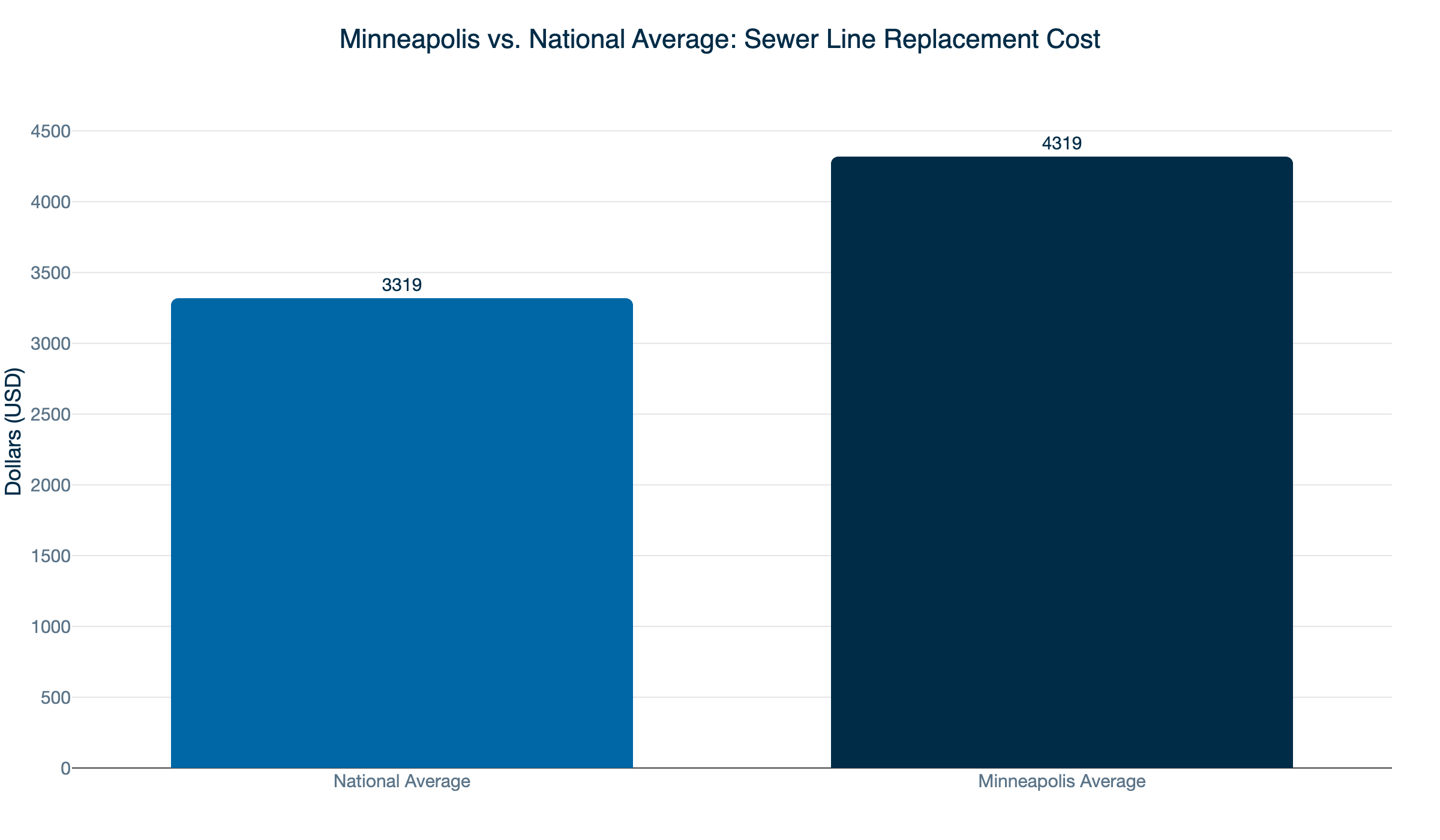
The average sewer line replacement cost in Minneapolis is $4,319, according to Angi’s 2026 data. That is about $1,000 above the national average of $3,319. This gap is not a coincidence. It reflects something specific about building in Minnesota: 42 to 48 inches of required frost depth, a construction labor rate that runs well above the national average, and housing stock where original clay pipe is still in the ground decades past its expected service life.
Most cost guides publish the national average and stop there. That number does not travel to Minnesota. This guide covers what Twin Cities homeowners actually need to know before calling anyone: you own the pipe all the way to the street main, frost depth is the single biggest driver of the local labor premium, and both Minneapolis and St. Paul have financial assistance programs that most contractors never mention.
Why Does Sewer Line Replacement Cost More in the Twin Cities?
Short answer: Two factors explain the premium. The Twin Cities requires pipes buried 42 to 48 inches below grade - deeper than most of the country. Minneapolis construction labor also runs 38% above the national average. Those two facts together make every sewer project more expensive here before you even get to the pipe itself.
Minnesota’s frost depth requirement is not optional. The minimum for the Twin Cities metro is 42 to 48 inches below grade. Northern counties require 54 to 60 inches. Per sewerscopeinspectionmn.com and the Minnesota Plumbing Authority, these depths reflect the 2015 Uniform Plumbing Code adopted under Minnesota Chapter 4714. Every extra inch means more excavation labor, more backfill, and more job time.
Minneapolis construction labor runs 38% above the national average. When both factors combine, a project that costs $3,319 at the national midpoint reaches $4,319 here. That is before you factor in pipe material, surface restoration, or the permit.
The permit is mandatory. Minnesota Revised Statutes Sec. 326B.46 requires a permit for any sewer installation, alteration, repair, or replacement. Only a licensed Master Plumber or authorized plumbing contractor may pull that permit. There are no local exemptions. A contractor who skips the permit is working illegally, and the liability transfers to the homeowner.
Pipe material adds a third layer for older homes. Clay was standard in Minnesota through roughly 1970, with a lifespan of 50 to 60 years. Its mortar-sealed joints become the prime entry point for tree roots and the first location to shift under frost heave. According to groundtechmn.com, cast iron lasts 75 to 100 years but shows accelerated deterioration near high-traffic streets from road-salt infiltration in acidic soil. Neighborhoods like Nokomis, South Minneapolis, Northeast, and Longfellow frequently have original clay laterals still in service. If your home was built before 1970, there is a reasonable chance your lateral has never been replaced.
Who Actually Owns the Pipe Under the Street?
Short answer: You do. In both Minneapolis and St. Paul, the property owner is responsible for the entire sanitary lateral - from the building foundation to the connection wye at the city main - including the segment that crosses under the public street.
This surprises most homeowners. The assumption is that anything under a public street belongs to the city. That is not how either city handles sewer laterals.
Minneapolis City Code Chapter 511 places responsibility for cleaning, maintenance, and repair of the full lateral on the land owner, including the connection wye. Minneapolis Public Works is clear: the city owns the main in the street. The service lateral that connects your home to that main is yours.
St. Paul Public Works follows the same rule. Property owners are responsible from the building exit to the wye at the public main, including the segment through the right-of-way. St. Paul adds a licensing requirement: lateral work must be performed by a City-licensed House Drain Contractor - a Master Plumber or certified house sewer worker. That requirement is separate from the state plumbing license.
One meaningful exception exists in Minneapolis. If a camera inspection shows the problem is in the city main rather than your private lateral, Minneapolis will reimburse you for a portion or all of the repair cost. That reimbursement depends on having documentation of where the failure actually is. A scope before any work begins is the only way to produce that record.
What Drives the Sewer Line Replacement Cost Up or Down?
Short answer: Four factors explain most of the spread: depth, pipe material and condition, method (trenchless vs. open trench), and what is above the lateral. Each can push a project significantly in either direction. Knowing which factors apply to your property before you call is worth the camera inspection cost several times over.
Depth
Every foot below grade costs more. Twin Cities frost depth starts every project deeper than the national baseline. A lateral with a 5-foot access pit takes longer and costs more than one at 3.5 feet. Combined with the 38% labor premium, depth is the most consistent driver of the local cost gap.
Pipe material and condition
Clay breaks at joints. Cast iron corrodes from the inside. Both materials have specific failure modes, and knowing which one you have - and how far along the failure is - determines whether a spot repair makes sense or whether full replacement is the right call.
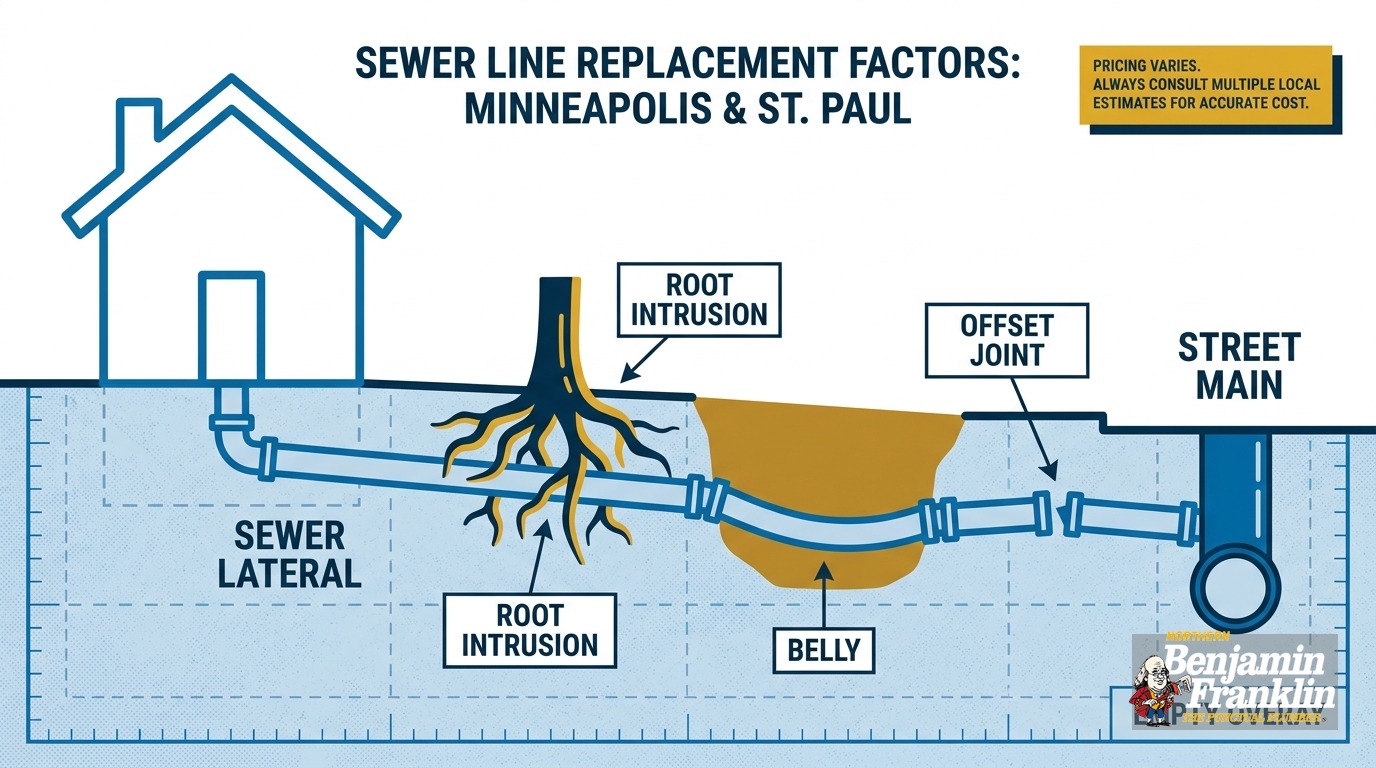
A sewer line camera inspection removes the guesswork. It documents whether the line has active root intrusion, offset joints, bellied sections, or structural cracks. For a home in a pre-1970 neighborhood with original clay laterals, that $100-$500 inspection can be the difference between a targeted repair and a $15,000+ emergency replacement.
Trenchless vs. open-trench excavation
Trenchless methods - pipe lining and pipe bursting - replace or rehabilitate the pipe without excavating the full run. Open-trench excavation digs up everything along the lateral path.
The cost comparison depends heavily on what is above the lateral. Per nuflow.com, trenchless typically runs 30 to 50 percent below dig-and-replace on total project cost when driveway restoration ($1,000-$4,000 for concrete) and landscaping ($1,000-$3,500) are included. If your lateral runs under a concrete driveway, trenchless can avoid that restoration cost entirely. If it runs under lawn, the gap narrows.
For a detailed side-by-side of how these methods perform on Twin Cities projects, see our trenchless vs. traditional sewer line replacement breakdown.
Surface restoration
Open-trench work cuts through whatever is above the pipe. Concrete driveways, mature trees, paved paths, and finished landscaping all cost more to restore than a simple grass lawn. This line item is often absent from initial estimates and fully visible in the final bill. Ask for it itemized before work begins.
Is Trenchless Sewer Replacement Always Cheaper?
Short answer: No. Trenchless is often the lower total-cost option, but it is not a universal rule. Specific pipe conditions make trenchless either unavailable or more expensive than excavation, and a camera inspection is the only way to know which situation you are in.
Three conditions change the calculation, per nuflow.com:
- Collapsed sections. Trenchless methods require structural integrity to work from. A fully collapsed section makes trenchless unavailable. The pipe has to be excavated.
- Major offset joints. Significant lateral movement at a joint cannot be lined over. Access, correction, and then possibly relining is the sequence - which adds cost to the trenchless side.
- Deep frost-depth access pits. When the access point must go especially deep because of frost requirements, labor cost on that entry point can close the gap between methods or push trenchless above excavation.
The method that looks cheaper in a first estimate can change after a camera scope reveals what is down there. This is why the inspection happens before a method decision, not after.
Our sewer line repair and replacement page explains how we assess which method fits each project.
What Do Minneapolis and St. Paul Homeowners Typically Pay?
Short answer: Minneapolis averages $4,319 with a typical range of $2,705-$6,336. St. Paul full dig-and-replace runs $8,000-$25,000+. Both cities have wider ranges than the national average because depth, method, and surface restoration vary so much from one property to the next.
Minneapolis cost data
According to Angi’s Minneapolis data:
- Average project cost: $4,319
- Typical range for most homeowners: $2,705-$6,336
- Full traditional replacement: $6,000-$15,000+
- Trenchless replacement: $7,500-$18,000+
Renovetted.com breaks Minneapolis cost down by linear foot at $63-$378, with a midpoint around $189. The length of your lateral - from the foundation wall to the main connection - multiplies directly against those per-foot figures. A longer run to the main costs more than a short one.
St. Paul cost data
According to comoparksewer.com:
- Full dig-and-replace: $8,000-$25,000+
- Pipe lining (trenchless): $4,000-$15,000
- Pipe bursting: $6,000-$18,000
The same source notes a pattern worth taking seriously: a $3,000 repair left unaddressed can become a $15,000+ emergency if the line fully collapses. That is not a hypothetical. A slow-building failure in a clay lateral under a concrete driveway is exactly the scenario where waiting multiplies the final cost.
None of these figures are Northern Benjamin Franklin Plumbing prices. Every number above comes from the third-party sources linked. For a quote on your specific lateral, call (763) 296-1844 or book online.
What Financial Help Is Available for Sewer Line Replacement?
Short answer: Both cities have two separate programs: a grant you apply for (lottery-based in Minneapolis, census-tract-based in St. Paul) and an assessment or loan that spreads the cost over years through your property taxes. In both cities, grants can reach $10,000 and the assessment programs avoid a lump-sum payment entirely.
Minneapolis: Private Sewer Lateral Grant
The 2026 MCES Inflow/Infiltration Grant awards between $5,000 and $10,000 per property. The amount depends on your property’s location in the CDC Social Vulnerability Index zones. Awards are made by lottery from a limited pool: the city’s 2026 allocation is $248,500.
Eligibility: owner-occupied single-family homes, duplexes, or triplexes in Minneapolis. If the grant window is open and your property qualifies, this is the first program to check.
Minneapolis: Special Assessment Program
If the grant window has closed or your property does not qualify, the Minneapolis Special Assessment Program spreads repair costs over 5, 10, 15, or 20 years. The term depends on the total project cost. Interest rates run 3.90% to 4.50% (2024 rates) with a $50 administrative fee. Homeowners who are 65 or older or permanently disabled can apply for deferral rather than payment.
There is also a timing benefit in Minneapolis. If the city is actively replacing the main in your street and you replace your lateral at the same time, Minneapolis covers 75% of the right-of-way replacement cost. A city infrastructure project in your neighborhood is worth checking before you schedule independently.
St. Paul: MCES Sewer Lateral Grant
St. Paul’s MCES Sewer Lateral Grant has two tiers in 2026. Properties in LIHTC Qualified Census Tracts qualify for 90% of costs up to $10,000. Properties outside those tracts qualify for 50% of costs up to $5,000. Check the census tract map on the St. Paul website before assuming which tier applies. The difference in potential award is significant.
St. Paul: Sewer Assessment Program
St. Paul’s Sewer Assessment Program provides a low-interest loan spread over 20 years, added to your property taxes. The eligibility requirement is straightforward: no delinquent taxes on the property at the time of application.
Metro-wide funding
The Metro Council Private Property I/I Grant distributes $1.5 million in wastewater funding across the metro in 2026. That pool is the source behind the individual city programs above. The access point is your city program, not the Metro Council directly.
If you are considering a larger project and want to understand financing options, ask when you call. Our team can walk through what is currently available and applicable to your address.
When Should You Call a Plumber About Your Sewer Line?
Short answer: Call before the slow drain becomes a backup. Call well before the backup becomes a collapse. The camera inspection is the decision tool. Once you know what is actually in the ground, every next step becomes clearer and less expensive.
These signs point to a lateral that needs attention:
- Multiple drains backing up together. When a toilet, floor drain, and laundry sink all slow or back up at the same time, the blockage is downstream of all of them - in the lateral, not in a branch line.
- Gurgling in one fixture when running another. A toilet that gurgles when the washing machine drains is a pressure signal from a restricted or partially blocked line.
- Sewage odors outside near the lateral path or in the basement. A cracked lateral leaks both waste and gas. The smell is specific and does not go away with cleaning.
- Soft or wet spots in the yard above the lateral, without recent rain. A leaking pipe saturates soil from below. The grass often looks suspiciously green over the same spot.
- Repeated clogs in the same drain, month after month, even after professional clearing. Root intrusion regrows if the entry point is not addressed.
Tree roots in Minneapolis and St. Paul sewer lines are worth understanding before you commit to a repair method. Root intrusion is not always a replacement-level problem. Hydro-jetting can clear an active root mass, and a follow-up scope can show whether the pipe is still structurally sound. If roots have cracked the pipe wall, the answer changes and full replacement becomes the right path.
The constant across all of these situations: a camera scope establishes what you are dealing with. Guessing is always more expensive than knowing.
We are locally owned and operated here in the Twin Cities. Our team arrives in the window we commit to. That is the On-Time Guarantee(R). If there is any delay, it’s you we pay! Call (763) 296-1844 or book online to schedule a sewer scope or get a quote on a replacement.
Frequently Asked Questions
Does a homeowner own the sewer pipe that runs under the street? +
Is trenchless sewer replacement always cheaper than open-trench excavation? +
Are there grants available for sewer line replacement in Minneapolis and St. Paul? +
Need a technician now?