
Trenchless Sewer Line Replacement vs Digging: What Decides
Key Takeaways
- The method is decided by site conditions, not homeowner preference.
- A cracked but structurally round pipe is a candidate for CIPP lining - no digging required. A collapsed pipe requires pipe bursting or excavation.
- Any belly or sag in the line cannot be corrected by a lining method. Excavation is required to reset the grade.
- Twin Cities sewer laterals typically run 6 to 10 feet deep due to Minnesota’s frost requirements. That depth makes open-trench excavation more expensive here than national averages reflect.
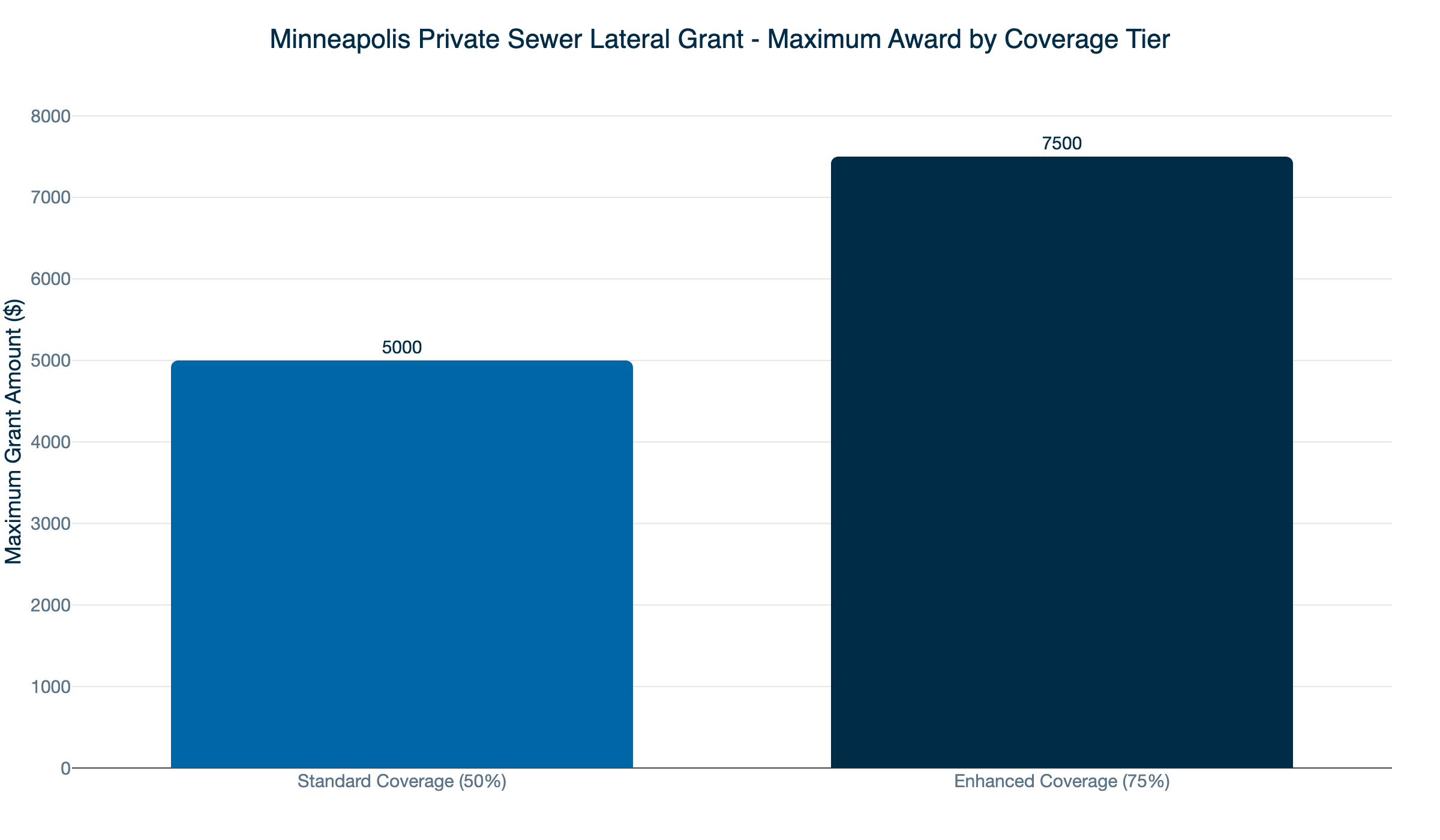
- Minneapolis homeowners may qualify for a Private Sewer Lateral Grant covering 50% to 75% of repair costs.
- A camera inspection answers every gate in this framework. Call (763) 296-1844 to schedule yours before committing to any approach.
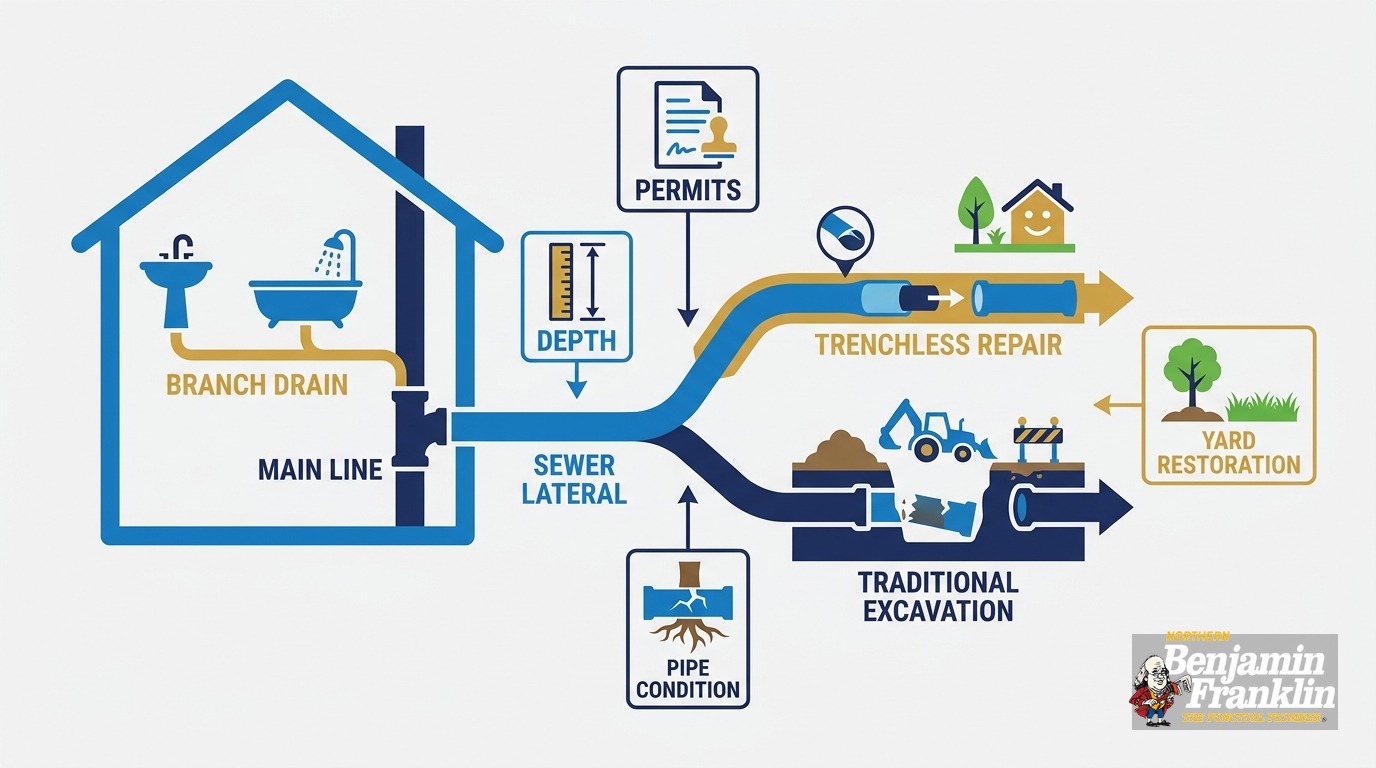
Trenchless or excavation? The question sounds like a preference. It is not. The condition of your pipe, the grade of the line, what covers it on the surface, and how deep it sits - these four factors usually determine the method before any quote is given. Most homeowners walk into this conversation without knowing which one applies to them.
This article organizes those four conditions as sequential gates. Work through them in order and your site will usually tell you where you land. A plumber who skips the camera inspection and quotes you a method over the phone is guessing. These four gates require actual footage.
What is the difference between trenchless sewer line replacement vs digging?
Short answer: Trenchless methods work inside the existing pipe: lining it with a resin sleeve or pulling new pipe through it. Traditional excavation digs down to the pipe, removes it, and installs new pipe in open ground. Both solve the problem. The right choice depends on pipe condition and what sits above the line.
When a sewer lateral fails, most homeowners want the no-dig option. That is reasonable. Trenchless repair leaves your yard, driveway, and boulevard largely undisturbed. But trenchless is not always available. The pipe’s condition and your property’s layout narrow the options before preference matters. Understanding the four decision gates helps you ask the right questions when our team reviews the footage with you.
Gate 1: Is your pipe structurally intact?
Short answer: A pipe that is cracked or root-invaded but still holds its round shape is a CIPP lining candidate. A pipe that has fully collapsed or deformed is not. Pipe bursting or excavation is required instead. The camera footage answers this gate directly, before any other decision is made.
Start here. A sewer camera sends live footage down the lateral. What the footage shows determines Gate 1.
CIPP lining works by pulling a resin-saturated sleeve into the existing pipe. It inflates against the pipe wall and cures in place. The result is a smooth new liner inside the old one. For this to work, the host pipe must be structurally intact - clearable of debris and still round. CIPP requires only small access holes at each end. No trench. No lawn disturbance. No driveway cut.
Pipe bursting is the trenchless option when the pipe is more severely damaged. A bursting head fractures the old pipe outward while pulling new HDPE pipe through in a single pass. This works even when the original pipe is badly cracked or displaced. The exception is a fully collapsed run that cannot accept the bursting head. At that point, excavation is the answer.
Slip lining - a third no-dig method - cannot navigate multiple bends or lateral connections. It is less commonly used for residential laterals in older Twin Cities neighborhoods with multiple direction changes.
For homes in Minneapolis and St. Paul built before 1970, pipe material matters. Clay tile laterals crack and shift over decades. Cast iron narrows and corrodes over time. Both can be strong lining candidates if the pipe holds its shape. Both can also degrade to the point where only excavation works. The camera tells you which situation you are in.
A round pipe with cracks or root intrusion: trenchless is on the table. A flat, crushed, or fully collapsed section: proceed to excavation planning.
Gate 2: Does your sewer line hold its grade?
Short answer: Sewer lines drain by gravity and need a consistent downward slope from the house to the city main. A belly - a low dip where the pipe has settled - traps solids and causes recurring backups. No lining method corrects a grade error. The pipe must be excavated, repositioned at the correct slope, and reburied.
If your drains back up on a recurring schedule - slow, then clear, then slow again - a belly may be the cause. Our post on what slow drains are telling you about your pipes covers the early warning signs worth paying attention to.
Here is the hard limit for trenchless: no method changes the pipe’s elevation profile. CIPP lines the inside of the pipe at whatever grade it currently sits. Pipe bursting pulls new pipe along the existing path. If that path includes a belly, the new pipe inherits it. The symptom returns within months.
Correcting a grade error means opening the ground. The crew lifts the affected section to the correct elevation, resets the pipe with proper slope, and compacts the backfill. There is no shortcut.
If the camera footage shows standing water pooling in a low section - often visible as a reflective puddle on the lens - that is a grade error. Excavation is the only fix.
Gate 2 eliminates trenchless quickly when it applies. Many homeowners do not learn they have a grade problem until the first camera run.
Gate 3: What is above your sewer line?
Short answer: Concrete driveways, boulevard pavement, and mature trees over the pipe’s path drive up excavation costs and trigger additional permit requirements in Minneapolis. Trenchless access pits can often stay within the property boundary. That can eliminate the right-of-way permit and surface restoration cost entirely.
Trace the path your sewer lateral likely runs from the house to the street. What is in that path?
Open lawn: the cost difference between methods narrows. Excavation in soil is straightforward. The crew digs, replaces the pipe, backfills, and compacts. The lawn recovers.
Concrete driveway, apron, or boulevard sidewalk: the calculation shifts. Cutting the concrete, completing the pipe work, and restoring the surface to city standards adds both cost and time. In Minneapolis, any work affecting the public right-of-way requires a separate utility connections permit on top of the standard sanitary lateral permit. Trenchless methods keep their access pits small. They can often stay entirely on private property. That can eliminate the right-of-way permit and the restoration cost altogether.
The City of Minneapolis requires a permit for any sanitary lateral repair. Permits for outdoor plumbing work are issued through the Public Works department at (612) 673-2451. Your contractor pulls these. We handle that on every job we take.
Older Twin Cities neighborhoods have established tree canopies. Minneapolis and St. Paul have long stretches of homes built from the 1920s through the 1960s. Root systems in these yards extend well beyond the trunk. Heavy excavation near significant roots risks damaging the tree. Trenchless methods - with their small access pits - substantially reduce that risk. When access pits fall in soft soil away from the trunk zone, tree risk is minimal regardless of method.
Gate 4: How deep is your sewer line buried?
Short answer: Twin Cities sewer laterals typically run 6 to 10 feet deep because Minnesota’s frost depth requires burial below the freeze line. At that depth, open-trench excavation involves significantly more soil removal, shoring, and restoration than in warmer climates. That amplifies the cost advantage of trenchless and is one reason the Minneapolis sewer lateral grant exists.
This is the factor most national comparison articles miss entirely.
Homeowners in warmer states may find their lateral at 3 to 4 feet. Dig a narrow trench, replace the pipe, backfill. The job is contained. In the Twin Cities, Minnesota’s design frost depth runs approximately 42 to 48 inches. Sewer lines must be buried below that line. Most metro laterals land between 6 and 10 feet underground.
That depth changes the excavation scope. A 6-foot trench requires shoring to protect workers. A 9-foot trench on a narrow city lot is a significant ground disturbance. Equipment, labor hours, soil management, and surface restoration all scale with depth. National average cost figures published online do not reflect what a Minneapolis homeowner is actually facing.
When a pipe is in otherwise good condition and holds its grade, the depth factor often tips the total-cost calculation toward trenchless. Not always - but in the Twin Cities, more often than national figures suggest. This is part of why the City of Minneapolis created the grant program described below.
What permits does sewer work require in Minneapolis?
Short answer: Minneapolis requires a permit for any sanitary lateral repair. Work affecting the public right-of-way adds a second utility connections permit. Before any excavation, Minnesota Statute requires notification to Gopher State One Call at (651) 454-0002 so underground utilities are located and marked. We handle permit applications and the One Call notification on every job.
Understanding the permit structure helps you evaluate proposals and timelines accurately.
The sanitary lateral permit covers the pipe repair itself. The City of Minneapolis issues these through Public Works at (612) 673-2451. If the repair stays on private property - which trenchless methods often allow - the lateral permit is the only one required.
If excavation reaches the boulevard or requires a street cut, a right-of-way utility connections permit is also required. That adds a step and may add lead time before work can begin.
The homeowner owns and is responsible for the sewer lateral from the house foundation to its connection at the city main. If a contractor causes damage during work, that contractor is responsible for the repair. Know this boundary before reviewing any proposal.
Gopher State One Call notification is required by Minnesota Statute before any excavation, trenchless or traditional. Underground utilities are located and marked so crews know where gas lines, water mains, and electrical conduit run. This step happens before every job.
Does Minneapolis offer financial help for sewer lateral repairs?
Short answer: Yes. The City of Minneapolis Private Sewer Lateral Grant, funded by the Metropolitan Council, covered 50% (up to $5,000) or 75% (up to $7,500) of repair costs in 2026, depending on property location. The 2026 window closed in March. Check the Minneapolis Public Works website for the next application cycle.
This grant exists because sewer lateral repairs in Minneapolis are genuinely expensive. The frost depth factor is part of why.
Eligibility in 2026 required: owner-occupied residential property, single-family through triplex only, location within Minneapolis city limits, and three bids from Target Market Program contractors. Applications went to a lottery when funds were oversubscribed. Recipients were notified in April 2026 and had six months to complete the repair.
Unfunded applicants could request that their share of the repair cost be spread across their property taxes. Published rates ranged from 3.80% to 4.70% depending on the repayment term: 5 to 20 years.
The grant program has run in prior years and is likely to continue. If you missed 2026, start with a camera inspection now. Having footage and a written scope in hand lets you apply quickly when the next window opens. Our sewer line repair and replacement page covers what a complete inspection and repair scope includes.
When excavation is the only option
Some conditions leave no path for trenchless repair:
Fully collapsed pipe. A bursting head cannot navigate a flattened run over any meaningful length. The old pipe has to come out.
Grade errors. No lining method corrects slope. If the camera shows bellies, excavation is required to reset the elevation and rebury the line at proper grade.
Route change required. Rerouting the lateral to eliminate a chronic low-point or bypass a repeatedly failed section requires open excavation. There is no trenchless path to a different route.
Combined conditions. A pipe with both grade problems and structural collapse has two issues. No trenchless method addresses either one. One excavation handles both. In practice, a camera inspection often surfaces more than one of these conditions on the same lateral. The inspection report maps each section and identifies which factor is driving the recommendation.
When excavation is the right call, the goal is to execute it efficiently and restore the surface correctly. We pull the required permits, notify Gopher State One Call before breaking ground, and coordinate restoration to city standards.
For older Twin Cities homes with clay or cast iron laterals that have shifted over decades, mixed conditions are common. Some sections could be lined. A low spot must be opened. A camera inspection with a written condition report maps each section so you know exactly what the job involves before work begins.
How Northern Benjamin Franklin Plumbing helps you decide
A comparison article can walk you through the framework. The camera footage answers the actual questions for your specific pipe and property.
We are locally owned and operated in the Twin Cities. Our team works in these soils, at these depths, and under these frost conditions every week. When we give you a recommendation on trenchless sewer line replacement vs digging, it reflects what a Minnesota lateral actually requires - not a national average, not a default preference.
Our On-Time Guarantee(R) means we arrive in the window you pick. If there is any delay, it’s you we pay - $5 for every minute we are late, up to $300. Every job is backed by a 100% satisfaction guarantee.
To schedule a camera inspection or get a sewer repair assessment, call (763) 296-1844 or book online. If you want to understand what a camera inspection involves before scheduling, our post on sewer line camera inspections for Twin Cities homeowners walks through what to expect. For homes dealing with recurring root intrusion between major repairs, our sewer line cleaning service covers the maintenance options that can extend lateral life.
Frequently Asked Questions
Can I choose trenchless sewer repair if my pipe is partially collapsed? +
Does the Minneapolis sewer lateral grant cover trenchless repairs? +
Do I need a permit for sewer line work in Minneapolis? +
How deep are sewer lines buried in the Twin Cities? +
Need a technician now?