
Trenchless Sewer Line Replacement Cost: Bursting vs. Lining
Key Takeaways
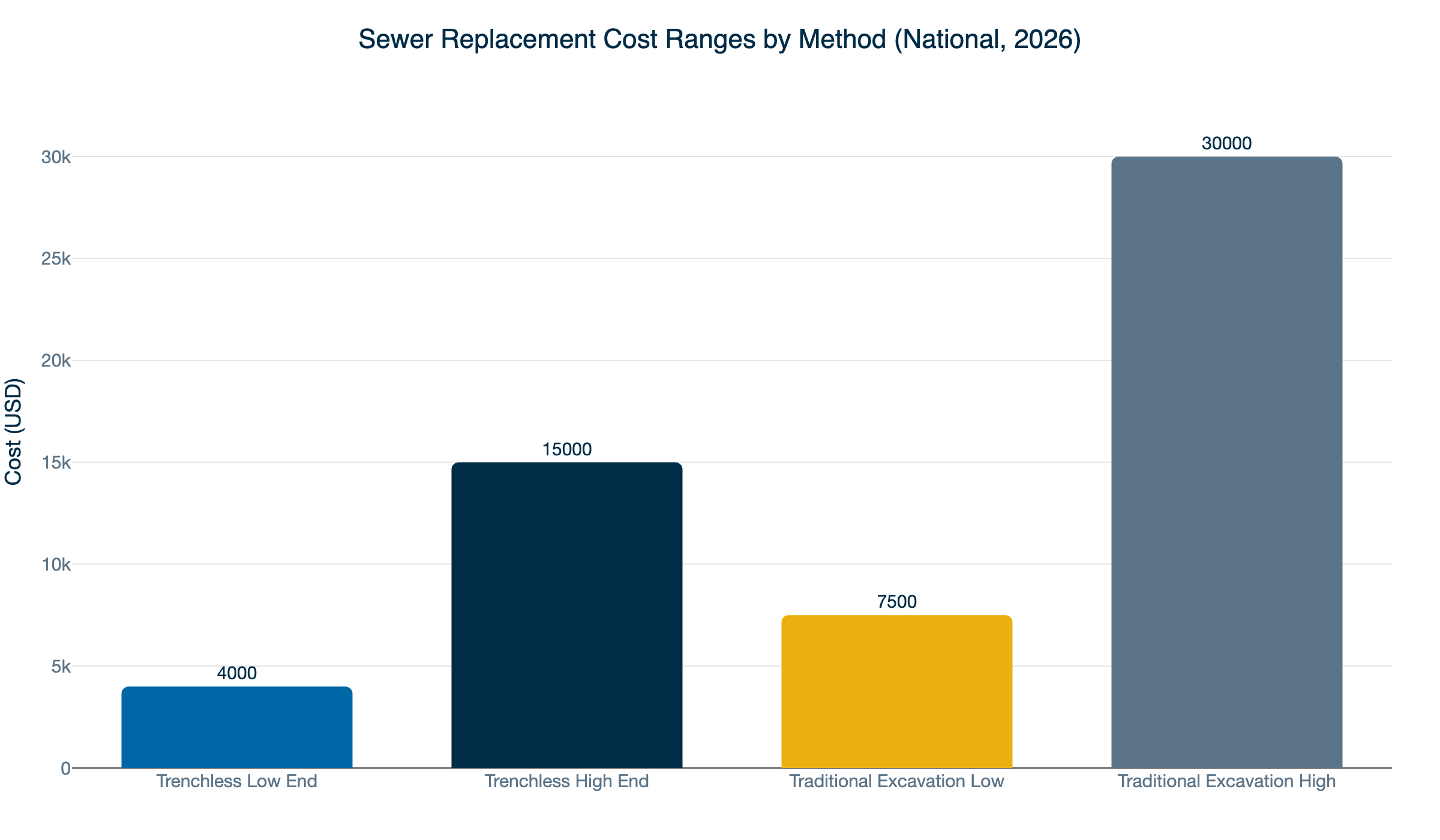
- Trenchless sewer line replacement cost runs $4,000-$15,000 nationally, with a $7,500 average, per PlumbingPriceGuide. In Minneapolis, Angi puts the average at $3,039, with a typical range of $1,991-$6,288.
- Two trenchless methods handle most jobs: CIPP (cured-in-place pipe) lining installs a resin liner inside the existing pipe. Pipe bursting fractures the old pipe while pulling a new one through.
- Trenchless is typically 30-40% less expensive than open-cut excavation when yard and driveway restoration is included, per PlumbingPriceGuide.
- In Minneapolis and Saint Paul, you own the entire sewer lateral - including the portion under the street - to the city main connection.
- Minneapolis offers a lottery-based MCES grant covering $5,000-$10,000 per property. Saint Paul offers a 20-year low-interest sewer assessment loan.
- CIPP lining works in all four Minnesota seasons. A February sewer failure does not require waiting for spring.
- Minnesota law requires a licensed contractor and a permit before any lateral work begins.
What Is Trenchless Sewer Line Replacement?
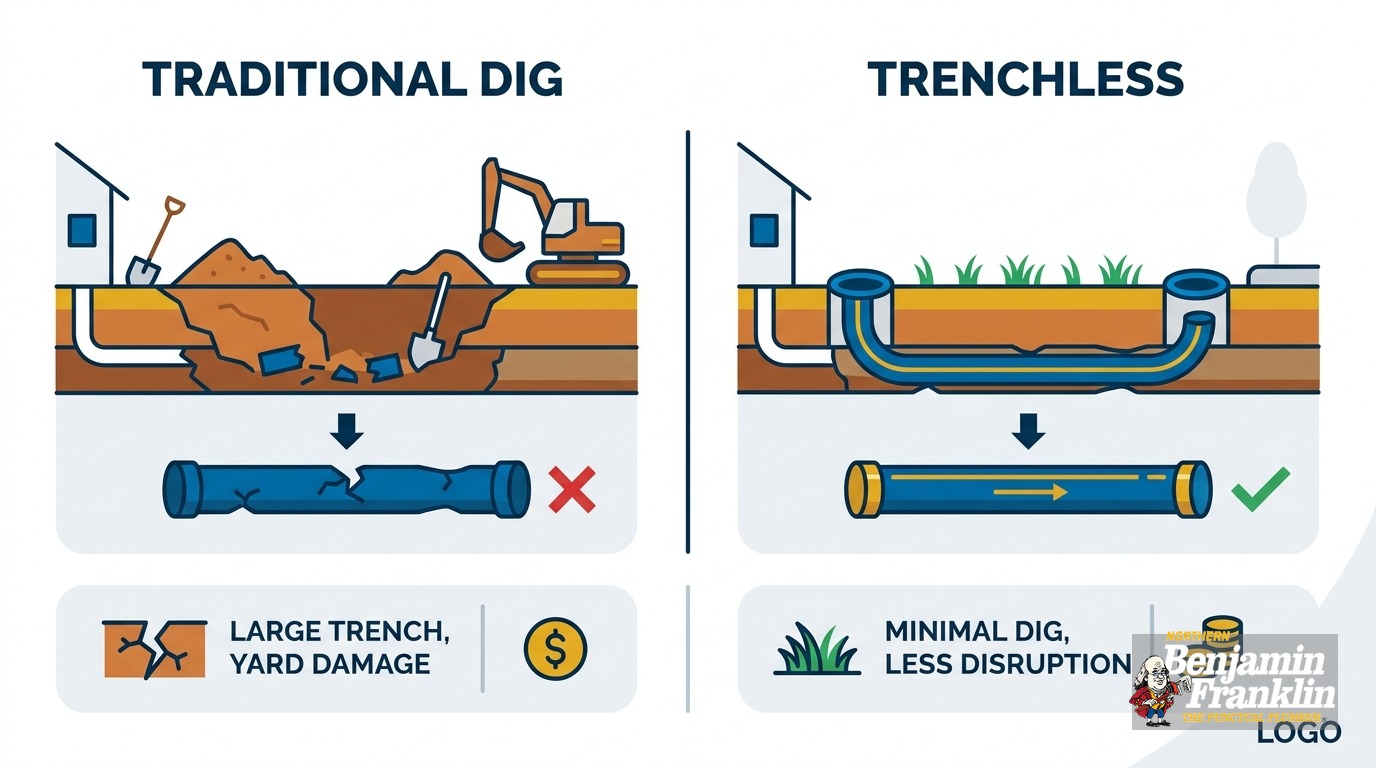
Short answer: Trenchless sewer line replacement repairs a failing sewer lateral with little or no excavation. A contractor accesses the pipe through one or two small entry points instead of digging a full trench. The two main methods are CIPP lining and pipe bursting.
Your home’s sewer lateral carries waste from the foundation to the city main. When it cracks, sags, or collapses, it needs repair or replacement. The traditional approach meant digging a trench from the house to the street. That trench tears through lawns, driveways, and sidewalks.
Trenchless methods do the same job with far less surface disruption. The damaged section is rehabilitated from the inside out, or a new pipe is pulled through the old one. Your yard and driveway stay largely intact.
Both major trenchless methods are approved under Minnesota Plumbing Code Chapter 4714, which requires CIPP installations to meet ASTM F 1216. Before any method is selected, a camera inspection maps the damage and confirms exactly where the problem sits. Our post on sewer camera inspection before buying a Twin Cities home covers what that process reveals and why it matters before any repair is authorized.
What Does Trenchless Sewer Line Replacement Cost?
Short answer: Nationally, trenchless sewer repair runs $4,000-$15,000, with a $7,500 average, per PlumbingPriceGuide. In Minneapolis, Angi reports an average of $3,039, with a range of $1,991-$6,288. Plumber-cost.com puts the statewide range at $2,800-$18,500 or more. These are third-party market figures. Call (763) 296-1844 for a quote on your specific lateral.
National and state averages aggregate thousands of projects with very different variables. Your actual trenchless sewer line replacement cost depends on several factors.
Pipe length. A 50-foot lateral costs considerably less than a 150-foot run that crosses a driveway and extends under the street. Cost scales directly with footage.
Pipe condition and method fit. A lateral with isolated cracks is a strong candidate for CIPP lining. A badly collapsed pipe may require pipe bursting or open-cut work. The camera scope determines this before any quote is final.
Pipe diameter. Most residential laterals are four inches. Some older Minneapolis and Saint Paul homes have three-inch lines. Larger diameter work adds cost per foot.
Access difficulty. A tight crawl space, deep burial, or a lateral routed under concrete all increase labor. Older urban neighborhoods in the Twin Cities often present routing challenges that suburban homes do not.
Diameter upsizing during pipe bursting. Pipe bursting can increase pipe diameter during replacement. Per PlumbingPriceGuide, upsizing adds $1,000-$3,000 to the project. For a home with a history of chronic backups, upsizing is often worth the premium.
Minneapolis utility permit fee. The city charges $160 for up to 75 feet of lateral work, plus $1.40 per additional foot, per the City of Minneapolis utility permit schedule. Your contractor pulls this permit.
Camera inspection. A pre-repair scope runs $150-$450, per PlumbingPriceGuide. It is not optional. The scope determines which method fits, confirms where the damage is, and tells you whether a Minneapolis city reimbursement may apply.
Pipe Bursting vs. CIPP Lining: Which Trenchless Sewer Line Replacement Method Fits Your Pipe?
Short answer: CIPP lining runs $80-$250 per linear foot and works best on pipes that are cracked or root-invaded but structurally present. Pipe bursting runs $60-$200 per foot and works even on collapsed or severely degraded pipe. Per-foot figures are from PlumbingPriceGuide. The camera scope determines which fits your lateral.
How CIPP lining works
A flexible liner soaked in epoxy resin is fed into the damaged pipe, then inflated against the pipe wall. The resin cures - using UV light, steam, or ambient temperature depending on the system - and hardens into a rigid, jointless pipe inside the old one. The host pipe becomes the structural shell.
CIPP requires that the original pipe be present enough to serve as a mold during curing. A fully collapsed section cannot be lined directly. Where it works, the result is a smooth, seamless inner surface that resists root intrusion and deposits. New CIPP liners typically carry a 50-year manufacturer warranty.
CIPP also works well when access is tightly constrained. Some jobs can be completed from a single entry point at one end of the run.
How pipe bursting works
Pipe bursting advances a cone-shaped bursting head through the old pipe, fracturing it outward into the surrounding soil. Simultaneously, a new HDPE (high-density polyethylene) pipe is pulled into position behind the head. The old pipe is destroyed; the new pipe replaces it along the same corridor.
The process requires access pits at both ends. These pits are small but do involve some excavation. The resulting HDPE pipe is smooth, continuous, and highly resistant to root intrusion. Because the bursting head can be sized up, pipe bursting is the only trenchless method that can increase pipe diameter in the same pass.
A home with a history of recurring slow drains or backups - even after repeated cleaning - may benefit from upsizing. The extra cost is often worth it when an undersized or damaged lateral has been the chronic problem all along.
How to know which method fits
The camera scope decides it. There is no universal answer, and a plumber who recommends a method before inspecting the pipe is guessing. Our trenchless sewer line replacement service page explains how we assess each lateral and what drives the method recommendation.
Is Trenchless Cheaper Than Traditional Excavation?
Short answer: In most cases, yes. Trenchless is 30-40% less expensive than open-cut replacement once restoration costs are included, per PlumbingPriceGuide. Traditional excavation can run $7,500-$30,000 or more when driveway and yard repair is factored in, per Clear Cost Index.
The pipe work itself is not always the largest cost in a traditional replacement. Restoring a concrete driveway, a mature lawn, or a section of public sidewalk can match or exceed the plumbing labor. Trenchless sidesteps most of that surface restoration.
Where open-cut still makes sense: a lateral in such severe collapse that no trenchless equipment can navigate it, or a repair that must expose the line for other underground work in the same trench. Those situations exist. They are not the typical case.
For a complete side-by-side breakdown - costs, timeline, and which conditions point to each approach - read our trenchless vs. traditional sewer line replacement overview.
Why Do Twin Cities Sewer Lines Fail at Higher Rates?
Short answer: Forty-eight inches of required burial depth, repeated freeze-thaw cycles, and expansive silty soils crack clay, Orangeburg, and cast-iron joints over decades. This is a local, climate-driven failure pattern. It is not a maintenance failure on your part.
Minnesota’s frost depth sets the baseline condition. Twin Cities sewer laterals must be buried at least 48 inches deep. In northern Minnesota, the requirement rises to 60 inches, per sewerscopeinspectionmn.com. The soil moves with every freeze-thaw cycle. MnDOT frost tracking shows that the Twin Cities typically reaches full frost depth by January or February and holds through March.
That same source explains the mechanism: silty Minnesota soils form ice lenses during freeze cycles. Those lenses push laterally against buried pipe joints. The effect accumulates over decades. Joint offsets - sections where the pipe has shifted out of alignment - are the most common result. The first six feet of the lateral from the foundation see the most stress and the most frequent damage.
Pipe material makes it worse. Most Twin Cities homes built before 1970 have clay or Orangeburg laterals. Clay is brittle and prone to root infiltration through mortar joints. Orangeburg is a tar-and-paper composite that softens, warps, and eventually collapses as it ages. Cast iron, common in 1950s and 1960s construction, corrodes from the inside out. None of these materials were engineered for the combination of depth, soil movement, and temperature range that Minnesota delivers every year.
The result is predictable: a single joint offset is enough to catch wipes, trap grease, and generate chronic backups that get attributed to “bad habits” when the real cause is 60-year-old clay in silty soil at 48 inches of depth.
For homes with cast iron laterals, our post on cast-iron drain pipe failure signs in Twin Cities homes walks through the warning patterns before a complete failure forces the issue.
Who Owns the Sewer Lateral in Minneapolis and Saint Paul?
Short answer: You do - the full run from your foundation to the city main connection, including any portion under the public street. Both Minneapolis and Saint Paul confirm this ownership in writing. Most homeowners assume their responsibility ends at the property line. It does not.
The City of Minneapolis states that homeowners own and are responsible for the sanitary lateral all the way to the city main, including sections running beneath the street. Saint Paul Public Works confirms the same ownership framework for Saint Paul properties.
There is one meaningful exception in Minneapolis. If a camera scope reveals that the damage is in the public sewer main rather than your private lateral, the City of Minneapolis will reimburse you for part or all of the repair cost. That reimbursement does not happen automatically. You need the scope to prove the damage location.
Getting a camera inspection before authorizing any repair protects your interest directly. A break that looks like it is in your lateral may turn out to be the city’s problem. A break that looks like a city issue may turn out to cross into your footage. The scope is the only way to know.
Are There Financial Assistance Programs for Twin Cities Homeowners?
Short answer: Yes. Minneapolis offers a lottery-based MCES grant covering $5,000-$10,000 per property. Saint Paul offers a 20-year low-interest assessment loan available to most property owners. Both programs can significantly reduce the net trenchless sewer line replacement cost.
Minneapolis MCES Private Sewer Lateral Grant
The Metropolitan Council Environmental Services (MCES) Private Sewer Lateral Grant is available to owner-occupied properties with one to three units in Minneapolis. The grant tier depends on the property’s location within an interactive city map: 50% of costs covered up to $5,000, 75% up to $7,500, or 100% up to $10,000, per the City of Minneapolis grant page.
The program is lottery-based. Not every applicant receives funding in a given year. The 2026 application window is already closed. Watch the grant page for the 2027 opening if your project can wait. An active backup or confirmed lateral collapse generally cannot wait.
Saint Paul Sewer Assessment Program
Saint Paul offers a low-interest loan spread over 20 years through its Sewer Assessment Program. Saint Paul Public Works states that most property owners are eligible. Income-qualifying households may apply for a deferred emergency loan, which allows the cost to be deferred until the property is sold or transferred.
If you own a home in either city, it is worth checking your eligibility before scheduling work. Ask about program timing when you call (763) 296-1844. For larger projects, we also offer financing options.
Can Trenchless Work Proceed During a Minnesota Winter?
Short answer: Yes. CIPP lining is not affected by frozen ground and can proceed in all four seasons. You do not need to wait for a spring thaw. Delaying an active failure through a Minnesota winter can turn a viable lining candidate into a full pipe replacement.
Frozen soil affects excavation, not CIPP installation. The liner and resin system enters through access points above the frost line, and the cure is self-contained. callhero.com’s Minneapolis trenchless resource confirms that CIPP lining proceeds year-round in the Twin Cities.
Pipe bursting requires small access pits at both ends of the run. Those pits involve limited excavation, which takes more effort in frozen ground. But the required disturbed area is far smaller than a traditional trench, and winter pipe bursting is feasible. Timeline and labor cost may increase modestly depending on frost penetration depth and site conditions.
The practical point: if sewage is backing up in January, call now. Waiting until April allows sewage contact to continue damaging your foundation and subfloor, accelerates pipe degradation, and may push a partially collapsed section past the point where lining is viable. The repair that costs $6,000 in February may cost significantly more if deferred until spring forces an emergency open-cut job.
What Permits Does Minnesota Require Before Sewer Work?
Short answer: Minnesota law requires a licensed plumber or sewer contractor, a Minneapolis utility permit for city lateral work, and a Gopher State One Call notification before any excavation - including the small pits for trenchless access. All of these apply to trenchless work, not just open-cut jobs.
Licensed contractor. Minnesota Statute 326B.46 requires a licensed plumber or licensed sewer contractor for all sewer lateral work. There are no exemptions for trenchless methods. Unlicensed lateral work is illegal and voids any city reimbursement claim.
Minneapolis utility permit. The base fee is $160 for up to 75 feet, plus $1.40 per additional foot, per the City of Minneapolis permit schedule. Your licensed contractor pulls this permit before work begins. If a contractor does not mention pulling a permit, ask about it directly before signing anything.
Gopher State One Call (GSOC). Minnesota law requires notification before any ground disturbance, including the access pits for trenchless work. The number is (651) 454-0002. The City of Minneapolis FAQ confirms this requirement applies to all sewer excavation. GSOC routes the notification to the statewide underground utility system, which marks buried gas, electric, and water lines before any digging starts.
Code compliance. Minnesota Plumbing Code Chapter 4714, Section 715.3 requires CIPP sewer lateral installations to follow ASTM F 1216 standards. A licensed contractor knows this requirement. It is part of what you are paying for when you hire properly.
A reputable contractor handles all permitting and notification before work begins. You should not need to chase any of it.
How to Get an Accurate Trenchless Sewer Line Replacement Cost
Every sewer lateral is different. Pipe length, burial depth, material, condition, and access all move the number. The only way to know what your project costs is a camera inspection followed by a written quote.
Northern Benjamin Franklin Plumbing is locally owned and operated in the Twin Cities. We back every appointment with the On-Time Guarantee(R): we arrive in the window you choose, or we pay you $5 for every minute we are late, up to $300. If there is any delay, it’s you we pay!
When a failing sewer lateral is involved, showing up when you said you would matters.
Our sewer line repair and replacement services include camera scoping, CIPP lining, pipe bursting, and full open-cut replacement when the situation requires it. For more context on what drives pricing across Minnesota, our companion post on sewer line replacement cost in Minnesota covers the cost variables in depth.
Call (763) 296-1844 or book online to schedule a camera inspection. We serve Minneapolis, St. Paul, Blaine, Bloomington, Brooklyn Park, Coon Rapids, Maple Grove, and the greater Twin Cities metro.
Frequently Asked Questions
How much does trenchless sewer line replacement cost in Minneapolis? +
Is pipe bursting or CIPP lining cheaper? +
Can trenchless sewer work be done in winter in Minnesota? +
Does Minneapolis have financial assistance for sewer lateral repairs? +
Need a technician now?