
Sewer Line Camera Inspection Before Buying a House
Key Takeaways
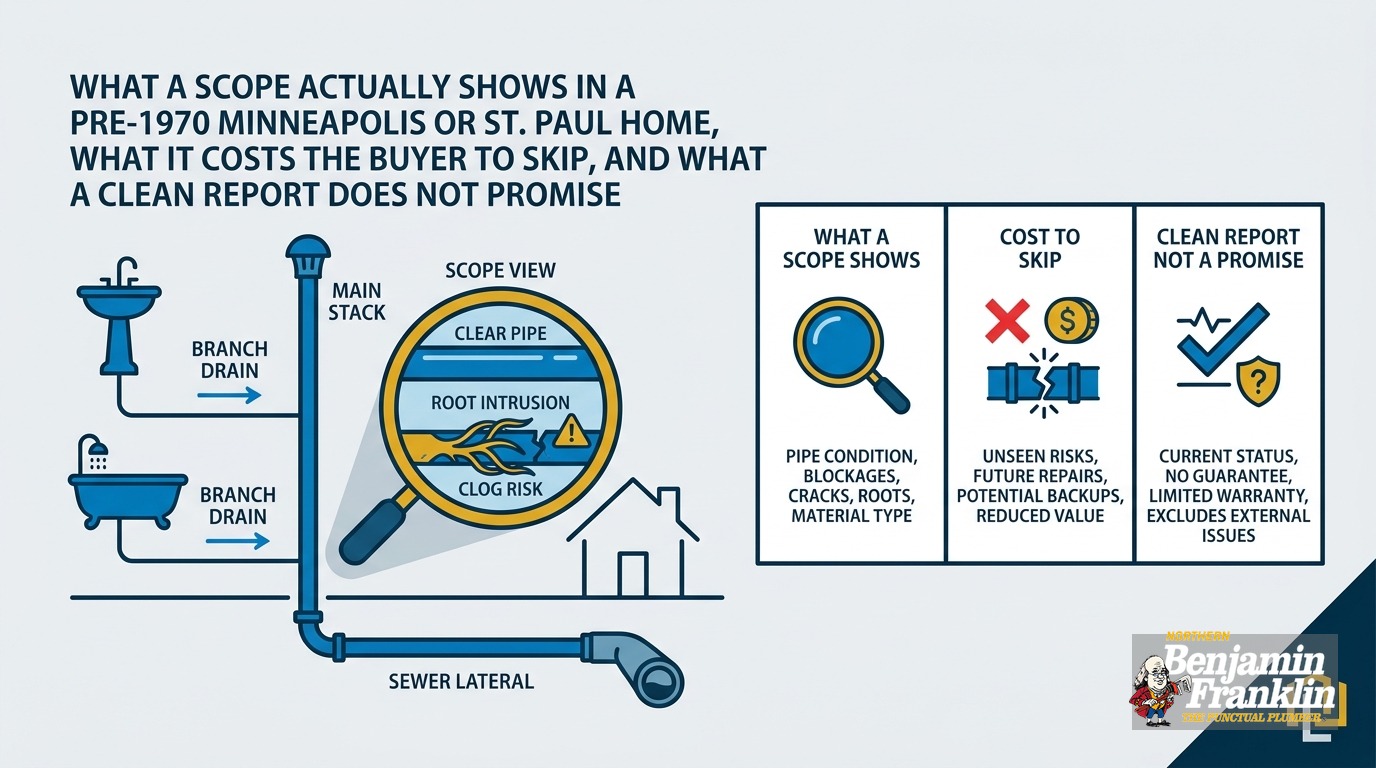
- A sewer line camera inspection before buying a house documents the interior of your lateral: pipe material, root intrusion, cracks, joint offsets, and pipe belly (a low sag where water pools and sits).
- About 60% of Minnesota homes over 40 years old with clay pipes have root intrusion. About 90% of remaining Orangeburg pipe in the state shows significant deformation or damage.
- A clean scope is a visual record from one day. It does not certify remaining pipe wall thickness or predict how the lateral holds up through the next freeze-thaw cycle.
- In Minneapolis, you own the sewer lateral from inside the house to the public main in the street, including the section that runs under the pavement.
- Both Minneapolis and St. Paul offer programs that help homeowners finance lateral repairs.
- Call (763) 296-1844 or book online to schedule before your inspection contingency closes.
What Does a Sewer Line Camera Inspection Actually Show?
A waterproof camera travels the full lateral from a cleanout or pulled toilet and sends live video to a monitor. The inspector documents pipe material, root intrusion, cracks, joint offsets, pipe belly, and standing water. The whole run from house to city main is covered in one pass.
In a pre-1970 Twin Cities home, the camera is likely to encounter one of three pipe materials, or a combination of all three.
Clay tile was the standard lateral material in Minneapolis and St. Paul from roughly 1900 through the late 1970s. Installers laid it in short segments, typically two to four feet long, with mortar or rubber-gasketed joints between them. That joint is the weakest point in the system. Clay itself is durable. The joints are not. After 50 to 80 Minnesota winters, those joints have been opening and closing with every freeze-thaw cycle. About 60% of Minnesota homes over 40 years old with clay pipe laterals show root intrusion. Root entry almost always starts at a joint.
Orangeburg pipe was used from the 1940s through the 1970s. It is made from compressed tar paper and was never designed to last more than a few decades. The material absorbs moisture over time, softens, and deforms. A round pipe becomes oval, then egg-shaped, then collapses inward. About 90% of remaining Orangeburg pipe in Minnesota shows significant deformation or damage. When the camera shows Orangeburg, repair or replacement is a matter of when, not whether.
Cast iron is common under the basement slab and in the interior building drain. It is more durable than clay or Orangeburg, but it corrodes from the inside out over decades, especially in sections that stay wet.
Beyond pipe material, the camera documents:
- Root intrusion. Tree and shrub roots enter at open joints or cracks and grow toward warmth and moisture inside the pipe. What appears on camera is rarely the full extent of the problem. The roots you see started at a structural failure in the pipe wall or at a joint.
- Pipe belly. A sag or low spot where soil has shifted beneath the lateral. Minnesota frost heave is a primary cause. Water sits permanently in a belly, which accelerates corrosion and catches debris. A belly cannot be cleared with a drain snake or hydrojetting. It requires excavation and re-grading of the affected section.
- Offset joints. One pipe segment shifted out of alignment with the next, leaving a gap or a step at the joint. Common where soil has settled unevenly or where frost has moved the ground. Roots enter offset joints first.
- Standing water. Water sitting in the lateral between uses points to a belly or a grading problem. The pipe should drain clear between uses.
- Cracks and fractures. Visible breaks in the pipe wall. In clay, most appear at or near the joints. In cast iron, they appear where corrosion has thinned the wall from the inside out.
The inspector timestamps each finding in the footage. You leave the inspection with a dated visual record tied to specific segments of the run. That documentation matters when you go back to the seller.
Why Do Pre-1970 Twin Cities Homes Carry More Risk?
Minnesota’s freeze-thaw cycle applies steady mechanical stress to buried pipe. Clay tile laterals installed before 1970 have been contracting and expanding at their joints for 50 to 80 winters. Those joints were never designed for that many cycles.
The Minneapolis and St. Paul housing stock is older than the national average. Many homes that sell each year in Bloomington, Brooklyn Park, Coon Rapids, and the inner Minneapolis neighborhoods were built before 1970. A large share of them still have the original clay lateral running from the house to the city main.
The climate compounds the material problem. Minnesota frost depth in the Twin Cities reaches roughly 60 inches, meaning the upper sections of a sewer run are subject to significant soil movement each winter. That movement opens clay joints incrementally, season by season. A joint that looked sealed during a fall inspection may admit roots by the following May. The scope shows today’s condition. It does not account for the 100-plus freeze-thaw cycles that pipe has already survived, or the ones it has ahead of it.
This is not a reason to avoid buying an older Minneapolis or St. Paul home. The pre-1970 neighborhoods are some of the most desirable in the metro. It is a reason to know exactly what you are buying before you close, so you are not surprised a year later.
What Can the Camera Not See?
The scope records the interior surface of the pipe. It cannot measure remaining wall thickness in sections that look intact, detect voids forming outside the pipe, or predict when an undamaged-looking clay segment will fracture. A clean visual record is not a service life guarantee.
This is what separates a well-informed buyer from one who assumes a clean scope means everything is fine. Nearly every article on pre-purchase sewer inspections focuses on what the camera finds. Almost none of them explain what a clean result does not tell you. In a Minnesota home with clay pipe, that gap is significant.
Here is what a clean scope does not certify:
Remaining pipe wall thickness. Clay corrodes from the outside in. The interior surface that looks smooth on camera may be backed by a wall that has thinned considerably. The camera cannot image through the pipe material to measure what is left. A segment that passes visual inspection can still be close to failure at the wall.
Voids in the soil surrounding the pipe. When clay cracks, water and fine soil particles migrate through the opening. That movement washes material away and leaves a void outside the pipe wall. The camera shows the crack on the interior. It cannot show the cavity forming around the exterior. Those voids eventually cause ground settlement above the pipe or a structural collapse from the outside.
Future root entry at currently clear joints. Clay joints open and close with every freeze-thaw cycle. A joint that was tight at inspection time is not guaranteed to stay tight. Root growth is slow and seasonal. A joint that was clear in late fall may show tendrils by the following spring. Every root intrusion case that appears on camera started at a joint that was once clear on a previous inspection.
Think of a scope as the best available evidence about a living system on one specific day. That evidence is valuable and worth having. It is not a warranty, and a seller or agent who treats it as one is overstating what a single inspection can promise.
What Does It Cost to Skip the Inspection?
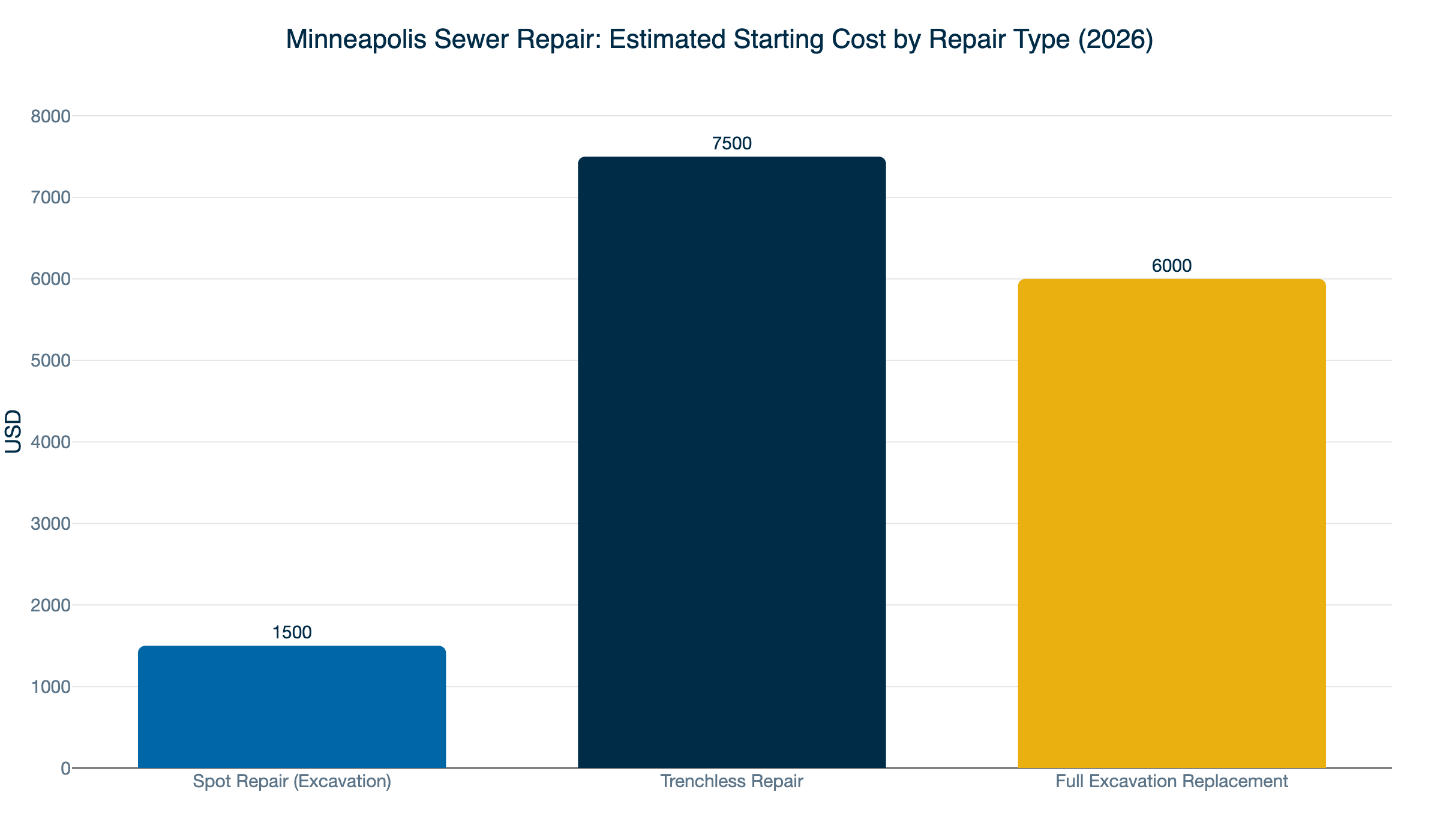
If the lateral fails after you close, you absorb the entire repair cost with no negotiating leverage. Sewer work in Minneapolis runs from $1,500 for a spot excavation repair to more than $18,000 for a full trenchless replacement.
Here are the 2026 cost ranges for Minneapolis sewer repairs, according to Cichy’s Water and Sewer:
- Spot excavation repair (single section, open cut): $1,500-$5,000
- Trenchless pipe lining or pipe bursting (full lateral): $7,500-$18,000+
- Traditional excavation full replacement (full lateral): $6,000-$15,000+
City permits are required for lateral replacement in Minneapolis. A city inspection adds time and cost to the project. Age of home and pipe material are the top cost factors, and pre-1970 homes with clay laterals sit at the top of that risk range.
A buyer who skips the scope and encounters a lateral failure in year one has no recourse. A buyer who scoped the lateral before closing and documented a problem has a written finding, a video record, and a repair estimate. That is enough to ask for a seller credit or a price reduction. For more on what repairs involve once you own the home, see our pages on sewer line cleaning and trenchless sewer line replacement.
Who Owns the Sewer Lateral Under a Minneapolis or St. Paul Street?
In Minneapolis, you own the sanitary lateral from inside your house to the connection at the public main in the street, including the segment that runs under the pavement. The city maintains the trunk main only. If the pipe under the street fails, the repair bill is yours.
This surprises many homebuyers. It is one of those details that is written clearly in city documentation but almost never comes up during the purchase conversation. The City of Minneapolis states it directly: property owners are responsible for the private lateral from the interior of the home to the tap at the public main. The tap and everything on the house side of it is the owner’s responsibility.
In older Minneapolis neighborhoods - Longfellow, Powderhorn, Seward, Nokomis, Northeast - the lateral often runs under a street that has been paved and repaved multiple times. When a failure occurs under the street surface, the repair typically requires a city permit, coordination for street cut and restoration work, and a longer project timeline. All of that adds to the total cost.
Ownership works the same way in St. Paul. Saint Paul Regional Water Services Engineering can answer jurisdiction questions for specific addresses. Their direct line is 651-266-6270.
Understanding that you own the lateral to the main changes the calculus on an hour-long scope inspection. You are not just checking the pipe beneath your yard. You are inspecting every foot of pipe you will be legally responsible for from the day you sign closing documents.
Can You Use the Report to Negotiate on Price?
Yes. A scope finding backed by timestamped footage is documented evidence. Get the scope done during your inspection contingency period, obtain findings in writing, get a repair estimate, and present both to the seller. Most sellers respond to written evidence with a source.
Here is how the process typically goes:
- Schedule the scope during the inspection contingency period, not after it expires.
- Ask the plumber to document findings in writing, referenced to footage timestamps.
- Get a written repair estimate from a licensed plumber.
- Present the finding and estimate to the seller’s agent in writing.
- Request a credit at closing or a reduction in the purchase price.
In a competitive market, a seller may decline. A seller who refuses to acknowledge documented sewer findings raises a disclosure question worth discussing with your real estate attorney. Minnesota sellers are required to disclose known material defects. A scope report you commissioned during the contingency period creates a clear record of what you found and when you found it.
If you buy the home and plan to address the lateral after closing, our team handles everything from drain clearing and hydrojetting for root intrusion to full sewer line replacement when the pipe is past the point of repair. If a slow drain inside the home is part of what tipped you off before the scope, our post on slow drains and what they signal covers the pattern in detail.
What City Programs Help Cover Sewer Repair Costs?
Minneapolis and St. Paul both offer programs that spread lateral repair costs over time. The Minnesota Housing Finance Agency offers rehabilitation loans that can cover sewer repairs for qualifying homeowners. All of these programs apply to the property owner, not the buyer before closing.
If you purchase a home that needs lateral work, you are not necessarily facing the full cost as a lump sum:
Minneapolis: The City of Minneapolis Private Sewer Lateral Assessment Program helps homeowners finance lateral repairs. Contact Public Works for current eligibility criteria and terms.
St. Paul: The City of St. Paul offers an assessment program where private lateral replacement costs are spread across property taxes over time. Contact SPRWS Engineering at 651-266-6270 for your specific address.
Minnesota Housing Finance Agency: The MHFA offers rehabilitation loan programs that can cover sewer repairs for qualifying homeowners.
All three require you to own the property first. If the scope turns up significant findings and you still want to purchase, ask your real estate attorney whether a seller credit can be structured in a way that applies toward program-eligible repair costs after closing.
Schedule Your Sewer Line Camera Inspection Before You Close
The right time for a sewer line camera inspection before buying a house is during the inspection contingency period, before you have waived the right to renegotiate or walk away. Most Minnesota purchase agreements provide 10 to 14 days. The scope takes about an hour and findings come back the same day.
In a pre-1970 Minneapolis or St. Paul home, the scope gives you:
- A dated record of pipe material and current interior condition.
- Documentation of any active problems: root intrusion, pipe belly, joint offsets, or cracks.
- A clear picture of what you are taking on as the new owner of that lateral, including the section under the street.
- A baseline you can compare against future scope footage, so you can track whether the pipe’s condition is holding or declining year over year.
If the home checks out clean and you move forward, knowing the lateral’s condition gives you a maintenance baseline. If the scope finds problems, you have the documentation to negotiate. Either way, you close with better information than you had before.
Northern Benjamin Franklin Plumbing is locally owned and operated, serving Minneapolis, St. Paul, Blaine, Bloomington, Brooklyn Park, Coon Rapids, Maple Grove, and the surrounding Twin Cities metro. Our team handles drains and sewer work, and we show up in the window we commit to. The On-Time Guarantee(R) backs every appointment: if we arrive late, we pay you $5 for every minute, up to $300. “If there is any delay, it’s you we pay!”
Call (763) 296-1844 or book online to schedule your pre-purchase sewer scope. Do not let the contingency window close before you know what is under the yard.
Frequently Asked Questions
How long does a sewer line camera inspection take before buying a house? +
Who typically pays for the sewer scope when buying a house? +
Does a clean sewer scope mean the pipe is fine for years? +
What should I do if a pre-purchase scope finds a pipe belly or root intrusion? +
Need a technician now?