
Tree Roots in Sewer Line: What Twin Cities Homes Face
Key Takeaways
- Tree roots in a sewer line are the leading cause of sewer lateral failure in Twin Cities homes built before 1960.
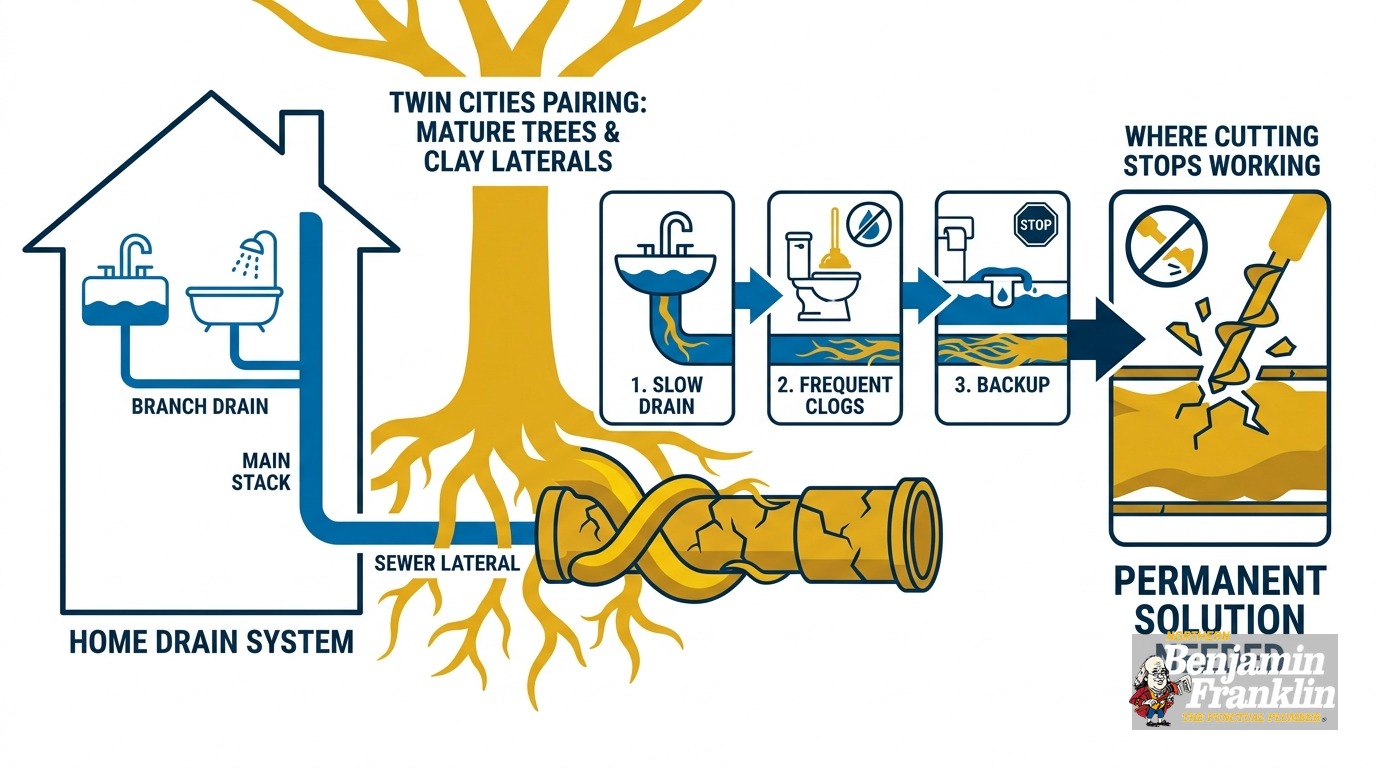
- Minneapolis and St. Paul residential laterals are largely clay pipe installed from the 1890s through the mid-1900s. The boulevard trees planted in those same decades are now fully mature, with root systems as wide as their canopies.
- Symptoms escalate in a predictable order: multiple fixtures draining slowly, gurgling sounds, foul sewer odor, wet yard patches, sewage backup into the home, and eventually a sinkhole.
- Mechanical root cutting clears the blockage but does not repair the pipe. Roots grow back faster after each cycle once the path is established.
- In both Minneapolis and St. Paul, homeowners own the full sewer lateral to the city main. That includes the section under the boulevard and the street.
- Both cities offer financial programs to help pay for lateral repairs without requiring full payment upfront.
- Call Northern Benjamin Franklin Plumbing at (763) 296-1844 for a camera inspection and a straight diagnosis before committing to any repair.
Why Tree Roots in Sewer Lines Are a Twin Cities-Specific Problem
Most cities deal with a generic version of this problem. Minneapolis and St. Paul deal with a specific one. It traces directly to when and how these neighborhoods were built.
Clay became the preferred pipe material for Minneapolis sewer lines around 1896. It remained the standard for residential lateral construction through the mid-1900s. Most pre-1960 homes in the metro sit above clay laterals that are 60 to 130 years old today.
Those same decades brought the city’s boulevard tree plantings. Silver maples, willows, and poplars went into the ground along residential streets across Minneapolis and St. Paul. These species are fast-growing. They are aggressive moisture-seekers. Today, those trees are fully mature. Their root systems reach as far underground as their canopies reach above.
Minneapolis and St. Paul rank among the most tree-canopied cities in the country. That is part of what makes these neighborhoods distinctive. It also means that deep, wide root networks run through the same soil where aging clay laterals are buried.
Clay pipe is assembled in short sections joined end to end. The bell-and-spigot joints between sections are sealed with material that degrades over time. A small gap releases warm, moist sewer gas into the surrounding soil. Roots follow that signal directly to the pipe.
Minnesota’s climate adds another layer of pressure. Twin Cities frost depth runs 42 to 60 inches. That is the same burial range as residential sewer laterals. Every winter, the soil at that depth freezes and shifts. Every spring, it thaws and settles. That annual movement cracks clay joints and opens new root entry points each season.
Clay soil, common throughout the Twin Cities metro, retains moisture. It draws roots toward the lateral even before the first crack forms. Aging clay pipe, fully mature moisture-seeking trees, and decades of freeze-thaw cycles create a predictable outcome. Tree root intrusion in Twin Cities sewer lines is not a random event. It is the result of infrastructure aging exactly as expected.
What Are the Warning Signs of Tree Roots in Your Sewer Line?
Multiple fixtures draining slowly at the same time is the clearest early warning. A single slow drain points to a localized clog, not a main line problem. When two or more fixtures are sluggish together, the problem is in the main lateral. In an older Twin Cities home with boulevard trees nearby, roots are the most likely cause.
That single distinction is the most reliable self-triage step before calling a plumber.
Watch for these additional signals, roughly in the order they develop:
Gurgling sounds from toilets or drains. When you flush and hear gurgling from a nearby drain, air is trapped behind a partial blockage in the main line. A root mass reduces flow enough to push air back through fixture traps.
Recurring clogs on the same line. If a drain or toilet backs up every few months after being cleared, the cause is not grease or debris. Roots are growing back through an established entry point. Each recurrence tends to come faster than the last.
Sewer odor from drains or the yard. A cracked pipe joint releases sewage gas into the home or the surrounding soil. You may notice it near basement floor drains, or as an outdoor odor along the path of the lateral through the yard.
Wet or unusually green patches in the yard. A section of lawn that stays greener or softer than the rest, even during a dry stretch, may sit above a leaking lateral. Sewage seeping into the soil acts as fertilizer and holds moisture there.
Sewage backing up into the basement. Water or sewage coming up through the floor drain or the lowest fixture in the house signals a near or complete blockage. This is an emergency.
A sinkhole or depression in the yard. Soil eroding into a collapsed pipe section creates a void at the surface. The pipe has failed in that section, and the surrounding soil is no longer stable. This is also an emergency.
For more on the difference between a fixture clog and a main line problem, our post on slow drains and what they signal covers that threshold in plain terms.
The Severity Ladder: When to Schedule, When to Call Today
Root intrusion follows a progression. Knowing where you are on it tells you how urgently to act.
Early stage. One fixture is slow and it has happened once. This is most likely a localized clog. A standard drain clearing resolves it. No camera inspection needed yet.
Developing stage. Two or more fixtures are sluggish at the same time. You have cleared the same drain more than once in the past year. Gurgling sounds are becoming regular. At this point, request a camera inspection alongside the clearing. You want to see the pipe condition before committing to another round of rooter service.
Active stage. Clogs are returning within weeks of clearing. Sewer odor is present indoors or in the yard. Wet patches are appearing along the lateral path. This lateral has structural damage. Continued cutting is managing a symptom rather than the problem.
Emergency. Sewage is backing up into the home. A sinkhole has appeared in the yard. These are same-day calls. Do not run water or flush until the line is cleared.
The practical threshold the plumbing industry uses: if you have cleared the same main line more than once in 12 months, rooter service has stopped working. A camera inspection is the right next step.
When Does Rooter Service Stop Working on Tree Roots?
Mechanical root cutting clears the obstruction, but it does not repair the pipe. Roots regrow through the same entry points, often faster with each cycle, because the path is already established. When camera inspection reveals cracked, offset, or collapsed sections, cutting provides only temporary relief. The pipe structure itself must be addressed.
This is the central misunderstanding about a recurring root problem.
A rotating cutter shears the root mass back to the pipe wall and restores flow. It does not close the crack the roots came through. It does not re-seal the joint. The roots are alive in the soil. They have a warm, moist channel. They return.
In clay pipe that is still structurally sound, periodic cutting is a legitimate management strategy. It extends the life of the lateral and defers replacement. That calculus changes when the pipe has fractured, when a joint has been pushed apart by root pressure, or when soil movement has offset a section. At that point, every rooter service buys a few months of flow before the cycle repeats. Roots return faster each time because the entry channel is wider and better established.
A camera inspection tells you which situation you are in:
- Clean interior wall with surface root hairs: mechanical management may still be viable.
- Open joints with roots entering through defined gaps: lining may solve it permanently.
- Fractured or collapsed sections: excavation and replacement are required.
If you have cleared the same main line more than once this year, a camera inspection is overdue. Our post on sewer line camera inspections explains what the process involves and what the findings typically mean.
What Are Your Repair Options for a Root-Damaged Sewer Line?
Three paths exist: periodic clearing for intact pipe with early intrusion, trenchless pipe lining for cracked but structurally present pipe, and open-cut replacement for collapsed or severely offset sections. Camera inspection determines which applies. Starting with a scope keeps you from paying for the wrong repair.
Mechanical clearing and hydrojetting. For laterals that are still structurally sound, scheduled clearing or high-pressure hydrojetting manages root growth and defers replacement. Hydrojetting cuts through root masses more thoroughly than standard mechanical cutting and leaves pipe walls cleaner.
Cured-in-place pipe lining (CIPP). CIPP is the trenchless repair option for laterals with cracked joints or minor fractures that have not collapsed. A resin-saturated liner is inserted into the existing pipe and cured in place. The result is a seamless, jointless pipe inside the old one with no joints for roots to enter. It covers most residential lateral diameters and requires no excavation of the yard or boulevard.
Open-cut replacement. When sections have collapsed, when offset is too severe for lining, or when the pipe is simply too deteriorated, excavation and replacement are required. Minneapolis requires a permit for lateral repair or replacement. Factor that permit timeline into your planning.
Our team handles sewer line repair and replacement and drain clearing across the Twin Cities metro. We scope the line before recommending a repair path so you understand what you are paying for and why. If a full lateral replacement is the answer, ask about financing options when you call.
Who Owns the Sewer Lateral in Minneapolis and St. Paul?
In both Minneapolis and St. Paul, the homeowner owns the full sewer lateral from the house to the connection at the city main. That includes the section running under the boulevard and the street. The city owns only the main itself. Most homeowners do not know this until a problem surfaces.
The property line ends at the curb. Lateral responsibility does not.
In Minneapolis, the homeowner is responsible for maintaining, repairing, and replacing the sanitary lateral for its full length. If root damage is in the section under the street, that repair is on the homeowner.
In St. Paul, the same rule applies. Homeowner responsibility runs from the property to the main line connection point.
This distinction matters for scoping the work. A lateral that runs from the basement to the main under the centerline of the street is a larger project than one that stops at the property line. Knowing the full scope early allows you to plan the budget, pull the permit, and explore city assistance programs before an emergency forces the issue.
Does Financial Assistance Exist for Sewer Lateral Repairs in the Twin Cities?
Yes. Both Minneapolis and St. Paul offer programs that allow homeowners to repair or replace a sewer lateral without paying the full cost upfront. Neither program is limited to low-income households. Both cities have a stake in getting aging private laterals repaired, and these programs reflect that.
Minneapolis: Private Sewer Lateral Assessment Program. When upfront payment is not feasible, the city can cover the repair cost and allow the homeowner to repay through property taxes over time. The program requires three competitive bids and the use of a City Target Market Program contractor. The property must be within Minneapolis city limits.
St. Paul: Sewer Assessment Program. St. Paul offers a low-interest loan for lateral repairs, repaid over 20 years. Most St. Paul property owners are eligible. A separate deferred emergency loan is available for low-income households facing urgent repairs.
If the cost of a lateral repair is a barrier, call the relevant public works office alongside calling us. Understanding the contractor and bid requirements early, particularly the Minneapolis program’s contractor rules, keeps the process on track from the start.
What Can You Do to Reduce Root Intrusion Risk?
The most impactful steps are a baseline camera inspection and preventive clearing on older clay laterals. Knowing the current pipe condition is the starting point. Proactive maintenance costs far less than an emergency call and gives you time to plan rather than react.
You cannot move a boulevard tree. You cannot change what the city planted six or seven decades ago. But a few steps can slow root progression and catch damage early.
Get a baseline camera inspection if your home was built before 1970 and has never had a scope. This is the starting point for any maintenance strategy.
Schedule proactive clearing on older clay laterals with known boulevard tree coverage. If a neighbor has had root problems and your trees are similar, your lateral is under similar pressure. Annual or biennial clearing is cheaper than an emergency service call.
Flush only toilet paper. Wipes, paper towels, and similar materials accumulate at partial root blockages. They push a manageable restriction into a full backup faster than most homeowners expect.
Be selective when planting near the lateral path. If you are landscaping near the line through the yard, avoid willows, silver maples, and poplars. A certified arborist can recommend lower-risk species.
Call Northern Benjamin Franklin Plumbing for a Camera Inspection
Tree roots in a sewer line are a manageable problem when you find them early. They become a far more expensive one when a cracked clay lateral deteriorates into a backup, a sinkhole, or an emergency replacement.
Northern Benjamin Franklin Plumbing is locally owned and operated in the Twin Cities. We know the housing stock, the soil, and the boulevard trees that line these neighborhoods. When you schedule with us, you get a confirmed arrival window. The On-Time Guarantee(R) stands behind every appointment. If there is any delay, it’s you we pay!
Call (763) 296-1844 or book online to schedule a camera inspection or drain service.
Frequently Asked Questions
How do I know if tree roots are in my sewer line? +
Does Minneapolis have a program to help pay for sewer lateral repairs? +
When does rooter service stop working on tree roots in a sewer line? +
Need a technician now?