
Sewer Backup vs. Clogged Drain: Know the Difference
Key Takeaways
- One slow drain, nothing else affected: most likely a local clog in a single branch pipe.
- Multiple fixtures backing up at the same time: almost certainly a main line blockage.
- The lowest-floor fixtures show main line symptoms first. Basement floor drains, ground-floor tubs, and showers fill before anything upstairs does.
- The moment you see cross-fixture backup, stop using all water in the house. Every flush adds sewage volume that has nowhere to go.
- A plunger does not fix a main sewer line blockage. Using one can push sewage into other fixtures.
- In Minneapolis, your sewer lateral is your responsibility from the foundation all the way to the connection at the city main. That includes the pipe under your sidewalk.
- A permit is required to repair a sanitary lateral in Minneapolis.
Is it a sewer backup or a clogged drain?
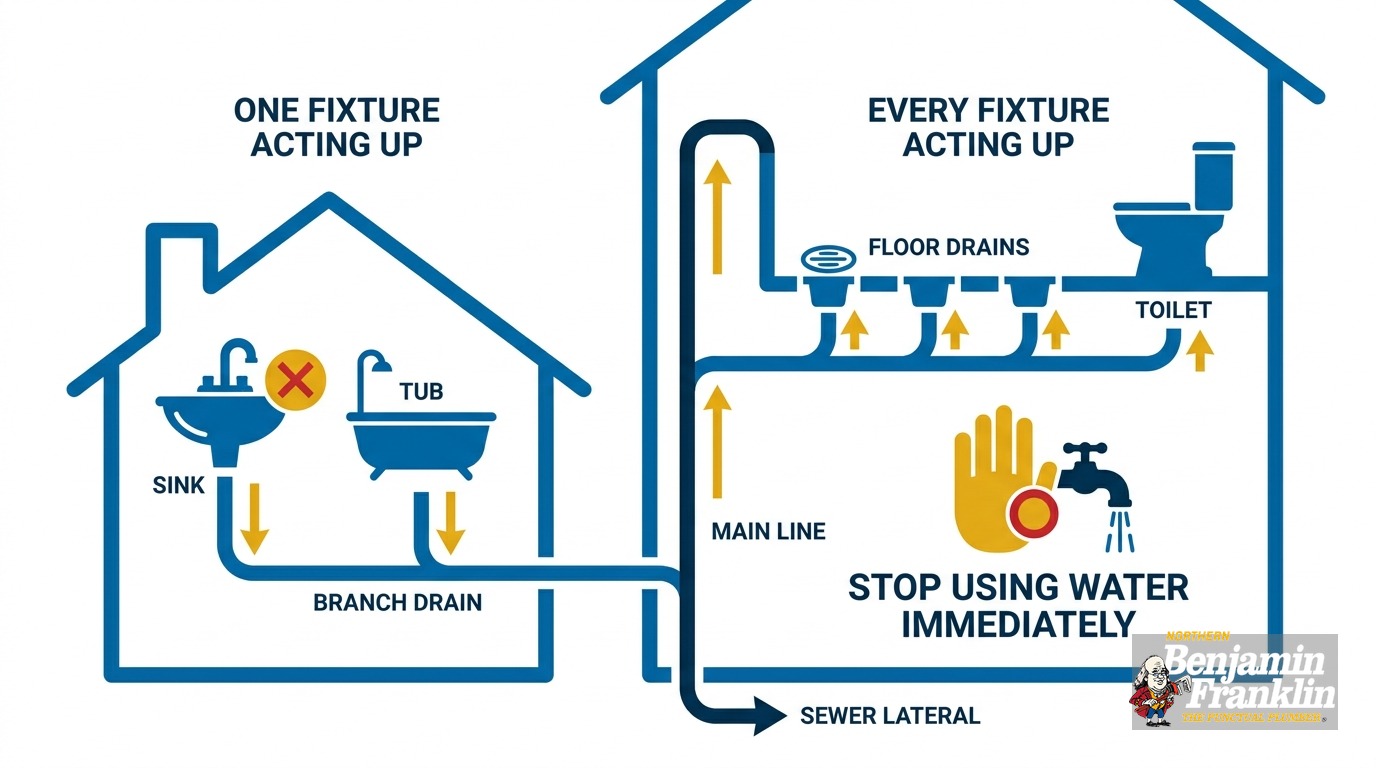
A single slow drain is a local clog. When two or more unconnected fixtures act up at the same time, the main sewer line is almost certainly blocked.
The fastest test is simple. Flush the toilet on your lowest floor and watch the tub or shower drain in the same bathroom. According to Mr. Rooter, water bubbling up in the tub or shower while the toilet flushes means the main line is blocked. One slow fixture with everything else working normally points to a local clog.
That one distinction changes everything about what you do next.
A local clog lives in a branch pipe: the section of pipe between one fixture and the main stack. It backs up one sink, one toilet, or one shower. The rest of the house drains normally.
A sewer backup is a blockage in the main line, the single pipe that carries every drain in your home out to the city sewer in the street. When that pipe is blocked, sewage has one direction to travel: backward into your house. It rises at the lowest available opening first.
Both problems can start quietly. Both can escalate quickly. The tell is the pattern of which fixtures are acting up, and when.
The fixture test: which drains are acting up together?
This is the diagnostic most guides skip. It is not just about which drain is slow. It is about the pattern across multiple fixtures.
One fixture is slow; nothing else is affected.
Your kitchen sink drains slowly. The bathroom next to it works fine. The basement shower is normal. This is almost certainly a local clog in the branch pipe between the sink trap and the main stack. Grease, food debris, and soap residue build up in that short run of pipe over time. A professional drain clearing handles it cleanly. If you want to understand when to try something yourself versus when to call, read our guide on drain clogs and when to call a plumber.
Fixtures in the same cluster act up.
Two bathrooms sharing the same branch line might both drain slowly. That is still likely a local clog, just farther up the stack where both branches share a common run of pipe. One fix point, one problem.
Fixtures on different floors and in different areas of the house act up at the same time.
This is the main line pattern. You run the washing machine and the basement floor drain backs up. You flush the upstairs toilet and the ground-floor tub gurgles. You run the kitchen sink and a toilet on the other side of the house rises.
Those two fixtures share no branch pipe. The only thing they share is the main sewer line. Cross-fixture backup is the clearest sign you have a main line blockage, not a local one.
Sewage flows downhill. When the main is blocked, backed-up sewage takes the path of least resistance and rises in the lowest available opening in your home. That is why basement floor drains and ground-floor fixtures show symptoms before anything on an upper floor. The symptom sequence, not just the presence of a slow drain, tells the story.
Sewage or water is standing at the cleanout cap.
Check your sewer cleanout, usually a capped pipe near the foundation or just outside the house. If water or sewage is standing at the cap, the blockage is confirmed and is located between your house and the main in the street. Stop using water in the house now and call a plumber.
A few additional signs that point toward the main line:
- Gurgling from drains or toilets when water runs elsewhere in the house.
- Toilet water level rises when a nearby sink drains.
- Basement floor drain or lowest-floor tub fills when fixtures on upper floors are in use.
- Sewer smell coming from drains or floor drains in the basement.
One of these signs, alone, with everything else working normally: investigate the local branch first. Two or more together, or any fixture with sewage backing into it: treat it as a main line backup.
What should you do the moment multiple fixtures are affected?
Stop using all water in the house and call a licensed plumber. That means sinks, toilets, dishwasher, and washing machine. Do not wait to see if it clears on its own.
Here is why the stop-immediately rule matters so much. When the main line is blocked, every gallon you send down any drain cannot move toward the street. It backs up into the lowest available opening in your home. Usually that is a basement floor drain, a ground-floor tub, or a shower.
The more water you use, the more sewage volume enters your living space. What might be a cleanup confined to a utility room floor turns into a job that spreads across finished areas on multiple floors.
The EPA estimates the U.S. sees between 23,000 and 75,000 sanitary sewer overflows per year in collection systems alone, not counting backups into buildings. The agency notes that backups cause property damage and threaten public health. When sewage enters your living space, it crosses from a plumbing problem into a health problem fast. Stopping water use does not fix the blockage. It limits the damage while you wait for a plumber.
Why does using water make a sewer backup worse?
Every additional use adds sewage volume to a system with no exit. That volume rises until it finds the lowest opening in your home.
Think of the blocked main line as a pipe with a cap at the far end. Anything you send from above piles up behind the cap. The low points in your house are the release valves when pressure builds: floor drains, tub drains, basement showers. Sewage rises until it finds those openings and comes out.
There is also a cleanup cost dimension. Sewage that reaches drywall, subfloor, or insulation creates a remediation job alongside the plumbing repair. The faster you stop adding volume, the smaller the affected area. In a backup situation, every flush genuinely matters.
Should you use a plunger or drain cleaner on a suspected main line backup?
No. A plunger is designed for local clogs in a single fixture. It creates pressure in a short section of pipe. It will not dislodge a blockage in the main line and can push sewage into other fixtures.
Chemical drain cleaners carry the same limitation. They dissolve organic material in a small section of pipe near the drain. They do not reach a blockage deep in the main, and they do not cut through root intrusion or remove solid debris. Pouring them down a backed-up drain when the main is blocked means the chemicals sit in standing sewage and eventually back up with it.
If you have one slow sink and you are confident nothing else in the house is affected, a plunger is a reasonable first attempt. If multiple fixtures are involved, skip the hardware store. Using the wrong approach on a main line backup costs time and can cause more damage than the original blockage.
What causes a main sewer line to back up in the Twin Cities?
The most common causes are grease buildup, root intrusion, and freeze-thaw cracking. In older Twin Cities homes, clay and cast iron laterals are especially vulnerable to soil movement and root entry.
The EPA identifies grease, roots, and debris as the leading causes of sanitary sewer blockages nationwide. Two local factors make this a sharper problem in Minneapolis and St. Paul than in warmer parts of the country.
Tree root intrusion. The Twin Cities has a dense urban canopy of boulevard elms, oaks, and silver maples. Roots seek moisture, and sewer lines carry warm, humid air and a reliable water supply. Any small crack or loose joint is an entry point. Roots enter, grow, and eventually fill the pipe. Once inside, they are not going away on their own. You can read about what the full process looks like and what fixes it in our post on tree roots in sewer lines in Minnesota.
Freeze-thaw pipe cracking. Minneapolis and St. Paul homes built between the 1950s and 1980s typically have clay or cast iron laterals. Freeze-thaw cycles shift the soil around those buried pipes season by season. Cracks form. Dirt infiltrates and mixes with grease to create stubborn, hard-to-clear blockages. A cracked lateral also allows groundwater into the system. That added load during spring snowmelt or a heavy rain event raises the risk of backup for every home on the same run. The damage accumulates quietly, pipe season by season, until a backup forces the issue.
Grease accumulation. Cooking fats and oils cool as they move through the pipe. They solidify on the walls. Over months and years, that layer thickens until it narrows or blocks the line entirely. Grease buildup is the most preventable cause on this list, and it often combines with root infiltration to create blockages that neither cause would produce alone.
Improper connections. Minneapolis requires homeowners to disconnect roof drains, downspouts, and sump pump discharge lines from the sanitary sewer. These connections feed stormwater into a system designed only for sewage. During heavy rain or rapid snowmelt, the volume overloads the main and can push sewage back into homes on the same line.
If you have had one slow drain for months and are now noticing other fixtures acting up, the problem probably built over time. A sewer line camera inspection shows you exactly what is in the pipe before a backup forces a more expensive conversation.
Who is responsible for the sewer lateral in Minneapolis?
The property owner is responsible for the sanitary lateral from inside the home to the connection at the city main in the street, including that connection point. This goes beyond the property line.
Most homeowners assume their responsibility ends at the property line. Minneapolis Public Works is explicit on this: the lateral does not stop at the property line. The city maintains the mains in the public right-of-way. Everything from your foundation to where your pipe connects to that main is your repair cost, including the section under the sidewalk.
What this means in practice:
- A cracked or root-filled lateral causes basement backup. That is your expense, not the city’s.
- A deteriorated lateral that allows groundwater infiltration adds load to the main and contributes to overflows during weather events. The city will not diagnose or clear your private lateral.
- A permit is required to repair a sanitary lateral in Minneapolis. A licensed plumber typically pulls it. Permits for outdoor sewer repairs are available by calling (612) 673-2451.
The city does clean the public mains on a schedule. Minneapolis Sewer Operations uses CCTV inspection and a historical tracking system to inspect manholes and pipe segments and handles emergency inspections of the public system. Diagnosing and clearing your private lateral is not part of that work.
If the city inspects their main and clears it, the problem is on your side of the connection. For homes built before 1990, a proactive camera inspection of the lateral is worth doing before a backup forces the decision. Clay pipe has a finite lifespan. Freeze-thaw damage adds up year after year without any visible warning above ground.
Drain clog or sewer backup: when to call a plumber
A local clog in one fixture is often a reasonable DIY starting point. A drain snake or a plunger may clear a hair clog near a bathroom drain or break up minor grease buildup close to the trap. If it does not clear in one attempt, stop. Repeated plunging on a stubborn clog can stress older pipes, and forcing the issue on a partial blockage can push material deeper into the line.
Call a licensed plumber directly for any of these situations:
- Multiple fixtures backing up or draining slowly at the same time.
- Sewage smell coming from drains or floor drains in the basement.
- Water or sewage visible at the cleanout cap.
- A drain that clears but backs up again within days or a week.
- Gurgling from other fixtures when water runs somewhere in the house.
- Sewage or dirty water appearing in a tub, shower, or floor drain you did not put water into.
A plumber can put a camera in the line, see exactly what is causing the problem, and clear it with the right method: drain clearing, hydro jetting, or sewer line repair. Getting the diagnosis right costs less than guessing and making it worse.
If you are not sure which situation you are dealing with, the safer move is to stop using water and call. A backup that floods finished space is a far more expensive problem than a diagnostic visit.
Get it diagnosed today
Northern Benjamin Franklin Plumbing is locally owned and operated in the Twin Cities. We serve Minneapolis, St. Paul, Blaine, Bloomington, Brooklyn Park, Coon Rapids, Maple Grove, and the surrounding metro.
When you schedule with us, our On-Time Guarantee(R) covers every visit: we arrive in the window you choose, or we pay you $5 for every minute we are late, up to $300. “If there is any delay, it’s you we pay!” Your visit is also backed by a 100% satisfaction guarantee.
Whether you have one slow sink or sewage backing up across multiple fixtures, we can diagnose it and tell you exactly what it takes to fix it. Call (763) 296-1844 or book online.
Frequently Asked Questions
What is the fastest way to tell a sewer backup from a clogged drain? +
Should I use a plunger if multiple drains are backing up? +
Who is responsible for the sewer lateral in Minneapolis? +
Need a technician now?