
Sewer Smell in House: A Room-by-Room Diagnosis Guide
Key Takeaways
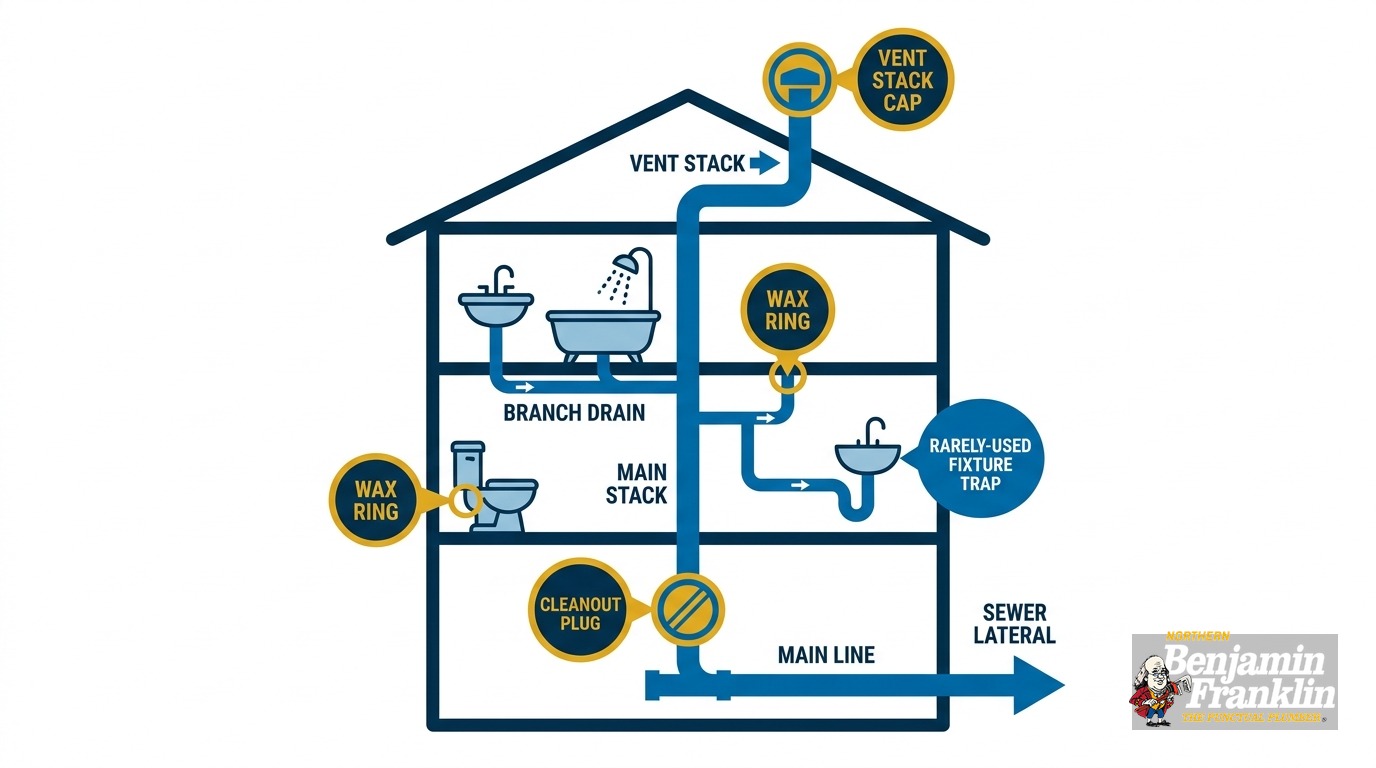
- A sewer smell in house can enter from at least seven places. Most are in the basement and on the roof, not just at bathroom fixtures.
- Work outside-in: start at the roof vent terminal, then the basement cleanout plug, then the floor drain, then rarely-used fixture traps, then the toilet wax ring last.
- A P-trap can dry out in under 30 days. One cup of water is the full fix for a dry trap.
- In a Minnesota winter, a frozen vent terminal pulls water out of every trap in the house at once. The symptom is gurgling from multiple drains, then house-wide smell.
- The wax ring test takes five seconds: grab the toilet bowl and rock it side-to-side. Any movement at the floor means the seal is gone.
- A missing or loose cleanout plug is a direct, unobstructed path to the sewer. National how-to guides do not cover this.
- If the smell is strong, continuous, or house-wide after clearing all DIY checkpoints, call a licensed plumber.
What Causes Sewer Smell in House, and Is It Dangerous?
Sewer gas is a mixture of gases released during waste decomposition in your drain system. Hydrogen sulfide (H2S) is responsible for the rotten-egg odor. At concentrations that trigger your nose, it is an irritant. Above 100 ppm, it becomes an unreliable warning.
According to the CDC’s Agency for Toxic Substances and Disease Registry, humans can detect H2S at concentrations as low as 0.0005 to 0.3 parts per million - far below any health threshold. At approximately 10 ppm with prolonged exposure, the gas causes eye irritation, headache, and fatigue. At 100 ppm, people lose the ability to smell H2S within 2 to 15 minutes. That makes the odor an unreliable safety signal at higher concentrations. Above 500 ppm, the risk of sudden unconsciousness and death is real.
What this means practically: faint smell that comes and goes from one area means you have a plumbing seal problem. Strong, continuous, or room-spreading smell means ventilate immediately and call a licensed plumber. Do not keep investigating in an enclosed space with a persistent strong odor.
The reassuring part: your nose detects H2S at concentrations thousands of times below the danger threshold. If you can smell it, you have time to act.
Why the Diagnostic Order Matters
A sewer smell investigation goes wrong when you skip to the most visible fix. Most homeowners go straight to the toilet or the floor drain. Both are valid checkpoints, but starting there means you may replace a wax ring and still have the same smell the next morning - because the real source was a loose cleanout plug or a frozen vent three floors up.
The protocol here is outside-in and systematic. You start at the roof and work inward. Each checkpoint takes under five minutes. Stop when you find the source. If you clear every checkpoint and the smell remains, you are likely dealing with a cracked line or a sewer lateral problem. That requires a camera inspection and a licensed plumber.
The five checkpoints in order:
- Vent terminal at the roof
- Basement cleanout plug
- Floor drain trap
- Rarely-used fixture traps
- Toilet wax ring and base
That sequence finds the most commonly missed sources first. The wax ring gets the most online attention. But it is the last thing to check.
Is Your Vent Stack Terminal Frozen?
In a Minnesota winter, a frozen vent terminal is one of the most common sources of house-wide sewer smell - and the one homeowners and national how-to articles almost never consider.
Every drain in your home connects to a vent stack that exits through the roof. The stack does two things. It lets air into the drain system so waste flows by gravity. And it prevents siphon pressure from pulling water out of your P-traps when drains run. When the vent terminal seals shut with ice, the drain system goes under negative pressure with every flush or drain cycle. That pressure pulls water out of every P-trap in the house simultaneously.
The symptom is distinctive. Multiple drains gurgle at once - often triggered when someone flushes a toilet or runs a long shower. Sewer smell then spreads through the whole house, not just one room. A single dry trap produces smell at one fixture. A frozen vent affects every fixture in the building at the same time.
Minnesota’s design frost depth is 42 inches. Vent stack terminals exit through uninsulated roof penetrations with no heat source. During sustained cold stretches - the minus-20 stretches that hit Minneapolis and the surrounding suburbs in January and February - condensate from warm air rising through the pipe freezes at the terminal opening and gradually seals it solid.
The field test: check your drains during or after a sustained cold snap. Gurgling plus house-wide smell is a frozen vent until proven otherwise.
The fix: carefully pour hot water into the vent from the roof to release the ice cap. Heat tape wrapped around the terminal is the longer-term solution. If the roof is steep or icy, or the terminal is difficult to reach safely, call a plumber. Diagnosing a vent freeze does not require climbing a frozen roof.
For more on what gurgling drains signal, see our guide to drain gurgling and plumbing vent problems.
How Do You Check the Basement Cleanout Plug?
The cleanout plug is a large threaded cap on the main drain stack in your basement. A missing or loose cap is a direct, unobstructed connection to the sewer - and no national plumbing guide mentions this as a source of sewer smell in house.
The main sewer cleanout is an access point built into the main drain stack. Plumbers use it to run a rooter cable or a camera into the line. During that work, the technician removes the cleanout plug. It gets cracked during removal, threaded back on loosely at the end of the job, or occasionally set aside and left off entirely.
Walk your basement. Look for a capped pipe, typically 3 to 4 inches in diameter, coming off the large central stack near the floor or wall. There is usually a square or hex nut head on the cap. Grab it and try to turn it by hand. A properly installed plug takes a wrench to move. If it turns freely, tighten it with an adjustable wrench. If it is visibly cracked, replace it. If it is missing, you have an open sewer entry into your home.
A cracked cleanout plug produces intermittent smell. The negative pressure in the drain system pulls gas through the crack during and after water use. The smell seems to rise from the basement generally, with no obvious point source - which is exactly why homeowners and online guides both miss it.
Replacing a cleanout plug is a minor repair. A rubber test cap or a threaded plastic replacement is available at any hardware store. But if the plug was missing after recent rooter work, have the sewer line inspected. Work on the line may have left debris or a partial blockage contributing to the pressure differential.
For a full walkthrough on finding your cleanout and what it accesses, see how to find and use your main sewer cleanout.
Is the Floor Drain the Source of Sewer Smell in House?
The basement floor drain is the most common single source of intermittent sewer smell in older Twin Cities homes. Its P-trap can dry out in under a month. In some older homes, the cast-iron drain body has corroded through the trap section entirely.
Bob Vila, citing master plumber Chuck Pound, explains it directly: “A sink drain can go dry in under 30 days, leaving a direct path for sewer gasses.” Floor drains often go months without use. Many Twin Cities basements have a floor drain that has not seen water since the last time a washing machine hose failed - sometimes years ago.
The fix for a dry floor drain trap is one cup of water poured directly into the drain. That refills the P-trap and restores the water seal. For a drain that dries out within a week, add a tablespoon of vegetable oil on top. The oil floats on the water surface and slows evaporation.
If you pour water and the smell returns within 48 hours, the trap itself may be compromised. Corrosion in an old cast-iron floor drain body can erode through the trap section over decades. Water poured in flows straight past and never forms a seal. A plumber can inspect the drain body and replace it if the trap is gone.
For a deeper look at floor drain traps and the smells they cause, see dry floor drain trap: causes and fixes.
Why Are Rarely-Used Fixture Traps Easy to Miss?
Any fixture that goes weeks without use has a P-trap that can dry out just like a floor drain. A basement bar sink, a laundry tub, or a guest bath used three times a year are all candidates - and all easy to overlook in a smell investigation.
Most homeowners focus diagnostics on the fixtures they use daily: the kitchen sink, the main bathroom. A finished basement with a wet bar, a second bathroom used only when guests visit, or a laundry tub sitting idle through winter can all produce sewer smell months after the last time they saw water.
Minnesota Plumbing Code requires a trap on every fixture drain to prevent sewer gas from entering the building. A dry trap means that requirement is present but not performing. Running water is the maintenance act that keeps it working.
The check is fast. Run each of these fixtures for 10 seconds - enough to refill the trap:
- Laundry tub or utility sink
- Basement bathroom sink, shower, or tub
- Bar or wet bar sink
- Any bathroom on a floor you rarely use
Running each one briefly, once a month through winter, takes under two minutes and prevents the problem entirely.
If a trap goes dry within days of refilling, even with regular use, the vent line serving that fixture may be partially blocked. A blocked vent siphons the trap water out quickly, and the smell returns no matter how often you run the tap. That pattern points to a venting problem and warrants a plumber.
What Is a P-Trap, and Why Does It Dry Out?
A P-trap is the curved pipe section under every sink and behind every toilet. It holds a small amount of standing water that blocks sewer gas from entering the room. When a fixture goes unused, that water evaporates and the gas barrier disappears.
Bob Vila’s plumbing resources put it plainly: “Every plumbing fixture that connects to the house sewer system will have a P-trap in it that needs to be kept full of water.” The trap is not a clog risk. It is a gas seal. The water in the low curve of the P is there by design.
In a home where some fixtures go weeks between uses, that water evaporates in under four weeks. In a Minnesota winter, forced-air heating pulls humidity out of indoor air more aggressively than a humid summer climate would. That drier air speeds up P-trap evaporation.
The geometry is simple. Water in the curve blocks the gas path from the drain system to the room. When the water is gone, there is nothing in the way.
Running each infrequently used fixture for 10 seconds once a month is the full prevention strategy. No chemicals, no tools, no special knowledge required.
How Do You Know If the Wax Ring Has Failed?
Grab the toilet bowl at the sides near the tank and rock it gently side-to-side. Any movement where the base contacts the floor means the wax ring has failed. A broken seal is a direct sewer gas entry point at every flush.
This five-second test is the diagnostic step that national guides leave out. The wax ring seals the toilet flange to the toilet base, forming both a watertight and gas-tight connection. If the toilet moves at all on the floor, that seal is broken - even when no water is visible at the base.
Other signs that point to a failed wax ring:
- Sewer smell that gets noticeably worse immediately after flushing
- Water or discoloration at the base of the toilet after a flush
- Soft, spongy, or stained flooring immediately around the toilet base
Replacing a wax ring means removing the toilet, scraping the old ring off the flange, and setting a new one before resetting the bowl. It is a moderately involved DIY repair. If the toilet flange is cracked, the floor bolts are corroded, or the subfloor feels soft during the repair, stop. Those conditions escalate the job past standard DIY scope.
For a complete guide to wax ring replacement, see toilet leaking at base: wax ring fix.
When Does Sewer Smell in House Require a Plumber?
Call a plumber when you have cleared all five DIY checkpoints and the smell remains, when the smell is strong and continuous, or when you find physical damage - a cracked flange, a corroded drain body, or a cleanout plug that was missing rather than just loose.
The five-step protocol covers the causes a homeowner can address without specialized tools or training. When all five checkpoints are clear and the smell persists, the source is likely one of these:
- A crack in the drain line or main stack
- Root intrusion in the sewer lateral
- A broken vent stack below the roofline
- A failed pipe connection inside a wall
All four require a camera inspection to diagnose. You cannot see or repair any of them from the basement floor or the bathroom.
Minnesota homeowners own the sewer lateral from the foundation wall to the public main in the street. If root intrusion or a crack sits in that stretch, the repair is yours to manage. Both Minneapolis and Saint Paul maintain lateral inspection and repair programs worth contacting if you have a confirmed lateral problem.
Our locally owned and operated team at Northern Benjamin Franklin Plumbing serves Minneapolis, St. Paul, Blaine, Bloomington, Brooklyn Park, Coon Rapids, Maple Grove, and the greater Twin Cities metro. When you schedule with us, our On-Time Guarantee(R) means we arrive in the window you chose. If there is any delay, it’s you we pay.
Call us at (763) 296-1844 or schedule a service visit online to have a licensed plumber identify the source of the sewer smell in your house - systematically, in one trip.
Frequently Asked Questions
Why does my house smell like sewer but I can't find the source? +
Is sewer gas in the house dangerous? +
How do I test if the toilet wax ring has failed? +
Can a frozen vent pipe cause sewer smell throughout the whole house? +
Need a technician now?