
Sewer Smell in Basement Floor Drain: The Permanent Fix
Key Takeaways
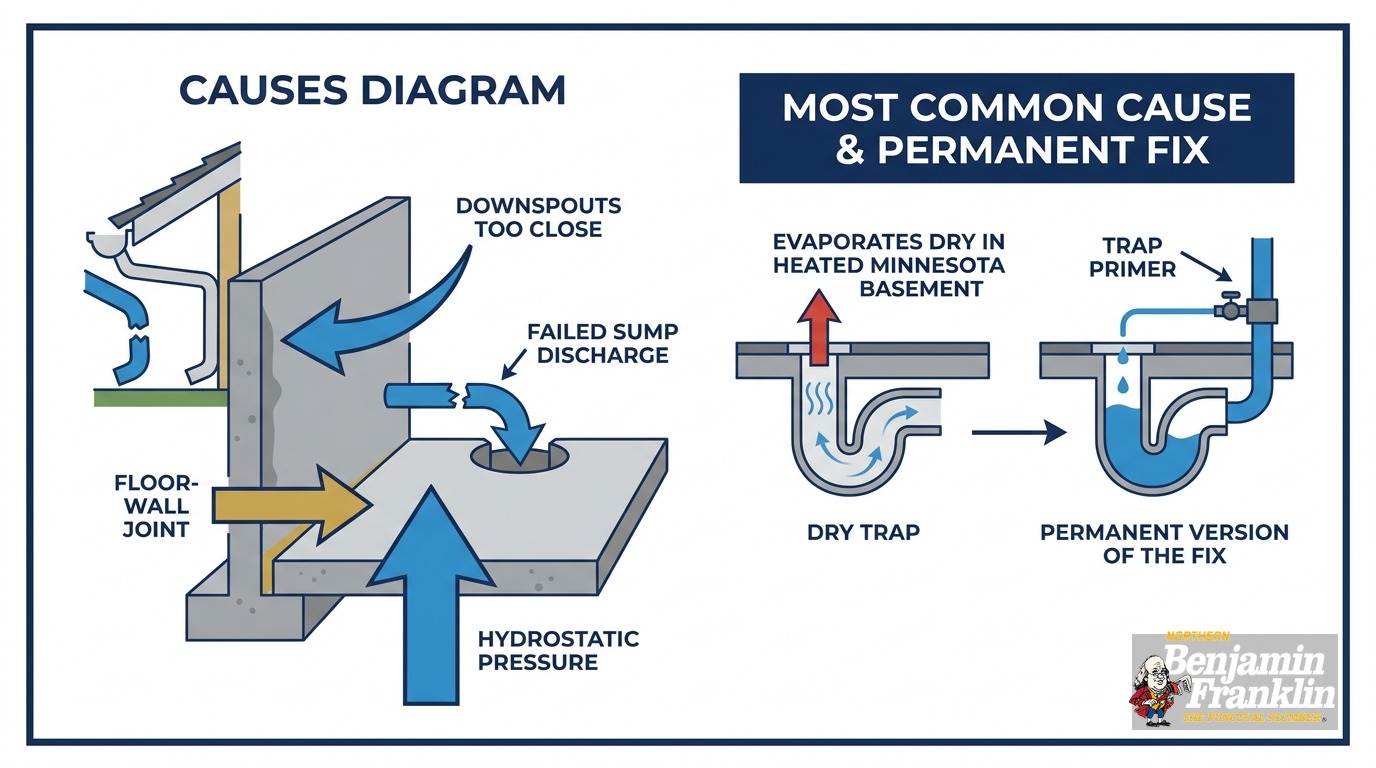
- The most common cause of a sewer smell near a basement floor drain is a dry trap: the water seal has evaporated and sewer gas is flowing up through the opening.
- Minnesota’s forced-air heating drops indoor humidity to 20-30% from October through April. A seldom-used floor drain can lose its full two-inch seal in three to six weeks.
- Sewer gas contains hydrogen sulfide. NIOSH reports it is immediately dangerous to life or health at 300 ppm. It also contains methane, which is flammable.
- The quick fix is pouring water down the drain. It works but needs repeating every few weeks through the heating season.
- The permanent fix is a trap primer: a device a licensed plumber installs that automatically replenishes the seal each time a nearby fixture runs.
- If the smell returns within a day after adding water, or if you hear gurgling when other fixtures run, the problem may not be a dry trap. Call a plumber to diagnose it.
A sewer smell in the basement can appear without warning. No flooded drain, no pipe noise, no visible leak. Just a low rotten-egg odor drifting from the corner where the floor drain sits.
For most homes across the Twin Cities, the explanation is straightforward: the water seal inside your basement floor drain has evaporated. Sewer gas now has a clear path from the sewer line into your home, and it is taking it. The fix is simple. The reason it keeps coming back in Minnesota homes is where most articles stop short, and that part matters more here than anywhere in the country.
What Is Causing the Sewer Smell in My Basement Floor Drain?
The water seal in your floor drain trap has evaporated. A floor drain trap holds a small amount of standing water at all times. That water physically blocks sewer gas from rising up through the drain pipe into your home. When the water evaporates, the barrier is gone and gas comes straight through.
Every drain in your home that connects to the sewer system has a trap. Under your kitchen sink, that is the P-shaped curve in the drain pipe. Basement floor drains work the same way. The trap may be a P-trap configuration just below the concrete slab, or in older Twin Cities homes, a drum trap with a larger water reservoir cast directly into the floor.
Minnesota Plumbing Code, MN Rules Chapter 4715 requires every floor drain to maintain a trap seal at all times. The minimum seal depth is two inches. That sounds like a reliable amount of water to hold. In a dry, heated Minnesota basement, it disappears faster than most homeowners expect.
Why Does a Heated Minnesota Basement Make This Worse?
Forced-air heating drives indoor humidity down to 20-30% through the heating season. At that humidity level, standing water in a seldom-used floor drain evaporates significantly faster than it would in a milder climate. With no water input to offset the loss, the two-inch seal can be gone in three to six weeks, based on trade sources.
In a coastal or Southern climate, indoor humidity stays much higher year-round. A floor drain that hasn’t been used in two months might still hold its seal just fine. In Minnesota, the furnace runs most of the day from October through late April and the indoor air stays dry. The EPA notes that indoor air quality problems arise when pollutant sources combine with inadequate ventilation, and basements have the lowest natural air exchange rate of any room in the house. That combination, dry heated air and minimal airflow, pulls moisture out of everything it contacts, including the standing water in the floor drain.
The floor drain in a utility or unfinished basement typically connects to a laundry standpipe or an emergency overflow for the water heater. If your washing machine does not drain directly into that floor drain and you have never had a flooding event, the drain may not have seen water in six months or more. It is still required to hold a two-inch seal at all times. It almost certainly does not.
Many older Twin Cities neighborhoods, South Minneapolis, Mac-Groveland, Northeast, and the inner-ring suburbs, have homes built before 1970. Basements in those homes tend to have utility-only floor drains that have not been actively used since the original laundry tub was removed or the utility space was reorganized. These drains are the most likely candidates for a dry trap.
Is Sewer Gas From a Floor Drain Dangerous?
Yes. Sewer gas contains hydrogen sulfide and methane, both of which carry real health and safety risks. A faint smell at low concentrations is unpleasant but not immediately harmful. At higher concentrations in a poorly ventilated space, the risk goes up quickly.
NIOSH, the National Institute for Occupational Safety and Health, has established that hydrogen sulfide is immediately dangerous to life or health at 300 ppm. Its recommended 15-minute exposure ceiling is 10 ppm. OSHA’s ceiling is 20 ppm. At 50-100 ppm, hydrogen sulfide causes eye irritation and respiratory symptoms within one hour. At 700-1,000 ppm, rapid unconsciousness follows.
Household sewer gas rarely reaches IDLH concentrations in open living space. A basement with even limited air movement will dilute the gas well below those thresholds in most cases. But a closed basement with minimal air exchange is a different environment. If the smell is strong, open windows and doors first, then address the source.
Methane is the other component worth noting. Its lower explosive limit is 5% in air. A furnace igniter or water heater pilot light can ignite it at the right concentration. Reaching that concentration requires almost no air movement and a sustained leak, which is unlikely in most residential basements. The risk is small, not zero, and it is one more reason a persistent sewer smell deserves a prompt response.
How Does a Floor Drain Trap Work?
The trap is a U-shaped or curved chamber below the drain grate that holds a pool of standing water. That water forms a passive plug: sewer gas cannot rise past it, and water can drain freely through it. No pressure, no electricity, and no mechanism. The seal relies entirely on gravity and pipe geometry.
Water sits in the low point of the curve because it has nowhere to go. As long as the water is there, the trap seals the drain. When it evaporates, the curve holds only air and gas travels freely upward.
The minimum seal depth under MN Rules Chapter 4715 is two inches. Drum traps, which you will find in many Twin Cities homes built before the 1970s, hold a larger water volume in a separate chamber. They are no longer code-compliant for new installations but many remain in service and still function on the same principle: water present equals seal intact; water absent equals seal broken.
Both configurations have the same vulnerability to evaporation. A drum trap holds more water, which may buy an extra week or two. It still dries out during a long Minnesota heating season if nobody is using the drain.
When Is the Dry Trap Problem Most Common in Minnesota?
The heating season: October through late April. That is when forced-air furnaces run continuously and indoor humidity drops to its lowest point. A floor drain that held its seal through the summer will often lose it for the first time in November or December, when heating hours peak and humidity is lowest.
Many homeowners notice the smell in late fall, a few weeks after the heat has been running steadily. Others notice it in January or February, when outdoor temperatures are at their lowest and the furnace is working hardest. A smaller group notices it in March or April, when the ground is still frozen but the heating season is winding down.
The timing tracks indoor humidity, not the calendar. If the smell appeared this fall or winter and you do not recall any recent plumbing work or unusual drain activity, a dry trap is the first thing to check. It is the most common cause and the fastest to test.
The Temporary Fix: Pour Water Down the Drain
Pour two to three gallons of water directly into the floor drain. Use a bucket or a slow hose fill. Let the water settle and wait a few minutes. If the smell stops, you have confirmed the dry trap diagnosis and fixed it at the same time.
This is a legitimate short-term fix. It is just not permanent. In a Minnesota heating season, the new water charge will evaporate in roughly the same time as the previous charge: three to six weeks. You’ll pour water, it evaporates, the smell returns, and you pour water again.
Adding a small amount of cooking oil or mineral oil on top of the water creates a thin surface layer that slows evaporation. It does not stop it. The oil layer extends the interval a few weeks and is worth doing if you choose the monthly-maintenance path.
If you are willing to check the floor drain every three to four weeks from October through April and add water each time, this approach works reliably. Many homeowners do exactly this and never think about the drain again between visits.
If you would rather not manage a seasonal maintenance task, a trap primer handles it automatically.
What Is a Trap Primer?
A trap primer is a small device that automatically replenishes the water seal in a floor drain trap each time a nearby fixture runs. You do nothing. The seal stays intact year-round.
The most common residential type is pressure-differential. A licensed plumber taps the primer into a pressurized cold-water supply line near the floor drain, typically the supply to a utility sink or a nearby lavatory. Each time that fixture runs and then shuts off, a brief pressure change causes the primer to open and deliver a small charge of water to the floor drain trap. The amount is enough to top off the two-inch seal and no more. Over a full heating season, it adds up to a few gallons total.
Electronic or timer-based trap primers use a small solenoid valve and a controller instead of a pressure differential. The valve opens on a set schedule, sending water to the trap once daily or once weekly depending on the setting. Both types are code-compliant and both work well in residential applications. Your plumber can recommend the right type based on your drain configuration and what supply lines are accessible nearby.
A simpler alternative is a trap guard or drain seal cap: a replacement drain grate fitted with a rubber flap or floating seal that blocks gas without relying on water. These devices do not require a supply line connection and are easier to retrofit in some configurations. They work well for many applications. Some plumbers prefer the primer for a full basement floor drain because it maintains a true water seal. Ask your plumber which solution fits your drain.
A properly installed trap primer requires minimal maintenance once it is in. Minneapolis and St. Paul draw water from the Mississippi River, and regional hardness is relatively low, around 50-90 mg/L as CaCO3 per Metropolitan Council environmental services data. Low hardness means less mineral scale buildup in the small orifices of a trap primer. That is a mild advantage for long primer life compared to harder-water markets.
Is Installing a Trap Primer a DIY Job in Minnesota?
No. Trap primer installation is plumbing work under Minnesota law and requires a licensed plumber and a permit from your local municipality. Most Twin Cities cities do not allow homeowners to pull a plumbing permit for their own work. Your plumber handles the permit application as part of the job.
Minnesota Statute 326B.46 governs plumbing licensing in the state. Connecting a device to a pressurized supply line and routing a water feed to a floor drain is a plumbing modification. It falls under the same licensing and permit requirements as any other residential plumbing work.
Your local authority having jurisdiction, the city or county building department, issues the permit. Cities including Minneapolis, St. Paul, Blaine, Bloomington, Brooklyn Park, Coon Rapids, and Maple Grove each have their own permitting offices. The permit means the work gets inspected. An inspected installation protects your home and your homeowner’s insurance coverage if something goes wrong later.
Attempting to tap a supply line without a permit or license creates two risks. The first is a plumbing failure that causes hidden water damage in a wall or subfloor. The second is coverage complications if you file a homeowner’s claim and the insurer discovers unpermitted work. Neither outcome is worth the shortcut.
What If the Smell Doesn’t Go Away After Adding Water?
If the smell persists after adding water, or returns within a day, a dry trap is not the only cause. A cracked trap, a downstream sewer blockage, or a blocked vent stack can all produce sewer gas even when the floor drain trap holds its seal. A licensed plumber can identify the source quickly, often with a camera inspection.
A few specific causes worth knowing:
A cracked or broken trap. Concrete moves over time, and older cast-iron or clay drain components can crack. A crack allows gas to bypass the water seal even when the water level is correct. A camera inspection of the drain line confirms or rules this out in one visit.
A sewer line backup or partial blockage. When a blockage creates pressure in the sewer line downstream, gas can push past functioning traps. A gurgling sound from the floor drain when you flush a toilet or run the washing machine is the clearest sign of this. See sewer backup vs. drain clog: how to tell for a full breakdown of the symptoms.
A blocked or ice-clogged vent stack. Every drain system needs a vent stack that pulls air in and exhausts gas above the roofline. A blocked vent creates negative pressure in the drain pipes, which can siphon water out of traps and draw gas back into the home. In Minnesota winters, ice can seal a vent cap and block the stack entirely. A plumber can check vent function as part of a sewer gas diagnosis.
A slow floor drain that isn’t flushing the trap fully. If the drain empties slowly on the rare occasions it does get used, the flow may not be strong enough to replenish the trap. Slow drains often signal a developing blockage further down the line. A drain snake and camera check can address both the slow drain and the sewer gas question in one visit.
When to Call Northern Benjamin Franklin Plumbing
If adding water fixed the smell and you are comfortable checking the drain every three to four weeks through the heating season, that is a workable approach. Mark it on your calendar and plan to pour water down the drain from October through April.
If you want a permanent fix, call us to install a trap primer. The job typically takes a few hours: tapping into a supply line, running the primer to the floor drain, and pulling the permit with your city. The result is a drain that maintains its own seal year-round with no action from you.
If the smell did not respond to water, or came back within 24 hours, call sooner. A sewer line issue, a blocked vent stack, or a cracked trap are not situations to monitor and wait on. Sewer gas in an enclosed basement is a health concern. Our drains and sewers team diagnoses these issues every week across the Twin Cities, and a camera inspection typically identifies the source on the first visit.
Northern Benjamin Franklin Plumbing is locally owned and operated. We serve Minneapolis, St. Paul, Blaine, Bloomington, Brooklyn Park, Coon Rapids, Maple Grove, and the surrounding metro. When you schedule with us, you get a firm arrival window and the On-Time Guarantee(R): we arrive when we say we will, or we pay you $5 for every minute we are late, up to $300. “If there is any delay, it’s you we pay!”
Call (763) 296-1844 or book an appointment online to schedule a trap primer installation or a sewer gas diagnosis. For more on basement drainage and why Minnesota springs put extra demand on floor drains, read our guide to spring runoff and your basement.
Frequently Asked Questions
Why does my basement floor drain smell like sewer? +
Is sewer gas from a floor drain dangerous? +
What is a trap primer and do I need one? +
Can I install a trap primer myself in Minnesota? +
Need a technician now?