
Basement Floor Drain Backing Up: Causes and What to Do
Key Takeaways
- A backed-up basement floor drain has three distinct causes, each with a different urgency level and a different first action.
- A dried-out P-trap or isolated surface clog is low urgency. Only the floor drain is affected, and all other fixtures work normally.
- A blocked main sewer lateral is high urgency. Multiple fixtures back up or gurgle, especially when the washing machine or another high-volume appliance runs.
- City sewer main surcharge is time-bound high urgency. The backup coincides with heavy rain or spring snowmelt, often with no interior plumbing running at all.
- Minneapolis and West St. Paul both recommend calling the city before calling a plumber when rain or snowmelt is the likely trigger. The city investigates at no charge.
- Standard Minnesota homeowners policies exclude sewer backup. A separate endorsement is required.
- Minneapolis homeowners may qualify for the Private Sewer Lateral Grant: between $5,000 and $10,000 toward lateral repair or replacement. You must apply before work begins.
What Does It Mean When Your Basement Floor Drain Backs Up?
Your basement floor drain sits at the lowest point in your home’s drain system. When something blocks flow downstream, sewage appears there first. The cause might be a dried-out trap you can fix with a bucket of water. Or it might be a blocked lateral that needs a licensed plumber and a city permit.
The gap between those two outcomes comes down to one question: is this floor drain the only fixture affected, or are others involved?
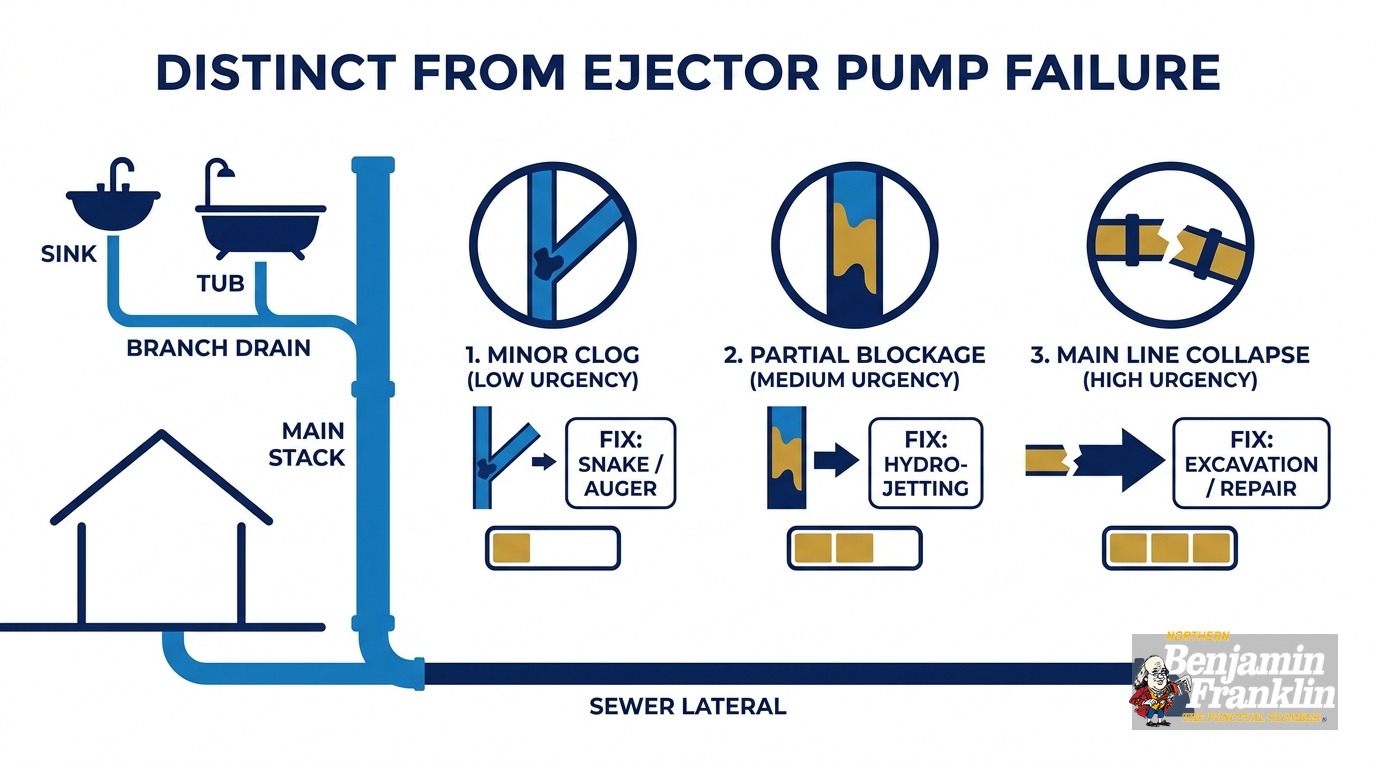
One note before we go further. If your basement bathroom and laundry fixtures are all backing up and the sump pit is full or the pump is silent, that is an ejector pump failure. It is a separate failure mode with its own diagnosis. This post covers the three causes specific to floor drain backup.
Is the Problem in the Floor Drain, or Somewhere Downstream?
Run your washing machine or flush a toilet on the main floor. If the basement floor drain backs up when that fixture runs, the blockage is downstream of the floor drain itself, in your sewer lateral or the city main. If the floor drain is the only fixture affected and everything else runs fine, the problem is local to that drain.
West St. Paul Public Works documents this diagnostic directly: if a backup occurs only when a faucet runs or a toilet is flushed, the blockage is probably in your service lateral. If it occurs with no plumbing running inside the home, the city main is the more likely cause.
Do this test before anything else. It takes three minutes and narrows you to one of the three causes below.
What If Only the Floor Drain Is Affected?
If other sinks, toilets, and showers drain normally and only the basement floor drain is backing up or smelling like sewer gas, the cause is almost always a dried-out P-trap or a surface clog. This is the lowest-urgency scenario and usually does not require an emergency call.
Every floor drain has a P-trap under it: a curved section of pipe that holds a small water reservoir. That reservoir blocks sewer gas from rising into your home. In a floor drain that rarely gets used - a utility room, a mechanical room, a laundry area that only sees foot traffic - that water simply evaporates. When the trap dries out, you get a sulfur smell rather than standing water.
For a sewer gas smell with no backup:
Pour a gallon of water slowly into the drain. Minneapolis Public Works recommends this as routine maintenance for floor drains in Minnesota basements. If the smell returns within a few days, a trap primer is the lasting fix. A trap primer is a small fitting that feeds a trickle of water to the trap automatically to keep it sealed.
For water backing up in only the floor drain:
Remove the grate and run a hand snake into the trap. Most surface clogs clear without a service call. When the snake fails or the clog returns within a few weeks, schedule a camera inspection. A plumber can confirm whether the issue is in the trap or further down the drain branch.
Winter check for Minnesota homes: A frozen roof stack vent produces gurgling drains throughout the house and can mimic a slow clog anywhere in the system. Minneapolis Public Works identifies iced-over stack vents as a seasonal Minnesota problem. If drains are gurgling but none are actually backing up, check the stack before scheduling a plumber.
More on the dry-trap problem: Why a dry floor drain causes sewer smell in your basement and how to fix it
Why Does My Basement Floor Drain Back Up When the Washing Machine Runs?
Your washing machine discharges several gallons in a short burst. When there is a partial blockage in your main sewer lateral, that surge has nowhere to go. It exits at the lowest point in the system: your basement floor drain. Other fixtures may also gurgle or back up at the same time.
This is the most common high-urgency cause of a backing floor drain in Twin Cities homes. The blockage is in the private sewer lateral, which runs from your home’s main cleanout under your yard to where it connects to the city main beneath the street.
Diagnostic signals:
- Multiple fixtures back up or gurgle at the same time
- The floor drain backs up specifically when the washer, dishwasher, or another high-volume appliance runs
- The backup happens with no rain and no city-main complaint from neighbors
What drives lateral blockages in Twin Cities homes:
Tree roots are the leading cause in the metro. Older neighborhoods across Minneapolis, St. Paul, and the first-ring suburbs have mature trees with root systems that follow moisture to sewer pipe joints. Roots enter through small cracks and grow into a mesh that catches grease and debris over years. By the time you notice a backup, the blockage is usually well-established.
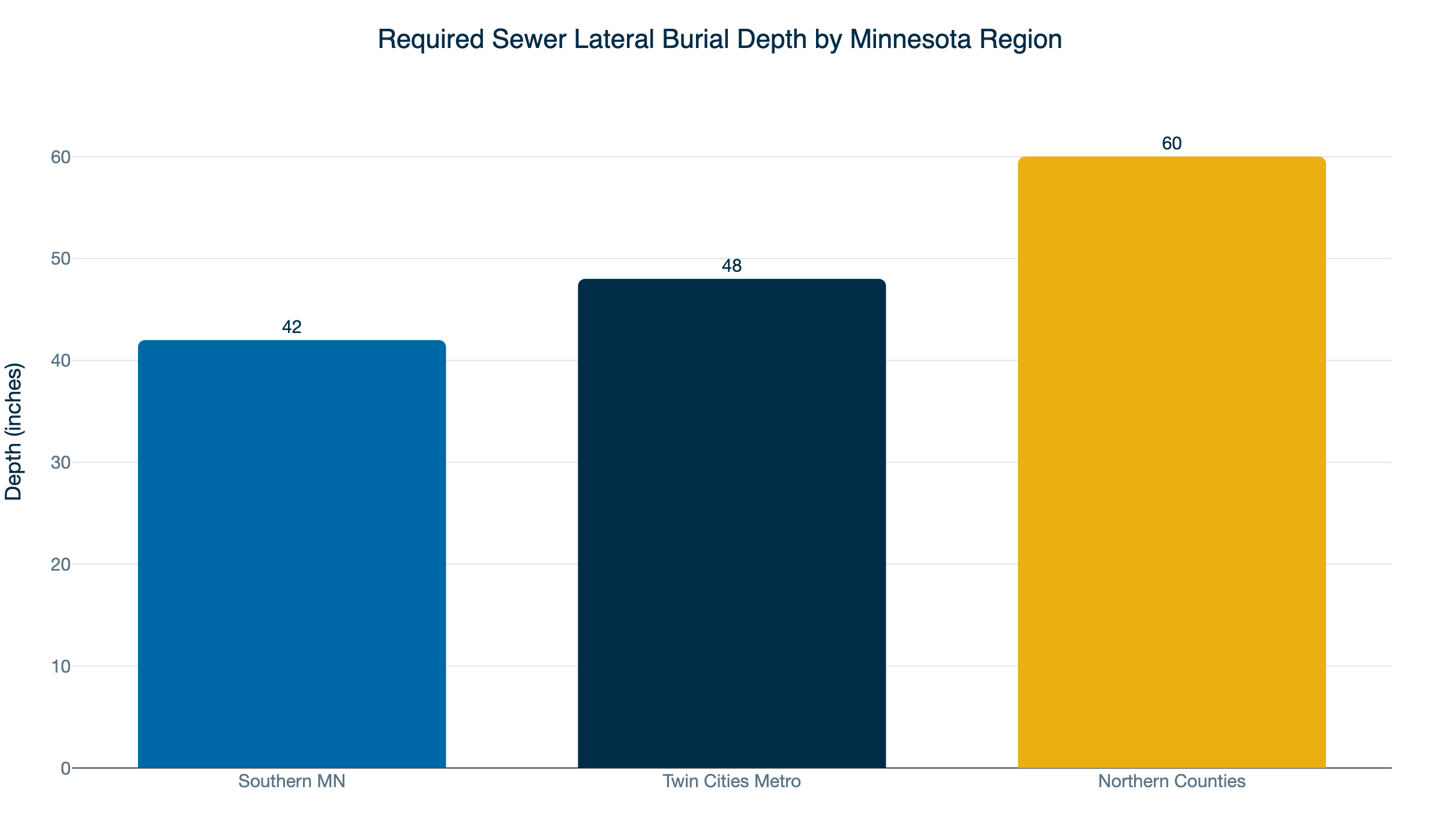
Frost heave is the other Minnesota-specific factor. Twin Cities sewer laterals must be buried at least 48 inches deep to stay below the frost line. Frost depth ranges from 42 inches in southern Minnesota to 60 inches in northern counties. Pre-1970 clay tile and cast-iron laterals develop joint offsets over decades of freeze-thaw cycling. Those offsets become collection points for debris and entry points for root intrusion.
Grease accumulation is slower and less dramatic. It narrows the pipe continuously over years, without a single visible failure event.
What to do:
Stop running water immediately. Adding volume to a blocked lateral makes the backup worse and the cleanup larger. Then call the city to rule out a public main problem before scheduling a plumber (the next section covers that step).
If the city main is clear, a licensed plumber with camera equipment will locate the blockage and give you options: drain clearing, hydrojetting for root-heavy clogs, or lateral repair if the pipe itself is damaged.
Minneapolis requires a permit for any sanitary lateral repair and the work must be done by a licensed plumber. Our team coordinates the permit as part of every lateral job.
For help reading the signals between a clog and a full sewer backup: Sewer backup vs. drain clog: how to tell the difference
Can Heavy Rain or Spring Snowmelt Cause a Basement Floor Drain to Back Up?
Yes. When a city sewer main takes in more volume than it can move, a condition called surcharging, wastewater flows backward through private laterals and exits through the lowest fixtures in nearby homes. That lowest fixture is your basement floor drain. The backup typically appears during or shortly after heavy rain or spring snowmelt, with no unusual plumbing use inside the house.
Spring snowmelt is the highest-risk period in the Twin Cities. A fast melt on still-frozen ground pushes large runoff volumes into aging sewer mains. Homes that see a floor drain backup every spring with no obvious interior cause are likely dealing with surcharge, not a private lateral blockage.
Signals pointing to city main surcharge:
- Backup starts during or shortly after heavy rain or a fast snowmelt
- No interior plumbing was running when it began
- Neighbors on the same block or street are reporting the same problem
What to do:
Stop running water in the house first. Then resist the instinct to call a plumber immediately. If the city main is surcharging, no work on your lateral will solve it. You would pay for a service call that does not fix the underlying cause.
Call the city instead:
- Minneapolis: 311 or the Minneapolis Public Works sewer operations line
- West St. Paul: 651-552-4150
Both cities respond 24 hours a day and investigate public main problems at no charge.
Document everything before any cleanup begins: photos, video, timestamps, and the weather conditions at the time of the backup. That record supports a reimbursement request from the city and any insurance claim you file afterward.
Should I Call the City or a Plumber First?
If the backup coincides with heavy rain or spring snowmelt, call the city first. Minneapolis Public Works says to contact sewer operations before hiring a plumber when you suspect a public main issue. If the main is at fault, the city investigates at no charge and may reimburse repair costs you have already paid.
In Minneapolis, the homeowner owns the sanitary service lateral all the way to the city main. The city is responsible only for the main under the street. If the city’s investigation shows the main is fine, the problem is in your lateral and the repair cost is yours.
That boundary matters when you are deciding who to call and what to authorize. A camera inspection by a licensed plumber identifies exactly where the blockage is. That location - your lateral or the public main - determines who pays and what gets fixed.
If the city main is clear and the problem is in your lateral, our team handles the diagnosis, the permit, and the repair. We are locally owned and operated in the Twin Cities and serve the full metro: Minneapolis, St. Paul, Blaine, Maple Grove, Brooklyn Park, Coon Rapids, and surrounding communities.
Does Homeowners Insurance Cover Sewer Backup in Minnesota?
No, not with a standard policy. A separate endorsement is required for coverage.
The Minnesota Department of Commerce is direct on this: neither flood insurance nor a standard homeowners policy covers damage caused by sewer backup or sump pump failure. If sewage backs up into your basement and damages flooring, walls, or personal property, a standard policy does not pay for it.
A sewer backup endorsement is available as an add-on to most homeowners policies. If you do not have one, contact your insurance agent before you need it. Adding the endorsement is far less expensive than paying for a cleanup and remediation without coverage.
If you are already dealing with a backup, document all damage with photos and video before any cleanup begins. Record timestamps, weather conditions, and any communication with the city. That documentation supports a reimbursement request and an insurance claim.
What Is the Minneapolis Private Sewer Lateral Grant?
A city program that pays Minneapolis homeowners between $5,000 and $10,000 toward the cost of repairing or replacing a private sewer lateral. You must apply before work begins. The program does not reimburse completed work.
The 2026 MCES grant program allocated $248,500 to Minneapolis. Individual grant amounts range from $5,000 to $10,000 and are determined by location using the CDC Social Vulnerability Index. The program is lottery-based, so availability varies year to year.
If you own a home in Minneapolis and face a lateral repair, apply before authorizing work. Our team can advise on what documentation the city typically needs from the plumbing contractor and help you time the work around the application process.
Lateral replacement is one of the larger plumbing costs a homeowner can face. A grant in this range is not a small number. Do not skip this step.
What Happens If You Ignore a Backing Floor Drain?
A dry trap stays a nuisance. A partial lateral blockage gets progressively worse, typically over months, and the end state is sewage on the floor without warning. Acting early costs less than acting late.
Here is how an unaddressed lateral blockage typically progresses:
- Stage 1: Backup when the washer or another high-volume fixture runs. Other fixtures drain normally.
- Stage 2: Backup becomes more frequent. Multiple fixtures drain slowly. The toilet occasionally gurgles.
- Stage 3: Backup happens without an obvious trigger. The blockage has grown large enough to restrict normal household use.
- Stage 4: Full backup. Sewage on the floor. Drain use stops until the lateral is cleared or repaired.
Each stage is more disruptive and more expensive than the one before it. A camera inspection is the low-cost way to know what you actually have: a soft clog that clears in an hour, or a damaged pipe that needs repair.
Getting ahead of slow or intermittent drainage issues is almost always worth the call.
A collapsed lateral in a Twin Cities home means excavation, or trenchless replacement where the pipe geometry allows it. Both cost substantially more than addressing the problem when the first symptoms appear.
When to Call Northern Benjamin Franklin Plumbing
Call us when:
- You cannot clear the floor drain with a hand snake
- Multiple fixtures are draining slowly or gurgling at the same time
- The city has confirmed the public main is fine and the issue is in your lateral
- You want a camera inspection to know what you have before something fails
- You need a permitted lateral repair or replacement
We are locally owned and operated in the Twin Cities. Our On-Time Guarantee(R) means we arrive in the window we book, or we pay you $5 for every minute we are late, up to $300. “If there is any delay, it’s you we pay!”
Call (763) 296-1844 or book a service appointment online.
We handle everything from drain clearing to full sewer line repair and replacement, including trenchless options where pipe condition and layout allow. We coordinate permits on lateral work so you do not have to manage that separately.
Frequently Asked Questions
Why is my basement floor drain backing up? +
Should I call the city or a plumber first? +
Does homeowners insurance cover sewer backup in Minnesota? +
What is the Minneapolis Private Sewer Lateral Grant? +
Need a technician now?