
Upflush Toilet Basement Minnesota: What to Know First
Key Takeaways
- An upflush (macerating) toilet is code-legal in Minnesota for one- and two-family homes, but MN Rules 4714.0710 caps it at one bathroom group: one toilet, one lavatory, and one shower or tub.
- Every upflush installation in Minnesota requires a plumbing permit. The homeowner exemption waives the license requirement only, not the permit or inspection.
- The ¾” discharge pipe is freeze-vulnerable. In cold basements or rarely used winter spaces, it can ice up and block completely.
- If you plan a second below-grade bathroom in the next decade, install an ejector pit now. The concrete work costs the same either way.
- Minneapolis and St. Paul municipal water (5.5-6 GPG after treatment) is easier on macerator motors than suburban well water, but descaling every 3-6 months is still required.
- Macerating units last 10-15 years with regular maintenance. Budget for it from day one.
Adding an Upflush Toilet to a Minnesota Basement
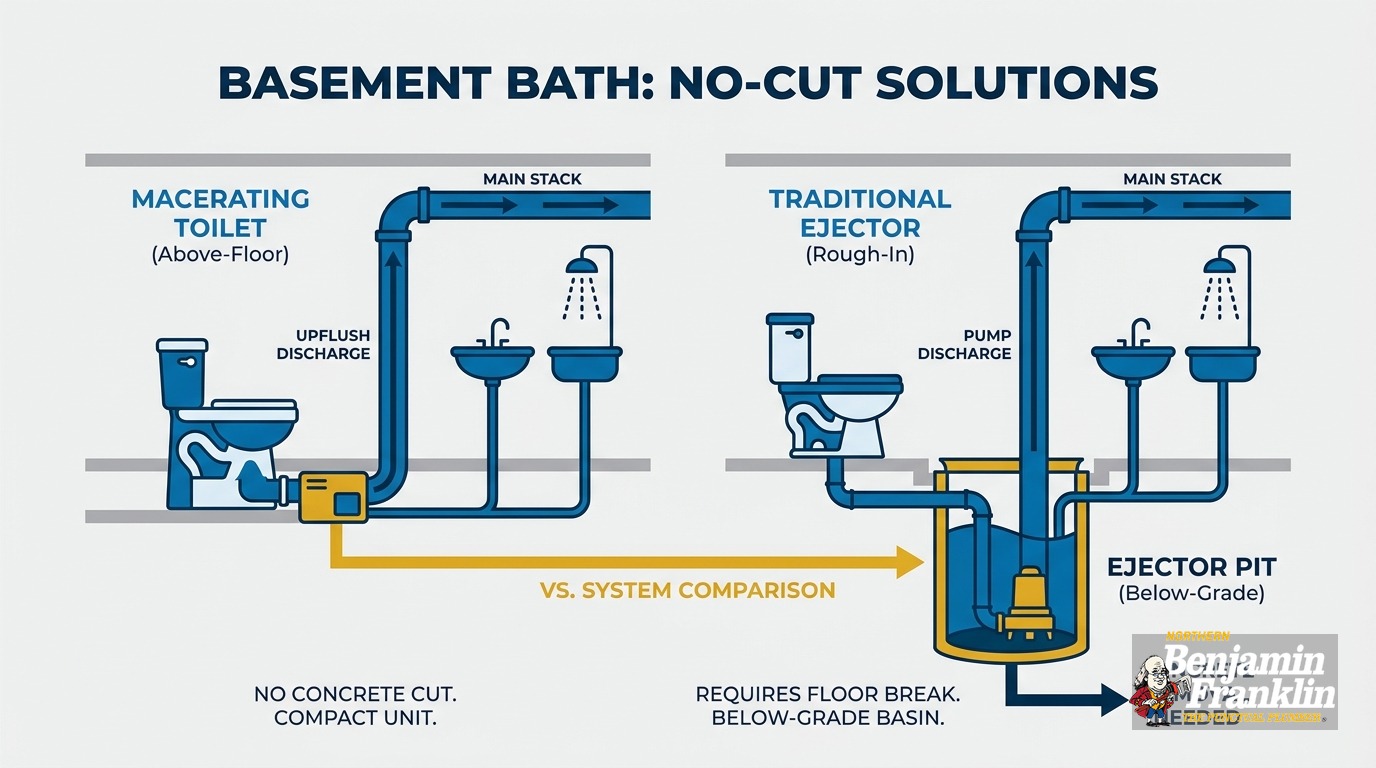
Adding an upflush toilet to your basement is one of the most common calls we get from Minnesota homeowners. The unit sits on top of your finished floor, grinds waste into a slurry, and pumps it up to your existing drain line. No jackhammer. No concrete cutting. Typically done in a day.
That convenience is real. So are three things the product brochures do not explain. The state plumbing code limits what a macerating system can legally serve. The ¾” discharge pipe that makes the installation easy is unusually vulnerable to freezing in a cold Minnesota basement. And every installation, no matter how quick it looks, requires a permit and an inspection.
This guide covers all three issues. It also covers the alternative: the ejector pump system that requires concrete work but carries none of those limitations.
Is an Upflush Toilet Legal in Minnesota?
Yes, for one- and two-family homes when gravity flow is not possible. But there is a hard limit: one bathroom group per system. That means one toilet, one lavatory, and one shower or tub. Nothing more.
MN Rules 4714.0710, §710.13 is the governing rule. It permits macerating toilets only when gravity drainage is not possible, and it caps the system at one bathroom group. One toilet. One sink. One shower or tub. That is the legal ceiling for a macerating installation in Minnesota, regardless of what a product brochure says.
The rule also sets hardware requirements. The discharge pipe must be a minimum ¾” diameter. A check valve and a shutoff valve are required. The entire unit must be accessible for service. An installation that buries the unit behind a finished wall with no access panel fails the inspection.
The constraint most homeowners miss is the expansion trap. If there is any chance you add a second below-grade bathroom in the next 10 to 15 years, a macerating system cannot legally serve that layout. You will need an ejector pump with a concrete basin regardless. If expansion is a possibility, pay for the ejector pit now. The slab work costs the same whether the floor is bare concrete or a finished bathroom stands on top of it.
For comparison, MN Rules 4714.0710, §710.12 permits ejector and grinder pumps in all building types with no bathroom-group cap. That is one of the more meaningful differences between the two systems.
Does an Upflush Toilet Require a Permit in Minnesota?
Yes, without exception. Setting any toilet in Minnesota, including an upflush or macerating unit, requires a plumbing permit. The homeowner DIY exemption waives the license requirement only. It does not remove the permit or skip the required inspection.
The Minnesota Department of Labor and Industry is explicit on this. Minnesota uses MN Rules Chapter 4714, based on the 2015 Uniform Plumbing Code with state amendments. A plumber or contractor quoting a no-permit upflush install in Minnesota is out of compliance with that code. Do not accept that quote.
The inspection matters beyond the paperwork. An inspector catches routing problems, missing check valves, accessibility failures, and improper pipe connections before they become a sewage backup or a blocked line inside a finished wall. Skipping it trades a small upfront cost for a much larger future one.
Pulling a permit also protects resale. If you sell the home and a buyer’s inspector finds unpermitted plumbing work in the basement, the remediation cost is yours.
The Freeze Risk: What Most Minnesota Guides Leave Out
Most basement bathroom guides for Minnesota homeowners skip this section entirely. It is the risk that bites.
The ¾” discharge pipe that makes a macerating toilet easy to install is the same pipe most likely to freeze in a Minnesota winter.
The physics are straightforward. A small pipe has a higher surface-area-to-volume ratio than a larger one. In a cold basement, heat leaves the water film on the pipe walls faster than in a 1¼” or 2” pipe. Each flush deposits that thin film. In a consistently used bathroom, the next flush arrives before the film freezes. In a rarely used basement bathroom, the film sits there as temperatures drop.
Add Minnesota’s climate. The Twin Cities frost depth reaches 48 to 60 inches, with Minneapolis at the deeper end. That is among the deepest frost penetration in the continental U.S. A basement wall facing north or west can see temperatures well below freezing on a -20°F night. A rim joist with inadequate insulation makes that worse.
Engineering discussions document the failure mode specifically: intermittent use plus cold routing plus a small pipe diameter equals a blocked discharge line. A sag or belly in the pipe that holds standing water makes the problem worse. Standing water in a cold pipe freezes faster than water in motion, even in segments that are technically below frost depth.
The use cases where this matters most:
- A basement guest suite that sits empty from November through March.
- A home gym bathroom used two or three times a week instead of daily.
- A walkout basement that is partially unheated in winter.
- Any discharge run that travels along an exterior wall before reaching the main stack.
Three practical ways to reduce the risk:
- Route the discharge pipe directly to the main stack. Avoid exterior walls and unheated rim joist areas.
- Insulate any segment of the pipe that runs near a cold wall, soffit, or unheated space.
- If the basement bathroom will see infrequent winter use, discuss that honestly with your plumber before committing to a macerating unit. The ejector system’s 1¼” pipe is less vulnerable to this failure.
Upflush Toilet vs. Ejector Pump: Which Is Right for Your Basement?
An upflush toilet is the low-disruption option for one finished basement bathroom with consistent winter use and no expansion plans. An ejector pump is the right foundation for everything else.
Both systems move waste from below grade to a drain line above it. The right choice depends on your space, your use patterns, and your long-term plans.
Macerating / upflush system
- Installs on top of the finished floor. No concrete cutting required.
- Capped at one bathroom group by MN Rules 4714.0710, §710.13.
- ¾” discharge pipe: easy to route, more vulnerable to freezing.
- Motor, blades, and seals need regular maintenance and eventual replacement.
- Best fit: single finished basement bathroom, consistent winter use, no expansion plans.
Ejector pump system
- Requires a sealed basin pit cut into the concrete slab.
- No bathroom-group limit under MN Rules 4714.0710, §710.12. Serves all building types.
- 1¼” discharge pipe: more resistant to freezing.
- Higher upfront cost because of the slab work. Fewer mechanical parts above the floor.
- Best fit: high-use spaces, multiple below-grade bathrooms, infrequent winter use, new construction.
The planning question is simple: Is there any chance you add a second basement bathroom in the next 10 to 15 years? If the answer is yes or maybe, the ejector pit is the smarter investment today. Doing the concrete work now costs the same as doing it later, minus the cost of demolishing a finished bathroom to reach the slab.
Our basement bathroom ejector pump guide covers the ejector system in detail.
How Much Does a Basement Bathroom Cost in Minnesota?
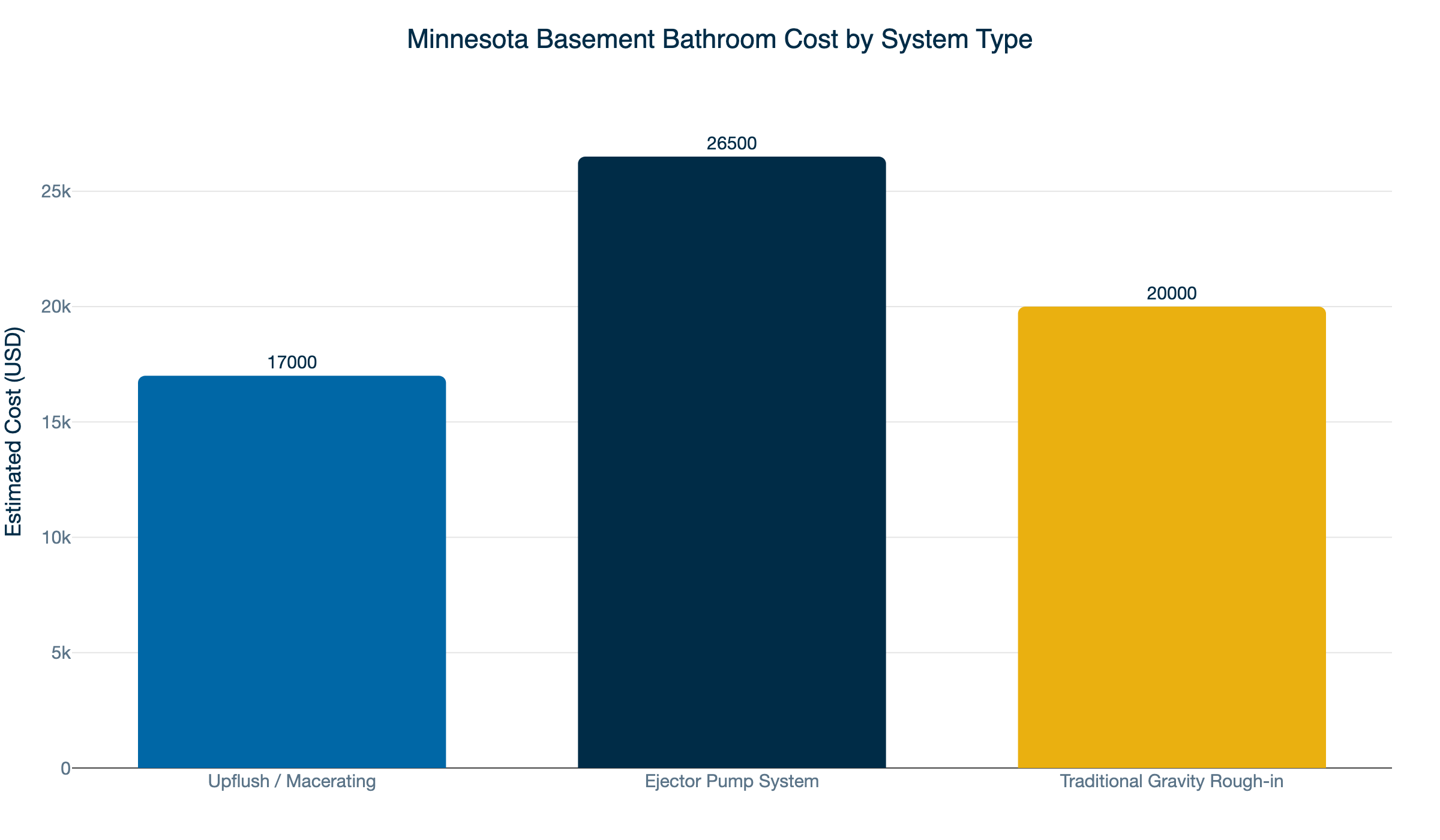
The biggest cost driver is whether you need to cut concrete. A macerating system skips that entirely. An ejector system does not. According to College City Design Build, a Minnesota contractor, full installations range from $12,000 to $35,000 depending on which system you choose and how much slab work is involved.
According to College City Design Build, the ranges break down as follows:
- Macerating / upflush system, no slab work: $12,000 to $22,000
- Ejector pump system, pit and slab work required: $18,000 to $35,000
- Traditional gravity rough-in, full concrete cut: $15,000 to $25,000
These are figures from a named Minnesota contractor, not national averages. Your actual cost depends on basement layout, pipe routing distance, permit fees, existing rough-in proximity, and finish level. The ranges are wide because basements vary widely. Get a real quote before building a budget around any number in these ranges.
For a project at the higher end, financing options are available. Call (763) 296-1844 or book online to discuss what fits your timeline.
How Long Does a Macerating Toilet Last?
With regular maintenance: 10 to 15 years. Well-maintained systems have reached 20 years or longer. Regular descaling every 3 to 6 months and annual professional servicing are the two practices that separate a unit that fails at year 10 from one that runs past year 15.
Saniflo units are tested to 50,000 flushes, and the manufacturer cites 10 to 15 years as a typical lifespan under normal conditions. Units that receive consistent attention regularly exceed that.
A 15-year total cost of ownership estimate covering parts, descaling, and annual servicing runs $2,150 to $4,510, according to PumpFlo. The motor and pump assembly is the most expensive single repair. Seals run lower. Descaling supplies cost very little. Skipping descaling is the most common path to an avoidable motor failure.
The practical budget guidance: expect one or two motor-related service calls over the life of the unit. Plan for annual professional inspection. Treat the 3-to-6-month descaling interval as a firm schedule, not a rough guideline.
Does Twin Cities Water Hardness Affect a Macerating Toilet?
Less than suburban well water, but descaling is still non-negotiable. Minneapolis and St. Paul municipal water runs 5.5 to 6 grains per gallon after treatment. That is well below the 20-plus GPG that private well water can reach in parts of the metro. Both require descaling every 3 to 6 months.
Minneapolis finished water runs approximately 94 mg/L, or 5.5 grains per gallon (GPG). Saint Paul Regional Water Services finishes at 5 to 6 GPG after lime softening. Both fall in the “slightly hard” classification.
That is meaningfully better for a macerator motor than suburban well water across the Twin Cities metro. Private wells in Maple Grove, Blaine, Brooklyn Park, and Coon Rapids can exceed 20 GPG. A homeowner on well water at that hardness is dealing with roughly four times the scaling pressure of a Minneapolis homeowner on city water.
Scale coats the macerator blades, strains the motor bearings, and shortens the lifespan of every moving part. Even at 5.5 GPG, the buildup happens. It just happens more slowly. Well-water homes should lean toward the 3-month end of the descaling range. Minneapolis and St. Paul homeowners on city water can stretch toward 6 months. Both should treat that interval as a firm calendar item.
If you want to know your exact hardness number, our water hardness guide for Minneapolis and St. Paul has the full metro breakdown.
What Can You Flush in a Macerating Toilet?
Human waste and toilet paper only. Nothing else should go in a macerating toilet. Flushable wipes, cotton swabs, paper towels, and feminine hygiene products will jam the macerator blades, damage the seal, and turn a minor maintenance call into a motor assembly replacement.
The macerator blades are not as heavy-duty as a commercial grinder pump. One jam can damage the seal. A damaged seal becomes a full motor assembly replacement that costs significantly more than a simple service call.
If the bathroom will be used by guests, put a small laminated sign in the space. It takes two minutes to make and can prevent a repair call that costs several hundred dollars. This is the most common cause of avoidable macerator failure that plumbers encounter.
When Is an Upflush Toilet the Wrong Answer?
An upflush toilet is the wrong answer for multi-unit buildings, for any basement with future plans for a second bathroom, and for spaces that sit cold and unused through January. The code, the freeze risk, and the maintenance commitment all weigh against it in those situations.
A macerating toilet solves a real problem for many Twin Cities basements. It is the wrong choice in a handful of specific situations.
You are in a multi-unit building. MN Rules 4714.0710, §710.13 restricts macerating toilets to one- and two-family dwellings. A duplex qualifies. A triplex or apartment building does not.
You are planning a second below-grade bathroom. One bathroom group is the legal ceiling. Plan for two, and you need a concrete ejector pit regardless of what you install today.
The space sees infrequent winter use. A walkout basement used as seasonal storage, a guest suite vacant from December through February, a home gym you skip in cold weeks: these are exactly the conditions where a ¾” discharge pipe ices up. The ejector system’s larger pipe handles those conditions better.
Low maintenance is a priority. A gravity drain or ejector pump requires less ongoing attention than a macerating unit. If minimizing mechanical systems matters to you, factor that into the decision before the unit is ordered.
What to Ask Your Plumber Before You Commit
Before any work begins, have this conversation:
- Where will the discharge pipe route? Does any segment run along an exterior wall or near an unheated rim joist?
- Is the unit accessible for service after installation? The code requires it. Not every rough-in makes it practical.
- Is this basement conditioned in winter? Could the pipe see sub-freezing temperatures during a cold snap?
- What is the expected maintenance schedule, and what does annual professional servicing cost?
- Is there any chance you add a second below-grade bathroom in the next 10 to 15 years?
A plumber who works in Minnesota basements regularly will have direct answers to all of these. Ask about the freeze risk specifically. A vague answer is a signal.
For a broader picture of what can go wrong with below-grade plumbing, our guide to basement floor drain backups covers the most common causes and fixes.
Ready to Add a Basement Bathroom?
A macerating toilet is a genuine solution for many Twin Cities basements. The code allows it. The convenience is real. So are the limits: one bathroom group, a freeze-vulnerable discharge line, and a maintenance commitment that starts from day one.
Northern Benjamin Franklin Plumbing is locally owned and operated. Our team works in basements across Minneapolis, St. Paul, Blaine, Bloomington, Brooklyn Park, Coon Rapids, Maple Grove, and the rest of the metro every week. We know which basement layouts create routing problems, which water hardness numbers drive the maintenance schedule, and when the ejector pit is the better long-term call.
Every appointment is backed by our On-Time Guarantee(R). We arrive in the window you choose. If there is any delay, it’s you we pay.
Call (763) 296-1844 or book your basement bathroom consultation online.
Frequently Asked Questions
Are upflush toilets legal in Minnesota? +
Does an upflush toilet need a permit in Minnesota? +
Can a macerating toilet freeze in a Minnesota basement? +
How long does a macerating toilet last? +
Need a technician now?