
How Hard Is Water in Minneapolis? City-by-City GPG Numbers
Key Takeaways
- Minneapolis city tap water is approximately 5-6 GPG. Most Minneapolis homeowners do not need a softener.
- Most Twin Cities suburbs draw from groundwater. Hardness there ranges from 12 GPG (Vadnais Heights) to 32 GPG (Brooklyn Park).
- Your city’s Consumer Confidence Report (CCR) has the official number. If it shows mg/L or ppm, divide by 17.1 to convert to GPG.
- Set your softener’s hardness dial to your city’s GPG. Then add 4 GPG for every 1 mg/L of dissolved iron in your water. Your CCR lists both.
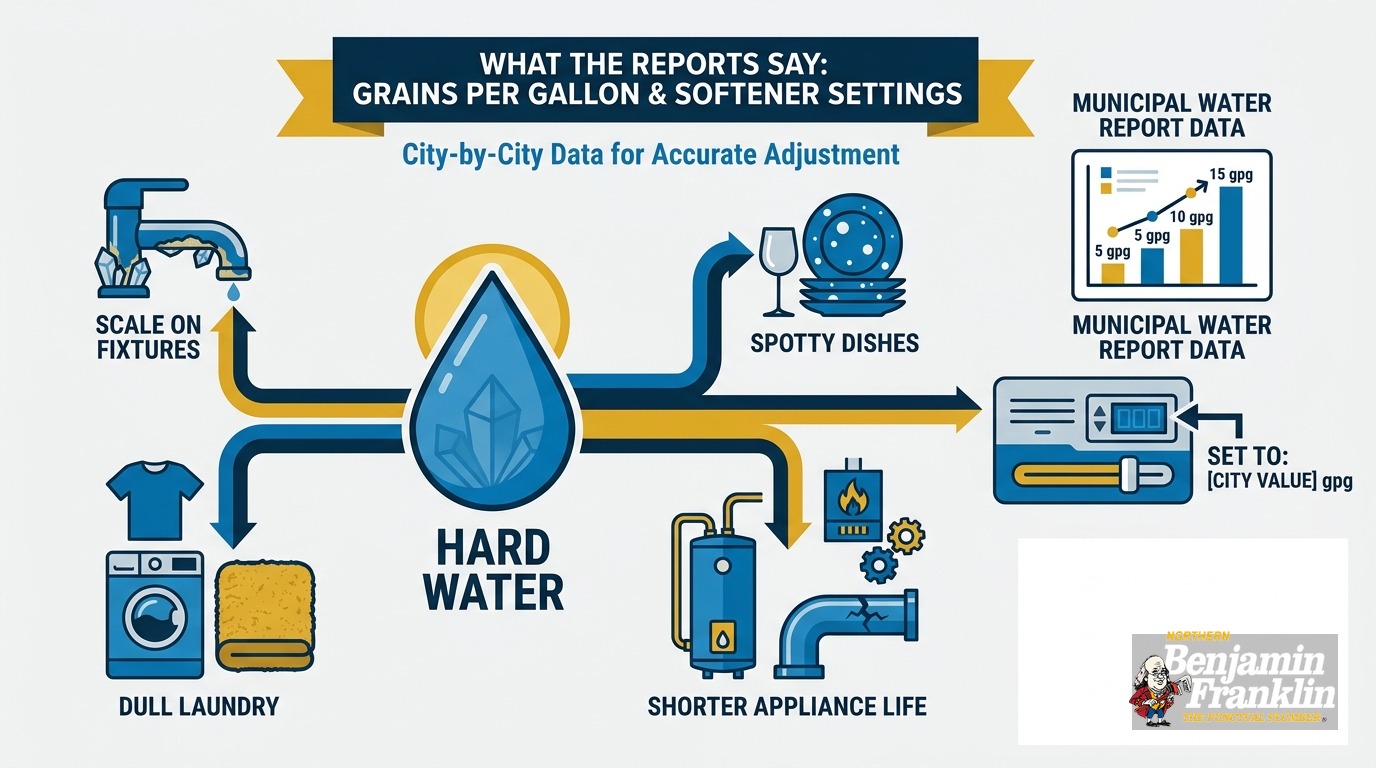
- Water above 20 GPG accelerates mineral scale in tank water heaters, reducing efficiency and shortening the heater’s life.
- To schedule a water test or softener service, call (763) 296-1844 or book online.
How Hard Is Water in Minneapolis?
Minneapolis city tap water runs approximately 5-6 grains per gallon (GPG) at the tap. The city draws from the Mississippi River, softens the water further during treatment, and delivers some of the softest municipal water in the metro. Most Minneapolis homeowners do not need a water softener.
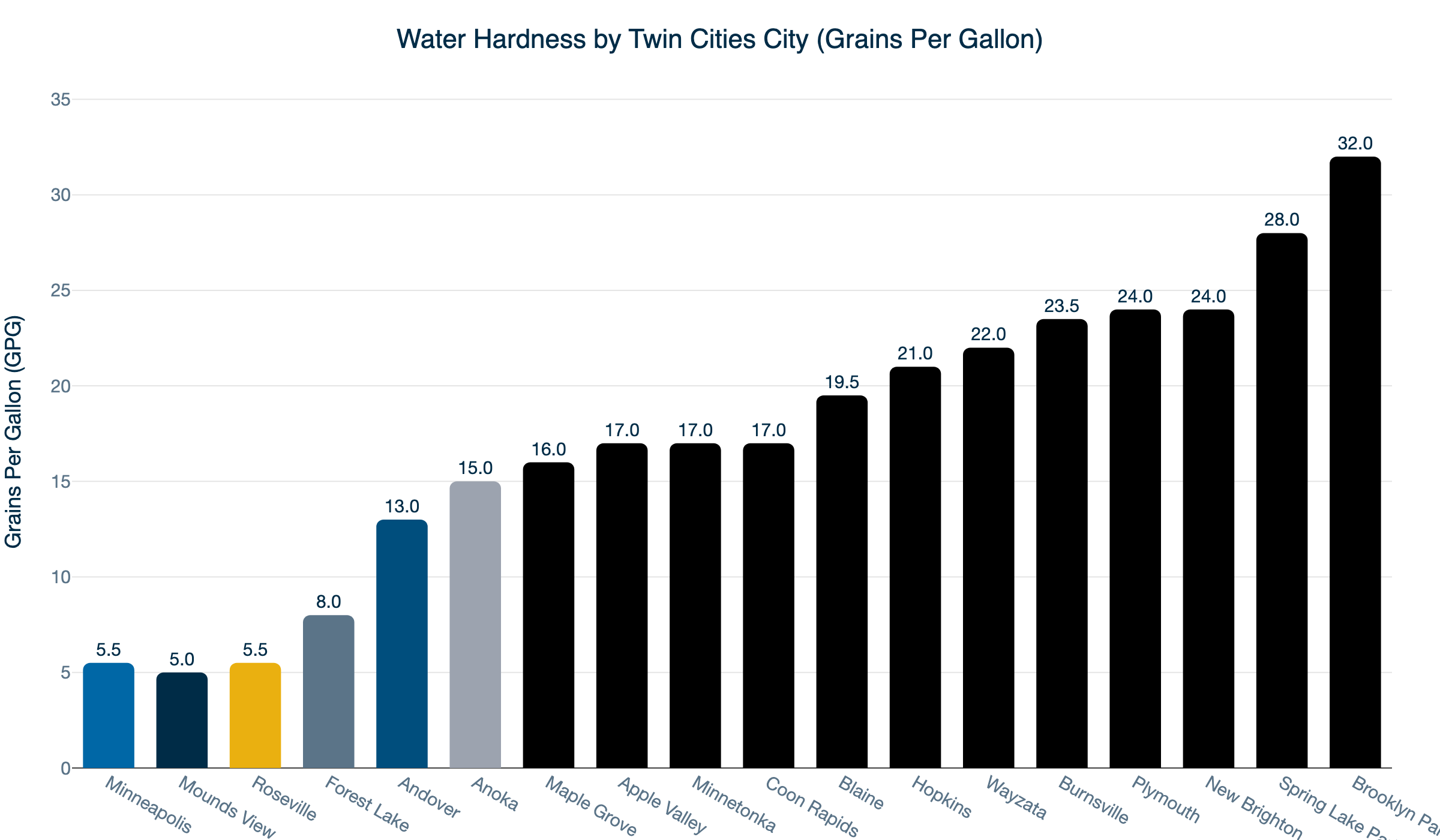
That is the correct answer for one slice of the Twin Cities. It is the wrong answer for nearly everyone else. Step into the groundwater-served suburbs and the numbers look completely different. Plymouth sits at 24 GPG. Spring Lake Park at 28 GPG. Brooklyn Park at 32 GPG - more than five times harder than the city. The question “how hard is water in Minneapolis” has a radically different answer depending on whether your zip code puts you on Mississippi River surface water or a deep groundwater aquifer. This post draws that line clearly, shows the official numbers by city, and walks through the three-number formula that gets your softener dialed to exactly the right setting.
Why Do Minneapolis and the Suburbs Get Such Different Numbers?
Surface water starts soft. Groundwater does not. Minneapolis draws from the Mississippi River at Fridley and treats approximately 57 million gallons per day. The treatment process reduces hardness further before the water reaches any tap. Most Twin Cities suburbs pump from deep underground aquifers. That groundwater travels through layers of limestone and mineral-rich rock, picking up calcium and magnesium the entire way. By the time it reaches a tap in Brooklyn Park, it carries 32 GPG.
The Minnesota Department of Health tracks all 965 community water systems in the state. Only 23 of those systems use surface water. The remaining 942 systems draw from groundwater. That is why the city-to-suburb gap is so large and why any blanket statement about “Twin Cities water hardness” misses the point entirely.
Golden Valley purchases its water from Minneapolis and summarizes the difference plainly on its utility page: “Mississippi River water is naturally much softer than groundwater, and it is further softened during treatment… This benefit saves water users the expense of purchasing and maintaining a home softening system.” Six other suburbs also buy Minneapolis surface water and share its low hardness: Columbia Heights, Hilltop, Bloomington, Edina, Crystal, and New Hope. Saint Paul Regional Water Services uses lime softening to bring raw hardness from the 20s down to approximately 5-6 GPG at the tap, so St. Paul proper also delivers soft water. Beyond those utilities, nearly every other suburb in the metro is on groundwater and running significantly harder.
How Hard Is Minneapolis Water Compared to the Suburbs? A City-by-City Breakdown
Minneapolis city water is 5-6 GPG at the tap - but the question of how hard is water in Minneapolis matters most to people who live in the broader metro, and those numbers are a different story entirely. The table below is compiled from utility water quality reports. Ranges reflect seasonal variation and testing methodology. Treat this as a starting point; your Consumer Confidence Report is the authoritative number for your address.
| City | Hardness (GPG) |
|---|---|
| Minneapolis | ~5-6 |
| Mounds View | 5 |
| Roseville | 5-6 |
| White Bear Lake | 5-7 |
| Forest Lake | 8 |
| Vadnais Heights | 12 |
| Andover | 13 |
| Stillwater | 13 |
| Anoka | 15 |
| Shoreview | 15 |
| Elk River | 16 |
| Maple Grove | 16 |
| Champlin | 17 |
| Apple Valley | 17 |
| Minnetonka | 17 |
| Osseo | 17 |
| Coon Rapids | 16-18 |
| St. Louis Park | 18 |
| Blaine | 18-21 |
| Brooklyn Center | 17-21 |
| Medina | 20-23 |
| Wayzata | 20-24 |
| Hopkins | 21 |
| Mound | 22 |
| Robbinsdale | 22 |
| Rogers | 22 |
| Burnsville | 22-25 |
| Savage | 23 |
| Shakopee | 23 |
| Chanhassen | 22-26 |
| New Brighton | 24 |
| Plymouth | 24 |
| Spring Lake Park | 28 |
| Brooklyn Park | 32 |
Sources: city-by-city hardness data from Minnesota utility reports; Minnesota city hardness compilation.
How to Read Your Consumer Confidence Report
Every water utility publishes an annual Consumer Confidence Report, also called the Annual Water Quality Report. Most cities post it in the utility or public works section of the city website. Search for “[your city] annual water quality report” plus the current year. If you cannot find it, call the utility directly - they are required to make it available.
The 2025 Minneapolis Consumer Confidence Report is a good example of the standard format. Once you have your city’s version open, here is what to do:
- Find the hardness row. It may appear under “Secondary Contaminants,” “General Mineral Analysis,” or simply “Hardness.”
- Check the unit. Many CCRs report in mg/L or ppm rather than grains per gallon.
- Convert if needed. Divide mg/L by 17.1 to get GPG. A report showing “hardness: 410 mg/L” equals 24 GPG.
- Note the iron level. Look for “iron” or “dissolved iron” on the same page. You need this number for the softener setting step below.
While you have the report open, take five minutes to scan it fully. You will see chlorine levels, any treatment advisories, lead status for your service area, and the list of parameters that were tested and the results. It is the most precise hardness figure available for your specific address, and it is the one that should drive your softener settings - not a neighbors’ recommendation or a test strip from a hardware store.
How Do You Set a Water Softener to the Right Number?
Start with your CCR’s GPG figure. Add 4 GPG for every 1 mg/L of dissolved iron your water contains. Enter that combined number as the softener’s hardness setting. A Plymouth home at 24 GPG with 0.5 mg/L iron should dial to 26 GPG. Setting it to 24 and ignoring the iron is the most common softener configuration mistake, and it is the one that explains why a “correctly set” unit still leaves scale on shower doors.
Here is the complete sequence:
Step 1: Get the GPG number. Use your CCR or the table above. If the report shows mg/L, divide by 17.1. Minneapolis residents can use the January 2025 plant analysis figure of 6.1 GPG as a baseline, confirmed in the 2025 Consumer Confidence Report.
Step 2: Note the dissolved iron level. Find it in your CCR. Twin Cities groundwater commonly reads 0.1-1.0 mg/L. If you are on a private well without a recent water test, you may not know this number yet. A professional water test will give it to you.
Step 3: Apply the iron correction. Multiply the iron figure (mg/L) by 4. Add that result to your hardness GPG. That combined number is your softener setting.
Example: Coon Rapids at 17 GPG, dissolved iron at 0.8 mg/L. 0.8 x 4 = 3.2, rounded up to 4. Set the softener to 21 GPG.
Step 4: Confirm the regeneration schedule. The softener calculates regeneration frequency from the hardness setting and estimated household water use. A setting that is too low means the resin exhausts before the timer fires and hard water passes through. A setting that is too high wastes salt on unnecessary regeneration cycles.
Step 5: Check salt level monthly. Use high-purity evaporated or solar salt. Keep the brine tank at least one-third full. Low salt is the most common reason a softener stops performing between service calls.
The EPA’s 2026 water softener efficiency guide sets practical benchmarks: efficient softeners should use 4 gallons or less per 1,000 grains removed, and salt efficiency should exceed 3,350 grains per pound of salt used. If your unit runs significantly below those marks, it may be time for a service call or a replacement.
The Iron Correction Step - Why It Is the One Competitors Leave Out
Dissolved iron competes directly with calcium and magnesium for space on the softener’s resin beads. When the softener does not account for iron in the hardness setting, the resin fills up faster than the timer predicts. The result is hard water passing through between regeneration cycles - scale building on fixtures, higher salt consumption, and a softener that regenerates more often trying to compensate.
The standard correction is 4 GPG per 1 mg/L of dissolved iron. This is the industry-standard approach for combining hardness and iron into a single softener setting. Your CCR will list iron. If you are on a private well and do not have a recent lab test, you are guessing at this number - and the odds are high that your water contains iron in a range that matters for the calculation.
If your water leaves orange or rust-colored staining in the toilet tank, on the inside of the toilet bowl, or around fixture bases, dissolved iron is likely the cause. That is a signal to get the water tested before adjusting the softener. Our home water testing service gives you an accurate baseline for both hardness and iron so the softener setting is based on real numbers, not estimates.
What Does Hard Water Do to Your Water Heater?
Hard water above 20 GPG causes mineral scale to build at the bottom of a tank water heater. That scale acts as insulation between the burner and the water. The heater runs longer to reach the set temperature, energy use climbs, the tank bottom overheats, and the unit can fail years before its rated lifespan.
This connection matters for the suburbs that run at 20-32 GPG. A homeowner in Spring Lake Park at 28 GPG without a functioning softener is putting mineral-loaded water into every appliance in the house, every day. The water heater takes the hardest hit because it cycles that water through heat repeatedly.
A few habits help:
- Flush the water heater annually to remove sediment. Annual water heater maintenance is straightforward and extends tank life considerably at high hardness levels.
- Keep the softener dialed to the correct setting so the water reaching the tank is already treated.
- Watch for warning signs: a popping or rumbling sound during heating, longer recovery times between hot showers, or rust-colored water coming from hot taps.
Those symptoms can indicate enough sediment has accumulated to affect performance, or that the tank bottom is beginning to corrode. Both are worth a call before the tank fails unexpectedly. Water heater failures at high GPG are rarely a surprise in hindsight - the signs show up first.
What Hardness Level Actually Requires a Water Softener?
The EPA classifies water above 7 GPG as hard. At 10 GPG and above, a softener is generally recommended. Most Twin Cities suburbs run well above both marks - some by a factor of three.
At 5-6 GPG, Minneapolis proper sits below the hard-water threshold. A softener there is a preference. Once you cross into the groundwater suburbs, the calculation changes. At 17 GPG, scale is visible on faucet aerators and in the shower within months. At 24-32 GPG, scale accumulates aggressively on every water-contact surface: water heater, dishwasher, ice maker, supply lines, and fixtures.
High hardness also affects daily household use in ways that add up:
- Soap and shampoo require more product to lather in hard water.
- Laundry washed repeatedly in hard water can feel stiff and look dingy.
- Hard water leaves a mineral film on skin and hair after bathing.
- At very high GPG, coffee and tea taste noticeably different.
One important distinction: a water softener removes calcium and magnesium through ion exchange. It does not remove chlorine, sediment, lead, or PFAS. If those are concerns at your address, a softener alone is not enough. Pairing a softener with a whole-home water filtration system addresses both hardness and other contaminants. Our blog post comparing water softeners vs. water filtration systems walks through when each solution fits, and when you need both.
Do You Need a Permit, and Is There a Rebate?
On permits: Minnesota Plumbing Code (Minnesota Rules Chapter 4714) governs softener installation. A straight swap of an existing unit with no changes to the supply line is typically permit-exempt. New installations that involve altering or connecting to the water supply line generally require a permit. Requirements vary by municipality - check with your local building department before any work begins. A licensed plumber handles the permit where it is required, makes the connections to code, and documents the work in a way that holds up at a future home inspection.
On rebates: Minnesota has no statewide residential water softener rebate program. Individual utilities occasionally offer programs, so it is worth checking your city’s utility website directly. The financial benefit of softening high-GPG groundwater tends to show up less in upfront rebates and more in reduced detergent and soap use, fewer plumbing service calls, and longer appliance life over years of use.
Ready to Know What Is in Your Water?
Getting the hardness number right matters. An undersized softener setting lets hard water through. An oversized setting wastes salt. And neither setting accounts for iron without the correction step. If you are buying a new softener, replacing an existing one, or noticing signs that the current unit is not keeping up, the right place to start is a water test - not a guess from the table above.
Northern Benjamin Franklin Plumbing is locally owned and operated in the Twin Cities. Our team handles water softener installation and service, professional home water testing, and water heater maintenance for homes where hard water has accelerated sediment buildup. For larger whole-home treatment projects, financing is available.
We operate under the On-Time Guarantee(R). Pick a service window and we will be there. If we are not, you receive $5 for every minute we are late, up to $300. “If there is any delay, it’s you we pay!” That is backed by a 100% satisfaction guarantee.
Call (763) 296-1844 or book online to schedule.
Frequently Asked Questions
How hard is Minneapolis city water? +
Why is water so much harder in the suburbs than in Minneapolis? +
How do I find my city's exact water hardness number? +
What should I set my water softener to? +
Does hard water damage water heaters? +
Need a technician now?