
Water Softener Maintenance Checklist for Twin Cities Homes
Key Takeaways
- Minneapolis and St. Paul city water reaches your tap at 5.4-5.85 GPG after treatment. Most suburban groundwater in the metro runs 13-32 GPG. Your maintenance schedule should reflect your actual hardness level.
- Check the brine tank monthly. In high-hardness suburbs like Brooklyn Park (32.1 GPG) or Maple Grove (26.6 GPG), check every two to three weeks.
- Clean the brine tank quarterly if your hardness is above 15 GPG. Treat the resin bed and inspect the venturi valve once a year.
- Switching from a timer-based softener to demand-initiated regeneration (DIR) can cut salt use by about 50%. Brooklyn Park offers a $100 rebate on qualifying DIR systems.
- Water softeners account for 25% of Minnesota’s chloride pollution. Correct regeneration settings reduce your environmental footprint and your salt costs.
- The valve head cracks first in a sustained freeze. Softeners in unheated spaces need heat tape, supplemental heat, or a full bypass-and-drain for the season.
What Is Your Home’s Hardness Level?
If you are on Minneapolis or St. Paul city water, your hardness is roughly 5-6 GPG after treatment. If you are on suburban groundwater, it may be two to six times higher. Check your city below before setting any maintenance schedule.
The Minneapolis water treatment plant reduces the hardness of raw Mississippi River water before distribution. Worth noting: Minneapolis post-treatment pH is 9.06. Even at that lower hardness, the elevated pH raises calcium carbonate scaling risk in water heaters. St. Paul Regional Water Services uses lime softening to reduce its water hardness, serving 450,000 residents through 1,200 miles of main.
If your home is on either city system, your softener is doing relatively light work.
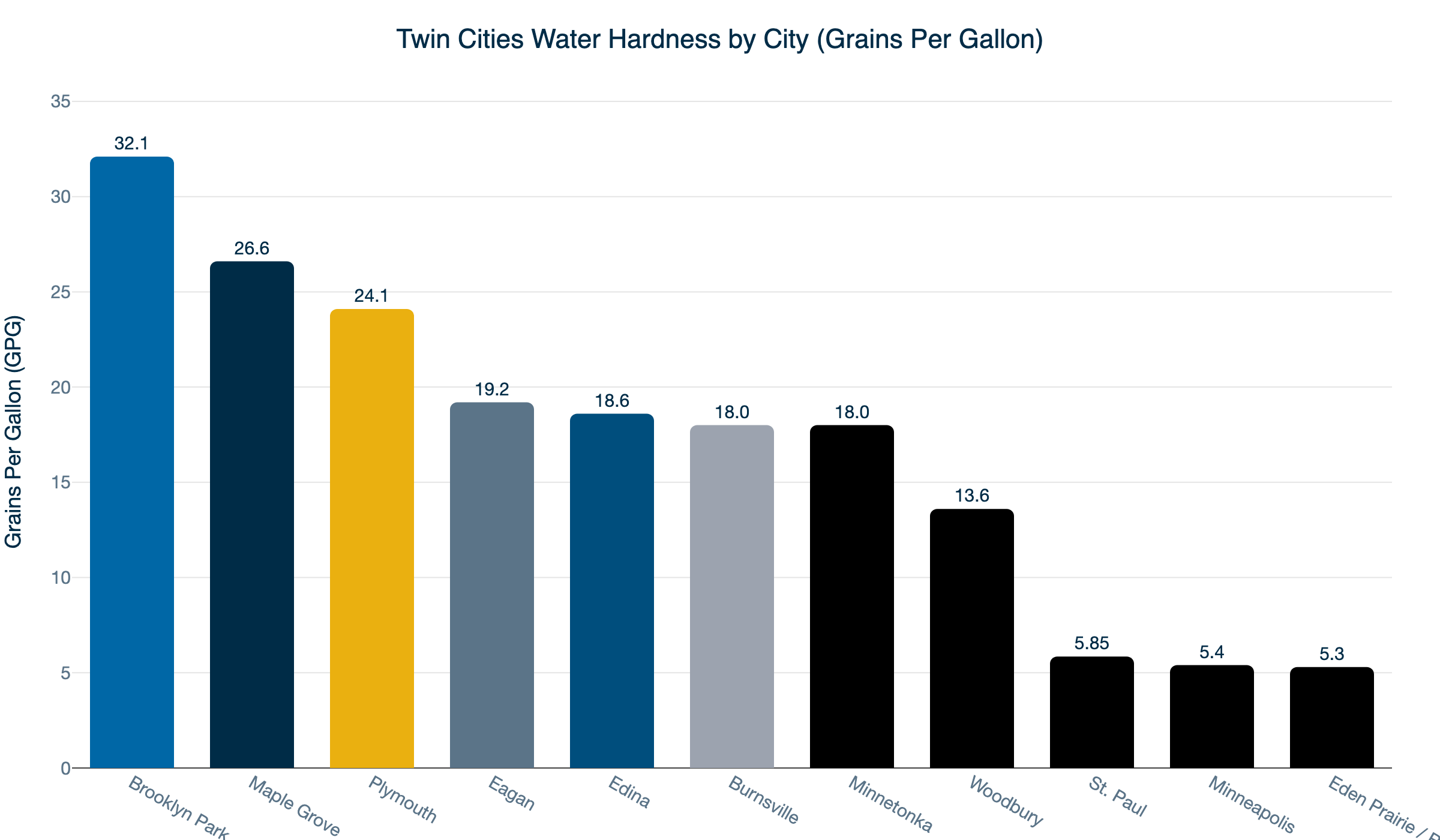
Suburban groundwater is a different category. According to city-by-city hardness data from aquatell.com:
- Brooklyn Park: 32.1 GPG
- Maple Grove: 26.6 GPG
- Plymouth: 24.1 GPG
- Eagan: 19.2 GPG
- Edina: 18.6 GPG
- Burnsville and Minnetonka: 18.0 GPG each
- Woodbury: 13.6 GPG
- Eden Prairie and Bloomington (municipal): 5.3 GPG
Our Twin Cities water hardness guide explains how to read your utility’s annual report if you want to confirm your exact number.
Throughout this checklist, “high-hardness” means 15 GPG and above. “Low-hardness” means below 10 GPG. Where you fall on that range determines how aggressively to schedule each task below.
Monthly Water Softener Maintenance
Check the brine tank once a month. That single habit prevents most softener failures before they start.
Salt level. Refill when the tank is about one-third full. Do not let it run dry. A softener with no salt passes untreated hard water through every fixture until someone notices the spots on the glasses.
Salt bridges. A bridge is a hardened crust that forms partway up the tank wall. The surface feels solid, but there is an air gap underneath. Salt is not reaching the water. Break it apart with a broomstick. If bridges keep forming, switch from rock salt to pellets. Rock salt bridges more easily than pellet-style salt.
Salt mushing. Fine-grained mush accumulates at the bottom of the tank over time. It can jam the float valve and block brine from drawing into the resin chamber. Scoop it out before it builds into a layer.
Hardness-tier note. Brooklyn Park groundwater is 32.1 GPG. That is roughly six times harder than Minneapolis city water at 5.4 GPG. The softener burns through salt proportionally faster. In a high-hardness suburb, plan to check every two to three weeks. Going a full month without noticing an empty tank means weeks of untreated hard water through your plumbing.
While the tank is open, glance at the regeneration timer. If it is set to fire every three days regardless of actual water use, it may be cycling well before the resin is depleted. That wastes salt and adds chloride to the wastewater stream. The right frequency depends on your household size and your hardness level. Both can be calculated from the softener’s manual or set automatically if you upgrade to demand-initiated regeneration.
Quarterly Water Softener Maintenance
Every three months, go a step further.
Inspect for iron and mineral buildup. Brown or orange rings inside the brine tank mean dissolved iron from groundwater is fouling the unit. High-hardness suburbs on well water are the most vulnerable. An iron-out treatment product cleans the tank and helps the resin shed accumulated iron. Our brine tank cleaning guide walks through the full process step by step.
Test your output water. Pick up a hardness test strip at any hardware store. Dip it in a softened tap, not the bypass faucet if your sink has one. A reading above 1-2 GPG means the softener is not keeping up. The most common causes are low salt, a salt bridge, iron fouling on the resin, or a failed regeneration cycle.
Check the bypass valve. Confirm it turns freely and seats fully. A stuck or half-open bypass valve mixes hard water with softened water. You want it to work on the day you actually need it, not bind up from years of sitting untouched.
Inspect the valve head for drips. A slow drip from the valve body usually means a worn O-ring. A replacement O-ring pack from the manufacturer costs almost nothing. Letting a slow drip run costs you a valve.
Hardness-tier note. If you are above 15 GPG, give the brine tank a thorough cleaning every quarter, not just annually. Higher hardness leaves more mineral residue faster.
Annual Water Softener Maintenance
Once a year, do the full service pass.
Treat the resin bed. Pour a resin cleaner into the brine well and run a manual regeneration. The cleaner removes iron, manganese, and organic material from the resin beads. Over years in high-iron suburban groundwater, this step becomes more important as the softener ages, not less.
Clean the venturi valve. The venturi (also called the injector) draws brine from the tank into the resin chamber during regeneration. It clogs with iron and sediment. Remove it, clean the screen and passages with a small brush, and reinstall. A clogged venturi is one of the most common hidden causes of a softener that stops producing soft water without showing an obvious error.
Verify the hardness setting. Your control head calculates salt dose per cycle based on the hardness number programmed into it. If the previous homeowner set it, it may be wrong. Compare it against the actual hardness number for your address and correct it. An over-programmed softener wastes salt on every single cycle.
Inspect the resin for depletion. Resin beads typically last 15-20 years in a low-hardness city-water home. In a Brooklyn Park home at 32.1 GPG, they work much harder and may not reach that lifespan. A plumber can test a resin sample and tell you whether a cleaner restores capacity or whether the bed needs replacement. Catching depletion early avoids an emergency call.
Minneapolis city-water note. Even at 5.4 GPG hardness, the pH of 9.06 raises calcium carbonate scaling risk inside water heaters. Combining the softener’s annual service with a water heater tank flush is a practical pairing for Minneapolis homeowners.
Why Does Your Regeneration Setting Matter in Minnesota?
An incorrect regeneration timer wastes salt, costs you money on every cycle, and puts chloride into Minnesota’s waterways. Fixing this setting is the highest-leverage maintenance task for most Twin Cities homeowners.
Most older softeners run on a fixed timer. They regenerate every two or three days regardless of actual water use. A household of two running a softener sized for five regenerates far more often than the resin needs. That excess salt flows into the wastewater stream, and from there into the environment.
According to the Minnesota Pollution Control Agency’s chloride reduction program, water softeners and other wastewater sources contribute to Minnesota’s chloride pollution. Road salt accounts for 42%. MPCA chloride data shows Minnesota lakes and streams already have chloride levels toxic to aquatic life. Seventy-five more are near that threshold. One teaspoon of salt permanently pollutes five gallons of water. Wastewater treatment plants cannot remove chloride once it enters the system.
Twenty-seven percent of Twin Cities shallow aquifer monitoring wells already exceed EPA drinking water chloride guidelines. Thirty percent exceed the state water quality standard.
The point is not to stop softening. Soft water protects pipes, extends water heater and appliance life, and reduces soap use. The point is to run your softener efficiently so the work it does does not cause unnecessary environmental harm.
Is Demand-Initiated Regeneration Worth Switching To?
Yes. Demand-initiated regeneration (DIR) regenerates only when the resin is nearly exhausted, not on a fixed calendar. Switching from timer-based to DIR can cut salt use by roughly 50%, per MPCA data. That means less money on salt and less chloride entering the watershed.
With a timer-based unit, the clock fires whether the resin needs it or not. With DIR, the control head measures actual water use and regenerates only when the resin is close to depleted. The MPCA’s guide to local water softener rebate programs cites approximately 50% salt reduction for households switching from timer to demand-initiated systems.
A high-hardness suburban home can burn through 40 to 50 pounds of salt per month. That reduction adds up to hundreds of dollars per year.
Rebates available now:
- Brooklyn Park offers a $100 rebate for homeowners who install a demand-initiated softener. Single-family homes, townhomes, and duplexes are eligible. Apply by emailing BPOM@BrooklynPark.org. Full details at brooklynpark.org.
- Minnesota HF 3324 / SF 3519 proposes a $200 statewide rebate for qualifying DIR softeners installed between July 2025 and June 2027, administered by the MPCA. Track its status at revisor.mn.gov.
If your softener is timer-based and approaching end of life, replacing it with a DIR model makes financial sense on top of the environmental benefit. Our water softener service team in the Twin Cities can evaluate your current unit and walk you through the options.
How Does Water Softener Salt Affect Minnesota’s Lakes?
Chloride from softener regeneration enters the wastewater stream. Once it is in a watershed, it cannot be removed. Running your softener efficiently is a direct action Twin Cities homeowners can take.
The MPCA data cited above is not abstract. It covers the monitoring wells and lakes near the suburbs where most high-hardness households are located. Chloride does not break down in the environment. It does not evaporate. It accumulates in groundwater, streams, and lakes over decades, and wastewater treatment cannot reverse it.
Most homeowners who own a water softener have a good reason to run one. Soft water is protective. None of that changes.
What changes is the regeneration schedule. A correctly programmed DIR softener running at actual household demand contributes a fraction of the chloride that an over-regenerating timer-based unit does. The MPCA reports that a softener replacement grant program in Marshall, Minnesota cut chloride from softeners by up to 90% at the community level. Individual households cannot hit that number. Getting your programming right is still a meaningful step.
If you are eligible for the Brooklyn Park rebate or the proposed statewide rebate, the upgrade makes both environmental and financial sense at the same time.
Will Cold Weather Damage Your Water Softener?
Yes, if it is in an unheated space. The valve head has tight internal passages that crack first in a sustained freeze. A single cold night is not the threat. Days of below-freezing temperatures are - and Minnesota winters reliably deliver those.
The brine tank handles cold better because salt concentration lowers its freezing point. The valve head is the vulnerable component.
If your softener is in an unheated garage, an exposed utility room, or a poorly insulated basement corner, take one of two approaches:
Option 1: Prevent the freeze. Wrap supply and drain lines with heat tape. Add a thermostat-controlled space heater to hold the area above 32°F. Do not rely on the building envelope alone during a Minnesota cold snap.
Option 2: Bypass and drain for the season. If the space cannot be reliably heated, put the softener in bypass mode, drain the valve head, and empty the brine tank before temperatures drop. The aquasureusa.com winterizing guide walks through the bypass and drain procedure in detail.
Older Twin Cities construction often has this problem. Water treatment equipment ends up in an unheated garage corner or back utility room. Those spaces were not designed to stay warm. If you are not sure how cold the space gets, walk it on a January day when outdoor temps are in the single digits. That tells you what you are dealing with.
When Should You Call a Plumber for Water Softener Service?
Call when hard water returns suddenly, when the unit cycles without stopping, or when you find water pooling on the floor. None of those symptoms are fixed with a salt refill.
Watch for these signs:
- Hard water is back. Spots on glasses, stiff laundry, poor soap lather. The softener is out of salt, has a salt bridge, or the resin is fouled or depleted.
- Continuous cycling. The unit regenerates over and over without finishing. A valve or float has likely failed.
- Water on the floor. A drip from the valve head or a cracked brine line needs a professional assessment, not a DIY patch.
- Grinding during regeneration. A worn motor drive gear. If it fails completely, the unit stops softening.
- High hardness on a test strip. Softened water testing above 1-2 GPG means the resin may be past what a cleaner can restore.
Hard water and water heaters are connected, too. Untreated hard water leaves scale inside the tank and on the heating elements. That shortens tank life and increases energy use. If your softener has been failing and your water heater is also showing problems, have both checked at the same visit. Our water softener troubleshooting guide covers each of these symptoms in more detail.
For anything that needs hands-on service, Northern Benjamin Franklin Plumbing is locally owned and operated right here in the Twin Cities. We back every appointment with the On-Time Guarantee(R): $5 for every late minute, up to $300. “If there is any delay, it’s you we pay!” Call (763) 296-1844 or book online to schedule your water softener service.
Frequently Asked Questions
How often should I add salt to my water softener? +
What is demand-initiated regeneration and does it save money? +
Can a water softener freeze in a Minnesota winter? +
Need a technician now?