
Water Softener Not Working: Diagnose 4 Common Causes
Key Takeaways
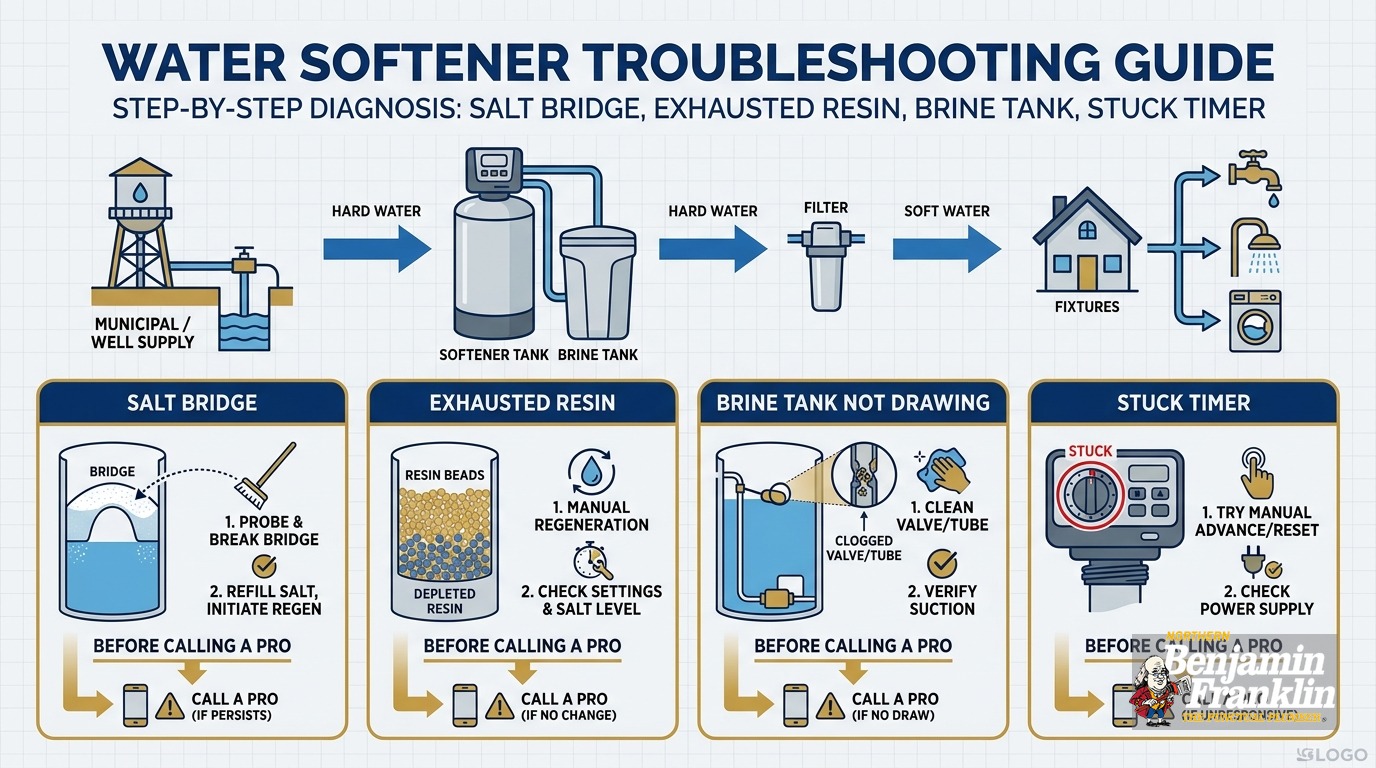
- The four most common reasons a water softener stops working are a salt bridge in the brine tank, a clogged injector or brine line, exhausted or iron-fouled resin, and a stuck or misconfigured timer.
- Check for a salt bridge first. It is the most common cause of sudden softener failure and takes five minutes to confirm or rule out.
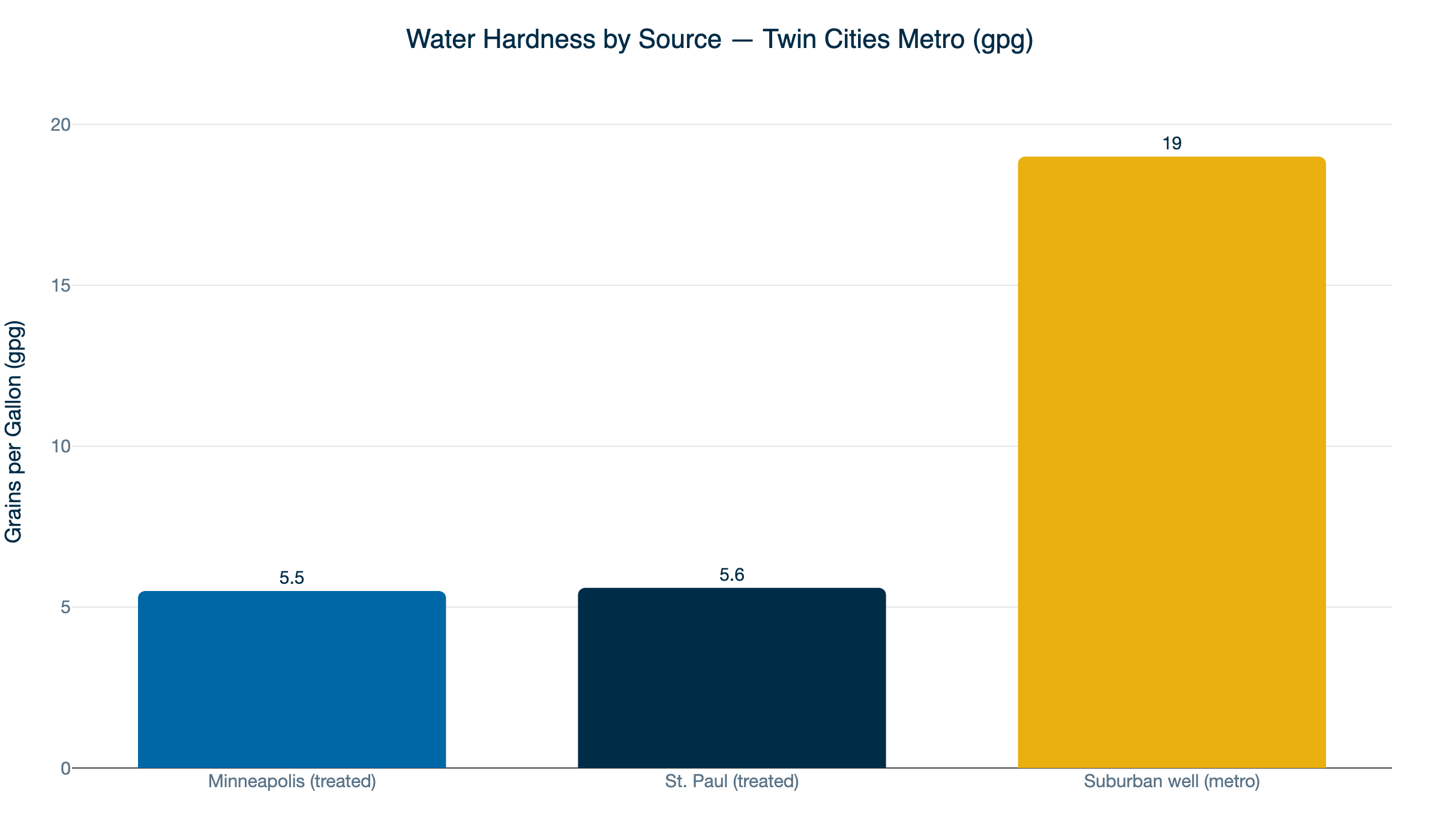
- Minneapolis and St. Paul homeowners on treated municipal water have roughly 5.5-5.6 grains per gallon (gpg) of hardness. Homeowners in Bloomington, Eagan, or Cottage Grove on a well can see 18-20+ gpg. That difference changes how often your softener should regenerate and what failure mode is most likely.
- A new water softener installation in Minnesota requires a plumbing permit. Like-for-like replacement may qualify for an exemption, but that is confirmed at the local-authority level, not assumed.
- If you cannot identify the cause within 30 minutes, stop and call a licensed plumber. Forcing a stuck control valve can take your water supply offline.
What Are the Signs Your Water Softener Has Stopped Working?
You may not notice immediately. The earliest signs are soap that does not lather as well as it used to, water spots on dishes and shower glass, and skin that feels dry or squeaky after bathing.
Other things to watch for:
- The salt level in the brine tank does not drop between fills. The softener is not using salt because it is not regenerating.
- Standing water in the brine tank that does not drain after a cycle.
- The display shows the correct time, but the unit does not run a regeneration cycle.
- White scale appearing on faucet aerators and showerheads.
- A slight rust tint or metallic taste in the water if your home is on a well with iron.
If you see any combination of these, start with the salt bridge check before anything else.
How Do You Know If You Have a Salt Bridge?
A salt bridge is a hardened crust of packed salt that forms above a void in the brine tank. The tank looks full from the top. But the salt below the crust is not in contact with water. No brine forms. The softener runs its cycle and delivers nothing.
To check:
- Remove the brine tank lid and look at the salt level. If the salt appears full but the water level is very low, that is a clue.
- Push a broom handle or long wooden dowel straight down through the salt. A firm, sudden resistance followed by a hollow space beneath is a salt bridge.
- Break it up by pressing the handle firmly around the edges of the crust. Work toward the tank walls, not the center. The goal is to crack the bridge so the pieces fall to the water at the bottom.
- Wait two to three hours for the salt to dissolve into brine, then run a manual regeneration cycle from the control head.
Why this happens more in Minnesota winters: Cold snaps followed by dry forced-air heat cause sharp humidity swings in finished basements. Salt pellets absorb and release moisture through those swings, and repeated cycling binds the crystals into a crust. January and February are peak salt-bridge months across the Twin Cities. If your softener stopped working in mid-winter, check the brine tank before you do anything else.
A note on salt type: Rock salt contains impurities that make bridging more likely. Solar or evaporated salt pellets crust less readily. Keeping the brine tank no more than two-thirds full also reduces bridging frequency. If the softener sits in a garage or unheated crawlspace, understand that the small-diameter brine line can freeze before the resin tank does. Any unit in an unconditioned space below 32 degrees is a freeze-risk unit.
What If the Brine Tank Is Filling but Not Drawing Down?
If the brine tank fills during a regeneration cycle but never empties, the injector is the first thing to check. The injector (also called the venturi assembly) creates suction that pulls brine from the tank into the resin bed. A plugged nozzle, throat, or screen kills that suction completely.
Steps to clean the injector:
- Put the softener in bypass mode so water continues flowing to your home.
- Locate the injector on the control valve. It usually unscrews with a quarter turn or a flathead screwdriver.
- Remove the nozzle, throat, and screen. Hold each piece up to a light. Rinse under warm water and use a small brush or straightened paper clip to clear any scale or sediment.
- With the injector out, disconnect the drain line and inspect the drain line flow control (DLFC), a small disc that limits drain flow rate. A plugged DLFC is the second most common cause of a failed brine draw. The AFW Filters troubleshooting guide walks through the full injector and DLFC cleaning sequence step by step.
- Reassemble, take the unit off bypass, and run a manual regeneration. The brine tank should empty during the draw phase, typically within 60-90 minutes on most residential units.
If the brine tank still does not draw after this cleaning, the issue is likely a failed check valve or piston inside the control valve itself. That is a licensed-plumber repair.
Cold-weather note: If the softener sits in an unconditioned space, the brine line can freeze solid while the resin tank remains intact. Humidity swings from cold snaps accelerate this risk. Warm the space and let the line thaw fully before running the injector check.
Could Exhausted or Iron-Fouled Resin Be the Problem?
Resin beads last 10-15 years under normal conditions. If your unit is older than 12 years and no single clear cause explains the softener failure, the resin bed is a legitimate suspect.
According to troubleshooting data from Softener Answers, iron above 2 ppm in the source water significantly accelerates resin fouling. Iron coats the beads and blocks the ion exchange process. The softener runs, uses salt, regenerates on schedule, and still delivers hard water.
How to check:
- Age test: Find your installation date. A unit past 12 years of continuous service with no clear single-part failure is a candidate for resin replacement.
- Iron test: If your home uses well water, test the raw supply for iron. If the level exceeds 2 ppm, try an iron-specific resin cleaner available at hardware stores. Pour it into the brine tank and run a manual regeneration. If the hardness reading on your soft-water side improves afterward, iron fouling was the problem. Regular cleaner treatments can extend resin life going forward.
- Visible breakdown: If you find small brown or orange beads in your faucet aerators or floating in the brine tank, the resin bed has physically disintegrated. That is a replacement job, not a cleaning job.
Resin replacement means draining the tank, removing the distributor tube, disposing of the old media, cleaning the tank interior, and packing fresh resin over new gravel underbed. Most homeowners hand this to a plumber. If the control head is also aging, replacing the whole unit is often the better financial decision.
For more on iron and manganese in well water, including when a standalone iron filter upstream of the softener makes sense, see our post on iron and manganese in well water.
What Is a Stuck Timer, and How Do You Test It?
On a timer-based softener, the control head advances a cam through regeneration phases on a fixed daily or weekly schedule. If the timer motor fails or the cam slips, the unit stops regenerating regardless of what the display shows.
Steps to test:
- Unplug the softener for 30 seconds, then plug it back in. Watch whether the display or clock advances normally. On mechanical cam units, listen for a faint motor hum.
- Press and hold the manual regeneration button, usually for 3-5 seconds. The unit should begin the backwash phase within seconds. If nothing happens, the control head motor has likely failed.
- On mechanical cam units, inspect the row of raised pins that set the regeneration days. A broken or shifted pin will cause the unit to skip or repeat cycles without warning.
If the unit responds to manual regeneration but the timer will not advance on its own, the timer motor has failed. This is typically a $30-60 parts repair if you are comfortable working around the control valve. If you are not, it is a short service call.
Regeneration frequency and water waste:
Timer-based units regenerate on a fixed schedule whether or not the resin actually needs it. According to EPA WaterSense softener efficiency data, older timer-based softeners use 150-200 gallons of water per week in regeneration water, which adds up to 7,800-10,400 gallons per year. Demand-initiated regeneration (DIR) units regenerate based on actual water use instead. The EPA WaterSense program benchmarks DIR efficiency at no more than 5 gallons per 1,000 grains of hardness removed.
If your aging timer unit is consuming more salt and water than your household requires, upgrading to a DIR-certified unit often pays back in lower utility costs within a few years.
City vs. Suburb: Why Water Hardness Changes the Diagnosis
Not every Twin Cities home puts the same load on its softener.
Minneapolis treated tap water runs approximately 5.5 gpg (94 mg/L), and St. Paul treated water comes in at 5.60 gpg (96 ppm) per the December 2025 official mineral report. Both cities remove significant hardness before water reaches your tap.
Homeowners in Bloomington, Cottage Grove, and other suburbs drawing from the Prairie du Chien-Jordan aquifer deal with well water hardness in the range of 18-20+ gpg. That is roughly three to four times harder than treated city water.
This matters for diagnosis in two specific ways.
If you live in Minneapolis and your softener is regenerating every other day, something is wrong. A timer set to cycle that often against 5.5 gpg treated water is misconfigured. You are wasting salt and potentially preventing the resin from building a full brine charge between cycles, which produces its own soft-water failures.
If you live on a well in Bloomington or Eagan and the softener cycles only once a week, it may be undersized for your actual hardness load. The resin could be reaching exhaustion between cycles. Hard water passes through even while the unit appears to be running normally.
A hardness test strip, available at any hardware store for about $10 a pack, will tell you what the water measures after it leaves the softener. Anything above 1 gpg on the downstream side means the resin is not doing its job.
For a detailed breakdown of Twin Cities hardness numbers by area, see our post on water hardness in Minneapolis and St. Paul.
When Should You Stop Diagnosing and Call a Plumber?
Stop the DIY process and call a licensed plumber when you cannot identify the cause within 30 minutes, when the resin bed needs physical replacement, when the control valve motor has failed, or when the unit is in a space with any freeze risk.
Specific triggers:
- The unit is 12-15 years old and no single part clearly explains the failure. Multiple components wear together. Repairing one piece while leaving the others may get you six more months, not six more years.
- Iron is above 2 ppm and resin cleaner has not improved output quality. This usually means the resin is beyond cleaning. A plumber can assess whether a pre-filter upstream of the softener is the right long-term fix.
- The control valve stalls during a manual regeneration cycle. Each phase should advance smoothly through backwash, brine draw, slow rinse, and fast rinse. A valve that stalls or skips a phase has a mechanical failure inside the head. Forcing it by hand risks binding it in an open drain position, which will drain your hot water.
- You have no soft water and cannot determine why after a full inspection. Some causes, including a cracked distributor tube or a failed bypass valve, do not surface visually. A technician with a test kit can confirm hardness levels at different points in the plumbing and narrow the cause quickly.
Our team at Northern Benjamin Franklin Plumbing handles softener diagnosis, repair, and full replacement across the Twin Cities metro. We are locally owned and operated, and every appointment is backed by our On-Time Guarantee(R). If there is any delay, it’s you we pay.
What About Permits When You Replace a Softener in Minnesota?
A new water softener installation requires a plumbing permit under MN Rules Chapter 4714/4715. Minnesota plumbing code is clear on this point. Like-for-like replacement without modifying the supply line may qualify for an exemption under MN Rule 1300.0215, but that exemption is granted at the discretion of the local authority. It is not automatic and it does not apply uniformly across Twin Cities municipalities.
What this means in practice:
- If you are replacing an aging softener with the same connection type in the same location, a licensed contractor can confirm whether your specific municipality waives the permit for that swap.
- If you are adding a softener for the first time, relocating an existing unit, or modifying the supply line connection, a permit is required. No exemption applies.
- The permit must be pulled by a licensed contractor or by the homeowner under the homestead exemption. Unpermitted work can complicate a home sale and affect the outcome of a water damage insurance claim if the softener’s connections are involved.
At Northern Benjamin Franklin Plumbing, permitting is part of every installation. You do not need to track down the local building department yourself.
A Water Softener That Is Quietly Failing Costs You Every Day
Scale buildup is slow and invisible until it is not. By the time you notice mineral deposits on your faucets, scale has already been accumulating inside your water heater and appliances for months.
The four checks in this guide cover most of what goes wrong. A salt bridge takes five minutes to rule out. A dirty injector takes under an hour to clean. Resin age and a stuck timer will tell you where things stand. If you work through all four and the cause is still unclear, it is time to call a plumber.
Reach our team at (763) 296-1844 or book your appointment online. We serve Minneapolis, St. Paul, Blaine, Bloomington, Brooklyn Park, Coon Rapids, Maple Grove, and the rest of the Twin Cities metro.
Frequently Asked Questions
Why did my water softener suddenly stop working? +
How do I check for a salt bridge in my water softener? +
When does replacing a water softener require a permit in Minnesota? +
How do I know if my water softener resin needs to be replaced? +
Need a technician now?