
Iron in Well Water Treatment Minnesota: Fix the Stains
Key Takeaways
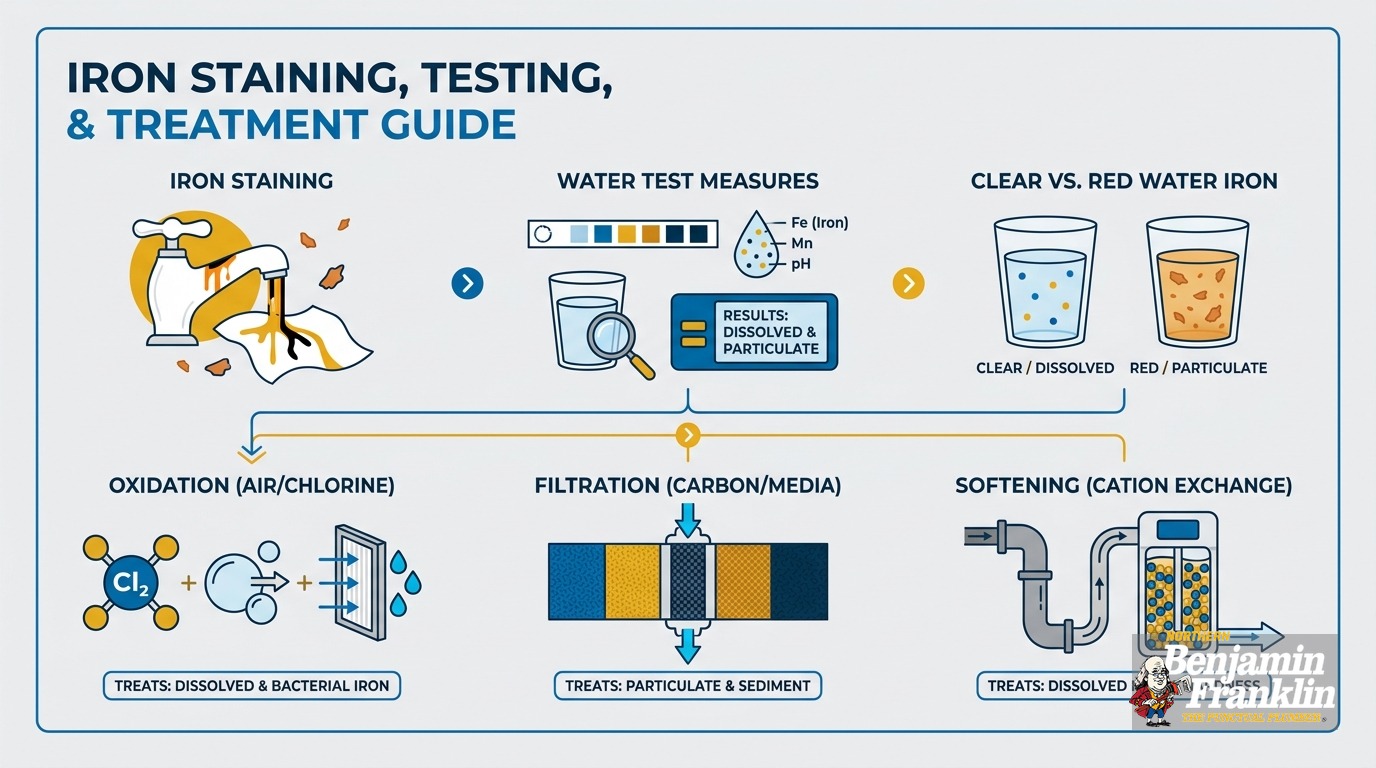
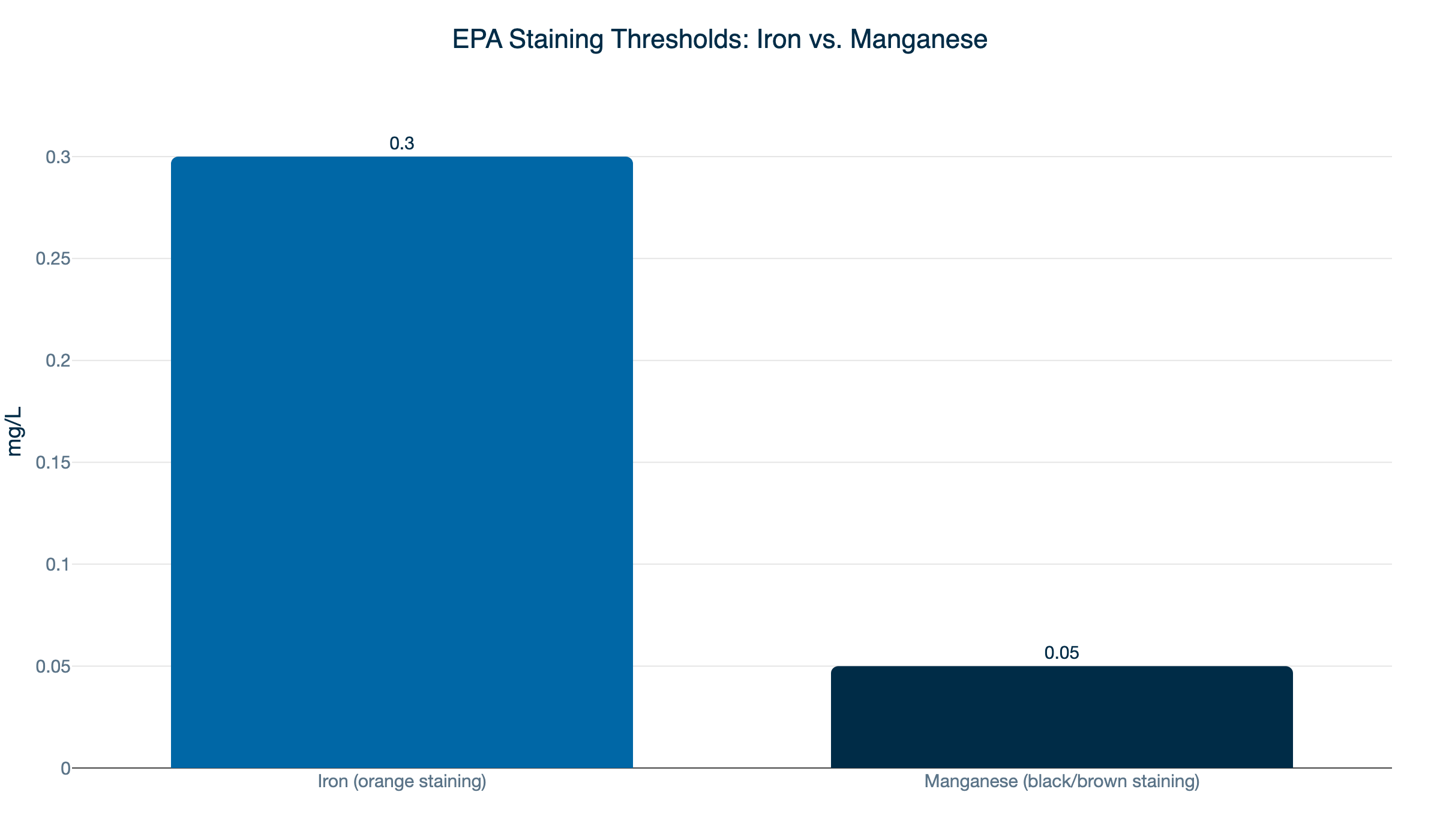
- Orange, rust, or reddish-brown staining in your sink, toilet, laundry, or plumbing fixtures points to iron. The EPA aesthetic action threshold is 0.3 mg/L.
- Black or very dark brown staining points to manganese, not iron. The manganese threshold is 0.05 mg/L - six times lower than iron’s. Many Minnesota wells have both.
- Minnesota well water carries four distinct types of iron: ferrous, ferric, organic, and bacterial. Each requires a different treatment. Installing the wrong system is why staining often continues after a homeowner puts in new equipment.
- A water test should measure iron, hardness, pH, alkalinity, and iron bacteria as a panel. The iron number alone does not tell you which treatment will work.
- A water softener handles ferrous (clear-water) iron up to about 2-5 mg/L in practice. It plugs on ferric (red-water) iron and does nothing for bacterial iron.
- Bacterial iron requires two separate steps: shock chlorination to kill the bacteria, then a separate filtration system to remove the iron itself.
- Before any contractor touches your well water system, verify their Minnesota license using the Department of Labor and Industry’s License Lookup tool.
Why Does Your Water Leave Orange and Black Stains?
The short answer: The stain color tells you which mineral is present. Orange or rust staining means iron above 0.3 mg/L. Black or dark brown staining means manganese above 0.05 mg/L. Both are EPA secondary drinking water standards - they are aesthetic thresholds, not health limits, but they are the widely used action points for iron in well water treatment in Minnesota.
Iron leaves a wider footprint than most homeowners expect. According to the Minnesota Department of Health, iron in water can stain dishes, laundry, and plumbing fixtures yellow, red, or brown. It can give tea and coffee a metallic rainbow sheen in bright light. It can turn potatoes black during cooking. Over time, it restricts flow inside wells, pumps, sprinklers, and dishwashers.
The stains are the warning you can see. The equipment damage is the problem you do not notice until it is expensive.
If your white laundry comes out with a rust tint, if your toilet bowl carries a ring that scrubbing does not remove, or if your sink basin has streaks you cannot explain, iron is the likely cause. If the staining is closer to black or very dark brown, that is a different mineral with a different threshold and a different treatment priority. The two show up together in many Twin Cities aquifers - a point that comes into focus when you understand what a complete water test actually measures.
Iron problems are also not new to Minnesota homes. The state’s geology puts a significant share of private wells in contact with iron-bearing bedrock and glacial deposits. Private wells across the metro - from the northeast suburbs to the communities stretching north and west - draw from aquifers where iron and manganese are routine findings. If your well water has been tinted for years and you have never had it formally tested, the information below gives you the framework to start.
What Are the Four Types of Iron in Minnesota Well Water?
The short answer: Minnesota well water can carry ferrous iron, ferric iron, organic iron, or bacterial iron - and often more than one at once. Each type is dissolved, suspended, bonded, or biological, and those physical differences determine which treatment system will remove it and which will fail.
Understanding the difference is the core of iron in well water treatment in Minnesota. Most homeowners who put in a system and still have staining bought the right category of equipment for the wrong type of iron.
Ferrous iron - often called clear-water iron - is fully dissolved in the water. The water looks completely clear at the tap. Once it sits, contacts air, or lands on a surface, it oxidizes and turns reddish-brown. If your toilet bowl has a persistent ring but the water in a glass looks clean and clear, ferrous iron is the most common explanation. It is dissolved because the water has not yet had the chance to oxidize it.
Ferric iron - red-water iron - is already oxidized before it reaches your tap. The water looks visibly rusty or yellow the moment it comes out. Ferric iron exists as suspended particles, not dissolved ions, and that physical state changes how it behaves in a treatment system. A softener designed for dissolved ferrous iron will plug quickly on ferric particles. The iron is not passing through the resin - it is coating and clogging it.
Organic iron is iron that has bonded to humic or other organic acids in the water. It may look colorless or carry a yellowish-brown tint. This form is more prevalent in shallow wells where the water passes through soils with high organic content. It appears more often in certain parts of the northeast Twin Cities metro and in communities farther north and northwest, where shallower water tables and organic-rich soils intersect. Organic iron behaves differently in treatment systems because the iron-organic bond resists the standard oxidation steps used for ferrous and ferric iron.
Bacterial iron is the most recognizable type once you know what to look for. Open your toilet tank and look inside. If you see a reddish-brown or yellow gelatinous slime coating the walls, float, or flapper, that is bacterial iron. A sulfur-like or musty odor from your water, or an iridescent sheen on standing water in a drain or bucket, are additional signs. According to the Minnesota Department of Health, iron bacteria are found in most Minnesota soils and can be introduced into a well during drilling, pump replacement, or any service call. A well that has never had bacterial iron before can develop it after a single service visit.
Knowing which type you have before you buy equipment is not optional. It is the starting point for effective iron in well water treatment in Minnesota.
What Does a Water Test Actually Measure - and Why Does It Matter?
The short answer: A proper iron test panel includes iron concentration, pH, hardness, alkalinity, and a separate iron bacteria test. The Minnesota Department of Health is explicit on this: treatment selection depends on all of these numbers together. The iron reading alone does not tell you which system will work - or whether the system you already own is the right match for your water.
Here is what each measurement tells a treatment professional and why skipping any of them leads to a mismatched recommendation.
Iron concentration confirms you are above the 0.3 mg/L staining threshold and tells you the magnitude of the problem. A reading under 5 mg/L puts you in softener-compatible territory if the rest of the chemistry supports it. A reading above 10 mg/L points toward oxidation-based treatment that a softener cannot provide.
pH governs whether specific treatment systems function correctly. Manganese greensand filters - one of the most common tools for ferrous and ferric iron in Minnesota - require a specific pH range to regenerate properly. Outside that window, the media does not recharge between cycles and iron removal degrades over time. You may not notice for months.
Hardness matters when a water softener is part of the conversation. Softeners use ion exchange resin to remove both hardness minerals (calcium and magnesium) and dissolved iron simultaneously. When hardness is low relative to iron concentration, the resin has fewer competing ions, and iron removal becomes unreliable. The MDH notes that while some softeners carry ratings up to 10 mg/L iron removal, 2-5 mg/L is the practical limit most systems consistently achieve in real-world Minnesota well conditions.
Alkalinity buffers pH swings during oxidation-based treatment. Low alkalinity can allow pH instability in systems that inject chlorine or hydrogen peroxide, reducing treatment effectiveness and accelerating equipment wear.
Iron bacteria requires a dedicated test, separate from the standard water chemistry panel. No chemistry result will reveal bacterial iron. If you skip the bacteria test, you can design and install a perfectly matched filtration system and still have slime in your toilet tank six months later.
Use an MDH-accredited laboratory. MDH maintains a lab search tool where you can find an accredited lab near you. A hardware store test strip gives you a rough number. It does not give you the complete chemistry picture you need to choose the right treatment system.
We help Twin Cities homeowners understand what home water testing results actually mean and what to do with them. If you have a water test in hand and are not sure how to read it, call us before you buy anything.
Which Iron Type Matches Which Treatment?
Once you have your complete water test results, treatment selection follows a clear logic. Each iron type has a system that works - and systems that will fail quickly or make the problem worse.
Ferrous (clear-water) iron: A water softener is a reasonable first option when iron is in the 2-5 mg/L range, provided pH and hardness support it. The ion exchange process that removes calcium and magnesium also captures dissolved ferrous iron. Above that range, a manganese greensand filter handles ferrous iron effectively up to 10-15 mg/L and is the better choice when iron levels are higher or when a softener alone is not bringing concentrations down consistently.
Ferric (red-water) iron: This is where the wrong system choice is most common and most costly. Ferric iron is already oxidized - it exists as suspended particles. Sediment filters, carbon filters, and water softeners will all plug quickly on ferric particles. According to the Minnesota Department of Health, these systems are not designed for ferric iron and will fail on it. The right tool is a manganese greensand filter for concentrations up to 10-15 mg/L. For higher concentrations, an aeration step or chemical oxidation using chlorine or hydrogen peroxide injection, followed by filtration, is the path MDH recommends.
Organic iron: The iron-organic bond resists standard oxidation chemistry. Treatment typically involves chlorination followed by filtration, or tannin removal followed by aeration and filtration. The specific design depends on the organic content in your water alongside the iron concentration, which is why a complete test panel matters more for organic iron than for any other type.
Bacterial iron: Covered in the next section. It requires a two-step sequence distinct from every other iron type.
If you are managing hard water alongside iron - a combination that is very common in the Twin Cities, where many homes pull from aquifers with significant hardness - our water softeners page explains how softeners handle both and where they reach their limits. Addressing the iron type correctly and the hardness together in a single system design saves money and avoids equipment conflicts down the road.
Why Does Bacterial Iron Require Two Separate Treatments?
The short answer: Shock chlorination kills the iron bacteria. It does not remove the iron. Once the bacteria are eliminated, a separate iron filtration system - sized to your iron type and concentration - removes the iron itself. Doing only one step leaves half the problem in place.
Bacterial iron is not just iron in your water. It is living organisms that use dissolved iron as a nutrient source. The reddish-brown or yellow slime in your toilet tank is a biofilm those bacteria have formed inside your plumbing. It builds up in pipes, coats the inside of pressure tanks, and collects in fixtures over time.
Shock chlorination at or near 200 ppm chlorine concentration disrupts the biofilm and kills the bacteria throughout the system. The Minnesota Department of Health’s guidance on iron bacteria details the procedure: chlorine concentration must reach but not exceed 200 ppm, the treated water needs to remain in the system long enough to contact all biofilm surfaces, and the entire system requires thorough flushing before you return to normal use.
After shock chlorination, the bacteria are gone. The iron is still present in the water. You still need a filtration system appropriate to the iron type you have - whether ferrous, ferric, or organic - using the treatment logic above.
There is a second complication: bacterial iron can return. Iron bacteria are found in most Minnesota soils, and drilling, pump replacement, or any service work on the well can reintroduce them into a system that was previously clean. If you treat your system, see improvement, and then staining and slime reappear after a service visit, the bacteria came back. The shock chlorination step needs to be repeated before any iron filtration system can be effective again.
This two-problem, two-treatment reality is what most iron treatment information glosses over. If you have bacterial iron, there is no single system that handles both in one pass.
Is That Black Staining Iron or Manganese?
The short answer: Black or very dark brown staining is manganese, not iron. The EPA secondary standard for manganese is 0.05 mg/L - six times lower than iron’s 0.3 mg/L threshold. A water test that checks only for iron will miss a manganese problem entirely, and iron treatment alone will not stop the black staining.
Manganese appears in many of the same aquifers as iron across the Twin Cities and greater Minnesota. If your fixtures show both orange and black staining, you likely have both minerals. If the staining is primarily dark, do not assume iron treatment alone will resolve it.
Manganese greensand filters address both ferrous iron and manganese in many situations, which is part of why they appear frequently in Minnesota water treatment designs. But the oxidation conditions required to remove manganese are not identical to those for iron. A filter optimized for iron at the wrong pH may not bring manganese below the 0.05 mg/L threshold where staining stops.
Tell your treatment professional about any dark staining before they design a system. If your test comes back with both iron and manganese, both need to be incorporated into the treatment design from the start. Retrofitting a system that was not designed for manganese costs more than designing for both at the outset. Our manganese in water page has more detail on how manganese behaves in Minnesota well water and how treatment priorities shift when both minerals are present.
How to Verify a Licensed Water Treatment Contractor in Minnesota
Before any contractor touches your well water system, run a license check. The Minnesota Department of Health explicitly recommends verifying that the person you hire holds a license as a licensed plumber or licensed water conditioning contractor in Minnesota. Use the Minnesota Department of Labor and Industry’s License Lookup to confirm before work begins.
This matters because improper installation can contaminate a private well, void equipment warranties, and fail to address the original problem. A contractor who cannot be found in the DLI lookup is not licensed for this work in Minnesota, and MDH is clear that the check belongs at the front of the hiring process - not after a system is already installed.
Northern Benjamin Franklin Plumbing is locally owned and operated in the Twin Cities. Our plumbers hold Minnesota licenses and work on water treatment systems across the metro - Minneapolis, St. Paul, Blaine, Bloomington, Brooklyn Park, Coon Rapids, Maple Grove, and the surrounding communities. When you call us, you can verify our license before we set foot in your home.
We back every service call with the On-Time Guarantee(R): we show up in the window you choose, or we pay you $5 for every minute we are late, up to $300. “If there is any delay, it’s you we pay!” That promise is why Twin Cities homeowners call us when they want the job done right the first time.
What to Do If Your Well Water Has Iron
Start with a water test from an MDH-accredited laboratory. MDH provides a lab search tool to find a lab near you. Request a panel that includes iron, hardness, pH, alkalinity, and iron bacteria. The iron number alone is not enough to make a treatment decision.
Once you have your results, bring them to a licensed professional who can match the treatment to your actual water chemistry. The right system depends on which iron type you have, the concentration, and the supporting numbers. A softener that works well for a neighbor at 2 mg/L ferrous iron will plug on ferric iron and do nothing for bacterial iron. Buying equipment before you know the type is the most common and most expensive mistake in iron in well water treatment in Minnesota.
If you also have hard water - common throughout the Twin Cities metro, where many homes draw from aquifers with significant calcium and magnesium levels - a well-designed system can address both iron and hardness together. That kind of combined design starts with the complete test results.
Call Northern Benjamin Franklin Plumbing at (763) 296-1844 or schedule your water treatment consultation online. Our team serves homeowners across Minneapolis, St. Paul, and the surrounding Minnesota metro. We will review your test results with you, walk through the treatment options, and give you a clear recommendation matched to what your water actually contains.
Frequently Asked Questions
What causes orange staining in well water? +
Will a water softener remove iron from well water in Minnesota? +
What is bacterial iron and how is it treated? +
How do I verify a water treatment contractor is licensed in Minnesota? +
Need a technician now?