
Whole House Sediment Filter: The Step Most Reps Skip
Key Takeaways
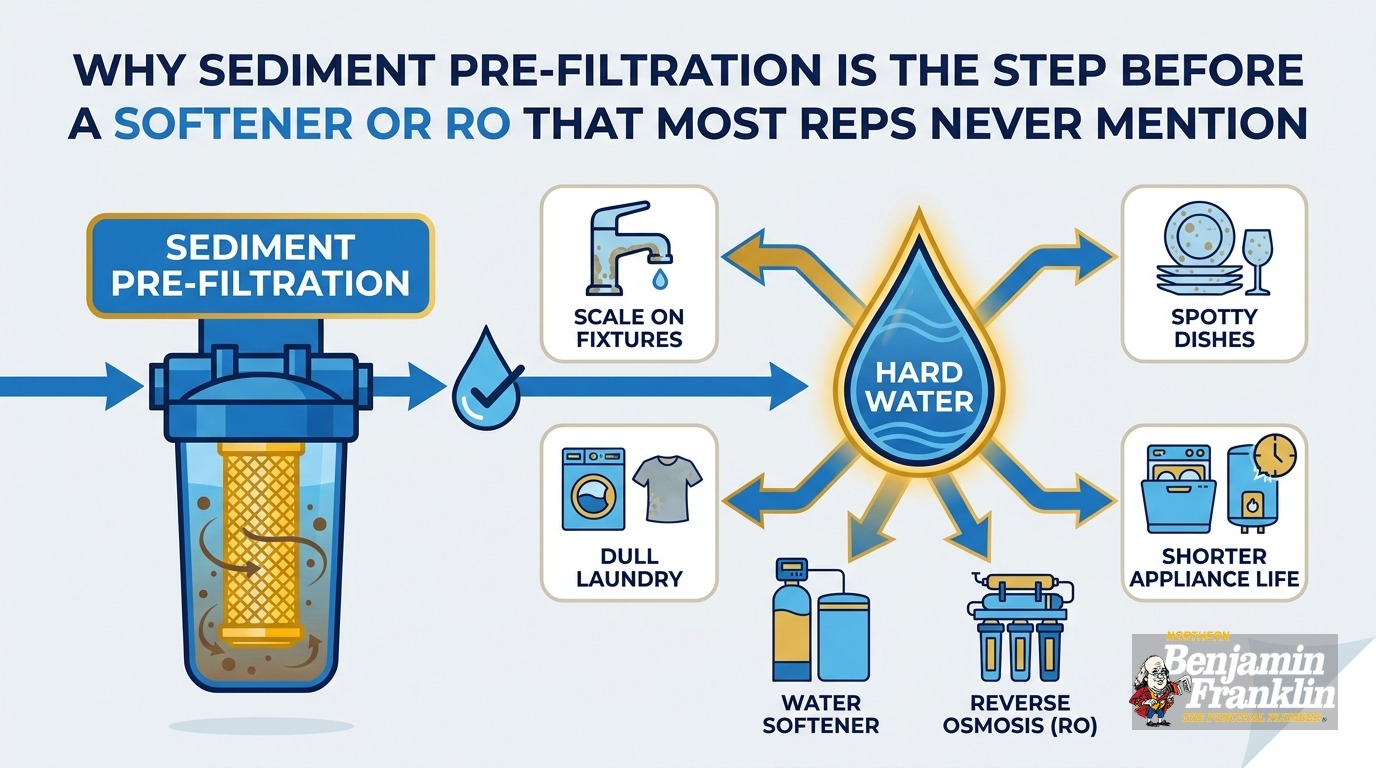
- A whole house sediment filter removes sand, silt, rust flakes, and oxidized iron from your supply line before water reaches any downstream equipment.
- It is the first stage in any water treatment stack. Without it, sediment fouls softener resin beds and clogs RO membranes.
- Micron rating depends on placement: 25-50 micron for general whole-house use, 10-25 micron before a softener, 1-5 micron before a reverse osmosis system.
- In the Twin Cities, sediment varies by source. Minneapolis municipal water carries river silt and distribution-pipe rust. St. Paul and most suburbs draw from hard groundwater where dissolved iron oxidizes into particles.
- Minnesota Rules Chapter 4715 requires a permit and a licensed plumber for any permanent connection to the potable supply - including a filter housing.
- Filter housings must sit in a heated mechanical space. A polypropylene housing in an unheated garage or crawlspace will crack in a Minnesota winter.
What Is a Whole House Sediment Filter?
The short answer: A cartridge filter installed on the main supply line that removes suspended solids - sand, silt, rust flakes, oxidized iron - before water reaches anything downstream.
The filter housing threads onto your main line, upstream of the water heater, softener, reverse osmosis system, and every fixture in the home. It holds a replaceable cartridge rated by pore size in microns. A 50-micron cartridge stops coarse, visible material. A 5-micron cartridge stops the fine particles that cause damage inside equipment.
One filter on the supply line. Everything in the home draws from filtered water.
That distinguishes it from an under-sink filter or a refrigerator filter, both of which protect a single point of use. A whole house sediment filter protects the pipes, the water heater, the appliances, and any downstream treatment equipment all at once. The placement matters: upstream of everything else is what makes it useful. The filter is not the main event. It is the layer that keeps the main event running.
Why Do Softeners and RO Systems Need a Whole House Sediment Pre-Filter?
The short answer: Sediment destroys the components that make softeners and RO systems work. Most reps skip mentioning it because the pre-filter does not add to the sale.
A water softener relies on a resin bed to exchange calcium and magnesium ions for sodium ions. That resin works only when its surface stays clean. Iron particles and fine sediment coat the resin beads over time. The softener keeps cycling and the salt keeps being consumed, but hardness removal drops. Eventually the resin is fouled beyond what regeneration can restore.
In high-iron groundwater areas - which includes most Twin Cities suburbs drawing from aquifer wells - this fouling happens faster than most homeowners expect. A resin bed that should last 12 or more years lasts five instead. The softener that was supposed to solve the hard water problem uses more salt and underperforms for most of its shortened life.
A reverse osmosis system has the same vulnerability, amplified. RO membranes filter at 0.0001 micron. They are extraordinarily effective and extraordinarily sensitive to particulate loading. A membrane running without upstream pre-filtration in a high-sediment supply can foul in weeks. Most RO manufacturers require a 5-micron sediment pre-filter as a condition of the membrane warranty. Skip it and you operate without coverage when the membrane fails ahead of schedule.
Our post on reverse osmosis systems for Twin Cities homes covers how RO systems work and what a full installation involves.
The economics are simple. The softener and the RO system are the expensive equipment. The pre-filter housing is not. The reason the pre-filter step gets skipped is that a rep closing an $800 softener or $1,200 RO unit is focused on that transaction. The $45 housing that extends the equipment’s useful life does not move that conversation forward.
What Happens to a Water Softener Without Pre-Filtration?
The short answer: Particulate iron and sediment foul the resin bed, raise salt consumption, and cut resin life significantly - often from 12 or more years down to five or fewer.
According to the USGS, calcium carbonate deposits form when hard water is heated, reducing equipment efficiency and shortening appliance life. That same chemistry applies inside a softener’s resin tank when iron is present. Iron deposits on resin beads are more stubborn than hardness scale. Routine salt regeneration removes hardness. It does not reliably clean iron fouling off the resin surface.
The downstream effects are measurable. Salt consumption climbs. The softener regenerates more often. The water coming out of the softener starts to feel harder because the resin can no longer perform across the full capacity of the bed. When the fouling is severe enough, the resin needs to be replaced or the unit replaced entirely.
A 10-25 micron sediment pre-filter ahead of the softener stops the particulate iron before it ever reaches the resin. The softener sees clean water and works as designed. The resin reaches its rated lifespan. Salt consumption stays predictable.
For homes on municipal groundwater in the suburban ring - Eden Prairie, Minnetonka, Eagan, Woodbury - where iron content is higher than Minneapolis municipal water, this protection is not a premium option. It is the baseline spec for any softener installation.
Our post on iron and manganese in Minnesota well water goes deeper on what those contaminants do to home water systems and treatment equipment.
What Micron Rating Do You Actually Need?
The short answer: Match the micron rating to what is downstream: 25-50 micron for general whole-house protection, 10-25 micron before a softener, and 1-5 micron before an RO membrane. Smaller numbers mean finer filtration and faster cartridge loading in high-sediment water.
Here is the practical guide by placement:
- 25-50 micron: General whole-house protection. Stops sand, grit, rust flakes, and coarse sediment. The right starting point for homes on low-sediment municipal water, or as the first stage in a multi-filter stack.
- 10-25 micron: Before a water softener. Stops the fine iron particles that foul resin without creating enough flow restriction to drop pressure throughout the home.
- 1-5 micron: Before a reverse osmosis system. This is the level most RO manufacturers specify for membrane protection. A 5-micron cartridge at this stage also handles fine silt and rust particles from aging cast-iron distribution pipes.
If you have both a softener and an RO system, the typical stack is a 10-25 micron filter before the softener and a second 1-5 micron filter before the RO membrane. The first filter handles the bulk load. The second protects the most sensitive component.
There is a practical trade-off to understand. Higher filtration catches more, but also loads faster and restricts flow more as it fills. A 5-micron cartridge run before a softener in a high-iron supply can blind in weeks and starve the softener of flow. That is why you stage the filtration rather than trying to do everything with one ultra-fine cartridge in the wrong position.
When a cartridge loads, the first symptom most homeowners notice is reduced pressure at the showerhead or a slow-filling washing machine. Installing a pressure gauge on each side of the housing gives you an exact read. A 10-15 psi differential is the signal to swap the cartridge.
Twin Cities Water: What You Are Actually Filtering Against
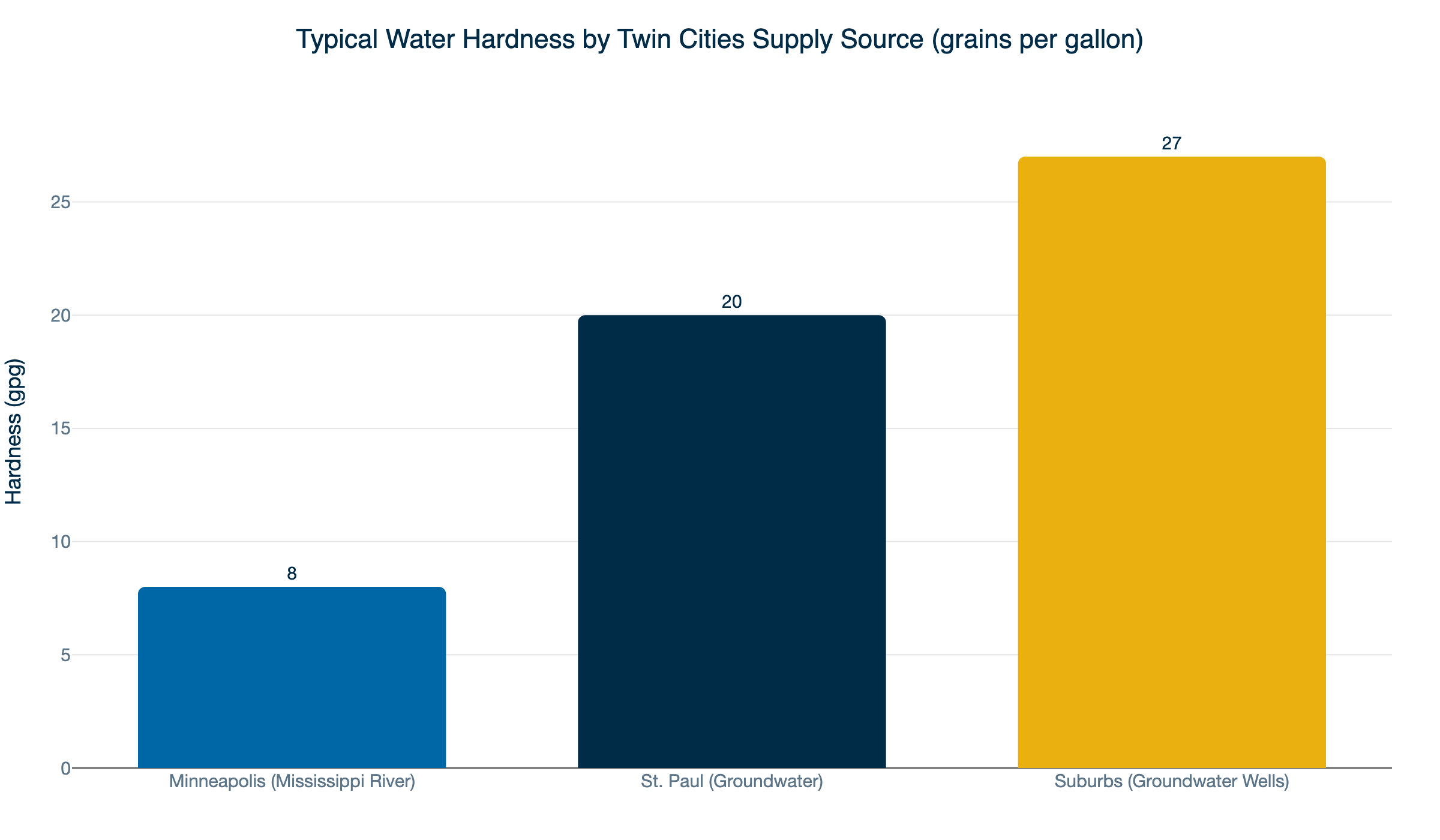
The Twin Cities is not one water supply. The sediment threat varies by neighborhood and source, and the filter spec should reflect that.
Minneapolis draws from the Mississippi River. Surface water treatment produces softer water - typically 6-10 grains per gallon (gpg). The sediment concern here is silt and turbidity from river water and rust from aging cast-iron distribution mains. When the city flushes water mains or after a main break, homes in Minneapolis often see orange or brown staining at the tap. A sediment filter on the supply line catches that before it reaches the water heater, fixtures, or appliances. The city publishes annual contaminant data through the Minneapolis water quality reports page.
St. Paul draws from deep groundwater - the Prairie du Chien-Jordan aquifer. That water is significantly harder, typically 17-22 gpg, and carries dissolved iron and manganese. When iron-rich groundwater meets air and pressure changes inside home plumbing, dissolved ferrous iron (Fe2+) oxidizes into solid ferric particles (Fe3+). Those particles are exactly what a sediment filter stops before they reach the softener resin or the RO membrane.
Twin Cities suburbs - particularly communities drawing from municipal or private groundwater wells - often carry the highest sediment load. Hardness commonly runs 20-35+ gpg. Iron levels are higher. In these homes, a whole house sediment filter before a softener is not an upgrade. It is the first item on the spec list for any water treatment installation.
The EPA’s private well guidance connects stained plumbing fixtures and laundry to iron, copper, and manganese - the same contaminants that foul treatment equipment when pre-filtration is skipped. The Minnesota Department of Health maintains dedicated guidance on iron in well water, confirming that iron in Minnesota groundwater is common enough to warrant specific state-level guidance.
Understanding where your water comes from matters before you spec any treatment system. Our post on water hardness across Minneapolis and St. Paul covers those differences in detail and helps you understand what you are actually treating.
If you are on a private well, get your water tested before installing treatment equipment. A sediment filter will not treat dissolved iron - but it is non-negotiable as the first stage before whatever system does.
Does Installing a Whole House Sediment Filter Require a Permit in Minnesota?
The short answer: Yes. Minnesota Rules Chapter 4715 requires a permit and a licensed plumber for any permanent connection to the potable water supply - including a filter housing on the main line.
Minnesota Rules Chapter 4715 governs all potable plumbing work in the state. Installing a filter housing on your main supply line is a permanent connection to the potable supply. It requires a permit. Minnesota Rules 4715.1100 addresses connections to the water supply system specifically.
This is the detail that every generic “whole house sediment filter” article skips. Those articles are written for a national audience. They tell you what cartridge to buy and roughly where to install it. They do not tell you that a homeowner connecting filter hardware to their own supply line in Minnesota is doing unlicensed plumbing work under state law.
The permit requirement exists for practical reasons. A licensed plumber assesses the installation site in person. They check the existing line pressure, plan for the pressure drop the filter housing will create, install the bypass valve correctly, and make sure the housing location meets the code requirements for your specific home. If pressure is high before the filter, the plumber accounts for that. If the mechanical space is too tight for the service clearance, the plumber knows before any cuts are made.
Beyond the code requirement, there is a liability consideration. If a DIY filter housing fails - a cracked housing, a loose connection, a fitting that lets go under pressure - and causes water damage, the homeowner has an unpermitted plumbing installation on record. That affects the insurance claim. It also affects the home’s disclosure when the property is eventually sold and inspectors start asking about unpermitted work.
Northern Benjamin Franklin Plumbing installs whole-home water treatment systems across the Twin Cities metro, from the permit through final inspection. Our whole-home water filtration page covers what a full installation involves.
Where Should You Install the Filter Housing in Minnesota?
The short answer: In a heated mechanical space, always. Filter housings hold standing water, and Minnesota winters will crack a polypropylene housing installed in an unheated area.
This is a cold-climate installation detail that product guides never cover, because most product guides are written for a national audience where freezing temperatures are not part of the installation calculus.
Filter housings are molded polypropylene. They hold standing water between cartridge changes. If the housing is installed in an unheated garage, in a cold crawlspace, against an exterior wall that drops below 32 degrees, or anywhere that temperatures can reach freezing - the standing water inside expands as it freezes and cracks the housing body. Polypropylene does not flex enough to absorb that expansion. The housing fails. The repair cost exceeds the cost of the filter many times over, and that is before accounting for any water damage.
In Minnesota, frost depth runs 42-60 inches and winter temperatures can hold below zero for extended periods. This failure mode is not theoretical. It is predictable.
The correct location is a heated mechanical room or utility space on the interior of the home. The supply line comes into the home, enters the heated space, and hits the sediment filter before branching to the water heater, softener, and the rest of the system. In most Twin Cities homes, that means the basement utility area near the pressure tank or water meter.
If your mechanical space is partially unheated - a common situation in older homes with basement layouts that predate modern mechanical equipment - the filter housing goes on the warm side of that divide. A licensed plumber walks the installation location before any hardware is ordered and knows the constraints of your specific home.
How Often Should You Replace the Filter Cartridge?
The short answer: Every 3-6 months as a starting point - but let the pressure differential across the housing tell you when the cartridge is loaded, not just the calendar. In high-sediment supplies like suburban groundwater wells, that interval can drop to 1-3 months.
A loaded cartridge restricts flow and defeats the purpose of having the filter installed. The first symptom most homeowners notice is reduced pressure at the showerhead or a slow-filling washing machine. Those are signs the cartridge has been loaded past its useful life.
The practical replacement schedule by sediment load:
- Light sediment (Minneapolis municipal, low iron): 6-12 months
- Moderate sediment (St. Paul municipal, some iron): 3-6 months
- Heavy sediment (suburban groundwater wells, high iron): 1-3 months
Spring is typically the highest-load period in Minnesota. Snowmelt carries more suspended solids into the water table. Homes on wells may see the cartridge load faster in April and May than at any other time of year. Plan the first cartridge swap of the year early, before the spring load peak rather than after you notice the pressure drop.
The most accurate method is a pressure gauge on each side of the filter housing. When the differential reaches 10-15 psi, the cartridge is loaded and ready for a swap. This is more reliable than a fixed calendar interval, especially in supplies where loading is not uniform across the seasons.
The swap itself is quick. The housing unthreads at the sump, the cartridge lifts out, and the new one drops in. The skill is in matching the replacement cartridge to the correct micron rating and housing size from the original installation spec. Swapping to a different micron rating changes both the protection level and the replacement interval going forward.
The Bottom Line on Whole House Sediment Filtration
A whole house sediment filter is not the headline piece of a water treatment system. It is the layer that makes everything else work as designed.
If you have a softener, the sediment filter keeps the resin clean and extends the softener’s useful life. If you have an RO system, it protects the membrane and keeps you within warranty coverage. If you have neither yet, it catches the rust, silt, and iron particles from aging distribution pipes before they reach the water heater, appliances, and fixtures.
The USGS documents that scale from hard water reduces water heater efficiency and shortens equipment life. Research from NREL (report NREL/TP-550-33515) attributes roughly 8 percent efficiency loss per quarter-inch of scale on water heater elements. In a Twin Cities home with suburban groundwater hardness above 20 gpg and no treatment in place, scale accumulates in months, not years. A sediment pre-filter will not dissolve existing scale, but it removes the particulate load that compounds the problem and fouls the equipment designed to treat it.
The install sequence matters: sediment filter first, then the softener, then the RO. That order protects the most expensive components with the least expensive stage. And in Minnesota, that installation is a permitted plumbing job - not a weekend DIY project - because the state code requires it and because the freeze risk in this climate makes a correct, interior installation non-negotiable.
Northern Benjamin Franklin Plumbing is locally owned and operated in the Twin Cities. We install water treatment systems with permits pulled and work done to code. Our On-Time Guarantee(R) means we show up in the window you choose. “If there is any delay, it’s you we pay!”
To schedule a water treatment consultation or get a whole house sediment filter installed, call us at (763) 296-1844 or book online.
Frequently Asked Questions
Do I need a sediment filter if I already have a water softener? +
What micron rating should a whole house sediment filter be? +
Does installing a whole house sediment filter require a permit in Minnesota? +
Where should a whole house sediment filter housing be installed in Minnesota? +
Need a technician now?