
Reverse Osmosis Water Filter for Twin Cities Homes
Key Takeaways
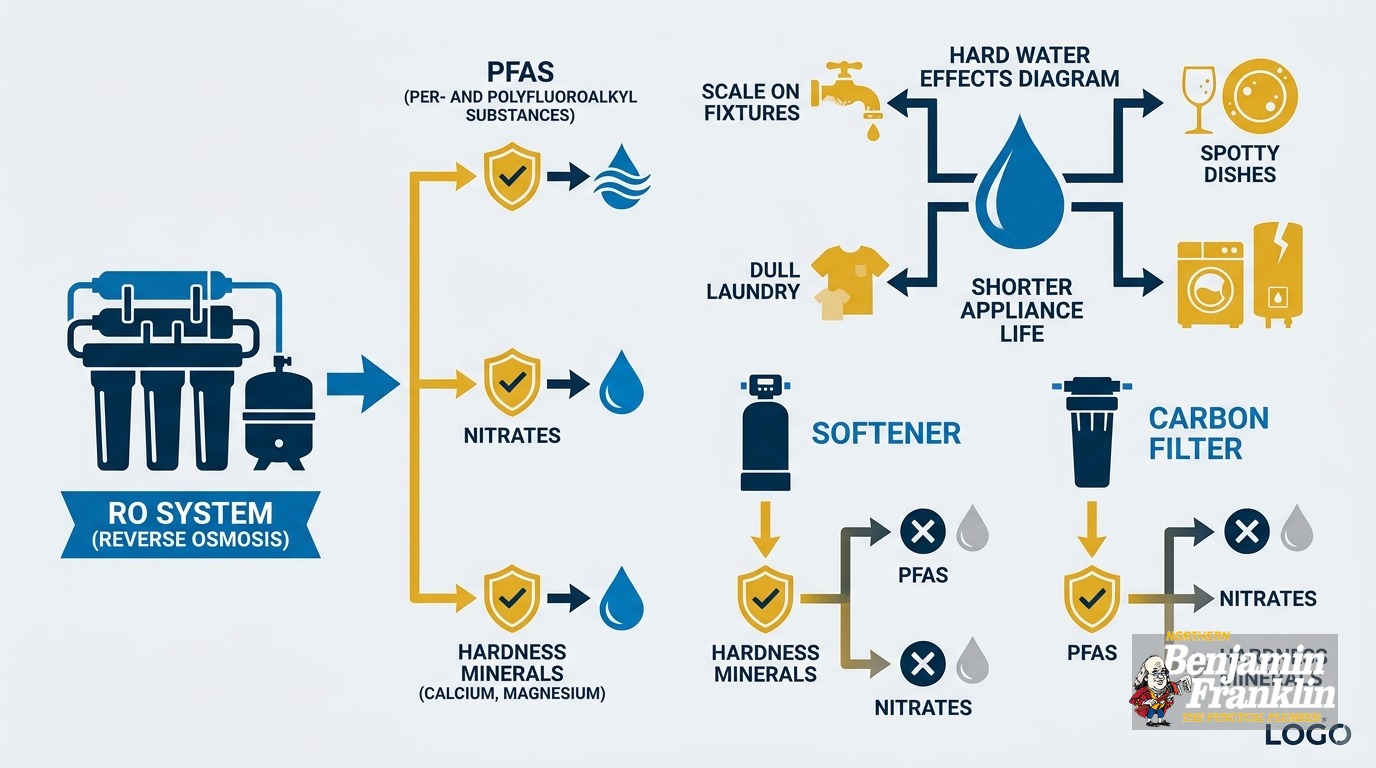
- A carbon block filter improves taste and removes chlorine. It does not remove PFAS or nitrates.
- A water softener removes hardness minerals for the whole house. It does not touch PFAS or nitrates.
- A reverse osmosis water filter is the only under-sink technology that addresses all three: PFAS, nitrates, and dissolved minerals at the kitchen tap.
- Twin Cities homeowners face documented PFAS contamination in the East Metro and nitrate problems in many collar-county private wells.
- The EPA’s April 2024 rule set PFOA and PFOS limits at 4 parts per trillion and named reverse osmosis as a best available treatment technology.
- Installing RO in Minnesota is a plumbing code event under MN Rule 4714. A licensed plumber is the compliant path.
- RO has real trade-offs: it treats only the kitchen tap, drains 2 to 4 gallons for every gallon it produces, and does not soften the whole house.
What exactly is a reverse osmosis water filter?
Reverse osmosis forces tap water through a semi-permeable membrane under pressure. The pores are small enough to block dissolved salts, heavy metals, PFAS molecules, and nitrates. Filtered water collects in a small storage tank under the sink. Rejected contaminants flush down the drain.
Most under-sink units run three to five stages: a sediment pre-filter, a carbon pre-filter, the RO membrane itself, and a carbon post-filter to polish the taste. Filtered water comes out of a dedicated tap beside your main kitchen faucet.
Standard units serve one or two fixtures - the kitchen drinking tap and sometimes an ice maker line. Every other faucet in the house gets untreated water, exactly as before. That is not a defect; it is how the technology works, and it is important to understand before you buy.
How is RO different from a water softener?
A water softener removes hardness minerals through ion exchange, swapping calcium and magnesium for sodium. It treats every faucet in the house. It does not remove PFAS, nitrates, or most other dissolved contaminants. RO removes PFAS, nitrates, and dissolved minerals at the kitchen tap only.
Think of them as tools for different jobs. A softener protects your water heater, appliances, and pipes from scale buildup. It keeps soap lathering and keeps laundry from going stiff. Every shower, every load of laundry, every hot-water appliance benefits.
What a softener cannot do is address the chemistry that makes water unsafe to drink. PFAS compounds are not hardness minerals. They do not bind to the resin bead inside a softener. Nitrate is a dissolved anion - same story. A home that runs city water through a softener and assumes the drinking water is protected is missing a layer. The softener did not touch what matters most at the glass.
RO handles what the softener leaves behind. At the kitchen tap, the membrane catches the PFAS and nitrate that ion exchange cannot touch. In exchange, you give up the whole-house reach. RO water stays at the sink.
Many Twin Cities homes need both tools. A softener for the house; RO for the drinking tap. They are not competitors. They solve adjacent problems.
For more on whole-house water softening in the Twin Cities, see our water softeners page.
How is RO different from a carbon block filter?
A carbon block filter removes chlorine, chloramines, some VOCs, and odor-causing compounds. It improves taste significantly. It does not reliably remove PFAS at the concentrations regulators now treat as dangerous, and it does not remove nitrates or hardness minerals.
Carbon filtration is the workhorse for municipal taste complaints. Minneapolis and St. Paul both chlorinate or chloraminate their water. A carbon block pulls that disinfection chemistry back out before it reaches your glass. For a homeowner whose only complaint is taste or smell, carbon alone may be enough.
PFAS is where carbon hits its ceiling. Some activated carbon filters reduce certain PFAS compounds. But the removal rate varies by PFAS type, filter quality, and flow rate. RO membranes are more consistent and more comprehensive across the PFAS family. That consistency is why the EPA’s April 2024 PFAS treatment fact sheet names reverse osmosis as one of the best available technologies for point-of-use PFAS removal.
For nitrates, the answer is simpler: carbon does not remove them. If your private well tests positive for nitrate, a carbon block is not a solution.
Does a reverse osmosis water filter address PFAS in Twin Cities water?
Yes. The EPA identifies RO as a best available treatment technology for PFAS removal at the point of use. The Twin Cities metro has documented PFAS contamination in the East Metro, where the Minnesota Department of Health has monitored groundwater since 2002.
In April 2024, the EPA finalized its PFAS drinking water rules. The maximum contaminant level for PFOA and PFOS is 4 parts per trillion, with a goal of zero. Public water systems have until 2029 to comply. In May 2026, the EPA proposed a two-year extension to 2031 for that compliance deadline.
The East Metro exposure zone is real and named. Communities in Washington and Dakota counties - downhill from documented PFAS sources at 3M Cottage Grove and the Minneapolis-St. Paul Airport - have been in MDH’s priority sampling program for years. MDH has assessed PFAS in groundwater in that area since 2002.
If you are on a private well in Anoka, Scott, Carver, Wright, or Isanti county, there is no utility to absorb the risk. You own your contamination exposure entirely. A point-of-use RO system at the kitchen tap is the only thing standing between that well water and the glass.
You can check your specific water system using MDH’s Interactive PFAS Dashboard.
As of May 2026, the EPA proposed to keep PFOA and PFOS standards in place but rescind standards for several other PFAS compounds - PFHxS, PFNA, and HFPO-DA. PFOA and PFOS enforcement is moving forward. The standards for the others are in regulatory limbo. An RO system treats the tap comprehensively and does not wait on regulatory timelines to decide which molecules to stop.
For a deeper look at how PFAS reached Minnesota water and what regulators are doing, read our post on PFAS in Minnesota drinking water and home filtration.
What about nitrates - does Minnesota have a problem?
Yes, particularly for private wells in rural and collar-county areas. The Minnesota Department of Health reports that more than 10% of private wells in some Minnesota townships exceed the federal limit of 10 milligrams per liter. SE Minnesota has a documented, state-addressed nitrate problem.
Nitrate causes methemoglobinemia - “blue baby syndrome” - in bottle-fed infants under six months. At high enough concentrations, it can cause serious illness or death in that population. MDH is direct about the risk.
The federal maximum contaminant level is 10 mg/L. MDH adds an important note below that threshold: nitrate above 3 mg/L in a well suggests human contamination - fertilizer runoff, septic leach - rather than natural geology. The legal limit and the concern threshold are not the same number. A well at 5 mg/L is below the MCL and still likely carrying agricultural runoff.
The Minnesota Pollution Control Agency has found PFAS throughout Minnesota groundwater and surface water. Nitrate tends to follow agricultural land use. If you are on a private well in a farming township, nitrate may be a more immediate concern than PFAS - or both may apply to your water.
Reverse osmosis removes nitrates. The Minnesota Plumbing Code names nitrate removal equipment explicitly when defining water treating equipment under Rule 4714. If you are on a private well and have a newborn in the house, nitrate testing and a point-of-use RO system is a reasonable combination.
Does RO help with Twin Cities hard water?
At the kitchen tap, yes. RO reduces dissolved minerals, including calcium and magnesium, producing noticeably softer drinking and cooking water. But RO is a point-of-use device. It does nothing for the shower, the laundry, or the scale building inside your water heater.
Minneapolis draws from the Mississippi River. Typical hardness runs around 170 to 190 milligrams per liter - classified “very hard.” Verify current figures against the Minneapolis Water Works annual report; the city portal returned a 404 during the research session that produced this post. Suburban well users in Maple Grove, Woodbury, and Burnsville can see significantly harder water - 20 to 30 grains per gallon in some areas.
Hard water leaves scale on showerheads, rings in the toilet bowl, and film on glassware. It shortens the life of water heaters and appliances. A whole-house softener handles all of that. RO at the kitchen tap is a complement: it gives you drinking water without the mineral load, and it does so without adding the sodium that softener ion exchange introduces.
The two systems work together well. A softener protects the house; RO protects the glass.
For hardness levels by Twin Cities city and suburb, read our post on water hardness in Minneapolis and St. Paul.
What does RO not remove or do?
This is the section most RO marketing skips entirely. Here is what a reverse osmosis system does not do:
- Whole-house treatment. The membrane sits under the kitchen sink. Your shower, laundry, and water heater see untreated water, just as before.
- Hot water treatment. RO works on cold supply only. Cooking water from the kitchen tap passes through the system. Your dishwasher’s supply line and the water heater do not.
- Instant flow. RO stores filtered water in a pressure tank. When the tank drains, you wait for it to refill. High-volume demand can outpace production.
- Water waste elimination. Standard under-sink units drain 2 to 4 gallons for every gallon of filtered water they produce. In a drought year or a water-restricted municipality, that ratio matters.
- Dissolved gas removal. RO membranes do not fully address radon dissolved in water. If radon is a concern, a different treatment approach applies alongside RO.
- Biological disinfection. RO membranes filter at a very fine scale, but they are not rated as disinfection devices. If source water has a biological contamination concern, a UV stage is added alongside the RO unit.
None of these are reasons to avoid RO. They are reasons to install the right combination of tools for your specific water quality. Knowing the limits is how you build a treatment system that actually does its job.
Does installing RO in Minnesota require a permit?
Yes. Under MN Plumbing Code Rule 4714, reverse osmosis is classified as water conditioning and water treating equipment. Installation falls under the plumbing code. A licensed plumber is the code-compliant path.
An RO unit purchased online and self-installed under the sink may work fine for months. It is also unpermitted plumbing work. When you sell the home, a home inspector may flag it. If the connection leaks and causes water damage, insurance coverage becomes a real question.
A licensed install means the permit is pulled, the connections are made correctly, and the system is tested before we leave your home. That is the path that holds up.
What does RO installation actually involve?
A standard under-sink install connects to the cold water supply line, runs a drain line to the P-trap, and adds a small dedicated faucet at the sink - through a knockout in the sink basin or a countertop hole. The storage tank and filter housings sit under the sink, out of sight.
Most kitchen installs take two to four hours. You end up with a dedicated RO tap alongside your main kitchen faucet. The filter housings and tubing are tucked away. Nothing about the finished install announces itself.
Maintenance is straightforward. Pre-filters and the post-filter swap out once a year. The RO membrane typically lasts two to five years, depending on water quality and how much the system produces.
When should a Twin Cities homeowner consider a reverse osmosis system?
RO is worth a conversation if any of these apply:
- You are in the East Metro and have questions about PFAS in your utility’s water.
- You are on a private well in a collar county with documented or suspected nitrate contamination.
- You have a newborn or infant in the home and use tap water for formula.
- You already have a water softener and want to add drinking-water protection for PFAS and nitrates.
- Your current carbon filter does not give you confidence on PFAS removal.
- You want to know your options based on what your water actually contains - not what you assume it contains.
A water test is the right first step. It points the solution toward real data, not guesswork. From there, our team can walk you through the reverse osmosis systems that fit your household size and your specific contaminant profile.
Call us at (763) 296-1844 or book online to schedule a water treatment consultation.
Northern Benjamin Franklin Plumbing is locally owned and operated, serving Minneapolis, St. Paul, and the surrounding Twin Cities metro. When you call, you reach a local team that knows Minnesota water, knows the plumbing code, and shows up when it says it will.
Every appointment is backed by our On-Time Guarantee(R). We arrive in the window you choose - or we do not. If there is any delay, it’s you we pay! That means $5 for every minute we are late, up to $300.
To learn more or schedule a consultation, call (763) 296-1844 or book online.
Frequently Asked Questions
Does a reverse osmosis system remove PFAS? +
What is the difference between RO and a water softener? +
Does installing a reverse osmosis system require a permit in Minnesota? +
Does reverse osmosis remove nitrates from Minnesota well water? +
Need a technician now?