
PFAS Water Filter Minnesota: What Works and What Doesn't
Key Takeaways
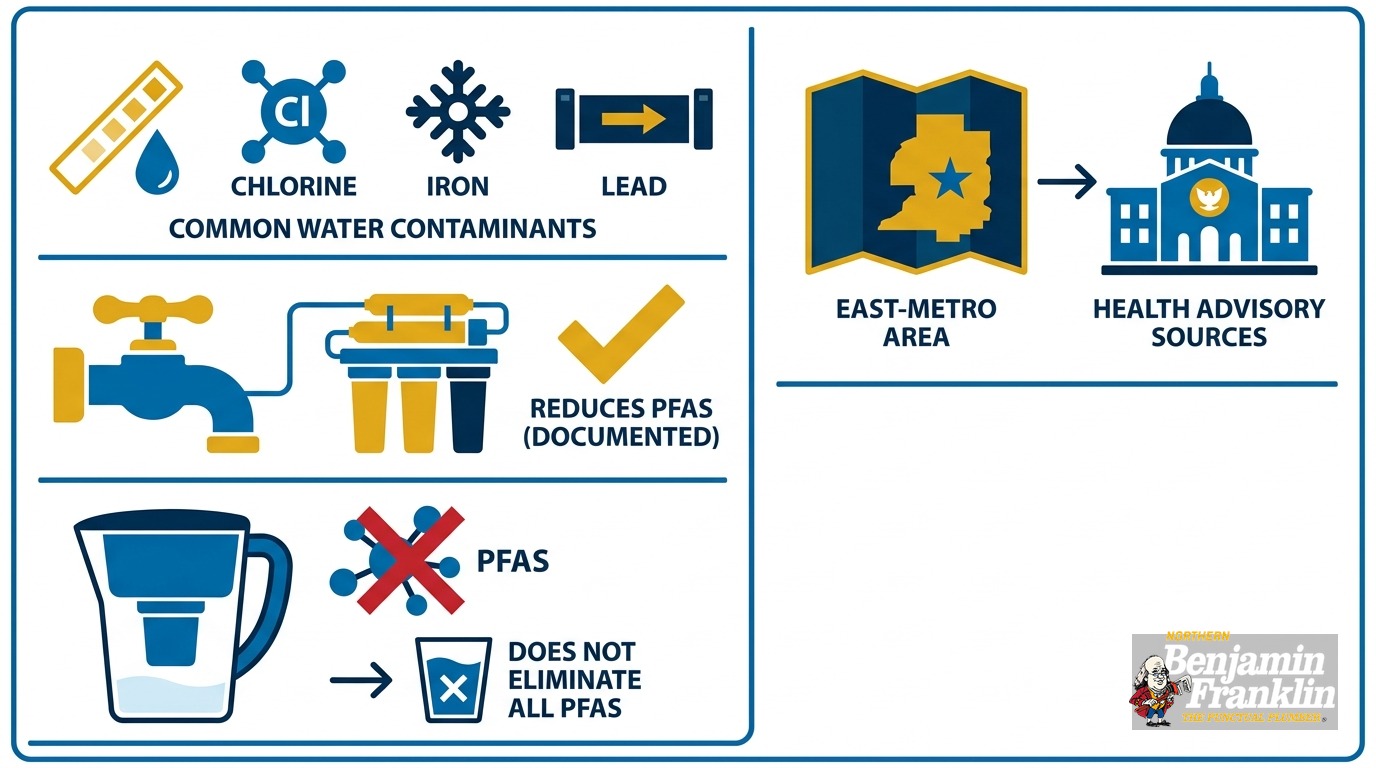
- Water softeners and iron filters do NOT remove PFAS. They are not a substitute for a dedicated, certified filtration system.
- Boiling water does not help. It concentrates PFAS compounds rather than eliminating them.
- The two certified residential technologies are activated carbon (NSF/ANSI 53) and reverse osmosis (NSF/ANSI 58).
- A standard pitcher filter is not certified to reduce PFAS. Some specialized models are - verify the specific model and cartridge before buying.
- Reverse osmosis is the most effective option, with documented removal above 90% across a wide range of PFAS compounds.
- Private well owners in 14 east-metro communities may qualify for free testing and a free whole-house system through the 3M settlement program.
- Test your water before buying any system. The result tells you what you are actually dealing with.
PFAS and Your Home Water: What a Filter Can and Cannot Do
Most Twin Cities homeowners already have some form of water treatment running. A water softener handles hardness. An iron filter might sit upstream. The system hums along and the water tastes fine, so the assumption follows: the water is handled.
PFAS contamination is a different category of problem. Your softener does not touch it. Your iron filter does not touch it. Boiling the water makes things worse, not better. And the pitcher filter in your refrigerator almost certainly does nothing for PFAS at all.
This post covers which PFAS water filter options Minnesota homeowners can rely on, where the east-metro contamination comes from, and how to find out what is in your water before spending money on a system that may not fit your situation.
Where does east-metro PFAS contamination come from?
The contamination traces to 3M manufacturing operations in Washington County. PFAS compounds used in industrial processes migrated into groundwater over decades. The MPCA and MDH have documented the plume across 14 east-metro communities. PFAS are called “forever chemicals” because they do not break down in the environment or in the human body - they accumulate and stay.
The MPCA and the Minnesota Department of Health have sampled private residential, municipal, and non-community wells across those 14 communities. The contamination is real, documented, and ongoing. There is no natural remediation timeline. Filtration is the path forward.
The picture is improving. MDH biomonitoring data show that blood PFAS levels in long-term east-metro residents are declining, following filtration interventions that started in 2006. Levels still remain above the US background population average. But the data confirm that the right filtration in place makes a measurable, lasting difference.
Which communities are in the affected area?
The 14 affected communities are: Afton, Baytown Township, Cottage Grove, Denmark Township, Grey Cloud Island Township, Lake Elmo, Lakeland, Lakeland Shores, Maplewood, Newport, Oakdale, St. Paul Park, West Lakeland Township, and Woodbury. Private well owners in these communities may qualify for free testing and treatment through the MPCA program.
If your home is in one of these communities and you rely on a private well, see the free-program section below before spending anything on a system.
If you are on municipal water, your utility must test for PFAS and report results in its annual Consumer Confidence Report. Request that report if you want to see the numbers for your specific system. Homeowners across the broader Twin Cities metro are not immune either. PFAS compounds have been detected in water sources across Minnesota. Knowing your actual water quality is the only way to make an informed filtration decision.
Does my water softener remove PFAS?
No. A water softener does not remove PFAS, and neither does an iron filtration system. MDH confirms this directly. Both technologies target different contaminants entirely, and neither affects PFAS compounds. If you assumed your softener covered PFAS, you need a separate, certified filtration system alongside it.
MDH treatment guidance is explicit on this point. Water softeners work through ion exchange. They pull calcium and magnesium ions from the water and replace them with sodium. That process is effective for hardness. PFAS molecules are chemically unrelated to hardness minerals. The softener resin ignores them completely.
An iron filter works through oxidation and media filtration designed for dissolved iron and manganese. Again, the chemistry has nothing to do with PFAS. The filter does its job. PFAS passes through unchanged.
This is one of the most common points of confusion for Twin Cities homeowners. Assumptions about softener coverage lead people to skip the filtration step entirely. That gap is the problem this post is written to close.
Your softener is a good investment for your pipes and appliances. It is doing exactly what it was designed to do. PFAS filtration requires a different system with a different mechanism. Our water softeners page explains what softeners handle well. For PFAS, you need to go further.
Does boiling water remove PFAS?
No. Boiling does not remove PFAS from water. It concentrates the compounds. When water boils and steam escapes, the PFAS stays behind in the remaining liquid. The same total load of PFAS now sits in a smaller volume, meaning a higher concentration per ounce, not a lower one.
MDH is direct on this: boiling is not an effective treatment for PFAS. Boiling is the right response to biological contamination such as bacteria and viruses. It is the wrong response here. If you have been boiling water out of concern for PFAS, stop. It is not helping.
Which PFAS water filters actually work?
Activated carbon and reverse osmosis are the two technologies with documented residential PFAS reduction. Both appear on EPA’s 2024 Best Available Technologies list. Activated carbon targets longer-chain compounds like PFOA and PFOS. Reverse osmosis is more effective across a wider range of PFAS, including shorter-chain compounds that carbon handles less reliably.
The EPA named four Best Available Technologies for PFAS in its April 2024 rule: granular activated carbon (GAC), anion exchange, reverse osmosis, and nanofiltration. For residential use, activated carbon and reverse osmosis are the practical options. Anion exchange and nanofiltration are primarily municipal-scale technologies not suited to home installation.
Activated carbon (GAC and carbon block)
Activated carbon physically traps PFAS compounds within a porous carbon matrix as water passes through. GAC and carbon block filters come in several configurations: under-sink units, whole-house inline systems, and faucet-mount filters.
For PFAS specifically, an under-sink carbon unit performs better than a faucet-mount. Contact time matters. The water needs to move slowly enough through the carbon to allow PFAS compounds to adsorb. A properly sized under-sink unit provides that. A quick-pass faucet mount does not always deliver the same results.
Activated carbon media does not last forever. The carbon becomes saturated over time and eventually stops adsorbing new contaminants. Following the manufacturer’s replacement schedule, typically every six to twelve months depending on water volume and PFAS levels, is not optional. A saturated filter can stop working with no visible indication that it has failed.
Reverse osmosis
RO forces water through a semi-permeable membrane with pores small enough to block PFAS molecules. According to the EPA treatment fact sheet, RO and nanofiltration membranes are typically more than 90% effective at PFAS removal. That performance extends across a wide range of compounds, including shorter-chain PFAS that GAC handles less consistently.
RO is the strongest residential option available. The tradeoff is water waste. Most residential RO systems produce two to four gallons of wastewater per gallon of filtered output. The ratio depends on the system and your incoming water pressure. RO is also more practical as a point-of-use under-sink installation than as a whole-house system.
Our reverse osmosis systems page covers what a professional installation looks like and what ongoing maintenance involves.
What certifications should I look for on a PFAS water filter?
Look for NSF/ANSI 53 on activated carbon units and NSF/ANSI 58 on reverse osmosis systems. These certifications mean the filter has been independently tested by a third-party lab and verified to reduce specific PFAS compounds. Without one of these, a manufacturer’s claims about PFAS removal are unverified marketing.
NSF International is the independent certification body behind both standards. NSF/ANSI 53 covers activated carbon and carbon block filters. NSF/ANSI 58 covers reverse osmosis systems. A product carrying either certification has been tested under controlled conditions and met the standard for the listed contaminants.
One important caveat: EPA has noted that existing NSF/ANSI 53 and 58 certifications were developed to target PFOA and PFOS specifically. EPA is working with NSF to update those standards to align with the new 4 parts per trillion MCL finalized in 2024. Until updated standards arrive, a certified filter still meaningfully reduces your exposure. It just may not guarantee non-detect at the new regulatory threshold.
When shopping, verify certification against the NSF product database, not just the box. The certification should list the specific contaminants and reduction levels. Confirm that PFAS compounds appear on that list for the specific model and filter cartridge you are buying. Certifications are model-specific and cartridge-specific. A certified brand does not mean every product that brand makes is certified.
Will a pitcher filter remove PFAS?
A standard pitcher filter is not certified to reduce PFAS. Most pitcher-filter cartridges use activated carbon tuned for chlorine taste and odor, not PFAS removal. Without specific PFAS certification, you cannot assume the filter is doing anything for PFAS compounds.
That said, the pitcher-filter category is not uniform. Some specialized pitcher-style and gravity-filter products have been independently tested and certified specifically for PFAS reduction. The Tap Score guide to certified PFAS filters documents which specific products qualify. If a pitcher-style option fits your situation, look up the specific model and cartridge against that resource before buying.
For most homes, an under-sink GAC or RO unit is a more practical fit. Higher throughput, no manual refilling, longer media life between cartridge changes, and no daily action required once the system is installed.
Point-of-use vs. point-of-entry: which approach fits your home?
For most households, point-of-use is more economical than a whole-house point-of-entry system. MDH guidance says so directly. An under-sink RO or certified carbon unit at the kitchen faucet is the standard starting point for homeowners wanting certified PFAS reduction at the tap.
Point-of-use (POU) systems treat water at a single faucet, usually the kitchen sink. An under-sink RO or GAC unit is a POU installation. You get filtered water for drinking and cooking at that one location.
Point-of-entry (POE) systems treat all water entering the home. Every tap, shower, and appliance draws from treated water. Installation and ongoing maintenance costs are higher.
MDH guidance is clear that POU tends to be more economical for most households. RO specifically is more practical as a POU system. A whole-house POE system makes sense when skin contact and inhalation exposure through showering is a documented concern, or when a remediation program mandates it.
The free MPCA program for east-metro private wells installs point-of-entry systems. At the contamination levels that trigger program eligibility, whole-house treatment is warranted.
For homeowners on municipal water wanting supplemental PFAS reduction, an under-sink unit at the drinking faucet is the standard starting point. Our home water testing page explains what a professional test covers. Testing first lets you match the system to what is actually in your water.
Is there a free PFAS testing and treatment program in Minnesota?
Yes, for private well owners in the 14 affected east-metro communities. The MPCA offers free testing, and if results exceed MDH health guidance, MPCA arranges free professional installation and maintenance of a whole-house point-of-entry system. The 3M settlement funds the program.
The MPCA well sampling program is the resource for private well owners in those communities. The process is straightforward: contact MPCA to request a test, wait for results, and if your well exceeds MDH guidance, MPCA manages contractor selection and installation at no cost to you.
This is a significant benefit. A professionally installed whole-house PFAS treatment system is a real investment. If you are in one of the 14 communities and on a private well, checking your eligibility before spending anything is the right first move.
The program does not extend to homes on municipal water or to homeowners outside the 14-community footprint. But if your address is in Woodbury, Lake Elmo, Cottage Grove, Oakdale, Maplewood, or any of the other listed communities, there is no cost to request a test.
What the regulatory numbers mean for your household
The EPA finalized Maximum Contaminant Levels of 4 parts per trillion for PFOA and PFOS in 2024, with a 2029 compliance deadline for public water systems. In May 2026, EPA proposed keeping those two limits while rescinding MCLs for four other PFAS compounds. The regulatory framework is still evolving.
Minnesota’s MDH also sets Health-Based Values (HBVs) for PFAS. HBVs are the more protective standard. Public water systems are not required to meet them - some are set at levels that are technically or economically unachievable at municipal scale - but MDH uses HBVs as guidance for private well programs and individual health advice.
If you receive a water test result, the relevant comparison is to both the federal MCL and the state HBV. Those thresholds can differ significantly. A lab consultant or MDH staff can walk you through what your specific number means for your household.
Getting the right system installed in your Twin Cities home
The single most useful step before buying any PFAS filtration system is testing your water first. A certified lab test tells you which PFAS compounds are present, at what concentrations, and how those levels compare to MDH and EPA thresholds. That result determines whether you need a point-of-use filter, a whole-house system, or whether you qualify for the free MPCA program.
Buying without a test result is guesswork. You might install an activated carbon unit suited to PFOA and PFOS when shorter-chain compounds in your water actually call for RO. A test removes that uncertainty.
Once you have results in hand, professional installation matters. A properly installed under-sink RO or GAC system performs differently from one that was rushed or incorrectly plumbed. Connections matter. Media sizing matters. And replacing filter cartridges on schedule is non-negotiable. An exhausted filter stops removing contaminants with no visible warning that it has failed.
At Northern Benjamin Franklin Plumbing, we are locally owned and operated in the Twin Cities. We install and service water treatment systems across Minneapolis, St. Paul, Blaine, Bloomington, Maple Grove, Coon Rapids, Brooklyn Park, and the surrounding metro. Our team can assess your current setup, help you interpret your test results, and install the right system the first time.
For larger whole-home filtration projects, ask us about financing options that can make the investment more manageable.
Every appointment is backed by our On-Time Guarantee(R). We arrive in the window you choose, or we pay you $5 for every minute we are late, up to $300. “If there is any delay, it’s you we pay!”
Call us at (763) 296-1844 or book online. You can also learn more about PFAS-specific treatment options on our PFAS forever chemicals page.
Frequently Asked Questions
Does a water softener remove PFAS? +
What is the most effective PFAS water filter for a Minnesota home? +
Can private well owners in the east metro get free PFAS treatment? +
Need a technician now?