
Test Home Water Quality in Minneapolis: A Homeowner's Guide
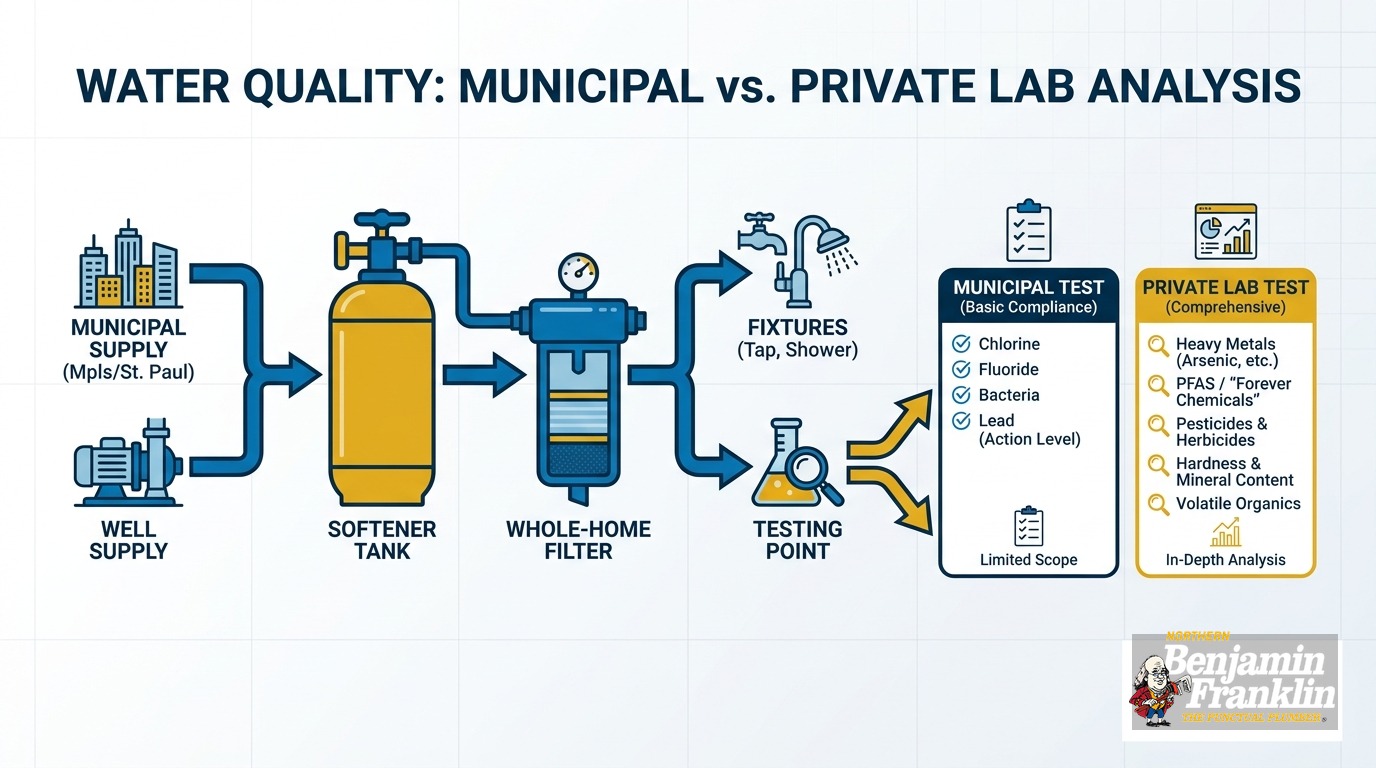
Key Takeaways
- Minneapolis and St. Paul publish annual Consumer Confidence Reports. Those reports cover water at the treatment plant and distribution points, not at your specific tap.
- Private plumbing inside your home is outside the utility’s test scope. Lead solder used until 1986, private-side lead service lines, and aging fixtures are your responsibility.
- Minneapolis water runs roughly 10-12 grains per gallon. That is hard to very hard, and it affects water heaters, appliances, and how a softener should be sized.
- Minneapolis intentionally raises water pH to roughly 9.0-9.5 to slow pipe corrosion. That changes what “normal” looks like on a private test panel.
- Seven situations call for a private lab test: a pre-1986 home, a private well, a home purchase, softener or filter sizing, PFAS concerns near industrial sites, after water main work, and unexplained GI illness.
- The city of Minneapolis offers free lead test kits and an address-level service line lookup. Use both if you live in an older neighborhood.
- Call Northern Benjamin Franklin Plumbing at (763) 296-1844 or schedule a water testing consultation to talk through your options.
What Does the Minneapolis Annual Water Report Actually Tell You?
The CCR is the utility’s annual report card on water leaving the treatment plant. It measures regulated contaminants at distribution points, not at your tap. Minneapolis and St. Paul each publish one, and both draw from the same Mississippi River source water.
The Consumer Confidence Report rule requires every community water system to publish an annual report. It covers roughly 90 regulated contaminants under the Safe Drinking Water Act. It documents source water, treatment methods, and any violations. It is public, free, and updated each year.
Minneapolis publishes its Water Quality Report online. Saint Paul Regional Water Services posts a comparable annual report for its east-metro service area. Both are genuinely useful documents. They tell you whether the utility found anything above federal limits. They give you a system-level picture of your water supply.
What a CCR cannot tell you is what happens after water enters your home. The moment water crosses the meter, the utility’s measurement is no longer accurate for your specific tap. That is not a flaw in the system. It is how the regulatory structure is designed. The utility controls the pipe up to your property line. Everything after that is private plumbing, and private plumbing is the homeowner’s domain.
The Private-Side Gap: What Leaves the Plant vs. What Reaches Your Tap
Minneapolis deliberately raises water pH to roughly 9.0-9.5. Higher pH makes water less corrosive. It slows the leaching of metals from pipe walls and solder joints. That is a smart, protective treatment decision. If you run a private test and see a pH near 9, that reading is not an error. It is the treatment doing exactly what it was designed to do.
The limitation is that pH-adjusted water at the main does not guarantee safe water at your faucet if your interior plumbing has lead in it. The EPA sets the action level for lead at 15 parts per billion, measured at customer taps. When more than 10 percent of sampled taps exceed that level, the utility must take corrective action. But the utility samples a selected group of homes. It does not sample yours.
Homes built before 1986 may have lead solder at pipe joints throughout the interior plumbing. Congress banned lead solder in residential plumbing with the 1986 Safe Drinking Water Act Amendments. In older Minneapolis and St. Paul neighborhoods, a large share of the housing stock predates that ban. The solder sits inside walls and behind fixtures. It is not visible without opening the pipe. A first-draw tap test is the only way to know what is in the water that sat overnight in those joints.
The same logic applies to private-side lead service lines. Minneapolis maintains an address-level service line lookup and offers free lead test kits to residents. Thousands of homes still have lead on the homeowner-owned section of the service line, which runs from the sidewalk to the house foundation. That section is the homeowner’s responsibility. The utility handles its side. You handle yours.
Minneapolis also uses chloramine as its secondary disinfectant rather than free chlorine. Chloramine produces different disinfection byproducts than free chlorine, including haloacetic acids. A basic private test panel captures chloramine byproducts; the CCR reports them at system scale. If you want your address-specific reading, a private test is the only path.
For a detailed look at what lead service line replacement involves in Minneapolis and St. Paul, see our post on lead service line replacement in the Twin Cities.
Does Minneapolis Water Have Lead?
At the treatment plant, Minneapolis water is within federal limits. Inside your home, the answer depends on when your house was built and what your private plumbing is made of. Pre-1986 homes carry a lead-solder risk that only a private test or the city’s free kit can reveal.
If your home was built before 1986, treat lead testing as a baseline step, not an optional one. Here is the minimum:
- Look up your address on Minneapolis’s service line map. If the private side is listed as lead or unknown, test and plan for replacement.
- Request a free lead test kit from the city, or hire a certified lab to run a first-draw and a 30-second-flush sample. Two samples at different draw points identify whether lead is coming from the service line side or from interior solder joints.
- Until you have results, run cold water for two minutes before drawing drinking water if the tap has sat unused for several hours.
The 2024 Lead and Copper Rule Improvements require utilities to replace all lead service lines within 10 years. That deadline covers the utility-owned portion. The homeowner-owned portion requires your participation, your timeline, and your budget.
Homes built after 1986 are not automatically clear. Low-lead faucets and fixtures were not required until 2014. If your fixtures are original to a 1990s or early 2000s home, one private test establishes a clean baseline. Running it once is worth the cost.
How Hard Is Minneapolis Tap Water, and Why Does It Matter?
Minneapolis water runs roughly 10-12 grains per gallon (GPG), which is hard to very hard on the standard classification scale. The CCR reports a distribution-system range. A private hardness test gives your exact address-level reading. That specific number is what a plumber needs to size a water softener correctly.
Hard water at 10-12 GPG has real, measurable effects on your home:
- Scale accumulates in water heater tanks and on heating elements. It reduces the heater’s thermal efficiency and shortens its lifespan. See our guide on Twin Cities water hardness and what it means for your appliances for a breakdown by GPG range.
- Dishwashers and washing machines work against mineral buildup over time. Detergent performance drops in very hard water.
- Faucet aerators and showerheads clog with scale deposits faster than in soft-water areas.
- Hot water lines accumulate scale faster than cold lines. Heat speeds up mineral precipitation.
A softener sized for 10 GPG and one sized for 12 GPG run different salt-dosing and regeneration cycles. If you use the CCR’s system-wide average instead of your specific reading, the softener is either undersized or oversized. Undersized leaves residual hardness in the water. Oversized wastes salt and runs unnecessary regeneration cycles.
Minneapolis’s published water quality data puts hardness at approximately 180-200 milligrams per liter as calcium carbonate. That converts to roughly 10-12 GPG. Saint Paul Regional Water Services draws from the same Mississippi River source. Hardness is comparable on both sides of the river.
What About PFAS in Minneapolis Drinking Water?
Minneapolis monitors PFAS levels and treats with granular activated carbon, which provides meaningful reduction in the distribution water. For city water customers, risk under current treatment is low. For private well owners near industrial or military sites, the situation is different and testing is recommended.
PFAS, sometimes called forever chemicals, are synthetic compounds that do not break down in the environment or in the human body. The Mississippi River has had detectable PFAS. Minneapolis treats source water with granular activated carbon and documents PFAS data in its annual water quality publications.
City water customers receive that treated water. Your private plumbing does not introduce additional PFAS after treatment. A private tap test for PFAS is reasonable as a one-time baseline, but it is not the urgent priority that lead testing is for a pre-1986 home.
Private well owners face a different situation. The Minnesota Department of Health has documented PFAS in Minnesota groundwater near industrial sites, military installations, and fire-training facilities. If your well is near any of those locations, MDH recommends testing specifically for PFAS and provides guidance on interpreting results.
For an overview of filtration options that address PFAS for Twin Cities homes on both city water and private wells, see our PFAS in Minnesota drinking water guide.
When Should You Test Home Water Quality in Minneapolis?
Test privately when the utility’s annual report cannot answer your specific question about your tap. Seven situations put your home outside what the CCR measures. Each one has a clear reason to act.
1. Your home was built before 1986. Lead solder was standard in residential plumbing before the 1986 ban. A first-draw lead test at the kitchen tap establishes your baseline. Run it once if you have not already. The cost of the test is low relative to the cost of acting on a false assumption.
2. Your service line has unknown or lead status. Check the Minneapolis address lookup tool. Unknown status means test. Confirmed lead status means test and plan for replacement. The private-side line is the homeowner’s responsibility and the homeowner’s cost.
3. You are buying an older home. A pre-purchase water test belongs alongside the plumbing inspection. You are buying the pipes as well as the structure. A private test before closing surfaces lead, bacteria, nitrate, and hardness issues that a visual inspection will not catch. Problems found before closing are negotiating points. Problems found after closing are your problem.
4. You are sizing a water softener or filter. Softener sizing, reverse osmosis membrane selection, and carbon filter specifications all depend on your actual water chemistry. The CCR gives a system-wide range. Your water treatment equipment will run on your specific water, at your address, with your pipe materials. Test first, then specify the equipment.
5. You own a private well. The Minnesota Department of Health recommends testing annually for coliform bacteria and nitrates. Test for arsenic at least every five years. Add PFAS to the panel if your well is near industrial land, a military facility, or an airport.
6. After flooding, water main work, or a pressure drop. Any disruption to the distribution system can introduce contaminants temporarily. A test after the event gives you a clean baseline before you return to normal water use.
7. Unexplained gastrointestinal illness in the household. If household members have recurring GI symptoms with no other clear cause, a coliform bacteria and nitrate test rules out the water supply as a contributor. This is not common, but it is worth testing once when there is no other explanation.
What Does a Private Lab Test Include?
A basic residential panel covers lead, coliform bacteria, nitrates, hardness, pH, iron, manganese, and chloramine byproducts. You can add PFAS, arsenic, and other parameters based on your home’s age, location, and intended use. The right panel depends on your specific situation.
Here is how to think about panels:
Basic panel (city water, post-1986 home): Lead, coliform bacteria, nitrates, hardness, pH, iron, manganese, total dissolved solids. This baseline covers the main plumbing-side risks for a modern home on city water. It also produces the hardness number you need for appliance and softener sizing.
Lead-focused panel (pre-1986 home or unknown service line): First-draw lead and 30-second-flush lead. Two samples at different draw points reveal whether lead is entering from the service line side or from interior solder joints. Running both samples narrows the remediation target and informs whether you address the line, the interior plumbing, or both.
Well water panel: Coliform bacteria, nitrates, hardness, iron, manganese, arsenic, pH. Expand to PFAS if your well is near an industrial or military site. The MDH publishes a current list of accredited testing labs in Minnesota.
Pre-purchase panel: Request the broadest panel your budget allows. Include coliform bacteria, lead, nitrates, arsenic, hardness, pH, iron, manganese, volatile organic compounds, and PFAS if the property has any environmental history worth investigating. A pre-purchase test is due diligence, not routine maintenance. The cost of a comprehensive panel is a small fraction of a home purchase.
A lab report gives you numbers on a page. A plumber or water treatment specialist translates those numbers into specific equipment recommendations and sizing. That translation step is the one most homeowners skip. They receive the PDF, see the numbers, and are not sure what to do next.
What to Do With Your Test Results
Results come back. The next step depends on what the numbers say.
Lead above 15 ppb: Act, do not monitor. Run cold water for two minutes before drawing drinking water when the tap has sat unused. Install a certified point-of-use filter rated to NSF 53 for lead removal at the kitchen tap as an interim measure. Then address the actual source: replace the private-side lead service line, replace accessible lead-solder joints, or both. Interim filtration buys you time. It does not solve the underlying pipe problem.
Hardness above 10 GPG: A water softener is the standard fix. Use your actual test reading, not the CCR average, to size the unit correctly. An undersized softener leaves residual hardness and the appliance wear that comes with it. An oversized unit wastes salt and water on cycles your water chemistry does not require.
Iron or manganese detected: Both are common in Minnesota water, especially in private wells and some older municipal service areas. Iron above 0.3 mg/L affects taste and stains fixtures. Manganese above 0.05 mg/L produces similar effects. Treatment depends on whether the iron and manganese are in soluble or particulate form, and on the concentration. The test gives you the numbers. A licensed plumber identifies the right filter type for your specific reading.
PFAS detected in well water: Contact the Minnesota Department of Health for location-specific guidance. Reverse osmosis and activated carbon filtration both reduce PFAS at the point of use. A plumber can assess which option fits your household’s volume and budget.
Coliform bacteria detected: Disinfect the well immediately following MDH shock-chlorination protocols. Retest before returning to normal use. Do not treat a positive coliform result as a watch-and-wait situation.
The Right Next Step
The Consumer Confidence Report tells you the utility is doing its job. That is genuinely reassuring, and it is worth reading every year.
It does not tell you what is happening inside your specific home’s pipes.
In the Twin Cities, where a significant share of the housing stock predates the 1986 lead ban and where water hardness runs hard to very hard across both cities, a private lab test is not an abundance of caution. It is the only way to know what is actually coming out of your faucet.
Northern Benjamin Franklin Plumbing is locally owned and operated in the Twin Cities. When your results come back and you need a plumber who shows up when promised, we back our work with the On-Time Guarantee(R): arrive in the window you choose, or we pay you $5 for every minute we are late, up to $300. “If there is any delay, it’s you we pay!”
Call (763) 296-1844 or book online to schedule a water testing consultation or any plumbing service.
Frequently Asked Questions
Does Minneapolis water have lead? +
How hard is Minneapolis tap water? +
What does the Minneapolis Consumer Confidence Report tell you? +
When should I get a private water test? +
Need a technician now?