
Lead Service Line Replacement Minneapolis: What to Do Now
Key Takeaways
- Minneapolis has just under 37,000 lead service lines still needing replacement. Current state and federal funding may run out after 2027.
- Use the Minneapolis project map to check whether your address is scheduled for 2025 or 2026.
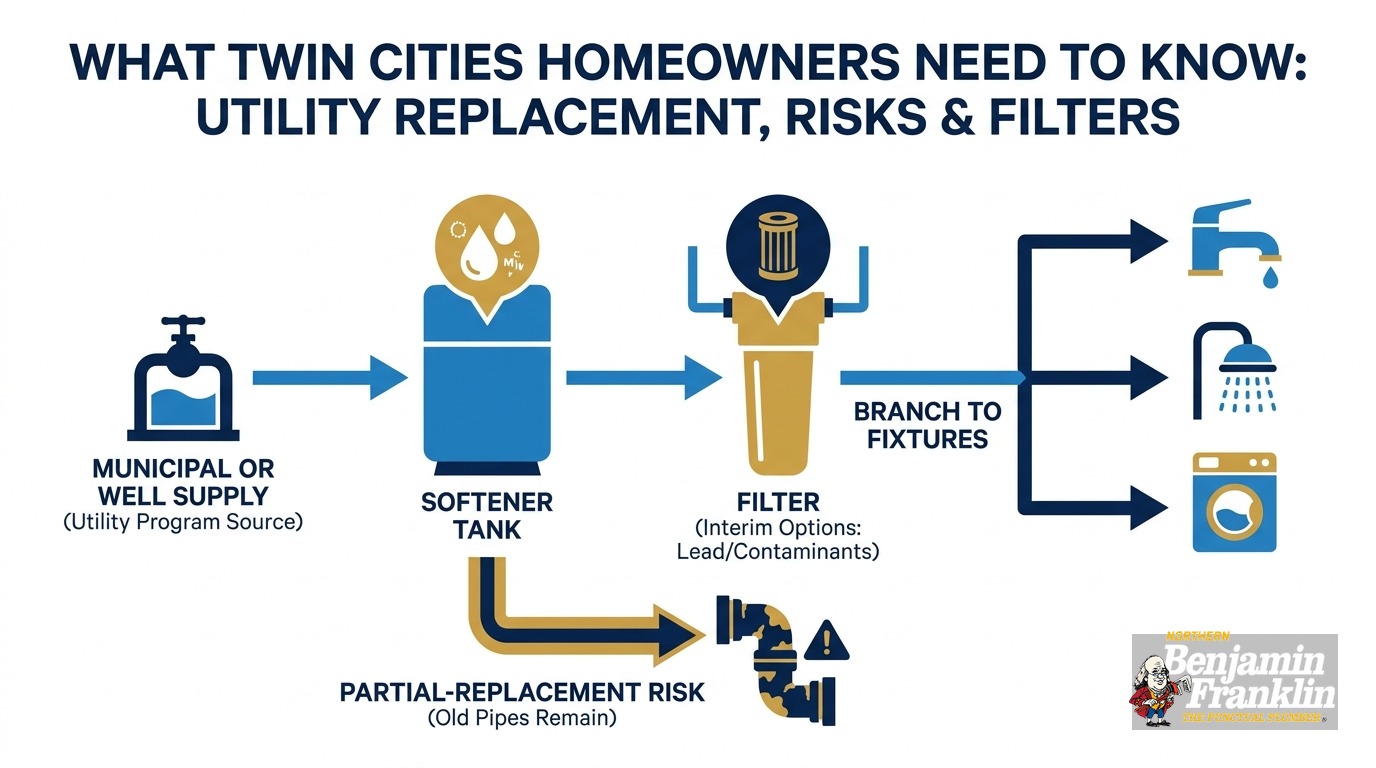
- Install an NSF/ANSI Standard 53 certified filter at the tap. Use cold water only for drinking and cooking until the line is replaced.
- After replacement, mandatory flushing is required before you drink the water. The disturbance releases lead debris into your interior plumbing.
- A partial replacement, public side only from a prior era, can temporarily raise lead levels at your tap.
- Pre-1997 faucets can leach lead on their own, independent of the service line.
- St. Paul homeowners can act now through the no-charge Lead Free SPRWS program.
- Call (763) 296-1844 or book online to schedule a private-side inspection or a post-replacement plumbing check.
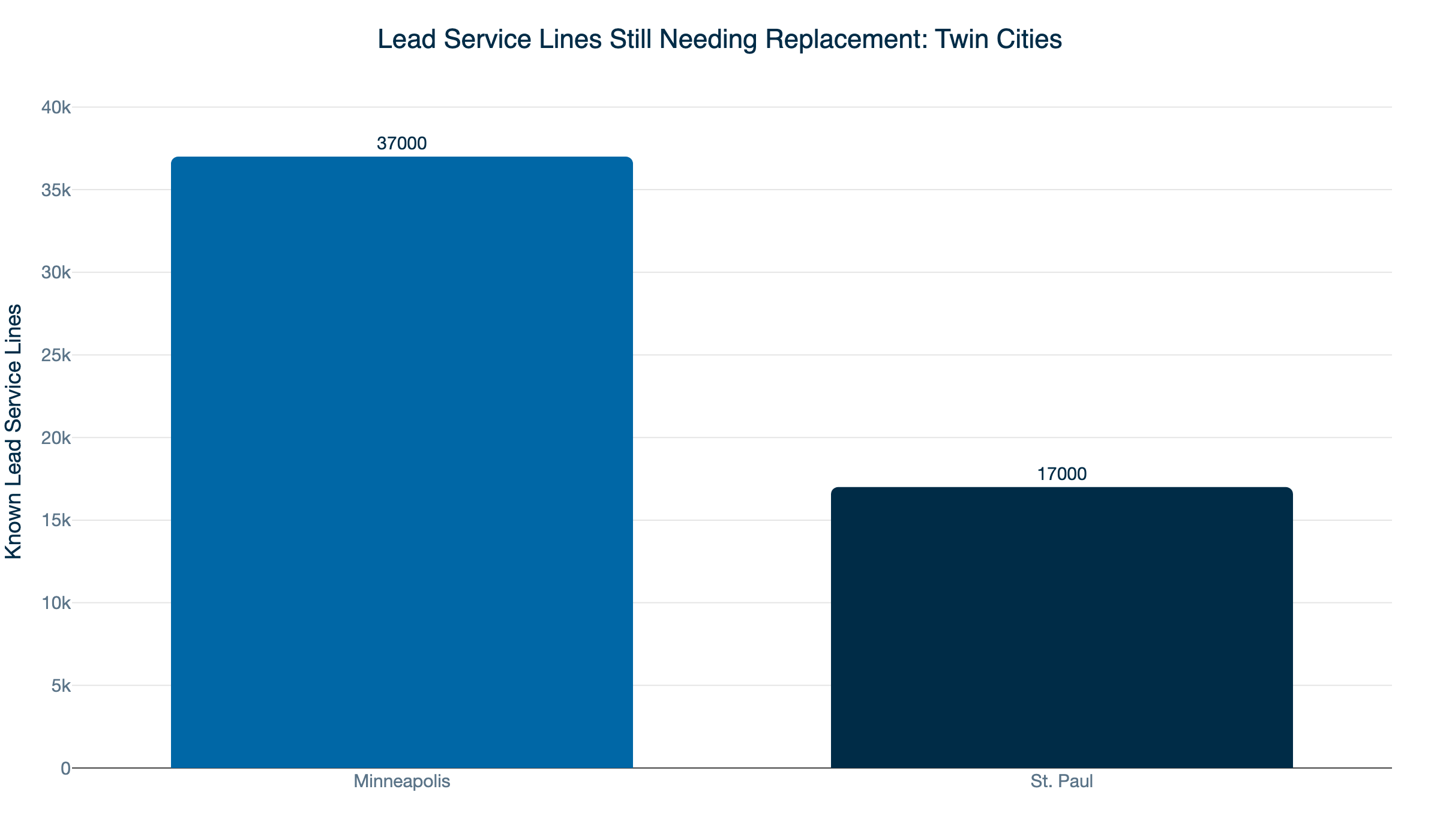
If your Minneapolis home was built before 1986, there is a good chance your water arrives through a lead service line. Lead service line replacement Minneapolis programs are active and funded right now, but the city has just under 37,000 lines still waiting for replacement. Most homeowners will not see a crew on their street for years.
That wait is not a reason to do nothing. The filter you install today, the faucets you audit, and the pipe history you understand give you real protection. This post covers where you actually stand, what interim steps work, and what happens at the moment of replacement that almost no coverage gets right.
What Is a Lead Service Line, and Why Does It Matter?
A lead service line is the underground pipe connecting the city water main to your house. Homes in Minneapolis and across the Twin Cities metro built before 1986 commonly have them. Lead dissolves into the water passing through the pipe. There is no taste, color, or smell to warn you.
Lead was the standard material for water service lines in the United States throughout most of the twentieth century. It is durable and easy to work with in the field. Congress banned it for new plumbing installations in 1986, but the pipes already in the ground stayed there.
The pipe runs from the city’s water main under the street to the foundation of your home. Water moving through it picks up trace amounts of lead with every pass. Pressure fluctuations, temperature changes, and the chemistry of the water all influence how much dissolves. Once dissolved, lead comes out of your faucet with no warning at all.
The CDC has established that no safe level of lead exposure exists for children. Even low-level chronic exposure links to developmental delays, learning difficulties, and behavioral changes. Pregnant women and infants face elevated risk as well.
The service line is not the only lead source in an older Twin Cities home. Solder used on copper pipes before 1986 often contained lead. Faucets and valves made before 1997 were frequently brass or chrome-plated brass with up to 8% lead content. But the service line is typically the largest single source, and replacing it is the highest-priority fix.
If you want a baseline reading before making any decisions, our home water testing service is a practical starting point.
Is Your Minneapolis Home on the Lead Service Line Replacement Schedule?
Use the Minneapolis project map to search your address. The current priority is the Northside green zone: McKinley and Hawthorne neighborhoods. Licensed daycares citywide are targeted for completion by the end of 2026. The Southside green zone, covering Phillips West, Midtown Phillips, and East Phillips, comes next. Most residential addresses will wait.
The city works neighborhood by neighborhood, not address by address. If your block is not in a current priority zone, you are likely looking at years before a crew arrives. Knowing your timeline is practical. It tells you how long to rely on interim protection and whether to pursue a private-side inspection now.
The Minneapolis program page describes how the city contacts eligible property owners before scheduling. Replacement covers both the public side under the street and the private side on your property. You do not pay out of pocket when the city’s program reaches your address.
How Does the Minneapolis Program Fund Lead Service Line Replacement?
State and federal grants pay the full cost. Minneapolis lead service lines are technically private property, which legally bars the city from using water utility fees to fund them. The program depends entirely on grant funding. That is also why the timeline is constrained.
When your address is scheduled, a contractor digs from the main under the street to your foundation. The old lead pipe comes out. A new line, typically copper, goes in. The ground is restored. You do not write a check.
Minnesota’s goal is to replace all lead lines by 2033. The federal EPA Lead and Copper Rule sets a deadline of 2037. Both targets require sustained federal and state investment over that entire period. The funding situation, covered next, is where the timeline gets complicated.
Will Funding Be There When Your Street Comes Up?
Not necessarily. Current state and federal funding is set to expire at the end of 2027 without a new legislative allocation. The 2026 construction season may be the last major one. Minneapolis still has tens of thousands of lines to replace.
Minnesota has approximately 87,000 known lead lines statewide, with $243 million committed toward replacement. Minneapolis accounts for just under 37,000 of those lines. The math does not close without a new federal or state appropriation.
Minneapolis can apply for additional infrastructure funds. The state legislature can act. But those decisions move on a political calendar that does not match individual household timelines.
The practical takeaway: if you are outside the current priority zone, plan for interim protection to be your reality for several years. The steps in this post are not a temporary inconvenience. They may be your plan for water safety until the city’s program reaches your block.
What Happens During Lead Service Line Replacement in Minneapolis - and Why Must You Flush Afterward?
The replacement dig disturbs lead particles that have settled inside the old pipe. After the new line is installed, that debris is in your home’s plumbing. Minneapolis requires homeowners to flush all plumbing before drinking any water after replacement. Follow the city’s protocol exactly.
Here is what the work looks like. A contractor digs from the main under the street to your foundation. The old lead pipe comes out. A new line goes in. The crew restores the ground and leaves.
Your job starts after the crew leaves. The removal knocked lead sediment loose from the inside of the old pipe. That sediment is now in your water system. Running the tap for a few seconds will not clear it.
The city’s flushing protocol specifies each fixture in sequence and how long to run each one. Read the guidance before the crew arrives. Have the steps accessible on the day of the replacement, when there is noise and a crew at your door and it is easy to forget. Do not drink the water, cook with it, or run it through a filter system until you have completed the full flush.
After flushing, a water test is the only way to confirm your levels are back to normal. The Minnesota Department of Health also provides interim guidance for the days after replacement while you wait for results. Our team can inspect the private-side plumbing for code compliance after city work is complete and document the results in writing.
Can a Partial Replacement Actually Make Lead Levels Worse?
Yes. When only the public side of the line is replaced and the private side remains lead, the disturbance at the joint can temporarily raise lead levels at the tap. EPA guidance on the Lead and Copper Rule Revisions documents this effect. The current Minneapolis program replaces both sides in the same dig. Homes with older city-only work may still be at elevated risk.
Some Minneapolis homeowners received city work on their service lines before the current program existed. In those older projects, only the public segment was replaced: the pipe running under the street. The private portion, from the property line to the foundation, stayed in place.
When the public side is replaced and the joint is disturbed, lead particles from the private-side pipe dislodge and travel toward your tap. Lead levels at the faucet can temporarily increase, even though the city’s work looked complete at the time. The remaining private-side lead pipe may continue to corrode as well.
The current federal standard under the Lead and Copper Rule Revisions requires full replacement of both sides in the same excavation. That is the right standard. The problem is the legacy from older half-projects. If your home received a city-side replacement in a prior decade, the private pipe may still be lead.
There is no way to know what material the private side is made of without inspecting it. A licensed plumber can do that. Our team identifies pipe material, explains what it means, and handles the permit, the excavation, and the restoration when replacement is the right call. Service lines in the Twin Cities metro are buried at 42 to 60 inches of depth, with the deeper end typical here. This is real excavation. It requires a permit, a licensed plumber of record, and proper restoration after.
Our post on galvanized pipe replacement in older Twin Cities homes covers a related problem: older private-side materials that have corroded and need assessment before they fail. The inspection process is similar, and it is often the same conversation.
What to Do Right Now While You Wait
You have real options today. None of them require the city’s schedule.
Step 1: Look up your address. The Minneapolis project map shows which addresses are on the 2025 and 2026 replacement schedule. If yours is not listed, step two is your immediate priority.
Step 2: Install a certified filter at the tap. Pitcher and faucet-mounted filters certified to NSF/ANSI Standard 53 are rated to remove lead. The EPA maintains a free search tool so you can verify a product before you buy it. Not every filter on the store shelf carries this rating. Check before purchasing. Replace the filter cartridge on the manufacturer’s schedule. A clogged filter is not a working filter.
Step 3: Follow MDH interim guidance. The Minnesota Department of Health recommends running the cold-water tap for 30 seconds to two minutes before using it for drinking or cooking. Use cold water only. Never use hot tap water for baby formula. Hot water picks up lead faster than cold, and that holds true even with a filter installed downstream.
Step 4: Audit your faucets. Any faucet installed before 1997 may contain brass or chrome-plated brass with up to 8% lead content. This is a separate lead source, independent of the service line, and it does not disappear when the city replaces your pipe. Lead-free faucets carry an NSF 61/9 stamp on the packaging. If your fixtures predate 1997, replacing them now reduces your exposure whether or not the service line work is done.
Our faucets and fixtures service covers replacement options for common Minneapolis and St. Paul home configurations. For a broader look at what lead exposure means for your water and your plumbing, our lead in water page covers every source in a typical older Twin Cities home, from the service line to the fixture at your sink.
Should You Replace Your Private-Side Line Before the City Arrives?
In Minneapolis, replacing the private side before the city replaces the public side creates the same partial-replacement problem described above. A new private line connected to an old public main still leaves a risk at the joint. Get a licensed plumber’s assessment of your specific address before spending money. In St. Paul, the calculus is different.
St. Paul Regional Water Services runs the Lead Free SPRWS program. It replaces both the right-of-way and private-property portions of lead service lines at no charge. About 17,000 lines still need replacing in St. Paul. SPRWS targeted 2,100 replacements in 2026 alone. Call 651-266-6270 or use the SPRWS service material map to check your address status.
St. Paul also offers a voluntary assessment program. Homeowners who want to replace their private line proactively can have the cost collected through property taxes. That option lets you act before the city’s schedule reaches you, without creating a partial-replacement situation.
Any work on a water service line in Minnesota requires a permit and a licensed plumber of record. Service line work never falls below the permit threshold in any municipality. The permit protects you: it ensures the work is inspected, meets the Minnesota Plumbing Code, and is on record for the life of your home.
What Northern Benjamin Franklin Plumbing Does for You
We are locally owned and operated in the Twin Cities. Our team handles the private-side work that the city’s program does not cover and the post-replacement verification that confirms everything is clean and compliant.
We inspect private-side service lines to identify pipe material. We tell you what you have, explain what it means for your water quality, and lay out your options clearly. When replacement is the right call, we pull the permit, excavate to code depth, replace the lead pipe with approved materials, and restore the ground after. We also conduct post-replacement inspections and document the findings in writing.
Water quality questions in the Twin Cities often go beyond the service line. Our lead in water page covers the full picture of lead sources in residential plumbing. Our home water testing service gives you a baseline reading before any work begins and a confirmation after it is done.
We show up when we say we will. Our On-Time Guarantee(R) means we arrive in the window you book. If we miss it, we pay $5 for every minute we are late, up to $300. If there is any delay, it’s you we pay!
Call (763) 296-1844 or book online to schedule a private-side inspection, a post-replacement plumbing check, or a water quality conversation. We will tell you what we can see. We will not invent what we cannot.
Frequently Asked Questions
How do I find out if my Minneapolis home has a lead service line? +
Is lead service line replacement free in Minneapolis? +
What should I do immediately after lead service line replacement in Minneapolis? +
Can a partial lead service line replacement make lead levels worse? +
Need a technician now?