
Minneapolis Water Service Line Replacement: What to Know
Key Takeaways
- In Minneapolis, the property owner owns the entire service line from the city water main to the home, including the curb stop valve. The city owns nothing on that run. (minneapolismn.gov)
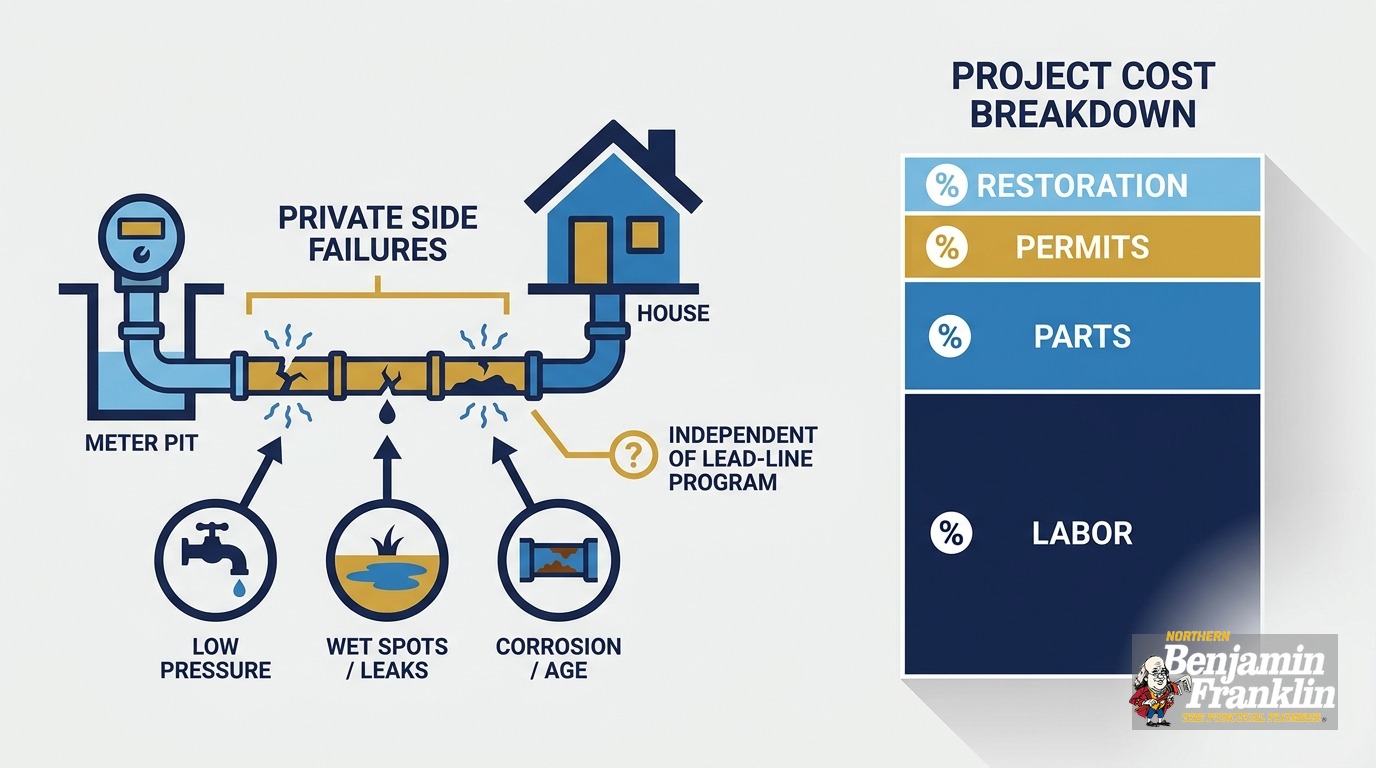
- The lead replacement program covers the public portion only - from the main to the stop box. The private segment, from the stop box to your foundation, is your financial responsibility alone.
- Galvanized steel service lines from the 1960s and earlier are at or past their 40-50 year expected lifespan. Many fail silently through interior corrosion before a visible leak ever appears. (ACWD)
- Minneapolis frost depth pushes required excavation to 72 inches or more. Local labor rates run above the national average as a direct result. (Angi.com Minneapolis)
- The 2026 Minnesota bonding bill allocated only $15 million statewide for lead line replacement - against the $250 million advocates requested. (MinnPost, August 2026)
- Six warning signs: persistent low pressure at all fixtures, rising water bills, soggy yard patches that persist after dry weather, discolored or rust-tinged water, the sound of running water with all fixtures off, and an older home with no record of a service line inspection.
- Every replacement in Minneapolis requires a Minnesota state plumbing permit, a city utility/excavation permit, and a Gopher State One Call notification before any digging begins.
Minneapolis homeowners who’ve already had the city replace their lead service line sometimes assume the plumbing work is finished. It isn’t. The city’s program covers one segment. Your water service line replacement in Minneapolis - the private side, from the curb stop valve to your foundation - is a separate project that no program schedules for you.
That segment is yours alone. When it fails, the bill lands on you. Depending on pipe age, depth, and route, costs range from a few thousand dollars to more than $20,000. With 2026 state funding for the free lead-replacement program cut far below what advocates requested, homeowners waiting in the queue face program uncertainty on top of the independent risk of a private-side line aging out on its own timeline.
This post covers how the private side of your service line fails and how to recognize it before it becomes an emergency. We’ll walk through the six warning signs, what a permitted replacement involves in Minneapolis, and what drives the cost from a typical project to a worst-case bill.
What Does the City’s Lead Program Actually Cover?
The program covers the public segment - from the water main to the stop box (curb stop valve). It does not cover the private segment from the stop box to your foundation. That private segment is your financial and physical responsibility.
According to the City of Minneapolis, service lines installed before 1930 typically used lead from the main to the stop box. The segment from the stop box to the meter is usually galvanized steel. Lead service lines cannot be repaired - only replaced. But the program funding that work is under serious strain.
Minneapolis has just under 37,000 lead lines, all privately owned, per MinnPost, August 2026. The state goal is to replace all lead service lines by 2033. The 2026 bonding bill put only $15 million toward the work statewide, against the $250 million advocates requested. Minneapolis cannot use utility fee revenue for private infrastructure. It relies entirely on state and federal funding. As those funds wind down, homeowners on the waiting list face growing uncertainty about whether the free-replacement window will still be open when their number comes up.
And that’s only the lead-program picture. The private-side galvanized segment can fail entirely on its own, on its own schedule, with no connection to any lead pipe or program timeline.
Who Owns Your Private Service Line in Minneapolis?
You do. The property owner owns the full run from the water main to the home, including the stop box. The city owns nothing on that run.
This surprises many homeowners. A line that runs under your driveway, under the sidewalk, or even under a lane of street is still your infrastructure. When it leaks or fails, the permits, the excavation, the new pipe, and the restoration of whatever surface sits above the line all fall to you. That responsibility is stated clearly on the city’s service lines page.
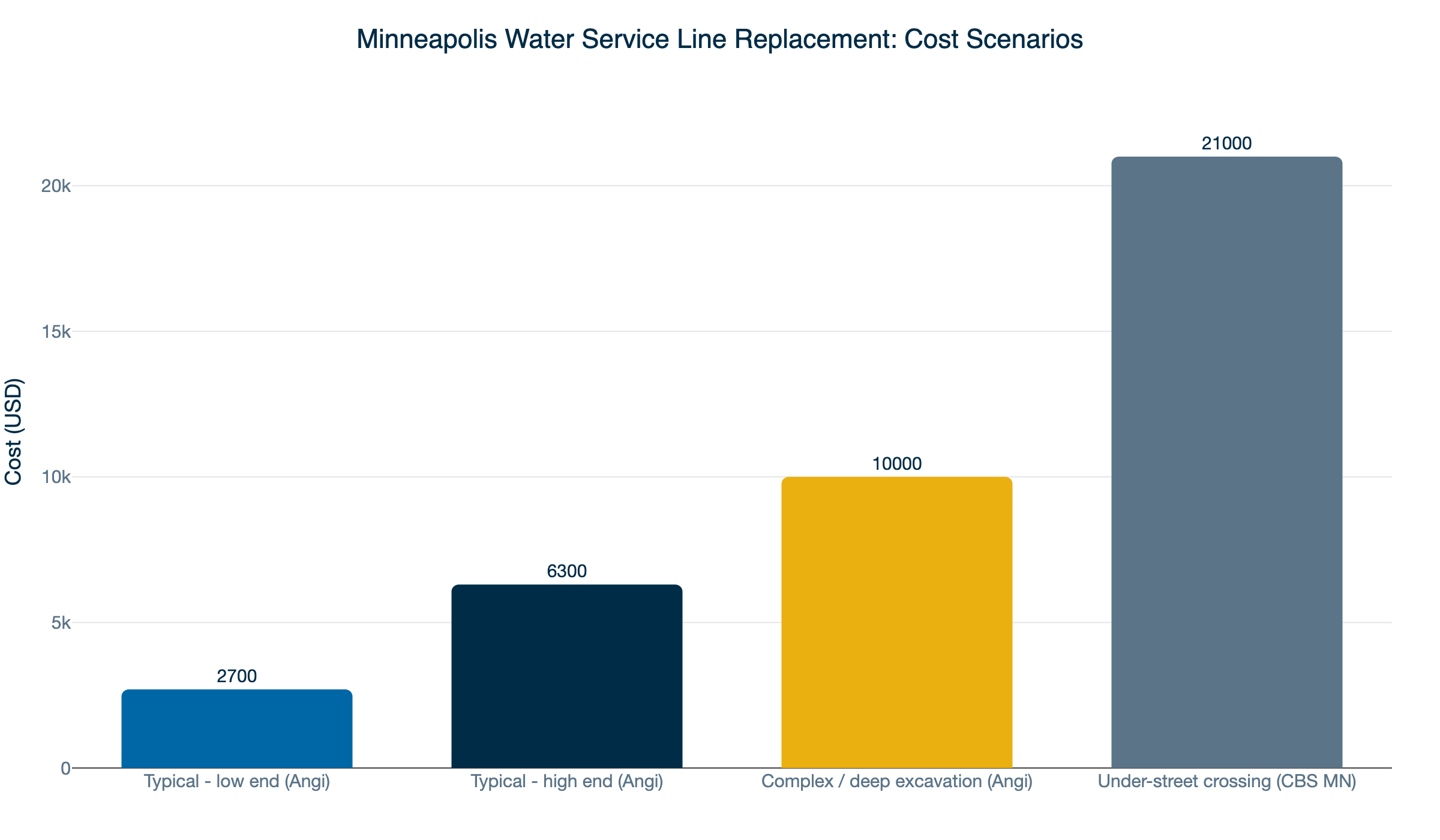
This ownership reality is what made one documented Minneapolis case so costly. A homeowner’s service line ran under four lanes of traffic. A city ordinance required full replacement of all lead segments whenever any repair is made - even a non-leaking section. Bids for that job came in at $17,000 to $21,000, according to CBS News Minnesota.
That’s an extreme situation. A standard yard-only replacement costs far less. But the ownership principle is the same across every job.
For context on the statewide scope: Minnesota has approximately 100,000 lead service lines. The Minnesota Department of Health estimates replacement at roughly $10,000 per line, totaling about $1 billion statewide. A portion of that total represents the privately owned lines, according to the 2025 Lead Service Line Replacement Report. Most of the exposure sits with individual homeowners.
Six Signs Your Water Service Line Needs Replacement in Minneapolis
Private service lines fail quietly. Symptoms build slowly, and they’re easy to dismiss until something forces the issue. The six signs below can appear one at a time or in combination. A single sign is worth investigating. Two or more together means a conversation with a licensed plumber is overdue.
Minneapolis homes built before 1970 are especially worth watching. Galvanized steel service lines from that era are at or past their 40-50 year expected lifespan, according to ACWD. The following warning signs are drawn from Structure Tech and Coastal Pipeline:
-
Persistent low pressure at every fixture in the house. Galvanized steel corrodes from the inside out. The resulting scale narrows the effective pipe diameter over years. A 3/4-inch pipe can shrink to a functional 1/2-inch opening. When every faucet runs weak, the problem is upstream of all of them.
-
An unexplained rise in your water bill. A slow underground leak won’t show up at the tap, but it will appear in your usage data. Track your meter over a 15-minute window with all fixtures off. Any movement on the dial means water is leaving the pipe somewhere.
-
Soggy or unusually green yard patches. A leaking service line saturates the soil above it. After a dry stretch, if one band of grass stays wet or noticeably greener than the surrounding yard, the pipe below is worth investigating.
-
Discolored or rust-tinged water. Interior scale breaks loose as corrosion progresses. If your water runs brown or rust-colored - especially if it doesn’t clear after running the tap for several minutes - the service line is a likely source.
-
The sound of running water with all fixtures off. If you hear water movement in the walls or near the meter when everything in the house is off, you have an active leak. Find your main shutoff valve and call a licensed plumber.
-
An older home with no record of a service line inspection. If your home was built in the 1960s or earlier and you’ve never had the line inspected, the material and condition are unknown. A camera inspection costs far less than an emergency replacement.
For more on what older pipe materials mean for your home’s plumbing system, see our post on galvanized pipe replacement in older Twin Cities homes.
What Does Water Service Line Replacement Cost in Minneapolis?
Costs vary by pipe length, depth, material, and the surface above the line. Residential water main replacements in Minneapolis vary in cost, according to Angi.com’s Minneapolis cost data. Complex jobs - those involving deep excavation, long runs, or street crossings - can reach $5,000 to $10,000 or more. The CBS News Minnesota case, where the line ran under four lanes of traffic, drew bids of $17,000 to $21,000.
These are third-party reported figures from named sources. The only number that accurately reflects your specific job is the one a licensed plumber gives you after seeing your actual line, depth, and route. Call (763) 296-1844 for a real quote.
The main variables that move the number:
- Pipe length and route. A short, straight run across a yard costs less than a line that crosses a driveway, sidewalk, or street right-of-way.
- Excavation depth. Minneapolis requires lines at 72 inches or deeper. Every additional foot of depth means more soil to move, compact, and restore.
- Per-foot costs. Angi.com reports per-foot pricing for both open-trench and trenchless methods in Minneapolis.
- Surface restoration. Lawn is the least expensive surface to restore. Concrete, asphalt, or established landscaping adds cost above the pipe work itself.
- Permit fees. The base city permit fee scales with line length, per Angi.com’s Minneapolis data. Street right-of-way work requires a separate excavation permit.
For context on a closely related category of underground work, our post on sewer line replacement cost in Minnesota walks through how those project costs break down.
Why Minneapolis Labor Costs Run Higher Than the National Average
Minneapolis’s frost line sits at approximately 60 inches. Minnesota Plumbing Code - Minnesota Rules, Chapter 4714 - requires water service lines to be buried at least 12 inches below the maximum local frost depth. That puts required excavation at 72 inches or more in the northern metro, per mywild.report’s frost depth data and the Minnesota Plumbing Code.
That depth is among the deepest burial requirements in the country. More depth means more excavation time, more equipment hours, and more soil to move and restore. Angi.com reports that Minneapolis labor rates run above the national average. The frost requirement is the largest single driver of that gap.
Beyond depth, the soil itself poses an ongoing challenge. Minneapolis’s freeze-thaw cycles shift the ground repeatedly each winter. That movement can crack pipe joints or shift alignment on lines that look undamaged from the surface. The same freeze-thaw stress acts on water service lines.
A line installed in 1962 has been flexed through more than 60 winters. Even without a visible crack, joints can be compromised enough that one hard winter pushes them to failure.
Does Water Service Line Replacement Require a Permit in Minneapolis?
Yes. Every replacement in Minneapolis requires three distinct approvals before work begins. Skipping any one of them puts the homeowner in violation of Minnesota statute and leaves the job without an inspection record.
The three required approvals are:
- A Minnesota state plumbing permit under Minn. Rules Ch. 4714
- A City of Minneapolis Utility Connections/Excavation permit, filed by a licensed master plumber
- A Gopher State One Call notification before any excavation begins
The city permit triggers a post-installation inspection confirming the new line is properly bedded and backfilled at the required depth. Skip the permit and you have no inspection record - a problem when you sell the home or file an insurance claim.
If a contractor offers to waive the permit to save money, walk away. All three requirements are documented on the City of Minneapolis Utility Connections Permits page and covered in detail by 4Front Energy’s Minneapolis plumbing permit guide.
Trenchless or Open Trench: Which Method Is Right for Your Line?
Trenchless methods (pipe bursting and directional boring) thread new pipe along the path of the old line without excavating the full run. Open-trench replacement digs the full route from stop box to foundation. Both are legitimate. The right choice depends on your line’s route, condition, and what sits above it.
Trenchless work costs slightly more per foot but spares your driveway, landscaping, and any tree roots near the line. Open-trench work gives the crew direct visual access to every section of old pipe and generally costs less per foot. The trade-off is more surface area to restore after the job is done.
Per Angi.com’s Minneapolis data, the per-foot cost range is comparable for both trenched and trenchless methods. Total project cost differences come from restoration, not from the pipe work itself.
Lines with intact joints and clear access are often good trenchless candidates. Lines with collapsed sections, offset joints, or heavy root intrusion typically require open-trench work. A licensed plumber who runs a camera inspection of the existing line can tell you which method suits your specific situation.
What Happens If You Wait?
A slow-failing service line does not stay slow. Pressure loss that starts as a minor annoyance accelerates as corrosion continues to narrow the pipe. A small joint leak expands with each freeze-thaw cycle. In Minneapolis, an undetected underground leak can run all winter under frozen ground - invisible until spring thaw reveals a saturated yard and a water bill that reflects months of loss.
The Minnesota Department of Health estimates costs for private-side service line replacement when state funding covers the public portion, according to the 2025 Lead Service Line Replacement Report. MDH also notes that most residents cannot afford even that private-side share without assistance. When a failing line causes secondary damage - a saturated foundation, eroded yard grade, or water intrusion - the scope of the repair grows beyond the line itself.
Catching the warning signs early keeps the job manageable. A camera inspection can confirm your pipe’s condition before a failure forces the decision on an emergency timeline.
If you’ve noticed any of the signs in this post - persistent low pressure, a rising water bill, wet patches in your yard after dry weather - call Northern Benjamin Franklin Plumbing at (763) 296-1844 or book online. We’re locally owned and operated in the Twin Cities, and we show up when we say we will. That’s the On-Time Guarantee(R): if we’re late, we pay you $5 for every minute, up to $300. As the guarantee puts it, “If there is any delay, it’s you we pay!”
For related reading, see our guide to lead service line replacement in the Twin Cities.
Frequently Asked Questions
Does the city's lead line program cover my full service line? +
How deep does a water service line need to be buried in Minneapolis? +
What permits are required for water service line replacement in Minneapolis? +
How much does water service line replacement cost in Minneapolis? +
Need a technician now?