
Galvanized Pipe Replacement Cost Twin Cities: What to Know
Key Takeaways
- Galvanized steel pipe is the dull gray, threaded pipe installed in most pre-1960 Twin Cities homes.
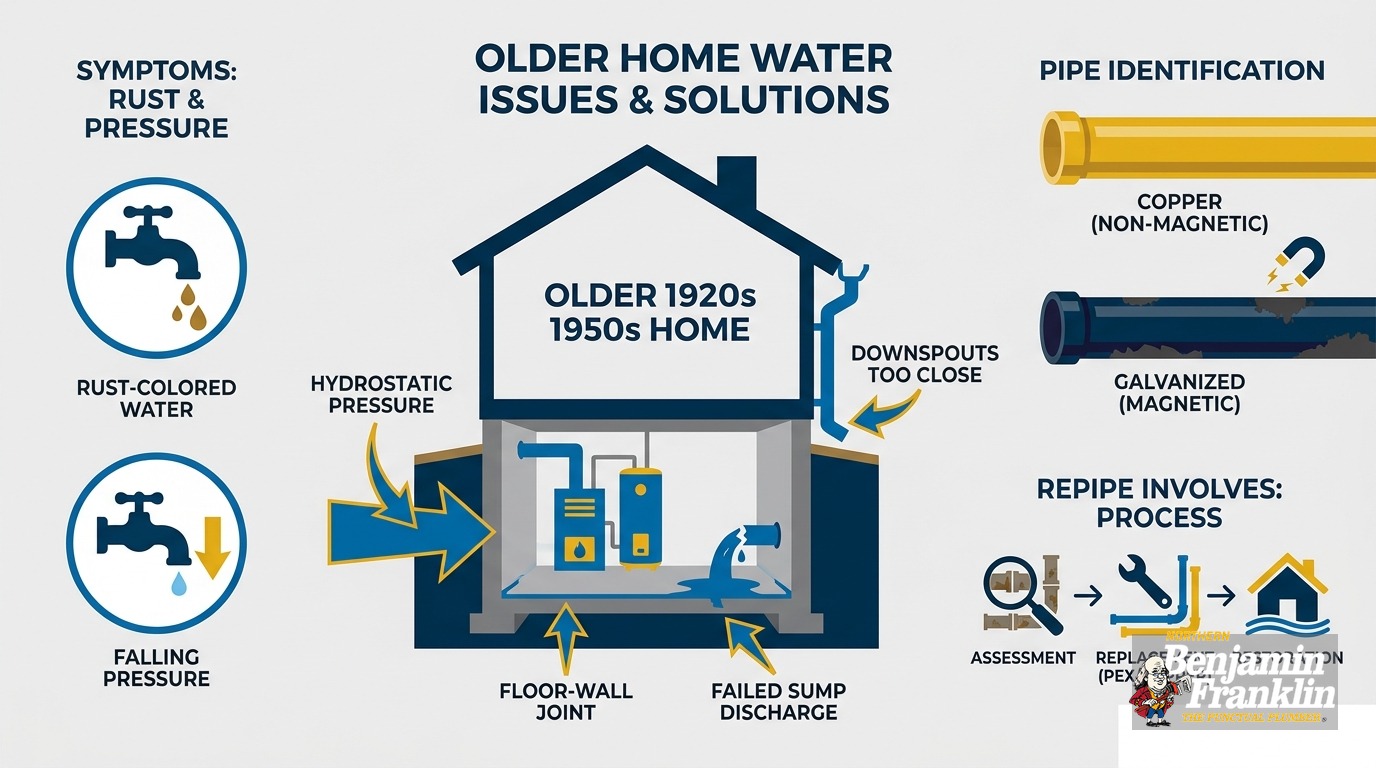
- Rust-colored water, falling pressure, and recurring joint leaks are the main failure signs.
- A magnet and a scratch test let you confirm galvanized pipe in your basement in about two minutes.
- The 2024 EPA Lead and Copper Rule Improvements created a “Galvanized Requiring Replacement” (GRR) classification for pipe that once sat downstream of a lead service line.
- Minneapolis is replacing lead and GRR service lines at no cost to property owners using state and federal funds.
- Whole-home repipes take one to three days; a plumbing permit is required in Minnesota.
- Call Northern Benjamin Franklin Plumbing at (763) 296-1844 or book online for an estimate on galvanized pipe replacement cost in the Twin Cities.
Why Galvanized Pipe Replacement Matters for Twin Cities Homeowners
If you own a home built before 1960 in Minneapolis, St. Paul, or the surrounding suburbs, galvanized pipe replacement cost is something worth understanding now. Rusty water and falling pressure are not just nuisances. They are signals from a plumbing system that is past its design life.
This guide answers the questions a Minneapolis homeowner with brown water actually has: how to identify what kind of pipe you have, what the 2024 EPA rule change means for pre-1930 homes, whether a free city program covers your service line, and what the full repipe process looks like from permit to patch.
What Is Galvanized Pipe, and Why Do So Many Twin Cities Homes Have It?
Quick answer: Galvanized pipe is zinc-coated steel pipe installed widely from the early 1900s through the 1960s. The zinc coating slows corrosion for a time, then fails. Once it is gone, the steel rusts from the inside out, narrowing the pipe and eventually causing leaks.
Builders used galvanized pipe because the zinc coating worked - for a while. Galvanized pipe has a service life of roughly 40 to 70 years depending on water chemistry and installation conditions. A home built in 1945 is carrying 80-year-old pipe. That pipe is past its rated life.
As the zinc corrodes, rust and mineral deposits build up on the pipe interior. The pipe narrows gradually. Water pressure drops. Eventually the pipe cracks or weeps at the joints. The process is slow, which is why many homeowners do not notice until the water turns brown or a fitting fails.
Minneapolis and St. Paul’s older housing stock means a higher share of homes in the metro still have original galvanized supply lines than in markets built out mostly after the war. Twin Cities water also runs moderately hard. Hard water speeds mineral buildup inside aging pipe, making deterioration more active here than in softer-water markets.
How Do You Tell Galvanized Pipe from Copper in Your Basement?
Quick answer: Galvanized pipe is dull gray with threaded fittings and a magnet sticks to it. Copper is orange-brown or green with smooth soldered joints and a magnet slides right off. Bring a refrigerator magnet to the basement and you will have your answer in about two minutes.
Here is the full visual breakdown:
| Pipe type | Color | Fittings | Magnet | Scratch test |
|---|---|---|---|---|
| Galvanized steel | Dull gray, often rust-blush | Threaded | Sticks | Gray underneath |
| Copper | Orange-brown or green patina | Smooth, soldered | Does not stick | Bright copper color |
| Lead (service line, pre-1930) | Dark gray, soft | May bulge at joints | Does not stick | Shiny silver |
| PEX (already replaced) | Red, blue, or white flexible tubing | Crimped or push-fit | Does not stick | N/A |
Start at the point where the water supply enters the basement. Follow the main supply line outward toward your fixtures. Scratch the pipe surface lightly with a key or coin. Gray underneath means galvanized. Bright copper color means copper.
If you find dark gray pipe that feels soft and shows slight bulging at joints, that is more likely lead. Lead on service lines is addressed separately by Minneapolis’s free replacement program, described below.
Many pre-1960 homes have a mix: galvanized supply runs throughout the house, with copper added when a bathroom was updated, or PEX in a section a previous owner already replaced. The question is how much galvanized remains and how corroded it is.
What Are the Warning Signs That Galvanized Pipe Is Failing?
Quick answer: Rust-colored water at the tap, gradually falling pressure across multiple fixtures, visible corrosion at threaded joints, and unexplained leaks in walls or ceilings are the clearest signals. In a pre-1960 home, any one of these warrants a professional assessment.
The most common warning signs:
- Rust-colored or brown water. This is rust flaking off the pipe interior. It shows up most often after water has sat overnight. It may clear after running the tap for a minute, but the condition will return.
- Falling water pressure. As the interior narrows, less water gets through. Gradual pressure loss over one to two years in an older home is a common galvanized indicator.
- Pressure or color problems at specific fixtures only. A corroded stretch upstream of one bathroom shows up as issues at that group of fixtures, not the whole house.
- Recurring leaks at the same joints. Threaded joints are the first spots galvanized pipe cracks or weeps. Patching the joint treats the symptom, not the pipe.
- Brown staining in the toilet tank. Rust settling in a tank fed by a galvanized line stains the porcelain and discolors the water.
Any of these signs in a home built before 1960 is worth a plumber’s look. The problem rarely stays contained to one stretch of pipe.
The 2024 EPA Rule Change and What It Means for Pre-1930 Homes
In October 2024, the EPA finalized the Lead and Copper Rule Improvements (LCRI), creating a new classification called “Galvanized Requiring Replacement,” or GRR.
The rule addresses a risk that had been underappreciated for years. Galvanized steel absorbs lead from upstream lead service lines. When a lead pipe is removed, the galvanized section downstream continues releasing that absorbed lead into drinking water for years afterward - even after the lead source is gone.
This matters for pre-1930 Minneapolis homes in particular. The typical configuration in those homes: lead pipe from the city main to the stop box, galvanized steel from the stop box to the meter. Even if Minneapolis replaces the lead portion at the curb, the galvanized stretch on your property side may still carry a lead burden.
The EPA’s maximum contaminant level goal for lead in drinking water is zero - there is no established safe level of exposure. Children face the greatest risk. Low-level lead exposure is linked to nervous system damage, learning disabilities, and impaired blood cell function. Water utilities now have until November 1, 2027, to comply with the LCRI’s GRR replacement requirements.
For homeowners, the practical implication is this: galvanized pipe in a pre-1930 Twin Cities home is no longer just an aging infrastructure problem. It may be a lead exposure problem even if your home has never had a confirmed lead service line.
Does Minneapolis Have a Free Service Line Replacement Program?
Quick answer: Yes. Minneapolis is replacing lead and GRR service lines at no cost to property owners using state and federal funds. Check your address before scheduling any service line work on your own.
The program covers the exterior service line from the city main to your home’s entry point - the stretch most likely to be lead or GRR galvanized in homes built before 1930. Minneapolis must replace all lead service lines by 2037 under federal mandate. Minnesota’s state target is 2033. Replacement work is accelerating.
State funding is also available through the MDH Lead Service Line Replacement Funding Program for cases where the municipal program has not yet reached a given property.
To check your address, use the Minnesota Lead Infrastructure Transparency Tool maintained by the University of Minnesota. It shows recorded service line material status across the state. If your address shows lead or GRR, contact the city before scheduling any exterior service line work.
One clear boundary: the free program covers the exterior service line only. It does not replace the interior supply piping running through your basement, walls, and floors. That work is a full home repipe - a separate scope, covered next.
What Does Galvanized Pipe Replacement Cost in the Twin Cities?
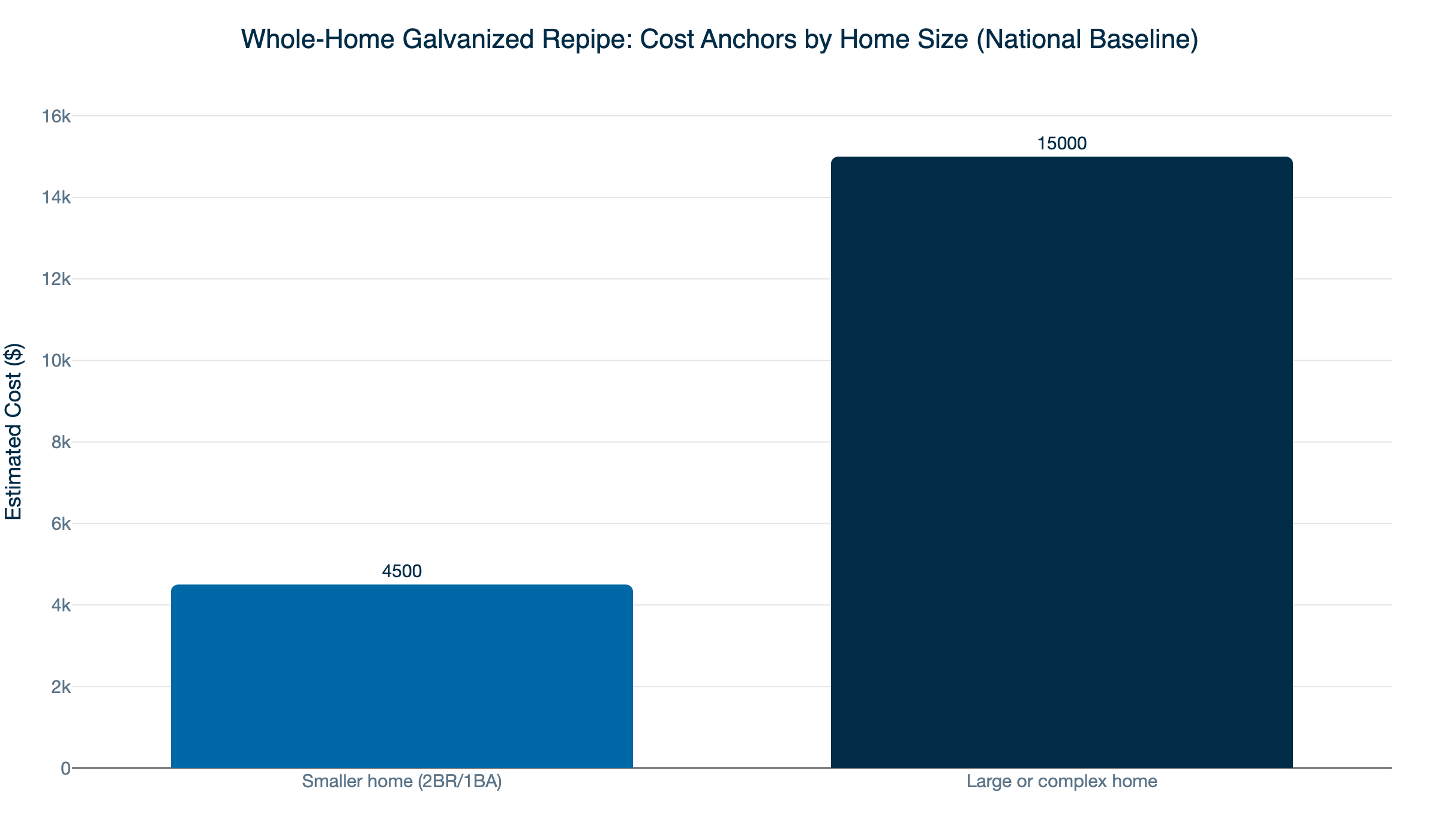
Quick answer: National data puts a whole-home repipe at $4,500 on the low end for a smaller home and $15,000 or more for a larger or more complex one. Twin Cities homeowners should plan toward the mid-to-high end of those ranges given local labor rates and the age of the regional housing stock.
The figures below come from CostHelper and We Do Repipes. They are national reference figures, not our prices. For a real estimate on galvanized pipe replacement cost in the Twin Cities, call (763) 296-1844.
What drives the cost:
- Home size and linear footage. More square footage means more pipe, more labor, and more wall access points.
- Material choice: PEX or copper. PEX runs $1.50 to $4 per linear foot installed. Copper runs $4 to $12 per linear foot installed. PEX is flexible and installs faster in tight spaces. Copper has a longer performance record and some homeowners prefer it in finished areas.
- Wall access. Open basement joists make runs straightforward. Finished walls and ceilings mean cutting drywall, which adds time and cost.
- Permit. Minnesota requires a plumbing permit for a full repipe. Permit fees vary by city and home size.
- Drywall repair. Most repipe quotes separate the pipe work from wall patching. Budget for both line items.
- Service line scope. If the city program has not yet reached your block and the service line also needs replacement, that adds to the total.
Pre-1960 Twin Cities homes often have complex supply routes through finished basement ceilings and lathe-and-plaster walls. That is why the mid-to-high end of national cost ranges is a more realistic planning figure for this region.
Financing is available for larger jobs. Ask about options when you call. For an estimate specific to your home, learn more about our repiping service or call (763) 296-1844.
What Happens During a Whole-House Repipe?
Quick answer: A licensed plumber assesses the system, pulls a permit, shuts the water, replaces pipe in sections or all at once, pressure-tests the new system, and restores service. Most repipes take one to three days of pipe work; wall patching comes after.
Here is what to expect step by step:
- Assessment. The plumber walks the home, maps existing supply runs, and identifies how many linear feet need replacement and where access points are needed.
- Permit. A plumbing permit is required in Minnesota for whole-home repipe work. The permit creates an inspection record that travels with the home. Northern Benjamin Franklin Plumbing handles the permit submittal.
- Water shutoff. The main is closed and supply pressure is relieved before any pipe is cut.
- Removal and replacement. Galvanized sections come out and new PEX or copper goes in. The crew works from the service entry outward to each fixture branch.
- Pressure test. The new system is pressurized and checked at every joint before water is restored.
- Inspection. A city inspector signs off on the permit. This step is a legal requirement, not optional, and the record protects you at resale.
- Wall patching. Any drywall or plaster opened for pipe access is patched after the inspection. This is typically a separate scope item from the plumbing work.
You will be without water during active pipe work - usually one full day, sometimes two. Our team works to keep that window as short as possible. That is the On-Time Guarantee(R) in practice: we arrive when we say we will. If there is any delay, it’s you we pay!
Minnesota Permit Requirements for Repiping
Minnesota Plumbing Code Rule 4714.0701 prohibits galvanized pipe underground. New galvanized installation below grade is not allowed. If a repipe touches any underground supply runs, those sections must be replaced with an approved material.
In an existing home, the permit may be pulled by a licensed Minnesota plumbing contractor or by the homesteading homeowner doing work on their own primary residence. In new construction, a licensed contractor is required. Minnesota Code 4714.0903 covers the full permit requirements for plumbing work in existing structures.
Most Twin Cities municipalities require a water riser diagram as part of the permit submittal: a drawing showing supply piping from the service entry to each fixture, with pipe sizes and material labeled. This documentation follows the home through any future sale. Having it on file is worth the effort.
A licensed plumber familiar with Twin Cities permit offices moves faster through this process. Northern Benjamin Franklin Plumbing handles all permit work in the metro.
Hard Water and Your New Pipes: A Twin Cities Factor Worth Knowing
Minneapolis finished water runs at approximately 93 to 100 parts per million of total hardness, which is moderately hard. St. Paul Regional Water Services reports similar hardness after lime softening treatment. Both cities draw from the same Mississippi River source.
Hard water does not degrade PEX. It can affect copper fittings over a long period. More practically, hard water accelerates scale buildup in water heaters, fixtures, and appliances throughout your system.
If you are repiping a hard-water Twin Cities home, it is worth discussing water treatment in the same conversation. A whole-home water softener reduces mineral load on the new pipes, the water heater, and every appliance that sees your water. If a lead test or a city notification has also flagged a lead concern at your address, our lead-in-water page covers interim steps while service line work is in progress.
When Should You Call Instead of Waiting?
Quick answer: If your pre-1960 Twin Cities home has not had its pipe material confirmed by a licensed plumber, now is a reasonable time to find out what you have. Galvanized pipe does not fail on a schedule, but 80-year-old pipe is past its rated service life.
Specific situations where calling sooner is the right call:
- Brown or rust-colored water that does not clear after running the tap for a full minute
- Water pressure that has dropped noticeably over the past year or two
- A plumber who found galvanized pipe while working on an unrelated repair
- A city notification about lead service lines on your block or in your neighborhood
- A home purchase inspection that flagged galvanized supply piping
You are not waiting for a disaster to happen. You are managing the probability of one. Getting an assessment now gives you accurate information: how much galvanized is left, how corroded it is, and what replacement actually costs for your specific home.
Northern Benjamin Franklin Plumbing is locally owned and operated in the Twin Cities, backed by the Benjamin Franklin Plumbing network. We handle the full scope: assessment, permit, repipe, and coordination with city inspection. Our On-Time Guarantee(R) means we arrive in the window we promise. If there is any delay, it’s you we pay!
Call (763) 296-1844 or schedule an appointment online. We will walk through your pipe system and give you an honest picture of what galvanized pipe replacement cost looks like for your specific Twin Cities home.
Frequently Asked Questions
How do I tell if I have galvanized pipes? +
Is there a free galvanized pipe replacement program in Minneapolis? +
How long does a whole-house repipe take? +
Who can pull a plumbing permit for a repipe in Minnesota? +
Need a technician now?