
Low Water Pressure Upstairs: Causes and How to Fix Them
Key Takeaways
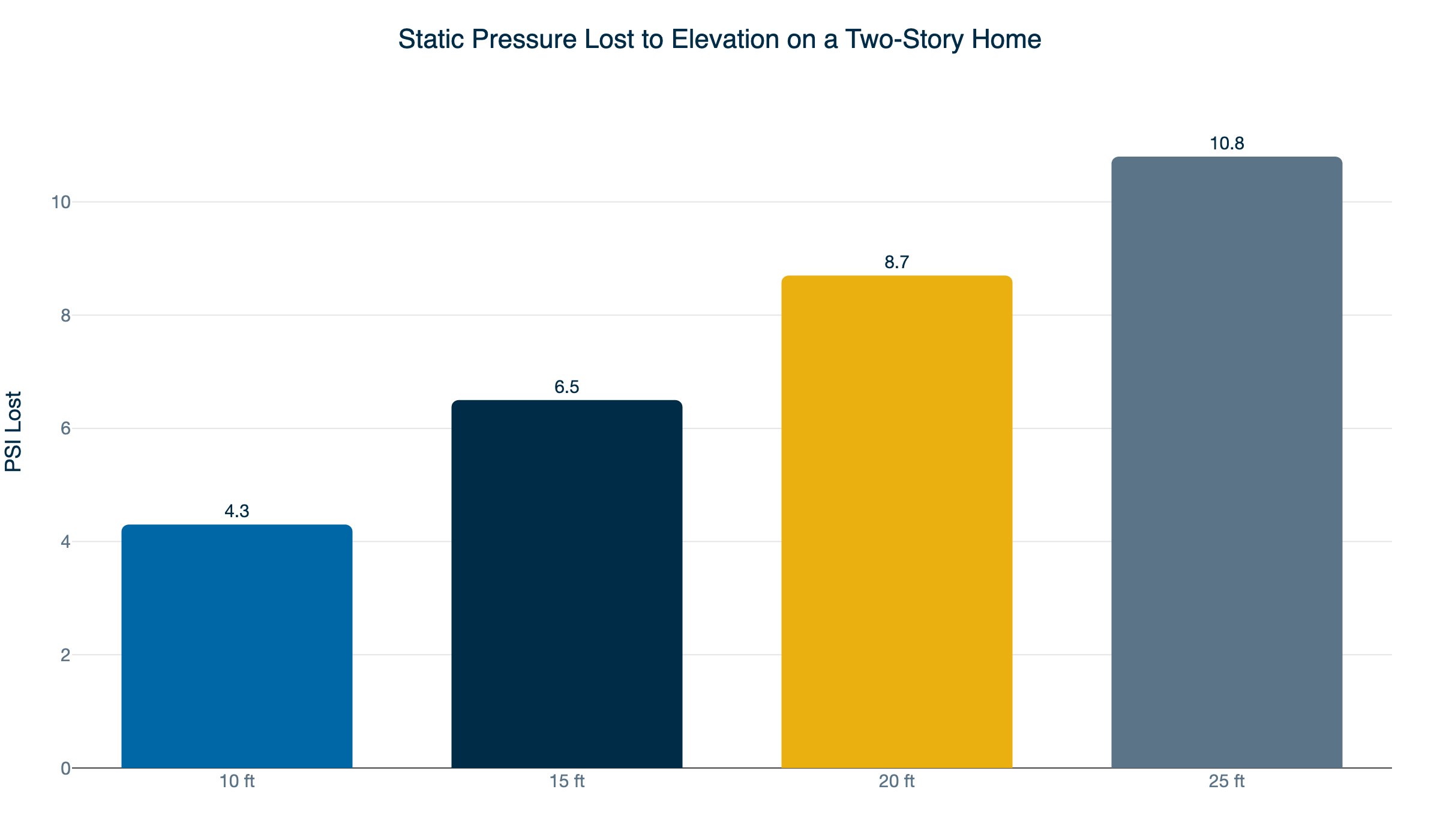
- Water loses 0.433 PSI for every vertical foot it travels upward. A second-floor fixture 15 feet above your meter starts with 6.5 PSI already gone. At 25 feet, that static loss reaches 10.8 PSI.
- A pressure-reducing valve set to the factory default of 50 PSI leaves upstairs fixtures at roughly 40 to 43 PSI at rest. Under simultaneous use, that can drop below 30 PSI.
- Minneapolis water carries 16.4 grains per gallon of hardness. Over years, that mineral buildup narrows branch lines and compounds an already tight pressure margin.
- If every upstairs fixture runs weak, start with the PRV. If it is one fixture, start with the aerator and the local shutoff valve.
- Northern Benjamin Franklin Plumbing can test your system pressure and identify the exact cause. Call (763) 296-1844 or book online.
Is the Low Pressure in One Fixture or the Whole Upstairs?
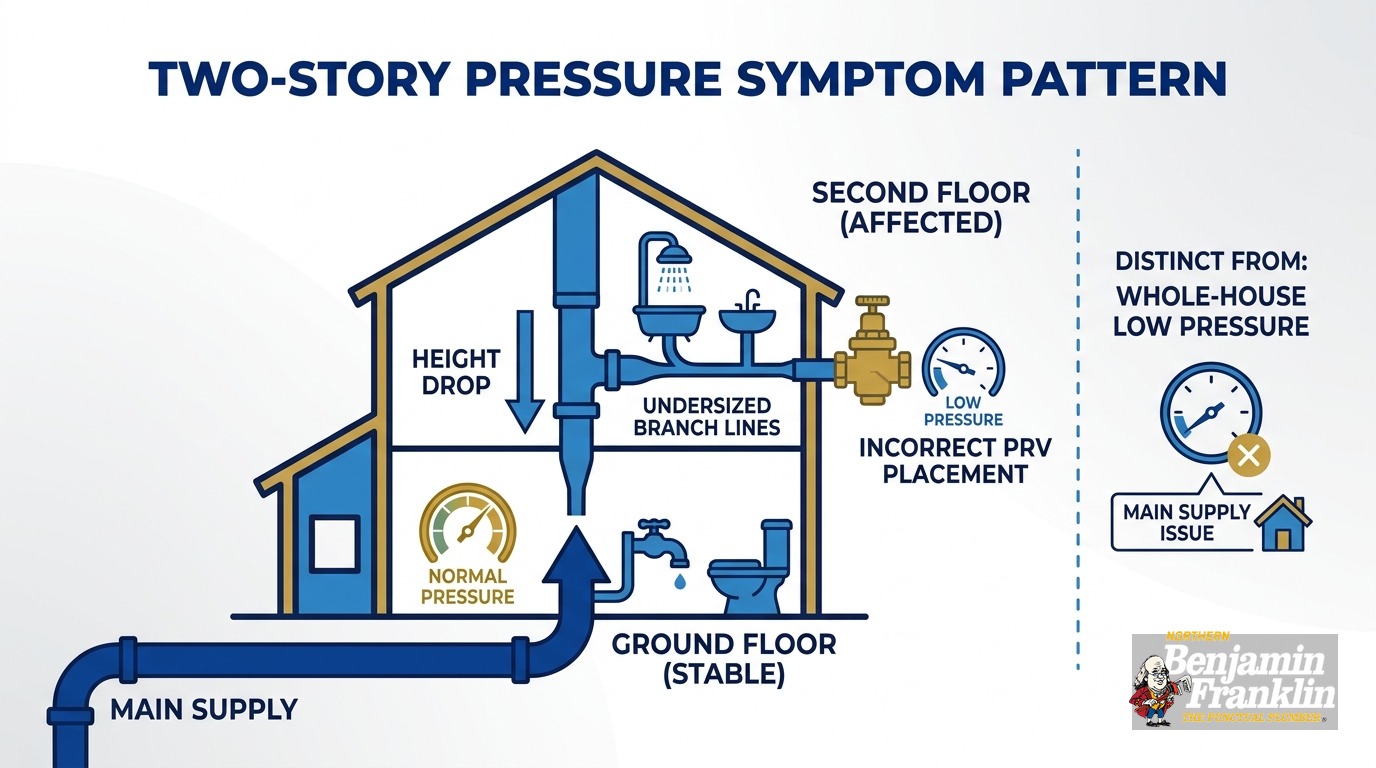
If a single faucet or showerhead is the only weak one, the problem is almost certainly local: a clogged aerator, a partially closed valve, or a failing cartridge. If every upstairs fixture runs weak, the cause is upstream - elevation loss, PRV setting, or undersized branch lines.
Start by turning on two or three upstairs fixtures at the same time. If pressure drops noticeably when a second fixture opens, the restriction is at the branch line or PRV level. If one fixture is weak while others run fine, test the aerator first.
A clogged aerator is the single most common cause of low pressure at an individual faucet. Hard water deposits - Minneapolis water carries 16.4 grains per gallon - build up inside the mesh screen and restrict flow without affecting line pressure at all. Unscrew the aerator from the faucet tip, rinse out the mineral buildup under the faucet, and retest. That takes five minutes and solves the problem more often than anything else.
If pressure is still low after the aerator is clean, check that the shutoff valve under the sink is fully open. A valve turned even a quarter-turn closed will cut pressure at that fixture while leaving every other outlet unaffected. This happens after plumbing work when a valve is not fully reopened, and it is easy to overlook for months. Our room-by-room low water pressure diagnosis guide walks through the full process fixture by fixture.
What Does Elevation Actually Do to Water Pressure?
Every foot of vertical rise costs water 0.433 PSI - a physical constant based on water density, not a plumbing variable. In a typical Twin Cities two-story home, the supply line climbs 20 to 25 feet from the basement entry to a second-floor fixture, losing 8.7 to 10.8 PSI before friction adds anything.
The math comes from the weight of water: 62.4 pounds per cubic foot divided by 144 square inches per square foot equals 0.433 PSI per vertical foot. The chart above shows the static pressure loss at heights typical in two-story Minnesota homes. There is no plumbing fix that removes this loss. What you can do is compensate for it by raising the PRV setpoint - covered in the next section.
The elevation distance in a Minnesota home is longer than in most states. Minnesota Plumbing Code 4714.0609 requires supply lines to be buried at least 12 inches below maximum local frost depth. In the Twin Cities, frost depth reaches 42 to 60 inches. That forces the supply line well below grade before it enters the house. From there, the water climbs up through the basement and continues to the second floor. The total vertical rise is 20 to 25 feet in most homes, and in older homes with deep basements it can reach 28 feet or more.
This loss is called static head loss. It is always present, whether or not anything is flowing.
Static versus dynamic loss. Friction loss is different from static head loss. Friction only appears when water is flowing, and it grows with flow rate. This distinction explains a symptom that confuses many homeowners: the upstairs toilet fills fine, but the upstairs shower feels weak. A toilet fill valve requires very low flow; friction loss is negligible. A shower runs at 1.5 to 2 gallons per minute through a long branch line; friction becomes significant. If the toilet fills at normal speed but the shower underperforms, the branch line itself - not just elevation - is part of the answer.
How Does Your PRV Setting Affect Upstairs Pressure?
A pressure-reducing valve set to 50 PSI - the most common factory default - leaves second-floor fixtures at roughly 40 to 43 PSI at rest. Under simultaneous use, that can drop to 30 PSI or below. Adjusting the PRV to 65 to 70 PSI is within Minnesota code and often resolves the complaint without any pipe work.
Minnesota Rules 4715.1740 requires a PRV in any home where street main pressure exceeds 80 PSI. Most Twin Cities homes have one. The PRV sits near the point where the water supply enters the house, typically in the basement, and reduces high street pressure to a safe working pressure for the home’s distribution pipes.
The problem is the setpoint. Most PRVs ship set to 50 PSI. Subtract the 8 to 9 PSI of static elevation loss in a two-story home, and upstairs fixtures start at 41 to 42 PSI at rest. That looks acceptable on paper. But PRVs experience pressure droop: as simultaneous demand increases - a shower plus a toilet fill plus a running dishwasher - the outlet pressure falls further than the dial position suggests. A PRV set to 50 PSI may deliver only 38 to 40 PSI under moderate simultaneous demand, and 30 PSI or below at peak load. Most shower mixing valves are designed to operate at 45 PSI or above. Running below that threshold produces the weak, hard-to-adjust flow that is the most common upstairs shower complaint.
The fix is often a 15-to-30-minute adjustment. A plumber attaches a pressure gauge to a hose bib, reads actual system pressure at rest and under flow, then turns the adjustment bolt on the PRV to raise the outlet setpoint. A target of 65 to 70 PSI leaves the system well under the 80 PSI maximum in Minnesota code while providing enough headroom to absorb elevation loss and simultaneous-use droop. If the PRV is 15 or more years old and can no longer hold a steady setpoint, replacement is the correct next step. Our post on signs a pressure-reducing valve is failing covers the specific symptoms to look for before scheduling that repair.
Why Is My Upstairs Hot Water Pressure Low?
Weak hot water pressure upstairs while cold runs fine usually points to scale inside the hot water branch line, a partially closed water heater isolation valve, or a cartridge that restricts the hot side only. Heat accelerates mineral scale formation, so hot lines narrow faster than cold lines carrying the same water.
Start by checking hot water pressure at a downstairs faucet. If it is normal downstairs but weak upstairs, the restriction is in the branch line between the water heater and the second floor. That branch is almost certainly a 1/2-inch line, and in a Minneapolis home, it has been carrying hard water for years.
The City of Minneapolis 2024 Annual Water Quality Report documents hardness at 280.5 mg/L, or 16.4 grains per gallon. That is well above the level at which mineral scale builds up meaningfully inside pipes. On the hot water side, the pipe wall itself reaches elevated temperatures, which causes dissolved calcium and magnesium to precipitate out of solution and adhere to the interior surface. A branch line that started at a full 1/2-inch bore can narrow substantially over 20 to 30 years of carrying Minneapolis water. That narrowing compounds what is already a tight pressure margin on the second floor.
If hot pressure is weak throughout the entire house - not just upstairs - the diagnosis is different. A partially closed isolation valve at the water heater, sediment blocking the outlet port, or a corroded dip tube each produce whole-house hot water weakness. Our guide to pipe lifespan in Twin Cities homes covers how galvanized, copper, and PEX lines age differently under hard-water conditions.
What Else Restricts Pressure Before the Water Reaches the Second Floor?
Beyond elevation loss and the PRV setpoint, a water softener, corroded galvanized pipe, and undersized branch lines each add their own pressure penalty. In Minneapolis homes with older housing stock, these factors compound each other in predictable ways.
Water softener restriction. Fine Homebuilding reports that a water softener can reduce household pressure by up to 10 PSI - the largest single restriction in a typical residential system. Most homeowners never connect the softener to a pressure problem. The resin tank creates friction as water passes through the ion-exchange media. Stack that 10 PSI loss on top of 8 PSI of elevation loss and a 50 PSI PRV setpoint, and upstairs fixtures are operating at roughly 32 PSI at rest before any simultaneous demand. A plumber can test pressure on both sides of the softener in a few minutes to confirm whether it is contributing to the problem.
Galvanized pipe. Many Twin Cities homes built before 1960 still have original galvanized steel supply lines. Galvanized pipe corrodes from the inside out. Rust accumulates in layers and progressively narrows the effective bore. A 3/4-inch line with heavy internal corrosion can restrict flow to what a 3/8-inch pipe would carry. In these homes, low pressure upstairs is a downstream symptom of a deeper problem. Adjusting the PRV may provide some improvement, but replacing the galvanized lines with copper or PEX is the only durable fix.
Undersized branch lines. Minnesota Plumbing Code Table 610.3 sets the minimum branch pipe size to lavatories, showers, and clothes washers at 1/2 inch. A 1/2-inch branch run meets code but carries higher friction loss than a 3/4-inch line at the same flow rate, especially over a long horizontal run before the pipe turns upward to the second floor. In homes where multiple upstairs fixtures run at the same time, the undersized branch line is often the final compounding factor that pushes pressure below an acceptable threshold.
Partially closed valves. If any valve in the supply path was closed during a repair and never fully reopened, that is worth checking before anything else. The main shutoff, the PRV bypass, and the water heater isolation valve are the most common culprits. Checking all three takes under five minutes.
How Do You Increase Water Pressure on the Second Floor?
The fix depends on the root cause. The most common first step is adjusting the PRV setpoint. Other fixes range from cleaning an aerator at no cost to repiping undersized branch lines. A system pressure test identifies which path applies to your home.
Here are the steps in order of cost and complexity.
Step 1: Aerators and local shutoff valves. Free, five minutes. If a single fixture is the problem, this resolves it most of the time.
Step 2: System pressure test. A plumber attaches a gauge to a hose bib or laundry hookup and measures static pressure at the meter. If static pressure is normal but upstairs pressure is low, the numbers will confirm whether elevation loss plus the PRV setpoint explains the full gap.
Step 3: Adjust the PRV setpoint. If system pressure tests below 60 PSI at the point of delivery, raising the setpoint to 65 to 70 PSI is a 15-to-30-minute job. It resolves a large share of second-floor pressure complaints without any pipe work.
Step 4: Replace a failing PRV. PRVs typically last 10 to 15 years. A worn valve loses its ability to hold a steady setpoint under simultaneous demand. If the adjustment does not hold, replacement is the right call.
Step 5: Address scale or galvanized pipe. Descaling or chemical treatment may provide temporary relief. Repiping with copper or PEX is the durable fix. A camera inspection of the branch line documents the interior condition before a recommendation is made.
Step 6: Upsize the branch line. If the run to the second-floor bathroom is 1/2 inch and more than 20 feet long, upsizing to 3/4 inch reduces friction loss significantly under simultaneous demand. This is a larger job but the correct solution when the home routinely runs multiple upstairs fixtures at once.
When Should You Call a Plumber for Low Water Pressure?
Call when the problem is at the PRV or branch line level, when you have galvanized or heavily scaled pipe, or when you cannot identify the cause after checking aerators and shutoff valves. Those repairs require a licensed plumber under Minnesota plumbing code.
Cleaning an aerator or fully opening a shutoff valve is a legitimate homeowner step. Everything upstream involves the pressure-reducing valve, supply branch lines, or the building supply itself - and those repairs require licensed plumbing work in Minnesota under the 2020 Minnesota Plumbing Code, which took effect December 17, 2021.
If pressure dropped suddenly rather than declining gradually over time, call sooner. Sudden pressure loss can signal a failing PRV, a valve problem you are not aware of, or a developing leak that has not yet surfaced at a visible location. A leak that starts small rarely stays that way. Our overview of supply line work and under-sink plumbing repairs covers what a plumber checks when pressure loss appears localized to one fixture.
Northern Benjamin Franklin Plumbing is locally owned and operated in the Twin Cities. Our licensed plumbers serve Minneapolis, St. Paul, Blaine, Bloomington, Brooklyn Park, Coon Rapids, Maple Grove, and the greater metro area. We carry our tools to your door backed by the On-Time Guarantee(R): we arrive in the window you pick, or you receive $5 for every minute we are late, up to $300. “If there is any delay, it’s you we pay!” To schedule a pressure test and diagnosis, call (763) 296-1844 or book online.
Frequently Asked Questions
Why is my bathroom sink faucet not getting any water pressure? +
Need a technician now?