
Low Water Pressure in House: A Room-by-Room Diagnosis Guide
Key Takeaways
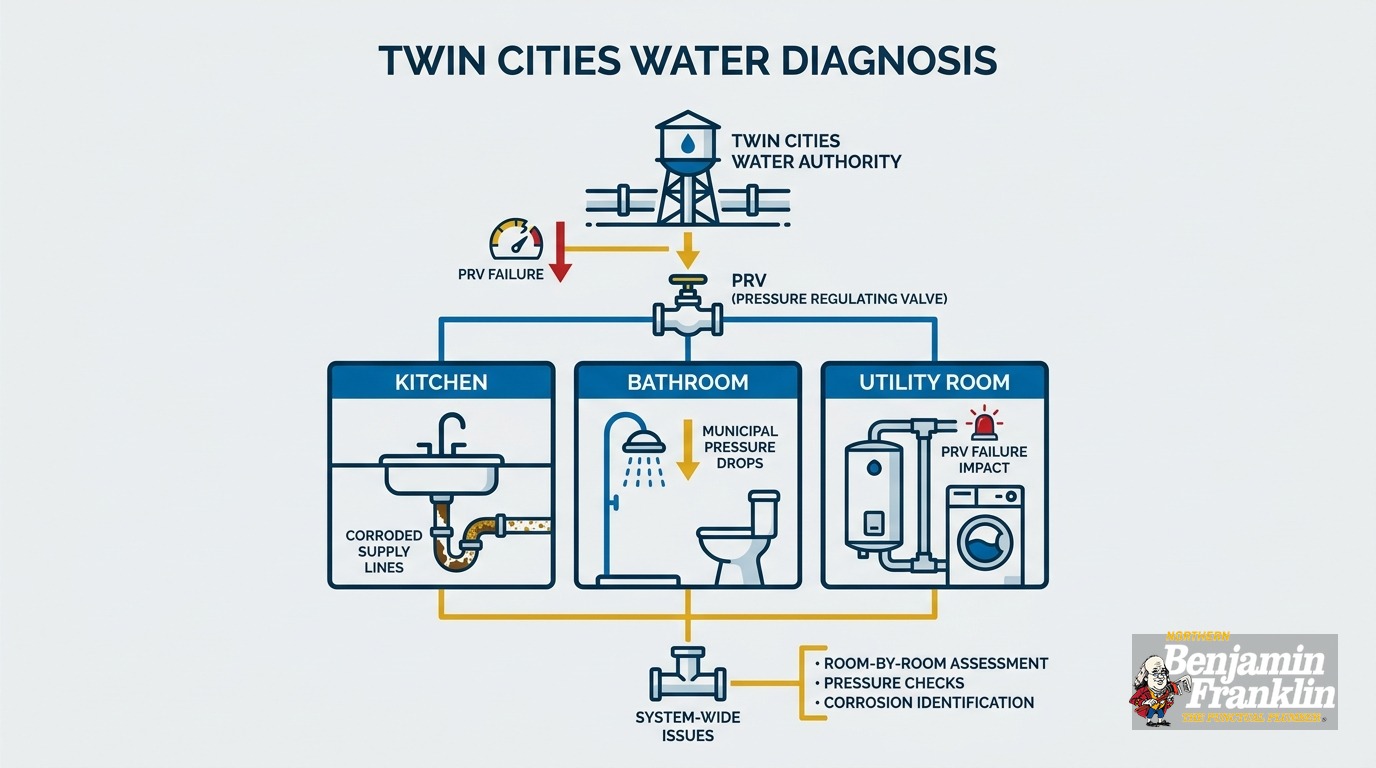
- Where low water pressure shows up - one fixture, one floor, the whole house, or only hot water - points you to very different repairs.
- A $15 hose-bib pressure gauge is the first diagnostic tool. Below 40 PSI at an outdoor spigot confirms a real pressure problem.
- If the whole house runs slow and it came on gradually, the pressure reducing valve (PRV) is the most likely cause.
- Twin Cities homes built before 1970 often still have galvanized supply lines. Those pipes narrow from the inside out and cause pressure to drop unevenly room to room.
- SPRWS owns the service line in the street right-of-way. You own everything from the curb stop into your home.
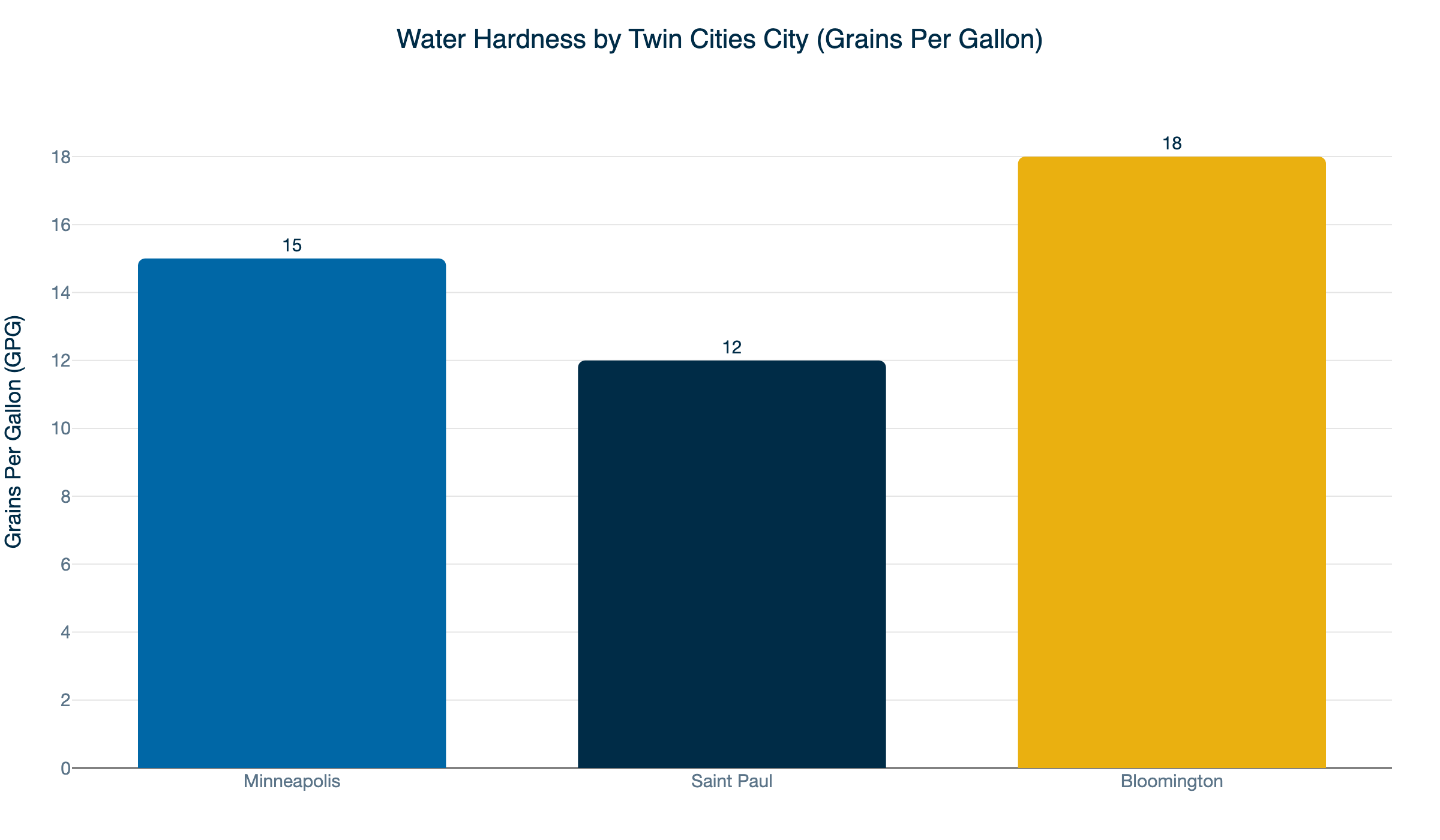
- Hard water across the Twin Cities metro (12-18 grains per gallon) accelerates pipe scaling and PRV wear faster than national figures suggest.
- If your neighbors have low pressure on the same day, call SPRWS at 651-266-6270 before calling a plumber.
- Northern Benjamin Franklin Plumbing is locally owned and operated in the Twin Cities. Call (763) 296-1844 or schedule a visit and our team comes to you.
Why the Location of Your Low Pressure Matters
Plumbing is a tree. Water enters your home through a single service line, passes through the PRV, and branches out to every floor, every fixture, and every appliance.
That structure means the location of your problem reveals a lot:
- One fixture runs slow: the restriction is local - usually the aerator, the supply shutoff, or the fixture’s supply line.
- One floor or zone runs slow: the restriction is on a branch line serving that area.
- The whole house runs slow: the restriction is upstream of every branch - the PRV, the main shutoff, the service line, or a municipal issue.
- Only hot water runs slow: the restriction is at the water heater or in the hot-water supply lines, not the cold supply.
Keep that tree in mind as you work through each section below.
Is Low Water Pressure in Your House Limited to One Fixture?
If only one faucet, showerhead, or toilet runs slow, the problem is almost certainly local. Start by cleaning or replacing the aerator on that fixture. Then check the fixture’s supply shutoff to make sure it is fully open. If neither fix works, the supply line feeding that fixture may be kinked, corroded, or partially obstructed.
Aerators are the most common single-fixture culprit in Twin Cities homes. Hard water deposits calcium and magnesium inside the aerator screen. The flow gets weaker over months. Unscrewing the aerator, soaking it in white vinegar overnight, and reinstalling it takes five minutes and often solves the problem entirely.
If the aerator is clean, open the cabinet under the sink and check the supply shutoff. It is the small valve on the water line feeding the faucet. These sometimes get turned partway closed during a prior repair and never opened back up. A quarter-turn clockwise closes it; counter-clockwise opens it.
If neither aerator nor shutoff is the issue, the supply line between the shutoff and the fixture may be the culprit. Braided stainless lines last longer than the rubber hoses they replaced, but they are not permanent. Replace any supply line that is kinked, swollen, or more than ten years old.
What Does It Mean When One Floor Has Low Pressure?
One floor with noticeably lower pressure than the rest of the house points to a branch line serving that level. The likely causes are a corroded or partially obstructed branch pipe, a stuck zone shutoff, or significant mineral buildup on that run. In an older Twin Cities home, this pattern often means galvanized pipe on that branch.
Upper floors show pressure loss from pipe corrosion first. Water pressure drops as water rises, and a narrowed pipe on the upper-floor branch accelerates that drop.
If you have a two-story house and the upstairs bathrooms consistently run weaker than the main floor, consider when the home was built. Minneapolis and St. Paul homes built before 1970 frequently still have original galvanized supply lines on upper floors, even if the main floor lines were replaced at some point.
Galvanized steel pipe narrows from the inside out as it corrodes, restricting flow and causing uneven pressure room to room. SPRWS states plainly: if you have galvanized steel pipe in your home, it is likely reaching the end of its life expectancy.
Our post on galvanized pipe replacement in older Twin Cities homes covers what to expect if your home is in that age range.
What Causes Low Water Pressure in Your House?
Whole-house low pressure means the restriction is upstream of everything: the PRV, the main shutoff, the service line from the street, or the municipal supply itself. The diagnostic order is simple: check the main shutoff first, then measure pressure at the outdoor spigot, then check with neighbors to rule out a municipal cause.
Start at the main shutoff. It is usually at the front of the house where the service line enters. Confirm it is fully open. A gate valve should be turned all the way counter-clockwise. A ball valve handle should sit parallel to the pipe.
Then measure. A hose-bib pressure gauge threads onto any outdoor spigot. Normal residential water pressure runs 40 to 80 PSI. Below 40 PSI at the spigot confirms a real pressure problem, not a perception issue.
If pressure is low and the main shutoff is fully open, the next step is the PRV.
What Does a Pressure Reducing Valve Do, and How Do You Know When It Fails?
A PRV steps incoming street pressure - which runs 100 to 150 PSI at the main - down to the 50-70 PSI range that residential plumbing is designed for. When it fails, pressure can swing in either direction. A PRV stuck low looks identical to corroded pipes or a partially closed shutoff until you put a gauge on the line.
Municipal water arrives at the main at 100-150 PSI. Residential plumbing is designed for 50-70 PSI. Without a working PRV, high incoming pressure would hammer your fixtures and appliance connections every time you opened a tap.
The PRV is a bell-shaped valve located where the service line enters the house, just after the main shutoff. It has an adjustment screw on top and a locknut.
[Signs of PRV failure include whole-house low pressure that appeared gradually, water hammer when shutoffs close, toilets that run intermittently, and appliance supply lines that fail early.](https://neighborhoodplumbinganddrain.com/2025/12/22/how-a-pressure-reducing-valve-prv-works-and-what-happens-when-it-fails/) PRVs typically last 10 to 15 years. In a hard-water market like the Twin Cities, mineral deposits inside the diaphragm can shorten that window. If your PRV is over a decade old and you have whole-house low pressure, have a plumber put a gauge on both sides of the valve before assuming the problem is in the pipes.
A failing PRV that reads low on the downstream side but high on the incoming side is a straightforward valve swap. A PRV showing normal readings on both sides points the diagnosis back toward corroded supply lines or a service line restriction.
How Do You Test Your Home Water Pressure?
Thread a hose-bib pressure gauge onto an outdoor spigot. Turn the water on fully and read the gauge. Below 40 PSI confirms a real pressure problem. Normal is 40-80 PSI. This one reading tells you whether you have a whole-house issue or a localized restriction, and it is the first question any plumber will ask you.
If the outdoor reading is normal (40-80 PSI), the problem is downstream of the spigot. Look for a localized restriction: a partially closed fixture shutoff, a clogged aerator, or a corroded branch line.
If the outdoor reading is low (below 40 PSI), the restriction is upstream: the PRV, the main shutoff, the service line, or a municipal supply issue.
Keep the gauge. A $15 tool that rules out a service call the first time you use it is good value.
Could Galvanized Pipes Be Causing Your Low Pressure?
If your home was built before 1970 and has not been repiped, there is a real chance you still have galvanized steel supply lines. Galvanized pipe corrodes from the inside out. The interior walls narrow over time, restricting flow. Corrosion happens unevenly, so pressure may be fine in the kitchen and noticeably weak in an upstairs bath.
Galvanized steel pipe begins significant corrosion at about 20 years of age. Brass lasts 40-70 years. Copper lasts 50 years or more. A pre-1970 Minneapolis or St. Paul home that has not been repiped has supply lines well past the galvanized threshold.
The uneven pattern is a tell. If pressure is fine on the main floor but weak in the upstairs bath, and fine on cold but reduced on hot, you likely have galvanized on specific runs rather than throughout the house. A plumber can trace the affected branch and give you options: targeted replacement of the corroded run, or a full repipe if enough of the system is compromised.
One detail relevant to St. Paul homeowners: as of December 4, 2025, SPRWS reports 17,772 lead service lines and 6,084 lines of unknown material still in service in Saint Paul. Lead and old galvanized service lines corrode and constrict. SPRWS provides an address lookup at sprwsonline.maps.arcgis.com if you want to check your property. Lead lines on private property in Saint Paul are replaced at no charge through the Lead Free SPRWS program.
Our repiping service addresses both corroded branch lines and full-house repipes in the Twin Cities.
Could a Municipal Issue Be Causing Your Low Pressure?
Yes - and it is the diagnostic step most homeowners skip. If your neighbors have low pressure on the same day, the problem is not in your house. SPRWS distributes 40 million gallons per day through 1,200 miles of water main. Hydrant flushing and main work cause temporary pressure drops. Call SPRWS at 651-266-6270 before calling a plumber.
SPRWS advises running cold water for five minutes after flushing stops if you experience discolored water or low pressure following hydrant activity. That flush clears the residual and restores normal pressure.
Minneapolis is also in the middle of active infrastructure investment. The city received a $4.5 million Minnesota Public Facilities Authority grant in December 2025 for pre-design and design of drinking water distribution infrastructure. Construction and pre-construction work on aging distribution mains can cause localized pressure fluctuations on nearby streets.
In Saint Paul, SPRWS lead line replacement work means some streets are actively being excavated in 2026. A pressure drop on a workday in one of those areas is most likely a temporary municipal disruption, not a household plumbing failure.
The quick check: step outside and ask a neighbor if they have the same thing. If yes, wait it out and call SPRWS. SPRWS owns the service line in the street right-of-way. You own and are responsible for the service line on your private property from the curb stop to the house. If the pressure clears up after the municipal work wraps, you did not need a plumber at all. If it does not clear up, the restriction is likely in the service line you own.
Twin Cities Hard Water Makes Every Pressure Problem Worse
The Twin Cities is a hard-water market. Minneapolis water runs approximately 15 grains per gallon (GPG). Saint Paul runs approximately 12 GPG. Bloomington draws from the Prairie du Chien-Jordan aquifer at approximately 18 GPG. Anything above 10.5 GPG is classified as hard.
Hard water deposits calcium and magnesium scale on every surface water contacts. Inside pipes, that scale narrows the flow path over time - the same end result as galvanized corrosion, but driven by mineral buildup rather than iron oxidation. Inside a PRV diaphragm, scale stiffens and degrades the rubber, shortening the valve’s service life.
Aerators in hard-water homes clog faster. Showerheads and fixture supply lines restrict sooner. Hot water lines are hit harder because heat accelerates mineral precipitation.
If you have whole-house low pressure and you have never had a water softener, water treatment is worth discussing when a plumber comes out. Treating the water does not undo existing scale inside the pipes, but it stops the accumulation going forward and extends the life of new fixtures and valves.
What About Low Pressure Only on Hot Water?
Hot-only low pressure means the restriction is downstream of where the supply lines split: at the water heater inlet or outlet, or inside the hot-water supply lines. The cold supply is fine, so the PRV and service line are not the cause.
Sediment and scale accumulate at the bottom of a tank water heater and can pack tightly enough to restrict the cold-water inlet. Scale also builds on the hot-water outlet fitting. Either restriction reduces hot-water flow without affecting cold.
Flush the tank annually to slow sediment buildup. If hot-water pressure has been declining for a while and the heater is more than eight years old, have a plumber inspect the inlet and outlet connections for scale before the problem progresses to reduced recovery time or temperature swings.
If the water heater checks out clean and hot-water pressure is still low in one part of the house, the restriction is in a hot-water branch line - likely a corroded run in a pre-1970 home.
When Should You Call a Plumber for Low Water Pressure?
Call a plumber when the pressure gauge reads below 40 PSI at the outdoor spigot, you have confirmed it is not a municipal issue, and cleaning aerators and opening shutoffs did not help. Also call if your home was built before 1970, has never been repiped, and the low pressure is uneven room to room or floor to floor. That pattern almost always means corroded pipe.
The shorter version: stop diagnosing and call when any of these apply.
- Whole-house low pressure that came on gradually, not from a single event
- PRV is more than ten years old and whole-house pressure is below 40 PSI
- Pre-1970 home with uneven pressure and no repipe history
- Consistent low pressure at the same fixtures across multiple weeks
- Aerator cleaning and shutoff checks produced no improvement
Northern Benjamin Franklin Plumbing is locally owned and operated in the Twin Cities. Our team arrives in the window you pick, ready to diagnose and repair - because showing up late costs us money. The On-Time Guarantee(R) backs every appointment: if there is any delay, it’s you we pay! We pay you $5 for every minute we are late, up to $300.
Call (763) 296-1844 or schedule online. If corroded galvanized pipe is the likely cause, ask about repiping options when you call. If you want to address the hard water driving the problem in the first place, our water treatment team can assess your home at the same visit.
Frequently Asked Questions
What is normal water pressure for a house? +
How do I test my home water pressure? +
Can galvanized pipes cause low water pressure? +
Need a technician now?