
Banging Pipes in House: Water Hammer vs. 3 Real Causes
Key Takeaways
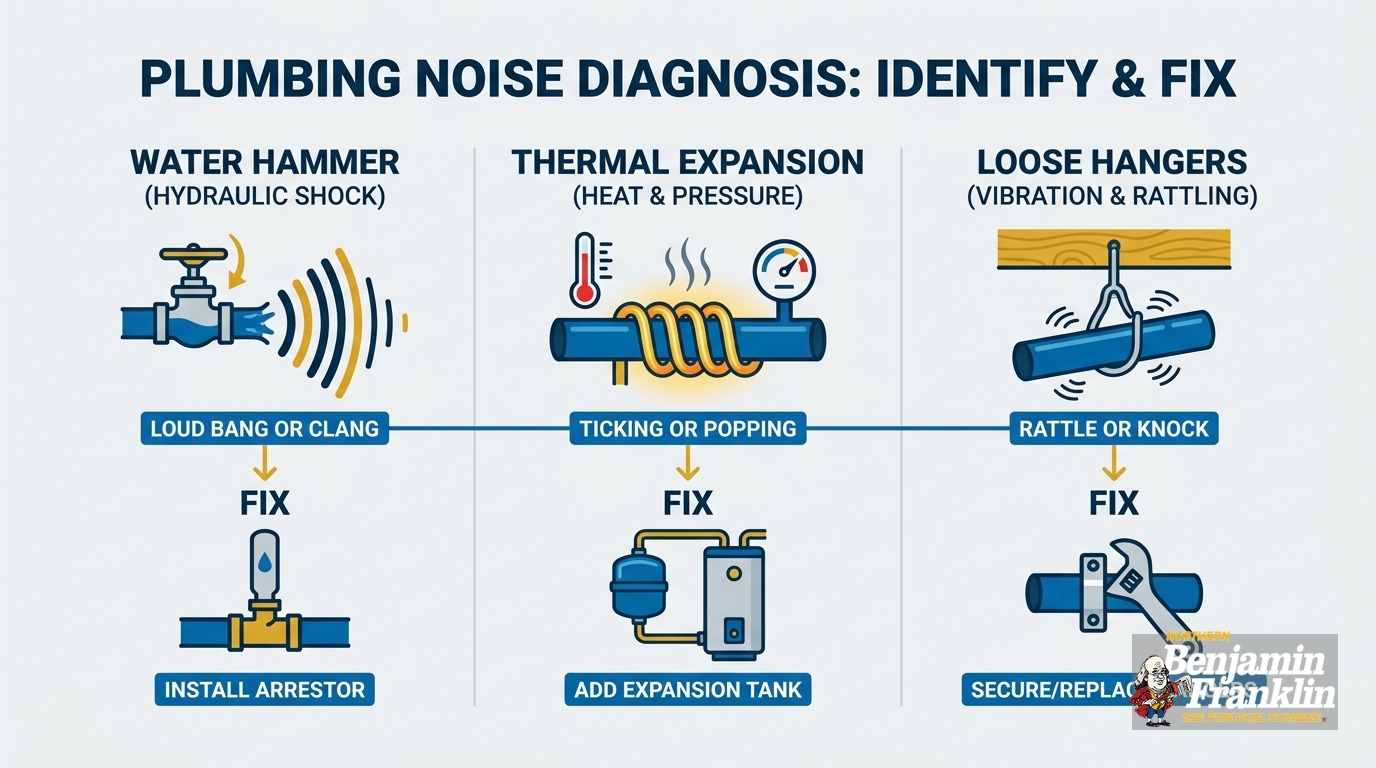
- Banging pipes in your house most often trace back to water hammer, thermal expansion, or loose pipe hangers.
- Water hammer is a sharp bang triggered by fast-closing solenoid valves inside washing machines, dishwashers, and water softeners.
- Thermal expansion is a ticking or creaking sound that occurs while hot water runs or just after. It is louder in Minnesota homes because of wider seasonal temperature swings.
- Loose hangers rattle or clunk at a fixed location every time water moves through the pipe.
- Most Twin Cities homes have a pressure-reducing valve (PRV) on the main supply line. That PRV creates a closed system and requires a properly charged expansion tank.
- Minnesota Plumbing Code requires water hammer arrestors once the problem has been identified, and expansion tanks wherever a PRV or backflow preventer creates a closed system.
- Tightening an accessible hanger is DIY work. Installing an arrestor or expansion tank requires a licensed plumber and a permit in Minnesota.
Banging pipes in your house could be water hammer, thermal expansion, or a loose hanger. Each cause has a different sound, a different trigger moment, and a different fix. Getting the diagnosis right before you open a wall saves time and money.
This guide walks through all three causes in detail, a timing-based cheat sheet to self-triage the noise, and what Minnesota Plumbing Code actually requires once you have identified the problem.
What is water hammer, and what causes the bang?
Water hammer is a pressure wave. It forms when a fast-closing valve suddenly cuts off moving water. The wave travels back through the supply pipe, bounces off the closed end, and oscillates until the energy dissipates. That oscillation is the bang you hear inside the wall.
The mechanism is well documented: a sudden valve closure sends a pressure wave backward through the supply line. The wave causes noise, vibration, ruptured fittings, and leaking connections. In homes with high water pressure, those waves hit harder and last longer.
The primary household triggers are solenoid valves. These are the electric valves inside washing machines, dishwashers, and water softeners. Solenoid valves close in milliseconds, far faster than any hand-turned faucet. That abrupt stop is what generates the spike.
Water hammer announces itself clearly. You hear a sharp bang immediately when the washing machine stops filling or the dishwasher shifts cycles. The sound comes from inside the wall near the appliance, not from a joint you can see. It often repeats on a schedule tied to the appliance cycle.
The long-term risk matters too. A single water hammer event is rarely catastrophic. But months or years of repeated pressure spikes work on every fitting and joint in the affected supply run. Fittings loosen gradually, compression connections back out, and eventually you have a small leak in a hard-to-see spot. Catching water hammer early and fixing it is far cheaper than finding the water damage later.
How does a PRV create a closed system, and why does that matter?
Most Twin Cities homes have a pressure-reducing valve on the main supply line. That PRV creates a closed system. A failed or missing expansion tank in a closed system turns every pressure event into a spike that amplifies pipe noise and stresses your water heater.
Minnesota caps building entry water pressure at 80 psi. Street main pressure in older metro neighborhoods frequently exceeds that figure. So a PRV is standard equipment across much of Minneapolis, St. Paul, and the suburbs. Both Saint Paul Regional Water Services and Minneapolis Water target 40-60 psi at the meter, but incoming pressure varies and often pushes past the threshold.
In an open system, pressure fluctuations bleed back toward the municipal main. In a closed system, they have nowhere to go.
Minnesota Plumbing Code Sections 608.2 and 608.3 require an expansion tank downstream of any PRV and wherever a check valve or backflow preventer seals the system. A waterlogged or failed expansion tank cannot absorb those spikes. The result is banging pipes, elevated pressure at the fixtures, and eventually a stressed temperature-and-pressure relief valve on your water heater.
If your home has a water softener, a reverse osmosis system, or a whole-home filter with a built-in check valve, confirm your expansion tank is present and functional. Expansion tanks get skipped during appliance installations more often than they should. The tank holds a rubber bladder inside. Bladders fail after roughly 5-10 years and leave the tank full of water with no cushioning effect.
Does thermal expansion cause banging pipes in your house?
Yes, but the sound is different. Thermal expansion produces a ticking, creaking, or groaning sound - not a sharp bang. It happens while hot water runs or just after. The sound comes from where the pipe contacts wood framing or a hanger, not from a fitting.
Copper expands as it heats up. The coefficient of thermal expansion for copper is roughly 0.0000117 inches per inch per degree Fahrenheit. A 20-foot run carrying 140-degree water through a 60-degree basement expands approximately 0.22 inches. That fraction of an inch is enough to push the pipe against a framing member or hanger. The result is a creak loud enough to hear from another room.
The Minnesota climate amplifies this problem. Our basements and crawl spaces run significantly colder in winter than the equivalent spaces in a mild-climate home. A copper pipe in a 35-degree basement suddenly carrying 120-degree water from the water heater has a far greater temperature swing. More swing means more movement and more noise. If your pipes seem louder in January than in July, this is almost certainly why - and it is a detail no national how-to article explains.
You can localize thermal expansion sounds by walking exposed pipe runs in the basement while hot water runs upstairs. The sound tracks the moving water and stops when the pipe finishes expanding or when you shut the tap off. If the creak follows that pattern at a consistent section of pipe, expansion is the most likely cause.
In a closed system, thermal expansion also raises water pressure directly. If the expansion tank is undersized or waterlogged, the pressure buildup adds a low-level knock on top of the creaking. A plumber can check the expansion tank’s pre-charge pressure in a few minutes during any service visit.
Are loose pipe hangers the problem?
Loose hangers produce a rattling or clunking sound at a fixed location every time water flows. The noise repeats at one spot and tracks any vibration in the line, including shock waves from water hammer elsewhere in the system.
Pipes in drilled stud and joist holes typically sit in oversized holes with a small gap between pipe and wood. When a pressure wave or thermal shift lets the pipe move, it swings and strikes the framing. A strap that has pulled loose by even a quarter inch can turn a minor vibration into a knock that carries through the whole floor.
Look for these visual confirms in accessible areas:
- A strap that has pulled free from the framing
- Missing or stripped screws holding the strap in place
- Visible rust or corrosion on the strap itself
- A pipe that shifts when you press it gently
One material detail matters specifically in older Twin Cities homes: do not use galvanized or steel straps on copper pipe. Dissimilar metal contact between galvanized steel and copper causes electrolytic corrosion that slowly works through the pipe wall. Use copper or plastic hangers on copper pipe. In Minneapolis and St. Paul homes built before 1980, check the strap material any time you are in a wall or utility room.
The repair for an accessible hanger is straightforward. Add foam pipe insulation inside the strap to snug the fit and absorb vibration. Or replace the strap with a properly sized copper or plastic hanger. Loose hangers inside finished walls may require a small access panel, which a plumber can cut cleanly during a service visit.
How do you diagnose banging pipes: water hammer, expansion, or hangers?
The fastest diagnostic tool is timing. Listen for when the noise starts, where it comes from, and what it sounds like. Each cause has a distinct acoustic pattern.
| When does it happen? | Sound character | Most likely cause |
|---|---|---|
| Immediately when a fast valve closes (washer, dishwasher, softener) | Sharp bang, single or rapid series | Water hammer |
| While hot water runs or just after | Ticking, creaking, groaning | Thermal expansion |
| Whenever water runs, at one specific spot | Rattling, clunking, physical pipe movement | Loose hanger |
| When the water heater’s heating cycle ends | Rumbling, popping | Sediment buildup |
The sediment row is worth explaining. Minneapolis water registers 5.8 grains per gallon of hardness (100 ppm) as of January 2026. That is classified as moderately hard. Scale that builds inside a tank water heater forces water to bubble through the sediment layer during the heating cycle. The result is a rumbling or popping sound that homeowners often mistake for water hammer. Flushing the heater annually reduces that buildup considerably. For more on what hard water does to your water heater’s lifespan, see our post on anode rods and hard water.
To self-triage before calling a plumber, work through this sequence:
- Run the dishwasher or washing machine and listen for a bang at the moment it stops filling. That timing pattern points to water hammer.
- Run a hot shower, then walk the exposed pipe runs in your basement while the water flows. A creak that follows the hot water and stops when you shut the tap off points to thermal expansion.
- Press gently on a visible pipe while water is running. Any movement or rattle at that point confirms a loose hanger.
Multiple causes can coexist in the same house. Fixing water hammer sometimes reveals an underlying thermal expansion creak that was masked by the louder bang.
What does Minnesota Plumbing Code require?
Minnesota Plumbing Code Rule 4714.0609 requires water hammer arrestors wherever water hammer has been identified. Once the problem exists, a licensed, permitted fix is required. This is not a suggestion - it is a code mandate.
Minnesota Rules Part 4714.0609 states that building supply systems where water hammer occurs must have arrestors complying with ASSE 1010 or PDI-WH-201, installed as close to the quick-acting valve as possible.
Minnesota Plumbing Board Interpretation PB0157 (January 2023) clarifies a common question: arrestors are not required proactively on every new supply system installation. They are required once water hammer has been identified. At that point, a permitted repair is mandatory.
For expansion tanks, the rule ties directly to your PRV. If your home has a PRV - and most Twin Cities homes do, given the state’s 80 psi entry cap - you need a properly charged expansion tank. This is a code requirement under Section 608.2, not an optional upgrade. Failure to have one is a defect that causes ongoing pressure damage and can void some manufacturer warranties on water heaters.
A licensed plumber handles the permit, sizes the arrestors for the supply line diameter and operating pressure, and tests the expansion tank pre-charge before leaving. Under Minnesota Statutes Chapter 326B, this is not work for an unlicensed handyperson.
Can you fix banging pipes yourself?
Some repairs are DIY-appropriate. Others require a license and a permit in Minnesota. Knowing the line before you start keeps you legal and your pipes protected.
DIY-appropriate repairs:
- Tightening or replacing an accessible hanger. Use copper or plastic straps on copper pipe, never galvanized steel.
- Adding foam pipe insulation inside a strap to reduce rattle and absorb minor movement.
- Checking your home’s water pressure with a hose-bib gauge (available at hardware stores for about $15). The optimal residential range is 45-65 psi. Anything over 80 psi means you need a plumber before you do anything else.
- Flushing sediment from a tank water heater annually to reduce rumbling and extend the heater’s life.
Requires a licensed plumber and a permit in Minnesota:
- Installing a water hammer arrestor (permitted work under Rule 4714.0609 once hammer is identified)
- Installing, replacing, or pre-charging an expansion tank
- Adjusting or replacing a pressure-reducing valve
- Re-hanging or repairing pipe runs behind finished walls
One additional point: if your gauge reads over 80 psi, stop and call a plumber before anything else. High pressure is the multiplier that makes every other cause worse. It accelerates damage to every fitting and appliance in the house and amplifies water hammer significantly.
When should you call Northern Benjamin Franklin Plumbing?
Call us when the fix involves code-required work like arrestor or expansion tank installation, when high water pressure needs a PRV adjustment, or when the source of the noise is inside a finished wall. We serve the Twin Cities with same-day and next-day scheduling often available.
Call us when:
- The banging is new or getting louder. A sudden change can signal a failing component.
- Your home has a PRV and you have not verified the expansion tank recently.
- Water hammer has been occurring for months without a fix. The cumulative pressure damage to fittings is real.
- A loose hanger is inside a finished wall you cannot open without help.
- You want a licensed plumber to check water pressure, expansion tank condition, and arrestor placement in one visit.
We are locally owned and operated in the Twin Cities. Our On-Time Guarantee(R) means we arrive in the window you pick, or we pay you $5 for every minute we are late, up to $300. “If there is any delay, it’s you we pay!”
Call (763) 296-1844 or schedule a plumbing repair online.
If the banging has come with any hot water concerns, our water heater repair team can evaluate the expansion tank and T&P valve at the same visit. If you are hearing noise in an older home with aging copper or galvanized supply lines, our post on how long home pipes last covers what to look for before a small noise becomes a larger repair.
Frequently Asked Questions
What causes banging pipes in a house? +
Is water hammer dangerous? +
Why are my pipes louder in winter in Minnesota? +
Do I need a plumber to fix banging pipes? +
Need a technician now?