
Pressure Reducing Valve Replacement in the Twin Cities
Key Takeaways
- A PRV is required by Minnesota code when street pressure exceeds 80 PSI. That covers most of the Twin Cities metro.
- Municipal mains commonly deliver high pressure to homes. Your plumbing is rated for 80 PSI or less.
- The standard lifespan is 7-15 years. Hard water in Saint Paul and groundwater-served suburbs can significantly cut that.
- The overnight gauge test is the definitive diagnostic. Thread a pressure gauge onto a hose bib, leave it overnight, and watch for pressure that climbs while the house is asleep.
- On a closed system, a failing PRV diaphragm and water-heater thermal expansion can combine to spike pressure to dangerous levels.
- Minnesota requires a licensed plumber and a permit for pressure reducing valve replacement under Chapter 326B.
- PRVs installed in unconditioned crawlspaces face Minnesota’s 42-inch frost depth. A freeze-cracked valve fails suddenly, not slowly.
Your pressure reducing valve sits behind your water meter, out of sight, and does its job without any help from you. That is exactly the problem. In Twin Cities homes, where municipal mains push water at elevated pressure and the water is harder than most national guides account for, PRVs wear out faster than the standard lifespan figures suggest. Most homeowners do not know when theirs was last replaced or whether it is still controlling pressure at all.
This guide walks through the overnight gauge test - the definitive go/no-go diagnostic - and explains what the local water hardness data means for how long your PRV will last.
What Is a Pressure Reducing Valve and Why Does Your Home Have One?
A PRV is a spring-loaded valve installed on the main water line. It drops high street pressure to a level your pipes and appliances can handle safely. Most Twin Cities homes are required by state code to have one.
City water mains run at high pressure to push water across miles of distribution pipe. MN Rules Chapter 4714.1702 requires an approved PRV on any building where street pressure exceeds the allowable limit. That threshold applies to the vast majority of the Twin Cities metro.
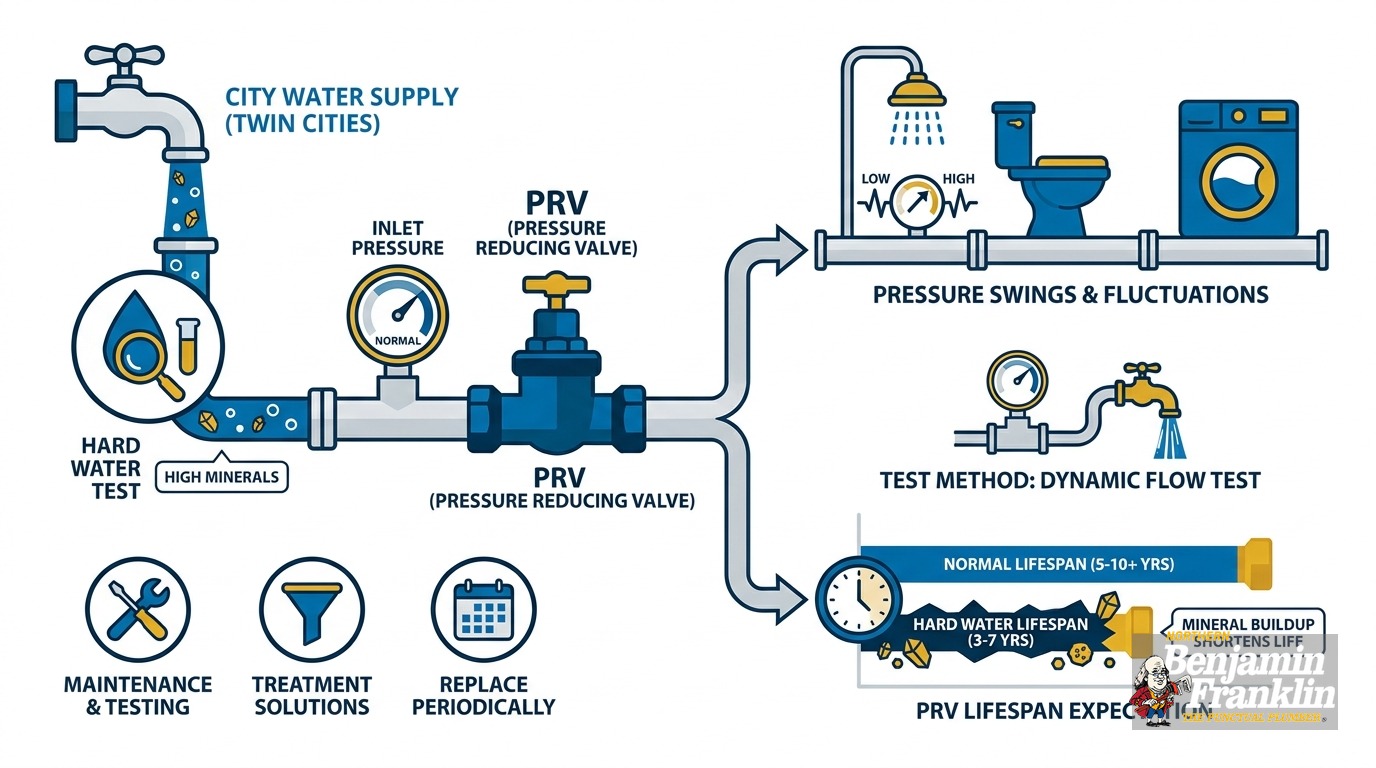
The valve has three main working parts: a spring, a rubber diaphragm, and an adjustment screw. Street pressure pushes against the diaphragm. The spring holds it back. The balance between the two sets your downstream pressure. When mineral deposits scale the internal spring and make it stiff, or when scale tears the diaphragm, that balance breaks.
Your home’s downstream pressure should run between 50 and 70 PSI. Below 50 PSI, fixture flow suffers noticeably. Above 80 PSI, supply lines, appliance hoses, and fixture seats are under sustained stress every hour of every day.
A failed PRV does not just pass high pressure through. It can also allow pressure to creep upward slowly, lock at a wrong setting, or swing between too-high and too-low as the worn spring responds unevenly to flow changes. Any of those failure modes will show up on a gauge test before they destroy an appliance.
What Are the Signs That a PRV Is Failing?
The symptoms of a failing PRV often look like other plumbing problems. Running toilets, early appliance failures, and banging pipes can all trace back to uncontrolled pressure - not to the fixtures themselves.
A failed PRV masks itself well. Watch for these:
- A brand-new toilet flapper that still runs. Pressure above 80 PSI can push water past a new flapper. Many homeowners replace the flapper two or three times before anyone checks the pressure.
- Supply line failures on appliances. Washing machine hoses, dishwasher inlets, and ice-maker lines that fail earlier than expected are often driven by high pressure, not the appliance itself.
- Water hammer. A sharp bang when a fixture closes fast is a pressure surge rattling supply lines against framing. It is not always a PRV problem, but when it shows up alongside high static pressure, the valve is the likely cause.
- Wildly variable pressure by location. Strong pressure at one fixture and weak flow at another can indicate a spring that has seized at an uneven position.
- Pressure spikes from the water heater. On a closed system, a failed PRV diaphragm and water-heater thermal expansion work together to push pressure past safe limits. More on this below.
If you can match two or more of these symptoms to what you are seeing right now, run the overnight gauge test before chasing anything else.
How Do You Run the Overnight Gauge Test?
Thread a $10-15 pressure gauge onto a hose bib. Read the static pressure (normal: 50-70 PSI). Leave the gauge overnight and check the reading in the morning. Pressure that rises while the house is asleep is the textbook sign of a failed PRV diaphragm.
The overnight gauge test is the most reliable diagnostic a homeowner can run without professional tools. Here is the procedure:
- Buy a standard pressure gauge at any hardware store. It threads onto a standard hose bib. Expect to pay $10-15.
- Screw the gauge onto an outdoor hose bib or a laundry room bib. Open the valve fully.
- Note the static pressure. Normal is 50-70 PSI. Above 80 PSI is a problem on its own, regardless of what happens overnight.
- Run a fixture briefly - flush the toilet or open a faucet - then close it. Watch the gauge needle. A spike above the static reading is a warning.
- Leave the gauge in place overnight. Do not run any water.
- Check the gauge in the morning. If the pressure has risen above where it was at bedtime, that is pressure creep. A working PRV holds pressure flat when nothing is moving. A failed diaphragm bleeds street pressure through slowly. The overnight window gives that bleed enough time to show on the dial.
One caveat for Twin Cities homes with both a PRV and a backflow preventer: overnight pressure creep can also come from water-heater thermal expansion in a closed system. If you are not certain which is causing the rise, that is exactly the situation to hand to a plumber rather than guess at. Acting on the wrong diagnosis replaces the wrong component.
How Long Should a PRV Last in the Twin Cities?
Standard PRV lifespan is 7-15 years. Twin Cities water hardness, especially in Saint Paul and groundwater-served suburbs, sits well above the levels that trigger accelerated mineral scale buildup inside the valve body.
Here is what the local water data shows:
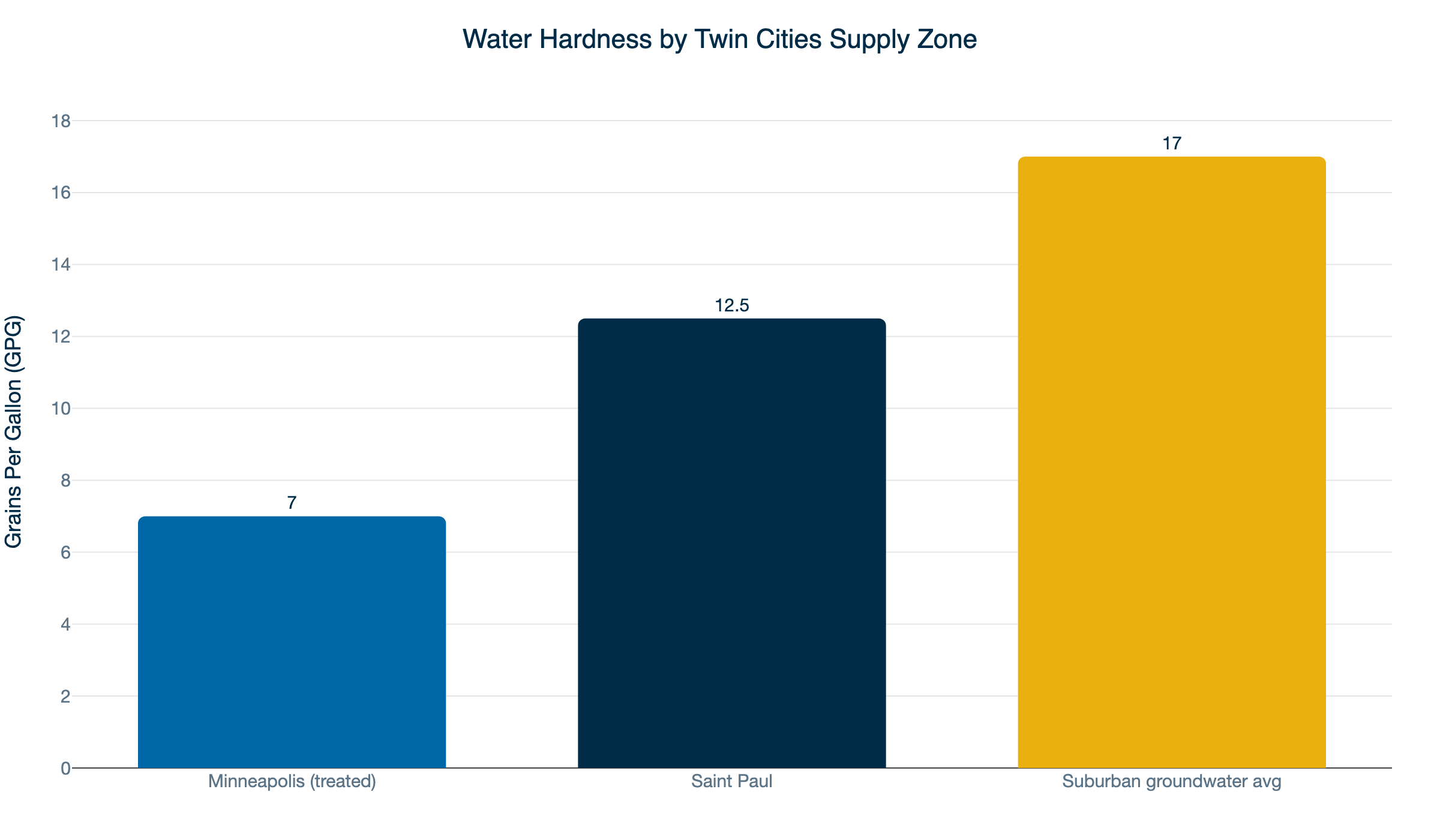
- Minneapolis (treated municipal water): 120 ppm / 7 GPG. Classified slightly hard, drawn from the Mississippi River and treated by the city. The finished water is relatively forgiving, but the raw source runs at 280.5 ppm / 16.4 GPG - “quite hard” - and treatment does not remove all mineral content.
- Saint Paul: 213 ppm / 12.5 GPG. Classified very hard, treated at the McCarrons Water Treatment Plant from a chain of Mississippi watershed lakes. Water softeners are specifically recommended for Saint Paul homes.
- Groundwater-served suburbs - Burnsville, Apple Valley, Shakopee, Maple Grove, and others depending on their water utility - run 270-320 ppm / 15-19 GPG. That is dramatically harder than Minneapolis proper and pushes into the range where equipment wear becomes a real annual budget item.
Hard water shortens PRV life by depositing mineral scale inside the valve body. Scale stiffens the internal spring. Scale tears the rubber diaphragm prematurely. A valve that would last 12 years in soft water can fail at 8 or 9 years in a Saint Paul home on city supply - and earlier than that in a suburb drawing from a hard-water aquifer.
Practical rule: if you have no service record for your PRV, treat its age as unknown. Any PRV more than 10 years old in the Twin Cities metro deserves a gauge test. Any PRV more than 15 years old should be replaced on schedule, regardless of what the gauge shows. The cost of proactive replacement is a fraction of the cost of chasing the supply line failures and appliance damage that a failed valve causes downstream.
Our post on water hardness in Minneapolis and Saint Paul covers how grains per gallon maps to real wear across plumbing equipment.
The Closed-System Connection: How a Failing PRV Can Spike Your Water Heater Pressure
Most newer Twin Cities construction includes both a PRV and a backflow preventer. Those two devices together create a closed system. Water flows in from the main but cannot flow back toward the street. That closed loop creates a pressure problem that most national guides miss entirely.
When your water heater heats water, the water expands. In an open system, that small volume of expansion bleeds back slightly toward the main. In a closed system, it has nowhere to go. Pressure inside your plumbing rises with every heating cycle.
A working PRV absorbs part of that variation. A failed PRV diaphragm cannot. The result is pressure spikes that stress supply lines and appliance connections - driven entirely by the water heater’s normal operation, not by street pressure coming through. This is a failure mode specific to closed systems, and it does not appear in any of the generic online guides.
Minnesota code requires a thermal expansion tank on any closed system to absorb expansion pressure before it can spike. The tank holds a cushion of air against a bladder. When we replace a PRV, we also check the expansion tank’s precharge. If the tank has lost its air charge, it is not doing its job. Replacing the valve without checking the tank leaves half the pressure problem in place.
Our post on high water pressure, PRVs, and expansion tanks covers the full closed-system interaction in detail.
Does PRV Replacement Require a Permit in Minnesota?
Yes. PRV replacement is plumbing work under Chapter 326B. A permit must be obtained from the authority having jurisdiction before work begins, and the work must be performed by a Minnesota-licensed plumber.
This is one area where DIY content written for other states simply does not apply here. Minnesota requires a permit before any PRV work starts, issued by the DLI or a delegated city or county authority. The work must be done by a Minnesota-licensed plumber. That is state law under Chapter 326B, not a suggestion.
There are technical reasons the requirement exists. Pressure reducing valve replacement involves:
- Shutting off the main water supply and draining the system
- Cutting and refitting supply lines at the entry point
- Installing the new valve and setting downstream pressure with calibrated gauges
- Inspecting the expansion tank and backflow preventer while the system is open
- Restoring water and pressure-testing all connections before closing up
A valve set too low starves fixtures and appliances of adequate flow. A valve set too high protects nothing. Getting the pressure setting right requires calibrated gauges and knowledge of local street pressure on that specific block. The permit process also protects the homeowner at resale. Unlicensed plumbing work can complicate homeowner’s insurance claims and home sales inspections in ways that are expensive to unwind.
Hiring a licensed plumber for pressure reducing valve replacement is not a bureaucratic extra in Minnesota. It is the law, and it protects your home.
How Freeze Risk Accelerates PRV Failure in Minnesota
This factor does not appear in any of the national guides on PRV lifespan. It is specific to Minnesota and to the older housing stock that makes up much of the Twin Cities.
A PRV installed in an unconditioned crawlspace or near an exterior wall faces Minnesota’s 42-inch frost depth every winter. A partially-frozen PRV body can crack. A seizing valve body, when it thaws, leaves internal components misaligned. Pressure control after a freeze-thaw event becomes erratic - or stops entirely. This is not a slow creep failure. It is a sudden high-pressure event that stresses everything downstream in a single morning.
If your PRV is in a cold location, check these things before winter:
- Is the pipe insulation on the supply line and valve body complete, with no gaps at couplings or fittings?
- Has any frost or condensation appeared on the valve body during cold snaps? That indicates the space is dropping to temperatures where damage is possible.
- Has the PRV been gauge-tested since last spring? Freeze-damaged valves frequently show pressure creep only after the seasonal thaw.
Our post on pipe insulation for exterior walls and freeze risk covers the full approach for supply lines in cold, poorly-conditioned spaces.
When Should You Call for Pressure Reducing Valve Replacement?
Call when the overnight gauge test shows pressure creep, when static pressure reads above 80 PSI, or when the PRV is 10 or more years old with no service record. In Saint Paul and groundwater-served suburbs, assume the lower end of the lifespan range.
Here is the decision framework:
Replace now:
- Overnight gauge test confirms pressure creep
- Static pressure reads above 80 PSI
- PRV is 15 or more years old
- Recent unexplained appliance supply line failures, chronic toilet running after flapper replacement, or new water hammer
Inspect and monitor:
- PRV is 10-14 years old, pressure is at the high end of normal (70-79 PSI)
- Home is in Saint Paul or a hard-water suburb with no service record on the valve
Add to the list while we are here:
- If we are replacing a water heater, clearing a main sewer line, or repiping a section, ask us to test the PRV pressure while the system is open. Ten minutes of gauge testing gives you a definitive picture at no extra trip cost.
What Happens During Professional Pressure Reducing Valve Replacement?
A licensed plumber shuts off the main, removes the old valve, installs and calibrates the new one, and inspects the expansion tank - all with a permit on file before work begins. Most replacements take one to three hours.
Here is what a standard pressure reducing valve replacement looks like:
- Shut off the main water supply and release pressure from the system.
- Cut out the old PRV. Replace any corroded unions or fittings at the same time.
- Install the new valve at the correct size and pressure rating for the home and meter size.
- Set downstream pressure to 50-65 PSI, confirmed with a calibrated gauge at a downstream fixture.
- Check the expansion tank precharge and inspect the backflow preventer while the system is open.
- Restore water supply and run a full pressure test at all connections.
- Confirm the permit is on file with the relevant authority before leaving.
Older Twin Cities homes with galvanized supply lines near the meter often present additional work at this stage. Corroded unions can add time, and in some cases the supply line section adjacent to the new PRV is corroded enough to merit replacement at the same time. That is something we assess before starting, not a surprise at the end.
Northern Benjamin Franklin Plumbing is locally owned and operated in the Twin Cities. When you call, you reach a team that works in Minneapolis, Saint Paul, Blaine, Maple Grove, and across the metro every day. We know what the water hardness is in your neighborhood, and we know what that means for every piece of plumbing in your home.
We back every appointment with the On-Time Guarantee(R). We arrive in the window you book. If there is any delay, it’s you we pay!
If your gauge test came back high, your PRV is past the 10-year mark with no service record, or you are seeing symptoms that point to a pressure problem, call us at (763) 296-1844 or book a plumbing repair appointment online. We will test the pressure, check the expansion tank, and replace the valve with the permit handled before we start.
Frequently Asked Questions
How do I know if my pressure reducing valve is failing? +
How long does a pressure reducing valve last in the Twin Cities? +
Does PRV replacement require a permit in Minnesota? +
What pressure should my home run at after PRV replacement? +
Need a technician now?