
Pipe Insulation Freeze Prevention for Minnesota Homes
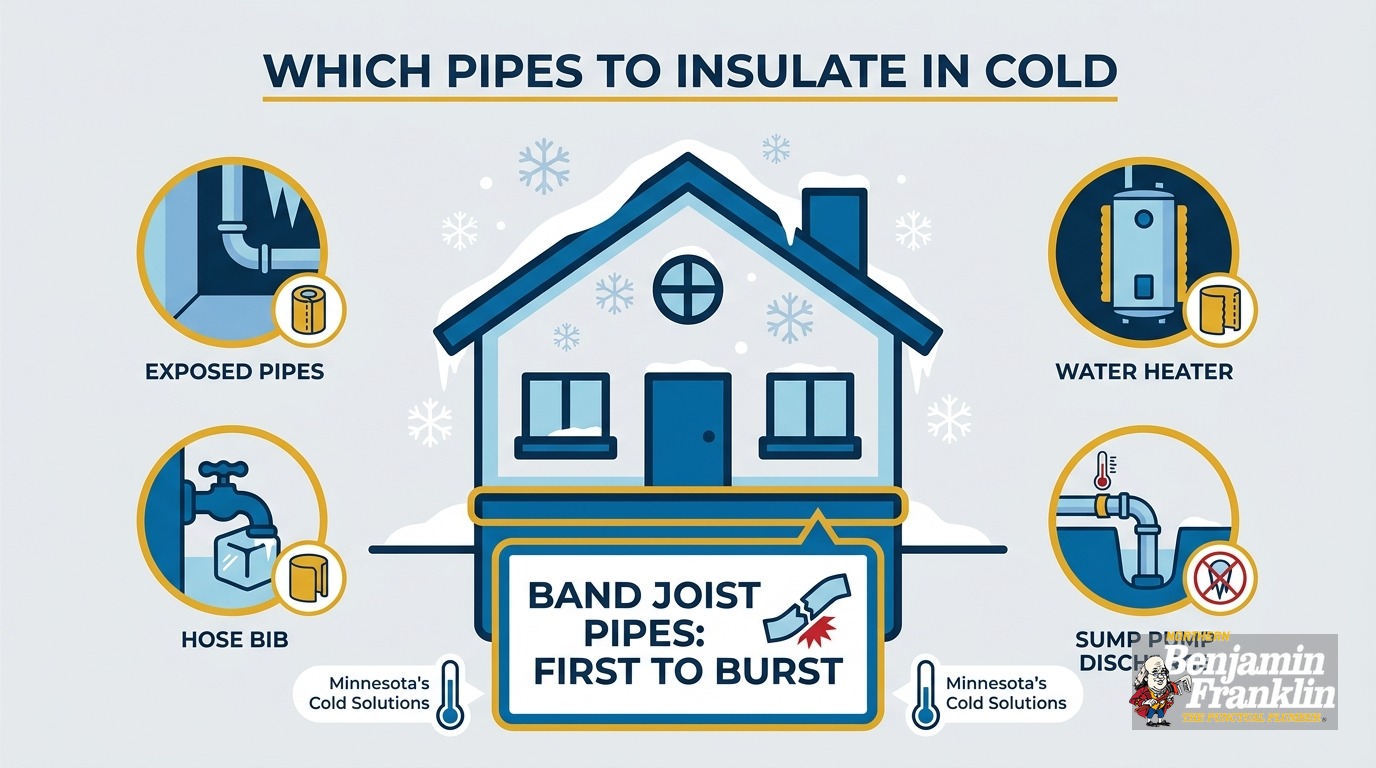
Key Takeaways
- Band joist pipes are the highest-risk location in pre-1980s Twin Cities homes. Outside air sits directly against them, with no thermal barrier between the framing and the pipe.
- The 20°F threshold is the trigger. Pipes become vulnerable when sustained outdoor temperatures drop below 20°F. The Twin Cities averages 22 days per year below 0°F, based on 1991-2020 climate data.
- Foam sleeve insulation works in conditioned spaces. In permanently cold cavities, no passive insulation holds pipe temperature on its own.
- Self-regulating heat cable is the correct product when a pipe lives in an unheated space and relocation is not practical.
- Pipes burst after the thaw, not during freezing. Pressure builds between an ice plug and a closed faucet as ice melts. The failure arrives hours after the cold snap breaks.
- Minnesota code requires buried supply lines at least 12 inches below frost depth, per MN Rules 4714.0609. The Twin Cities frost depth is 5 feet.
- Homeowners insurance can hinge on maintaining minimum heat. Negligence in keeping the home warm can reduce or void a burst pipe claim.
Why Do Band Joist Pipes Freeze First?
In most pre-1980s homes, the band joist zone has no air barrier between the exterior framing and the pipe. Cold air moves through gaps and sits directly against it. That makes the band joist an effectively outdoor cavity, regardless of how warm the rest of the basement runs.
The band joist - also called the rim joist - sits on top of your foundation wall. It closes the gap where the sill plate meets the floor framing. In houses built before modern energy codes, contractors routed supply lines through this zone because it was accessible. Insulation was supposed to come later. In many homes, it never did.
First Call Restoration describes the zone clearly: the framing band where the foundation meets the floor is “often poorly sealed. Cold air moves through gaps and sits directly against pipes running through that space.” For a house in Minneapolis or Blaine, where overnight lows can hold below zero for days, that direct contact is enough to freeze copper or plastic within hours.
The other factor is visibility. Homeowners rarely look at the band joist unless they are finishing a basement or doing a major remodel. Air gaps stay open. Insulation stays absent. The pipe spends every winter exposed.
What makes the band joist different from a pipe behind a finished exterior wall is the direct air path. In a framed wall, the pipe sits behind sheathing, a stud cavity, and whatever insulation fills it. The band joist in an older home may have none of that separation.
What Makes Older Twin Cities Homes More Vulnerable?
Many Minneapolis and St. Paul homes were built before modern energy codes required insulation in exterior walls, basements, attics, and crawlspaces. Unless a homeowner has updated those areas, the original framing cavities are still in place - and the pipes inside them are still at risk.
The Twin Cities housing stock skews old. A large share of homes in Minneapolis, St. Paul, and the first-ring suburbs date to before 1980. In that era, builders were not designing around frost protection the way current code requires. The result is a significant portion of the metro with original plumbing in locations that were never meant to be permanent pipe routes.
Calldeans.com notes that many Minneapolis homes built before the 1980s may lack sufficient insulation in exterior walls, basements, attics, and crawlspaces, unless updated by the homeowner. Sky Blue Home Inspections observes that in older homes, outdated plumbing, less wall insulation, and drafty framing make exterior wall pipes especially vulnerable.
Our team at Northern Benjamin Franklin Plumbing is locally owned and operated in the Twin Cities. We work in these older homes year-round. The pattern repeats: a burst pipe in January, an uninsulated band joist, and a repair that would have cost far less in October.
Which Zones Carry the Highest Pipe Freeze Risk?
Band joist pipes are highest risk, followed by pipes in unheated attics, pipes in exterior wall cavities, and pipes adjacent to an unheated garage. Each zone fails for a different reason and requires a different fix.
Here is the freeze risk hierarchy for a typical Twin Cities home built before 1980:
1. Band joist pipes. No thermal buffer. Direct contact with outdoor air. A supply line running through an uninsulated, unsealed band joist in a 1962 Minneapolis home is, in practical terms, an outdoor pipe.
2. Unheated attic supply lines. Attic air in a Minnesota winter can drop to outdoor temperatures. A Philadelphia Insurance Companies analysis of 433 burst pipe claims identified unheated attics as the most common location for frozen and burst pipes. If supply lines were routed through an attic during a remodel or addition, they need evaluation.
3. Exterior wall cavities. Supply lines in poorly insulated exterior walls lose heat to the surrounding cavity. In an older home with no blown-in insulation, those walls can get cold enough to freeze a copper line during an extended cold snap.
4. Garage-adjacent pipes. An attached garage can reach near-outdoor temperatures when the door is left open or the space is unheated. Any supply line passing through a wall shared with the garage is in the exposure zone.
What Pipe Insulation Freeze Prevention Products Actually Work in Minnesota?
Foam pipe sleeves work well in spaces that stay above freezing. Fiberglass wrap is unreliable in damp environments because it absorbs moisture and loses R-value when wet. In permanently cold cavities, no passive insulation holds pipe temperature on its own, and self-regulating heat cable is the correct product.
Three products dominate the Twin Cities residential market for pipe protection. Here is where each one belongs and where each one falls short.
Foam pipe sleeves
Pre-slit polyethylene or polyurethane tubes that slide over a pipe and tape at the seam. In a conditioned space - a finished basement, a utility room that stays above 40°F - foam sleeves slow heat loss significantly. They are affordable, easy to install, and the right starting point for pipes that already share heat with the home.
The limitation is that foam is passive. It holds the pipe’s existing heat. Once the surrounding air is cold long enough to strip that heat, the pipe temperature falls anyway. In a permanently cold space, foam just slows the process.
Fiberglass wrap
Sometimes applied to band joist pipes or crawlspace runs. The problem in a Minnesota basement is moisture. Fiberglass absorbs humidity and loses insulating value when wet. If your basement or crawlspace has any history of moisture - common in older Twin Cities homes - fiberglass can end up providing almost no protection by the time a cold snap arrives.
Air sealing first, then insulation
Before any insulation goes on, the right first step in the band joist is air sealing. Calldeans.com recommends pest-resistant foam, caulk, and weatherstripping to close gaps in the band joist before adding insulation layers. Air sealing stops cold air movement. Insulation holds temperature. Doing only the second step is why band joist pipes keep freezing even after a homeowner installs foam sleeves.
Frost-proof hose bibs
A frost-free exterior hose bib eliminates one common freeze point by placing the valve seat inside the conditioned wall. Water drains back into the line when you shut it off, so no standing water is left exposed. Our post on spring hose bib leak checks covers how these work and what to inspect each spring.
When Should You Use Heat Cable Instead of Insulation?
When a pipe lives in a permanently cold space, self-regulating heat cable is the correct answer. Insulation can only hold existing heat. A pipe in an unheated band joist, crawlspace, or attic run has no heat source to hold, so foam alone cannot protect it.
Self-regulating heat cable wraps around the pipe and adjusts its output based on the surrounding temperature. When it gets colder, the cable produces more heat. When the space warms, it backs off automatically. This self-regulation makes it efficient to leave running for extended periods and far safer than a fixed-wattage cable.
Installation has three requirements: cable runs along the pipe, foam insulation goes over the cable, and a GFCI outlet must be within reach. Without foam over the cable, you heat the surrounding air instead of the pipe. Without a GFCI outlet, the installation is code-incomplete. If your band joist zone has no nearby outlet, adding one is part of the job.
Heat cable is not a substitute for relocating a pipe or conditioning a space that could realistically share heat with the home. Use it when a pipe is in a zone that will stay cold and moving it is not practical.
How Deep Does Minnesota Code Require Your Water Line?
MN Rules 4714.0609 requires supply and yard piping at least 12 inches below the maximum local frost depth. The Twin Cities frost depth is 5 feet. A compliant buried service line in Hennepin or Ramsey County sits at a minimum of roughly 5 feet 1 inch below grade.
The code language is direct: “Building supply and yard piping shall be located not less than 12 inches (305 mm) below the maximum local frost depth.” The frost depth for the Twin Cities metro is set at 5 feet under the Minnesota State Building Code, based on the DLI frost depth map.
For context, the International Plumbing Code requires exterior supply piping “not less than 6 inches below the frost line and not less than 12 inches below grade.” Minnesota’s standard is more specific and applies an additional protective margin.
If you are purchasing an older Twin Cities home, a camera inspection of the service line confirms whether it was installed at code depth. Lines run shallower than code - common in homes predating current requirements - are worth knowing about before the first hard winter. Our team can schedule that inspection and give you a direct answer on the line’s current condition.
Why Do Pipes Burst After the Thaw, Not During?
A pipe does not split at the coldest point of a cold snap. Ice plugs form and block water movement. As the plug melts, pressure builds between the ice and a closed faucet or fixture. That pressure spike is what fails the pipe, often hours after outdoor temperatures have already risen.
The sequence that leads to a burst:
- Sustained temperatures below 20°F cause water to freeze at the coldest point in the pipe, typically near the band joist or an exterior wall cavity.
- The ice plug forms. At this stage, the pipe itself usually holds. Copper and PEX have enough flex to accommodate the expansion.
- Temperatures rise. The plug begins melting from the outside in.
- Water between the melting plug and a closed fixture has nowhere to go.
- Pressure builds. The pipe wall fails at its weakest point.
- The pipe bursts.
This mechanism is part of why State Farm processed more than 20,000 frozen pipe claims totaling over $628 million from 2024 through June 2025. Many of those events followed the thaw, not the coldest night of the cold snap.
The practical implication: when a major cold snap is ending, open cabinet doors under exterior-wall sinks, keep interior heat consistent, and watch for wet spots or soft drywall in the day or two after temperatures climb. A pipe that froze but has not yet burst can sometimes be thawed safely if caught in time. Once it splits, the repair is more involved.
If you suspect a frozen pipe, call before it becomes a burst one. Our team handles burst and frozen pipe repair across the Twin Cities metro, with same-day service available.
What Should You Do for Pipe Insulation Freeze Prevention Before Winter?
Seal air gaps in the band joist, add insulation in conditioned spaces, install heat cable on any pipe in a permanently cold cavity, and locate your main water shutoff before you need it under pressure.
The list is short, but the order matters:
1. Walk your band joist. Get a flashlight into the basement and look at the zone where the foundation wall meets the floor framing. Uninsulated pipes and open gaps are your first priority. Seal with pest-resistant foam, then add pipe insulation over the sealed surface.
2. Check your attic. If supply lines were run through an unheated attic during a remodel or addition, trace them. Add foam sleeve insulation plus self-regulating heat cable on any section that does not share heat with the living space.
3. Locate your main water shutoff. If a pipe bursts, cutting the water in the first few seconds limits the damage significantly. Know where the shutoff is, test it, and confirm it closes fully. Our guide to finding and testing your main water shutoff valve walks through this step in detail.
4. Maintain heat while traveling. Set your thermostat to a minimum of 55°F when you are away. Homeowners insurance may not cover burst pipe damage if the home was left unheated. According to First Call Restoration, coverage can be reduced or voided where negligence in maintaining home temperature is shown.
5. Treat 20°F as your action threshold. When a forecast holds below 20°F for more than a few hours, band joist and attic pipes are at active risk. Check your insulation before that day arrives, not during it.
6. Review your full winterization checklist. For a complete walkthrough of pre-season steps, see our winterizing your plumbing guide for Twin Cities homeowners.
When to Call Northern Benjamin Franklin Plumbing
You do not need to be certain something is wrong before calling. If you have an older home, have not inspected the band joist, or noticed reduced pressure on a cold morning, those are all worth a call.
Northern Benjamin Franklin Plumbing is locally owned and operated in the Twin Cities. We serve Minneapolis, St. Paul, Blaine, Bloomington, Brooklyn Park, Coon Rapids, Maple Grove, and the surrounding metro. When we schedule a visit, we arrive in the window we give you. The On-Time Guarantee(R) backs every appointment: if we are late, we pay you $5 per minute, up to $300. “If there is any delay, it’s you we pay!”
For frozen or burst pipes, same-day service is available. For a pre-winter pipe insulation inspection or a service line camera check, book a scheduled visit at a time that works for you.
Pipe insulation freeze prevention in Minnesota is worth doing in October, before the first hard freeze. It costs far less than a water damage claim in January.
Call (763) 296-1844 or book online.
Frequently Asked Questions
Which pipes freeze first in a Minnesota home? +
Does foam pipe insulation alone prevent freezing in Minnesota? +
How deep does a water line need to be buried in Minnesota? +
Need a technician now?