
Where Is My Main Water Shut Off Valve? Fall Drill Guide
Key Takeaways
- Where is my main water shut off valve? For most Twin Cities homes, it is in the basement near the front wall, on the same side as your water meter.
- Minnesota’s Twin Cities metro frost depth is 42 inches. Your supply line is buried below that. The pipes in your interior walls are not.
- Gate valves corrode and seize, especially in hard-water areas of the metro. A gate valve forced past its limit can permanently lose the ability to close.
- The curb stop at the street is a backup shutoff. In most Minnesota municipalities, you own it and are responsible for maintaining it.
- Test your main shutoff valve at least twice a year. The fall test belongs in October, before the first sustained cold sets in.
- A problem discovered during this drill is an October problem. Solvable, on your schedule. The same problem during a burst pipe at 2 a.m. in January is a crisis.
Why October Is the Right Month for This Drill
A burst pipe does not give you time to search. It gives you maybe forty seconds to think clearly, at 2 a.m., in January, after the temperature has been below zero for a week straight. That is why you do this drill in October.
Minnesota winters are not a single cold night followed by a thaw. They are sustained multi-week cold events. The Twin Cities metro frost depth is 42 inches, and code requires water service lines to be buried below that to stay out of the freeze zone. The pipes inside your walls have no such protection. They are exposed to whatever temperature the house drops to when a cabinet is left open or a heater cycles off for too long.
December is when sustained cold locks in for the season. By then, the window to prepare has closed. The ground is frozen, the curb stop may be inaccessible under ice, and any repair now happens under pressure and on the coldest possible timeline.
October is the window. The ground is still workable. Outdoor faucets have not yet gone through a freeze cycle that could already have damaged them. If you find a problem during the drill, you have days or weeks to fix it on your own schedule. That is the entire case for doing it now.
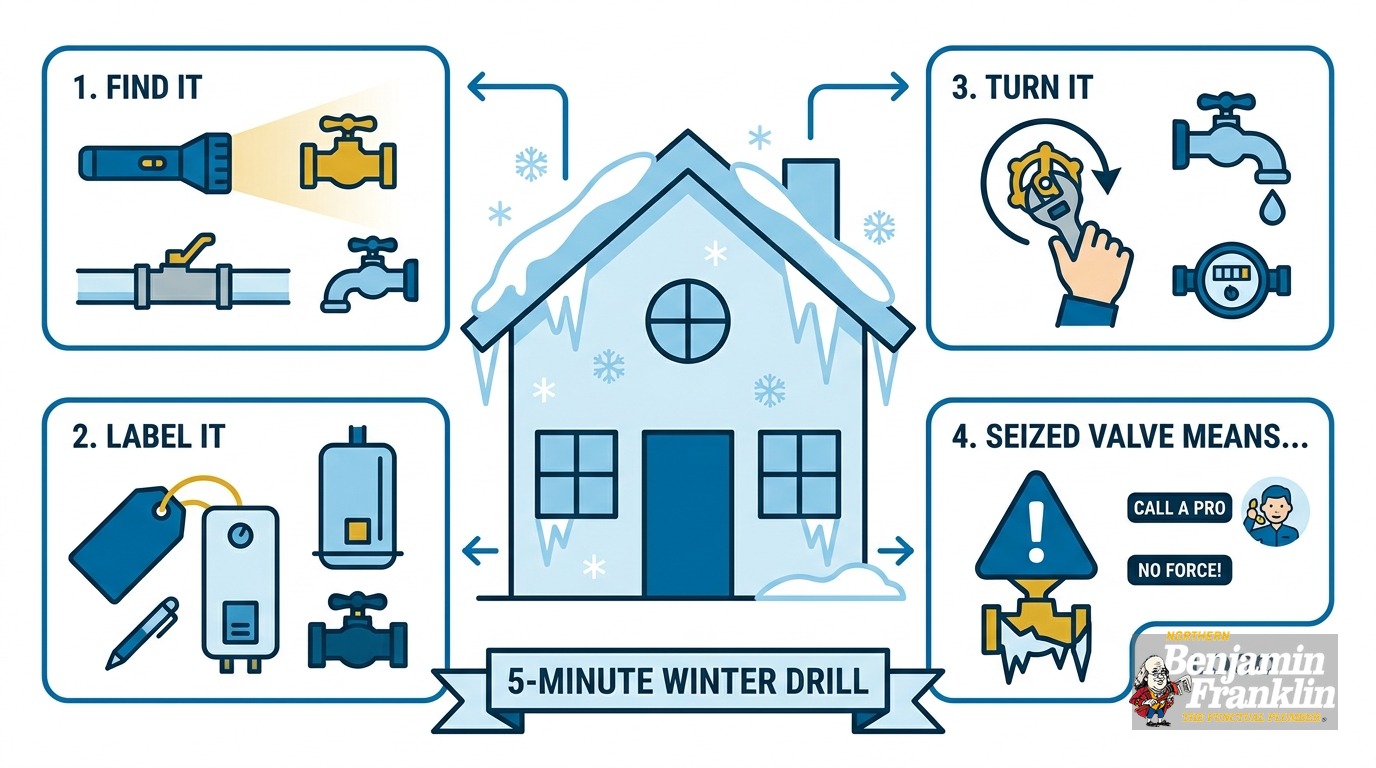
The drill has four steps and one bonus check. Together, they take about five minutes.
Where Is My Main Water Shut Off Valve?
Your main water shut off valve is almost always in the basement, near the front wall of the house, on the same side as your water meter. Look for the pipe entering through the foundation wall or through the concrete floor. The shutoff typically sits within a few feet of that entry point.
If you cannot find it that way, use this trick from home inspectors: stand at your front outdoor faucet and note the exterior wall it sits on. Go directly to the lowest level of the house and move inward from that same wall. The valve is almost always within a few feet of that line.
Homes without a full basement follow a slightly different pattern. In a crawl space home, the shutoff is often near the crawl space access or the foundation entry. In a slab home, check the utility closet near the water heater or mechanical room. In a condo or townhome, look in the utility closet or under the kitchen sink. If none of those lead you to it, your original inspection report should have the location noted.
Once you find the valve, identify the type before you touch it.
Gate valves have a round hand wheel with spokes, similar to a small steering wheel. Closing requires turning the wheel clockwise through multiple full turns until it stops. Gate valves are the older standard. Many Twin Cities homes built before the 1990s still have them at the main shutoff. The threaded brass stem inside corrodes over time and accumulates mineral scale with every passing season, especially in hard-water areas.
Ball valves have a single lever handle. One quarter-turn of the lever, from parallel with the pipe to perpendicular, stops water completely. They are the current standard for new construction and replacement work. They are simpler to operate under stress, faster to close, and far less prone to seizing.
If your home has a gate valve that has not been exercised in several years, read the seized valve section below before you do anything else.
Step 2: Label It and Tell Your Household
Knowing the location yourself is only half the job. A plumbing emergency does not wait for the most prepared person in the house to be home.
Mark the valve clearly. Wrap a strip of bright tape around the pipe and write on it in permanent marker: “MAIN WATER SHUTOFF.” Walk every adult in the household to the valve and show them how to operate it. For a gate valve: clockwise to close, counterclockwise to fully reopen. For a ball valve: quarter-turn lever to close, return to open.
Take a photo of the valve location on your phone and share it with one trusted person outside your household: a neighbor, a family member, or your property manager. If you are ever unreachable during an emergency and someone needs to shut off the water, that photo is worth a lot.
Clear the space around the valve while you are there. Storage bins, seasonal boxes, and dehumidifiers migrate toward the back wall of a basement over years. Emergency shutoff access should never be blocked by anything.
If you live alone or travel frequently for work, write the valve location on a note taped inside your electrical panel cover. Emergency plumbers and first responders check there.
What Should I Do When I Test the Valve?
Turn it toward closed, then reopen it fully. For a gate valve, rotate the hand wheel clockwise several turns, then counterclockwise back to fully open. For a ball valve, turn the lever a quarter-turn to the closed position, then return it to open. Complete this test each fall and each spring.
The physical exercise loosens early-stage mineral scale before it can harden into a permanent bond. In Minnesota, this matters more than in many other parts of the country. South St. Paul municipal water measures 18 grains of hardness, or 307 parts per million, which the city itself describes as relatively high. Many metro-area suburbs draw from comparably hard sources. That mineral load settles on metal surfaces, including gate valve stems, every time water flows through the system.
Exercising the valve at least twice a year is the standard recommendation to keep it operational: once in October before sustained cold, once in spring after the ground thaws. Mark both on your calendar now.
When you test the valve, pay attention to how it feels. A gate valve should offer clear, steady resistance as you turn. A ball valve should move firmly and smoothly through the quarter-turn. If either requires unusual force, feels gummy, or sticks at any point in the motion, stop there and read the next section before applying more pressure.
After the test, open a nearby faucet briefly to confirm water is flowing normally. This confirms the valve reopened completely.
What Happens If My Main Water Shut Off Valve Won’t Turn?
Stop immediately and do not apply more force. A seized gate valve forced past what the corroded stem will give can snap the internal stem, leaving the handle spinning freely with no ability to close. At that point, the only way to stop water to the house is the curb stop at the street or an emergency call to the utility.
Here is why gate valves seize. The threaded brass stem travels through the valve body as you turn the wheel. It is in constant contact with the water supply and every mineral dissolved in it. Over years, corrosion builds on the threads. Hard water deposits calcium and magnesium carbonate. Where dissimilar metals meet at the connections, galvanic corrosion compounds the process. Years of disuse allow all of those layers to harden into a rigid bond. The result is a valve that cannot be turned regardless of how much force is applied, or one that gives just far enough to snap the stem.
If you find a seized valve, stop and call a licensed plumber. This is not a job for penetrating oil and a pipe wrench. The right fix is a full valve replacement, and the replacement is almost always a ball valve.
Ball valves use a polished brass or stainless ball seated in PTFE (Teflon) rings. Mineral scale cannot bond to Teflon. Even after extended inactivity, a ball valve can be operated cleanly when it is needed. To replace a seized gate valve, your plumber will use the curb stop at the street to cut water to the house, swap the valve, and restore service. For most homes, that work is completed in a single visit.
A seized valve you find in October becomes a scheduled appointment. The same valve discovered during a burst pipe in the dead of winter is a different situation entirely.
For a broader look at what Minnesota winters do to the rest of your plumbing system, see our guide to preventing frozen pipes for Twin Cities homeowners.
Check the Fixture Shutoffs While You Are at It
While shutoff valves are on your mind, spend two more minutes on the smaller valves throughout the house. These are the shutoffs under each sink and behind each toilet. They seize for exactly the same reasons as the main shutoff, and they are the valves you reach for first when a specific fixture is leaking or needs service.
Toilet supply shutoffs are oval handles on the supply line coming out of the wall. Turn each one clockwise toward closed, then counterclockwise back to open. Note any that resist or feel corroded.
Under-sink angle stops control the hot and cold supply to each faucet. Same exercise: close, reopen, note anything that does not move freely.
A fixture shutoff that seizes during a repair turns a simple job into a bigger one fast. If the shutoff behind a leaking toilet supply line will not budge, the toilet cannot be isolated and the next shutoff up the line is the main. Knowing the condition of these valves before you need them is part of the same drill.
What Is the Curb Stop and Do I Own It?
The curb stop is a second water shutoff valve buried at the street, approximately 5 feet from the curb. In most Minnesota municipalities, you own it and are responsible for keeping it accessible and operable. It is reached through a small round cap set flush with the ground surface.
In Robbinsdale and most Twin Cities metro municipalities, that cap must be covered by no more than 3 inches of soil and must remain operable at all times. If a utility worker cannot operate your curb stop in an emergency, the cost to restore access falls on you. A licensed plumber handles that repair.
The curb stop matters in two situations.
First: your interior shutoff valve has seized or snapped and cannot stop water to the house. The curb stop is the only available backup before the utility’s main line.
Second: a frozen service line. The League of Minnesota Cities is clear that extreme cold is typically beyond a city’s control and is not grounds for city liability. If your service line freezes on the homeowner’s side of the curb stop, the thaw and repair cost falls on you. An accessible, operable curb stop means a repair crew can begin work immediately rather than waiting for utility dispatch.
As part of this fall drill, walk to the curb line in front of your property and locate the small cap. It may be set in the parkway grass, housed in a small concrete collar flush with the sidewalk, or buried under sod that has grown over it through the summer. Clear it. Note the location. Mark it if it is not obvious from the street. You may not use it for years. When you do need it, seconds matter.
Should I Also Check My Outdoor Faucets?
Yes. Outdoor faucets fail silently, and the damage does not show up until spring. Most modern Twin Cities homes have frost-free sillcocks, which place the shutoff point 8 to 12 inches inside the wall. They work correctly when the faucet is pitched slightly downward, allowing water to drain from the stem after shutoff.
When the pitch is wrong, or when a hose is left connected after the last use of the season, water stays trapped in the stem. It freezes. It expands. It ruptures the stem inside the wall, often with no external sign. The damage becomes visible in April or May, when the faucet is turned on for the first time and water pours into the wall cavity rather than out the spout.
For each outdoor faucet this fall:
- Turn it off at the handle.
- Disconnect any hose. A connected hose defeats the frost-free design by blocking drainage from the stem after shutoff.
- If there is an indoor shutoff valve for that faucet line, close it and briefly open the outdoor faucet to drain the remaining water from the stem.
If you are not sure whether your sillcocks are correctly pitched or have drained fully, it is worth checking during a fall plumbing inspection. For the complete fall plumbing checklist, see our 10 essential fall plumbing prep tips.
What If I Cannot Stop the Water at All?
Call 911. For water emergencies on nights, weekends, and holidays, most Twin Cities metro municipalities dispatch Public Works through 911. They can shut water at the utility main when both the interior shutoff and the curb stop are unavailable. South St. Paul Public Works uses this system, and most metro municipalities follow the same protocol.
Before that situation arises, save two numbers in your phone today: the non-emergency line for your municipality’s public works department, and the number for a licensed emergency plumber. While you wait for help, move valuables off the floor, place towels around the source, and turn off the electrical breaker serving any area where water is accumulating. This step takes about three minutes to set up now and saves time when every minute counts.
Schedule the Fix Before the Ground Freezes
Five minutes of preparation now versus hours of water damage later. The math is straightforward.
Find the main water shut off valve. Label it and walk your household through it. Test it and confirm it moves. Identify whether you have a gate valve that needs attention. Locate the curb stop and clear the cap. Check the outdoor faucets and confirm they drained.
Every step has a clear, actionable outcome. If any step surfaces a problem - a seized main shutoff, a corroded gate valve that should be replaced, an inaccessible curb stop, a frost-free sillcock that did not drain last fall - those are October problems. Scheduled, calm, and handled on your timeline before the ground freezes and the stakes rise.
Northern Benjamin Franklin Plumbing is locally owned and operated right here in the Twin Cities. We handle pre-winter plumbing inspections, gate-to-ball valve replacements, outdoor faucet winterization, and burst pipe repair when Minnesota winters take over. Our On-Time Guarantee(R) means we show up in the window you choose, or we pay you $5 for every minute we are late, up to $300. If there is any delay, it’s you we pay!
Call us at (763) 296-1844 or book online to schedule a pre-winter plumbing check before the ground freezes.
Frequently Asked Questions
Where is my main water shut off valve? +
What should I do if my main water shut off valve won't turn? +
Who owns and maintains the curb stop at the street? +
Need a technician now?