
Automatic Water Shutoff Valve Minnesota: Flo vs. Phyn
Key Takeaways
- A shutoff valve limits damage by closing the main line when flow looks wrong. It does not fix the leak.
- Flo’s freeze warning fires when the water inside the valve reaches 36 degrees. That is water temperature, not air temperature.
- Phyn Plus uses pressure wave analysis and an ultrasonic flow sensor. Its auto-shutoff starts working after a learning period that varies by home.
- Both devices cut into your main line. Phyn recommends a licensed plumber, and only licensed contractors can pull a Minnesota plumbing inspection permit.
- Both need Wi-Fi and power. A cabin or empty home that loses either one loses the alerts.
- For unexplained high water bills, check your meter and toilets first. Then pick a device that fits your pipe size.
- Neither device replaces insulation, heat, or fixing the cold spot that freezes your pipes.
The Short Answer
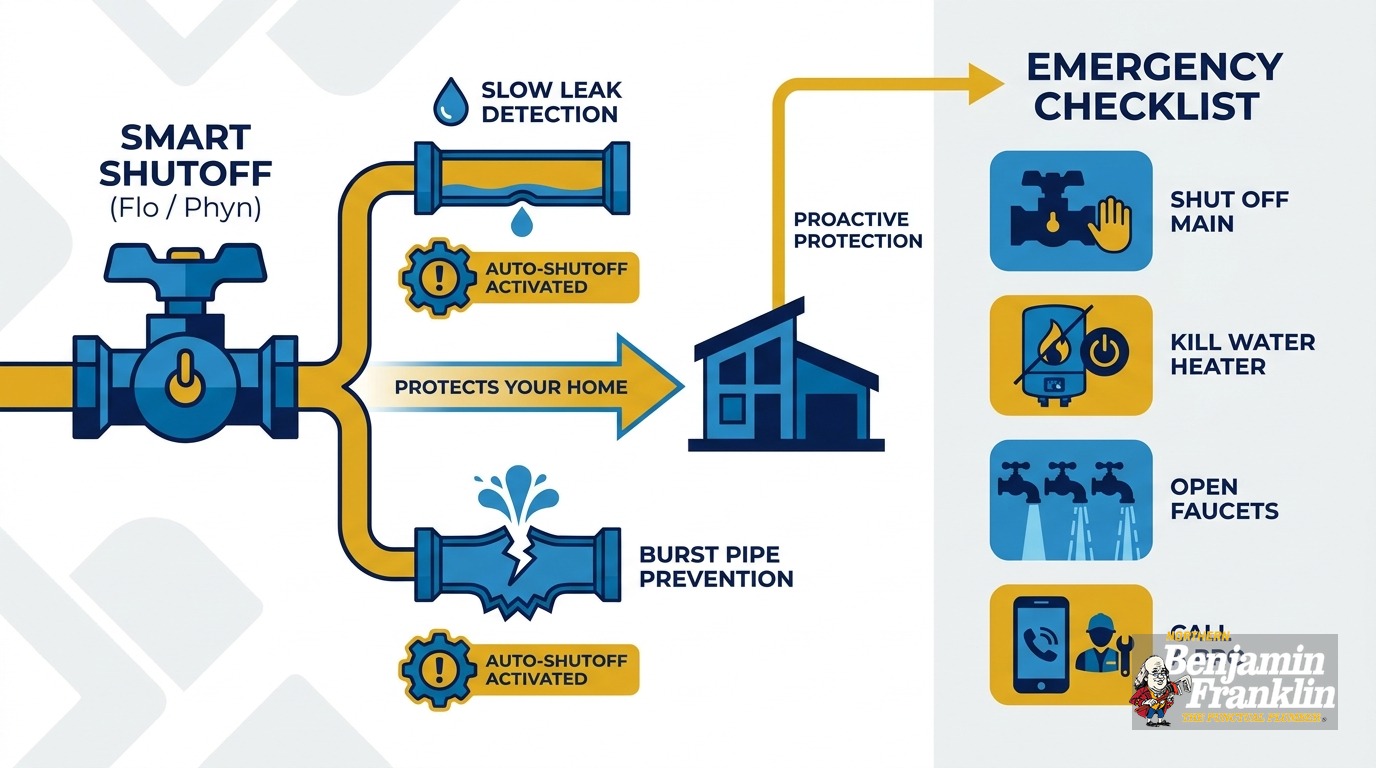
An automatic water shutoff valve watches the water entering your home. When the flow looks like a leak, it closes the main line and sends an alert to your phone. In a Minnesota winter, that matters most, because a burst pipe can flood a basement fast.
Two devices lead most shopping lists: Flo by Moen and Phyn Plus. Both install on the main line. Both need Wi-Fi. Both are only as good as the install and the power behind them.
We are Northern Benjamin Franklin Plumbing, a locally owned and operated plumbing company. We see the water damage these devices aim to prevent.
Why does an automatic shutoff valve help?
An automatic shutoff valve limits damage by acting faster than you can. It spots abnormal flow, closes the main line, and alerts your phone. Water stops entering the house even if you are at work, asleep, or out of town. That cuts the damage from a burst pipe or a failed supply line.
Most water damage starts small. A pinhole leak drips behind a wall. A supply hose weeps under a cabinet. By the time you see a stain, the drywall is already wet.
The EPA reports that the average household’s leaks can account for nearly 10,000 gallons of water wasted every year. You pay for that water, and you often never see it.
A shutoff valve helps in three ways:
- It limits the volume. A burst pipe keeps pouring until someone closes the main. The valve closes it for you.
- It shortens the delay. You learn about the problem from an alert, not from a stain on the ceiling.
- It reveals slow leaks. Many apps track usage, so odd patterns show up before they become damage.
It does not replace maintenance. It covers the gap between when a leak starts and when you notice.
Our existing guide on whole-house leak detectors and insurance questions covers the insurance side. This post looks at how the two big devices work and what Minnesota adds.
How does the valve get its signal?
The valve gets its signal from sensors built into the device. They measure flow, pressure, or water temperature inside the pipe. Software compares those readings to your home’s normal pattern. When something looks wrong, it closes a motorized valve and sends an alert over your home Wi-Fi.
Here is the sequence in plain terms:
- Sensing. The device sits on your main line, so all the water entering the house passes through it.
- Learning. It builds a picture of normal use: showers, laundry, sprinklers, the dishwasher.
- Comparing. Live readings are checked against that picture.
- Acting. If flow is abnormally high or constant, the valve closes.
- Alerting. Your phone gets a notice, and you decide when to reopen.
Phyn’s page says its auto-shutoff works after a learning period that varies by home. It triggers during “an abnormally high flow.” The page does not give the length of the learning period or the detection thresholds.
That gap matters. In the first days after install, the device is still learning, so don’t assume full protection on day one. Read the setup guide for your model and ask your installer what to expect.
The Wi-Fi link is the other half of the signal. If your network drops, the sensors may keep working locally, but you may not get the alert. Check how your model behaves offline before you buy.
How do Flo and Phyn Plus compare on leak detection?
Phyn Plus detects leaks with pressure wave analysis and an ultrasonic flow sensor. Flo’s best-documented feature is its freeze warning, which reads water temperature inside the valve. Both close the main line automatically. Neither page gives full detection thresholds, so ask for current spec sheets before you decide.
Phyn Plus. Phyn’s page describes “patented, high-definition pressure wave analysis” and an ultrasonic flow sensor with no moving parts. In simple terms, it listens for the tiny pressure changes that fixtures and leaks create. It also measures how much water moves.
The Phyn page lists these install facts:
- It fits a main line of 1 1/4” or smaller, with 1” NPSM male threaded ends.
- It may need a 1” NPS to NPT adapter. Those are two common pipe thread types.
- It needs Wi-Fi at the install spot.
- It needs a power outlet within 12 feet, and a GFCI outlet is recommended.
- It ships with a 12-foot power cord.
The same page lists Phyn Plus at $579.99 on sale and does not mention a subscription. That is the price of the unit, not an installed cost. Installation is a separate job.
Flo by Moen. The Flo detail we can confirm is the freeze warning, covered next. Moen’s main product page was not available to us when we researched this post, and we won’t repeat spec claims we could not verify. Check Moen’s current page for its flow-sensing method, learning period, and any paid plans.
One product roundup lists Flo pipe sizes of ¾”, 1”, and 1.25”. Model lists can conflict, so confirm your model against your actual pipe before you order.
The practical difference for you:
- Match the device to your main line size first. A great device that does not fit is useless.
- Compare how each handles freeze risk, because that is the Minnesota issue.
- Compare power and Wi-Fi needs against where your main line sits.
- Ask about ongoing fees before you buy, not after.
Neither device stops a pipe from failing. They limit the damage afterward.
What does a Minnesota winter change?
A Minnesota winter makes freeze alerts and cold-spot repairs the most important part of any shutoff valve decision. A burst pipe in January can release water for as long as the line stays open. A valve that warns you early, and shuts off on a major leak, can reduce the damage.
Start with how Flo’s alert works. Moen says its Freeze Warning fires when “the water inside the valve reaches 36 degrees.” The page states it is based on water temperature inside the valve, not air temperature.
That has a clear limit. The valve sits on your main line, often in a heated basement. A pipe in an exterior wall, a crawl space, or an unheated garage can freeze long before the water at the valve gets cold. The alert tells you the water at the valve is cold. It does not tell you which pipe is in trouble.
Phyn says it sends “pre-freeze warnings” but gives no temperature threshold on its page. Ask Phyn what triggers its warning before you rely on it.
Either way, a freeze alert tells you to act, and a repair still has to follow. To understand where freezing starts, read our guide on what temperature pipes freeze in Minnesota. If a wall pipe is the weak spot, see our post on insulating pipes in exterior walls.
Moen’s cold-snap tips on the same help page are simple and free:
- Let cold water drip from faucets on exposed pipes.
- Open kitchen and bathroom cabinet doors.
- Keep the thermostat the same day and night.
- Keep garage doors closed.
Those habits keep warm air moving around vulnerable pipes. They work with or without a smart valve.
If a pipe does freeze, don’t use an open flame or force anything. Our guides on how to tell if pipes are frozen and how to thaw frozen pipes safely walk through the safe steps. If a pipe has already burst, our team handles burst and frozen pipe repair.
Who can install an automatic shutoff valve in Minnesota?
A licensed plumber should install it. Both devices cut into your main water line. Phyn recommends a licensed plumber for that reason. In Minnesota, plumbing inspection permits must be requested by a licensed plumbing contractor, a licensed water conditioning contractor, or an authorized license holder doing the work.
Here is the permit language from the state. The Minnesota Department of Labor and Industry says permits must be requested by a “licensed plumbing contractor, licensed water conditioning contractor” or an “authorized license holder performing the work.”
We have not confirmed local rules for unlicensed homeowner work in every city. If you are thinking of doing it yourself, call your city’s building department first. A mistake on a main line can flood your house.
Phyn’s page says installation typically takes one to two hours. Several things can stretch that time:
- A stuck or failing main valve. Many older homes have a shutoff that has not moved in years.
- Pipe size mismatch. You may need an adapter or a different model.
- Distance to power. The outlet must be within 12 feet for Phyn.
- Poor Wi-Fi at the main line. Basements are often dead zones.
- Sprinkler systems. Phyn says standalone sprinkler lines are fine if the device goes in after the branch point.
A good install also checks the rest of the setup. We look at your main shutoff, your pressure, and the condition of the pipe on both sides of the device. If your pressure runs high, a valve can wear faster. Our guide on signs a pressure reducing valve is failing explains what to watch for.
Not every valve in your home is the same kind. A shower that turns scalding when a toilet flushes points to a different part entirely. We explain that in our post on why shower temperature swings when a toilet flushes.
What happens at a cabin or an empty home?
At a cabin or a home left empty, the device only protects you while it has power and Wi-Fi. Both devices need both. If either one fails in January, the alerts may stop and the home may be unprotected. This is our inference from the install requirements, not a claim from either product page.
Think through the failure chain:
- A winter storm cuts power to the home.
- The furnace may stop too, so the house cools.
- The Wi-Fi router loses power, so your alerts cannot reach you.
- Pipes can freeze while nobody is watching.
A smart valve does not break that chain on its own. It helps only if it has power, it closes in time, and you get the message.
If you leave a home empty in winter, add layers of protection:
- Ask a neighbor or property manager to check the house on a schedule.
- Confirm your router and valve return online after a power outage.
- Test the alert by triggering it on purpose.
- Keep the heat on at a safe setting.
- Consider a full shutdown and drain-down of the plumbing instead.
For seasonal homes, draining the system is often the safer plan. Our guide to winterizing a cabin or seasonal home covers the steps. A smart valve can add a layer, but it should not be your only one.
How do you choose a monitor when your water bill is unexplained?
Start by confirming a leak is real, then choose a device that fits your pipe, your Wi-Fi, and your power. A monitor can show where water goes. It cannot tell you about a bill error, a rate change, or a running toilet unless you check those yourself.
Step one: rule out the simple causes.
- Read your meter with every fixture off. If the dial moves, water is leaking somewhere. Our guide on reading your water meter to find hidden leaks shows how.
- Check toilets for a silent leak. A worn flapper is a common culprit. See our post on replacing a toilet flapper.
- Look at seasonal use. Our article on why summer water bills climb explains common causes.
Step two: check the fit.
- Measure your main line size. Phyn fits 1 1/4” or smaller. One roundup lists Flo sizes of ¾”, 1”, and 1.25”.
- Check for a fire sprinkler branch.
- Note where the outlet and Wi-Fi signal sit.
Step three: compare what matters to you.
- How it detects leaks and how long it takes to learn.
- What its freeze alert measures.
- What it costs to buy, and any monthly fees.
- What your insurer will recognize.
On insurance, we found no Minnesota rebate program for these valves. Discount numbers online come from third-party sites, and we could not verify them. Call your insurance company and ask what it accepts. Get the answer in writing.
Step four: consider a pro leak hunt. If the meter moves but you cannot find the leak, a monitor will only tell you it exists. Our leak detection service finds the source. For a leak behind a wall, see our guide on finding leaks behind walls in Minnesota.
A monitor suits you if you want ongoing protection. It is a poor way to solve a one-time bill mystery. Fix the leak first, then decide if you want the extra layer.
How do you turn a stuck water valve?
Do not force it. A stuck valve can snap or start leaking if you crank on it. Try a gentle back-and-forth motion by hand. If it will not move, stop and call a plumber. A valve that sticks is a good reason to replace it during a shutoff device install.
The install begins with closing your main. If the main will not close, the job cannot start safely. Find out before the plumber arrives.
Steps to try:
- Locate the main shutoff. Our guide on finding and testing your main water shutoff shows common spots.
- Turn the handle gently. Wiggle it slightly to break loose mineral buildup.
- Do not use a pipe wrench or a cheater bar for leverage. Heavy force can damage the stem.
- If it moves part way, work it back and forth a little at a time.
- If it will not move, or it drips at the stem, stop.
Older valves are the usual problem. Hard water leaves mineral buildup, and valves that never move tend to seize. Exercising your valves a couple of times a year helps keep them working.
Our post on what to do when a shutoff valve will not turn goes deeper. If a smaller fixture stop is the problem, see angle stop shutoff valve replacement.
What a shutoff valve cannot do
A shutoff valve is a safety net that limits damage after something fails. Knowing its limits helps you set the right expectations.
It cannot:
- Stop a leak that is too small to trip it. A slow drip may only show up as an app alert, if at all.
- Fix the cause. The pipe, hose, or fitting still needs repair.
- Protect you without power or Wi-Fi. Both devices need both.
- Replace insulation or heat. A freeze alert is a warning, not a fix.
- Cover water that never passes through the main. A sump pump failure or a sewer backup is a separate risk. See our posts on sump pump battery backup and telling a sewer backup from a clog.
The valve is one layer. Good plumbing, regular checks, and a quick response are the others.
Next steps with Northern Benjamin Franklin Plumbing
If you want an automatic shutoff valve, start with the basics. Know your pipe size, your Wi-Fi strength, and the condition of your main shutoff. Then have a licensed plumber confirm the fit and handle the install and permit.
We are locally owned and operated, and we serve homeowners across the Twin Cities. Our team can check your main line, test your shutoff, and tell you if your home is ready for a smart valve. We can also fix the pipe problems that a valve only warns you about.
We also respect your time. Our On-Time Guarantee(R) means we arrive in the window you pick. If we do not, we pay you $5 for every minute we are late, up to $300. As we put it: “If there is any delay, it’s you we pay!”
For bigger jobs, such as a main line replacement, ask us about financing.
Ready to protect your home? Call (763) 296-1844 or book online.
Frequently Asked Questions
Will an automatic shutoff valve work with a fire sprinkler system? +
How long does installation take? +
Is there a Minnesota rebate for an automatic shutoff valve? +
Need a technician now?