
Why Your Shower Gets Scalding Hot When the Toilet Flushes
Key Takeaways
- When the toilet flushes, it pulls a burst of cold water from the supply line. Cold-side pressure drops in your shower. A worn pressure-balancing cartridge cannot compensate in time, and the mix turns dangerously hot.
- Many Twin Cities homes already have a pressure-balancing valve. What has failed is the cartridge inside it. That is a maintenance repair, not a new installation.
- Hard water accelerates cartridge wear. St. Paul groundwater is significantly harder than Minneapolis river water. Homes in harder-water areas often see cartridge failure in 8-12 years instead of the 15-25 year range expected with softer water.
- Homes built before the mid-1990s may have no pressure-balancing valve at all. The fix there is a full valve rough-in, not a cartridge swap.
- In the standard case, cartridge replacement does not require tile removal or wall access. It is a front-plate repair.
- Minnesota law requires a licensed plumber for shower valve work. This is not a legal DIY repair.
Why does your shower get scalding hot when the toilet flushes?
When the toilet flushes, it pulls cold water from the supply system. Cold-side pressure drops in your shower. A working pressure-balancing valve compensates in fractions of a second. A worn or missing valve cannot, and hot water surges through.
If you have ever stepped into a scalding rush of water the moment someone flushed a toilet down the hall, that is what happened. The toilet used cold water. Cold-side pressure dropped. The shower’s hot supply kept flowing at full strength. Without a functioning valve to rebalance the mix, the temperature spiked.
This is not a water heater problem. Your water heater did not get hotter. The pressure balance inside your shower valve broke down.
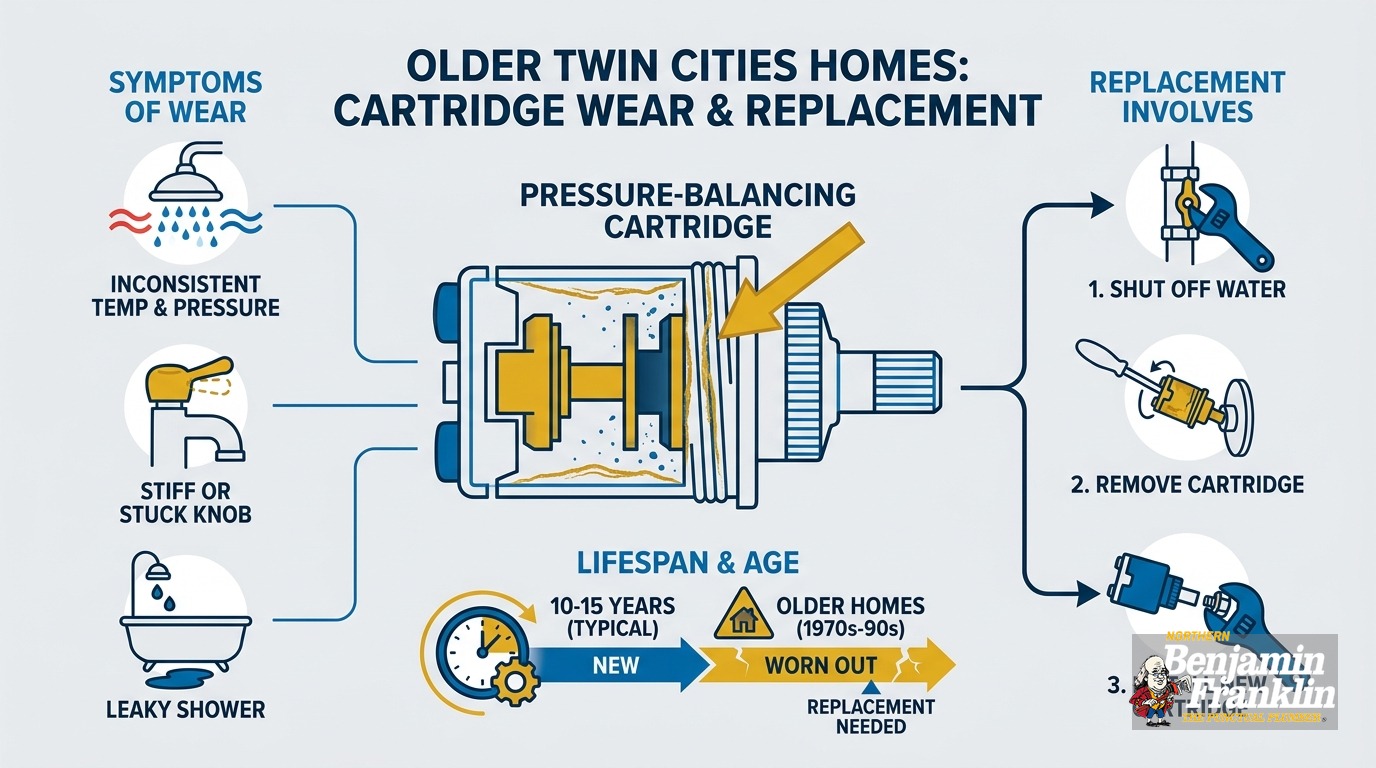
A healthy pressure-balancing valve corrects this automatically. The piston inside the valve senses the pressure difference between the hot and cold supply inlets. It shifts position to restrict whichever side has excess pressure, keeping the blend at a stable temperature. You should not feel the flush at all.
The problem begins when that piston stops moving freely. That is what a cartridge failure looks like. The valve body stays in the wall. The working component inside it wears out.
How a pressure-balancing valve works
A pressure-balancing valve uses a sliding piston to regulate the hot-cold ratio flowing to the showerhead. The piston lives inside a replaceable cartridge. When supply pressure shifts on either inlet, the piston slides to compensate. The temperature at the showerhead stays stable.
This is a mechanical response, not an electronic one. The piston reacts to pressure, not temperature. It does not lock in an exact temperature the way a thermostatic valve does. What it prevents is dangerous temperature spikes when supply pressure changes elsewhere in the house.
Minnesota Plumbing Code Chapter 4714 adopts the Uniform Plumbing Code with state-specific amendments. It requires showers and tub-shower combinations in new construction and substantial renovation to have a pressure-balancing or thermostatic mixing valve. The specific provision is MN Rules 4714.0408, which sets the scald protection standard for permitted shower work in Minnesota.
The cartridge is the serviceable component. It pulls out through the front of the valve body. The wall stays closed. The tile stays in place.
What goes wrong: the cartridge wears out
A cartridge holds rubber seals and a spring-loaded piston. Those components cycle every time pressure shifts anywhere in the house: a dishwasher starting, a washing machine filling, a toilet flushing, a hose bib opening outside. That is dozens of pressure events every day, for years.
Rubber degrades over time. Mineral deposits from hard water coat the inside of the cartridge housing. The piston that once moved freely now hesitates. Eventually it sticks.
When the piston cannot move to compensate for a cold-side pressure drop, the mix tilts hot and stays there. The valve fails to do its job. The shower temperature spikes.
Most articles about this problem frame it as “you need to install a pressure-balancing valve.” That framing misses most Twin Cities homeowners dealing with this symptom. If your home was built after the early 1990s, you almost certainly already have a pressure-balancing valve. What you may not have is a working cartridge inside it.
That distinction changes the repair entirely. A missing valve requires a full rough-in. A worn cartridge requires a replacement. The rough-in involves wall access and permits. The cartridge swap typically takes one to two hours with no demolition.
Does your home have a pressure-balancing valve at all?
If your home was built after the mid-1990s in Minnesota, it almost certainly has a pressure-balancing valve. If it was built earlier, you may not have one, and your plumber needs to confirm before a cartridge conversation makes any sense.
MN Statute 326B.43 establishes the State Plumbing Code and requires municipalities to permit and enforce plumbing work to its standards. The scald protection requirement applies to new construction and permitted renovation. Homes built or substantially updated after the code took effect should have a compliant valve.
Homes built before the code was in force are a different story. A 1960s or 1970s bungalow in Minneapolis or St. Paul may have the original two-handle shower, with one knob for hot and one for cold and no pressure-balancing protection at all. In that home, a toilet flush creates an uncontrolled temperature spike because there is nothing in the valve to stop it.
If you are not sure what type of valve your shower has, a plumber can identify it in minutes. A two-handle setup is a strong indicator that pressure-balancing protection is absent. Fixing that requires a rough-in and a permit. It is a more involved job, but it eliminates the problem for decades.
For homeowners already planning a renovation, this is a good time to address the valve type. We cover the plumbing decisions that come up during a remodel in our post on bathroom remodel plumbing: what to know.
Why do Twin Cities homes wear out cartridges faster?
Hard water deposits mineral scale inside cartridge housings, binding the piston and shortening its useful life. St. Paul groundwater is substantially harder than Minneapolis river water, and the difference shows in how long cartridges hold up.
Not all Twin Cities tap water is the same. That matters directly to cartridge lifespan.
Minneapolis draws its drinking water from the Mississippi River and treats it to soft-to-moderate hardness levels before distribution. The treated water going through Minneapolis plumbing carries a lighter mineral load.
St. Paul Regional Water Services draws from deep aquifer wells. Aquifer water in this region carries far more dissolved calcium and magnesium than surface water. St. Paul water commonly arrives in homes at 20-28+ grains per gallon, which sits in the very hard classification. That mineral content settles into valve housings over time. It coats the chamber walls, narrows the piston’s travel range, and adds friction with every cycle.
In softer water, a pressure-balancing cartridge in a major brand valve may last 15-25 years. In St. Paul-range hard water, expect closer to 8-12 years before symptoms surface. A Twin Cities home with a shower valve installed in the late 1990s that has never been serviced may be running on a cartridge well past its useful life.
The hard-water problem is not limited to St. Paul. Many suburbs drawing from aquifer sources deal with similarly high mineral content. If your fixtures leave white scale deposits around faucet aerators and drain openings, your cartridges are handling the same buildup internally.
Treating hard water at the source extends the life of every valve and fixture in the house. Our post on water hardness in Minneapolis and St. Paul breaks down what different source waters deliver. If scale buildup is a recurring problem throughout your home, water softener options for Twin Cities homeowners are worth a conversation.
What are the warning signs of a failing cartridge?
Temperature spikes when the toilet flushes are the clearest sign. A stiffening handle and inconsistent temperature even without other fixtures running are earlier warnings you should not ignore.
Watch for these symptoms:
- Scalding water on a flush. The defining sign. If the shower goes from comfortable to scalding during a toilet flush or dishwasher start, the balancing function has failed.
- Handle stiffness. A piston binding from scale or seal wear makes the handle harder to turn. Gradual stiffening over a year or two is the cartridge wearing down.
- Temperature drift without a clear cause. If water temperature wanders warm and cool on its own, even when no other fixture is running, the cartridge is not holding its position.
- Handle position no longer matches temperature. What used to be a comfortable setting now runs too hot or too cool. The piston is drifting past its calibrated range.
- Age plus water hardness. A single-handle valve that has been in service for 12 or more years in a hard-water area deserves a proactive check, even if the symptoms are still mild.
Scald risk is serious and well-documented. The U.S. Consumer Product Safety Commission has tracked this hazard for decades, citing approximately 3,800 tap water scald injuries treated in U.S. emergency rooms each year. Children under 5 and adults over 65 are at greatest risk. Both groups have thinner skin, which means a shorter gap between hot water contact and a serious burn.
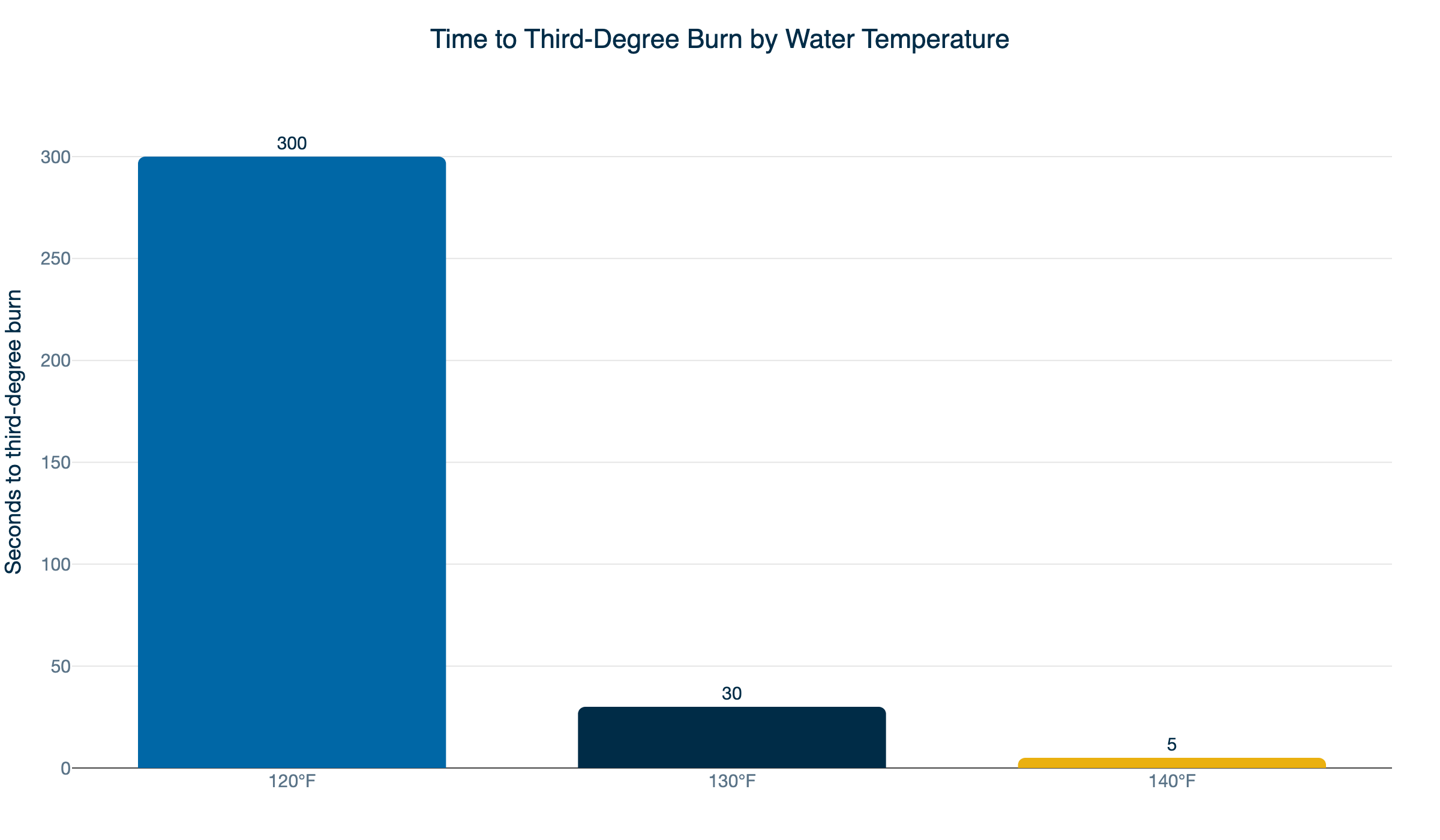
The numbers make the urgency concrete. Water at 120°F causes a third-degree burn in roughly 5 minutes of exposure. At 130°F, the window drops to 30 seconds. At 140°F, it takes about 5 seconds. A shower that swings uncontrolled toward those temperatures is a safety problem, and the risk compounds every day the cartridge is not replaced.
Is cartridge replacement a DIY job in Minnesota?
No. Minnesota requires a licensed plumber for shower valve work. Beyond the legal requirement, correct cartridge replacement demands exact part matching and precise installation. The consequences of getting it wrong include leaks inside the wall and worsened temperature instability.
MN Statute 326B.43 establishes the State Plumbing Code and requires plumbing work to be performed by a licensed plumber. Minnesota does not provide a homeowner exemption for shower valve cartridge repairs.
The technical demands justify that requirement. Pressure-balancing cartridges are not interchangeable across brands. A Moen cartridge does not fit a Delta valve. Within a brand, different valve models use different cartridges. Installing the wrong cartridge can cause the valve to leak, fail to seal, or make temperature instability worse than before.
Orientation matters too. On many valve designs, a cartridge installed upside-down reverses the hot and cold inlets. The repair looks finished. The shower runs backwards: full counterclockwise is scalding hot, full clockwise is cold. The fix is a second disassembly.
A licensed plumber identifies the valve manufacturer and model, sources the exact OEM replacement cartridge, removes the worn one cleanly without damaging the seat, installs the replacement at the correct orientation, and tests under live pressure before closing the trim. That sequence is the repair, done correctly the first time.
If the seat is corroded or the valve body is damaged, the plumber can also tell you before opening the wall whether this is a cartridge swap or a full valve replacement. That distinction determines the permit requirements and how long the job takes.
What does cartridge replacement actually involve?
In the standard case: handle off, cartridge out, new cartridge in, test under live pressure, trim reinstalled. No tile work. No wall access. Typically one to two hours.
Here is what the repair looks like step by step:
- Water shutoff. The supply to the shower is shut off, either at the main or at a dedicated shutoff behind an access panel.
- Trim removal. The handle and escutcheon plate come off the front of the valve. On a standard single-handle design, no tile has to be disturbed.
- Cartridge removal. The cartridge pulls out of the valve body, usually after removing a retaining clip. The plumber inspects the seat and housing for corrosion or damage.
- Replacement installation. The new cartridge goes in at the correct orientation, fully seated and secure.
- Pressure test. The water turns back on before the trim goes back. The plumber checks for leaks and confirms the temperature response is balanced.
- Trim reinstallation. Handle and plate go back on. The job is done.
A seat that is corroded or a valve body that is cracked may require wall access and a permit. Your plumber will tell you which scenario you’re in before the work starts, not after.
Cartridge condition is also a useful data point in older homes with aging plumbing overall. A shower valve installed in the 1990s is not the only component approaching end of service. Our post on how long home pipes last covers the typical lifespan of different pipe materials common in Twin Cities homes.
When is it time to call a plumber?
When the shower gets scalding hot during a toilet flush, call now. The temperature spike means the valve is not protecting you. Every flush is a pressure event the cartridge cannot handle, and every shower carries uncontrolled burn risk until it is fixed.
If the problem is active, do not wait. The cartridge will not improve on its own. The instability will not resolve.
One interim step worth taking: check your water heater setting. A heater set above 120°F means the shower can reach dangerous temperatures during a pressure drop even before the cartridge is fully gone. Dialing it back reduces the peak. It does not repair the cartridge. The temperature swings continue.
If your home was built before the 1990s and you have never had the shower valve type confirmed, schedule a plumber’s inspection even without active symptoms. A two-handle shower in a pre-code home has no pressure-balancing protection at all. Learning that before an injury happens is better than learning it after.
Northern Benjamin Franklin Plumbing is locally owned and operated, serving Minneapolis, St. Paul, Blaine, Bloomington, Brooklyn Park, Coon Rapids, Maple Grove, and communities across the Twin Cities metro. Every appointment is backed by our On-Time Guarantee(R). If there is any delay, it’s you we pay. To quote it exactly: “If there is any delay, it’s you we pay!”
Call (763) 296-1844 or book through our plumbing repair page. A worn shower cartridge is a one-visit repair. The scald risk it creates is not something to put off.
Frequently Asked Questions
Why does my shower get scalding hot when the toilet flushes? +
How long does a pressure-balancing cartridge last? +
Can I replace a shower cartridge myself in Minnesota? +
Will turning down my water heater fix the problem? +
Need a technician now?