
Anti-Scald Valve Installation Minnesota: The 140/120 Strategy
Key Takeaways
- Most Minnesota homeowners set their water heater to 120°F. That temperature sits inside the zone where Legionella bacteria grow.
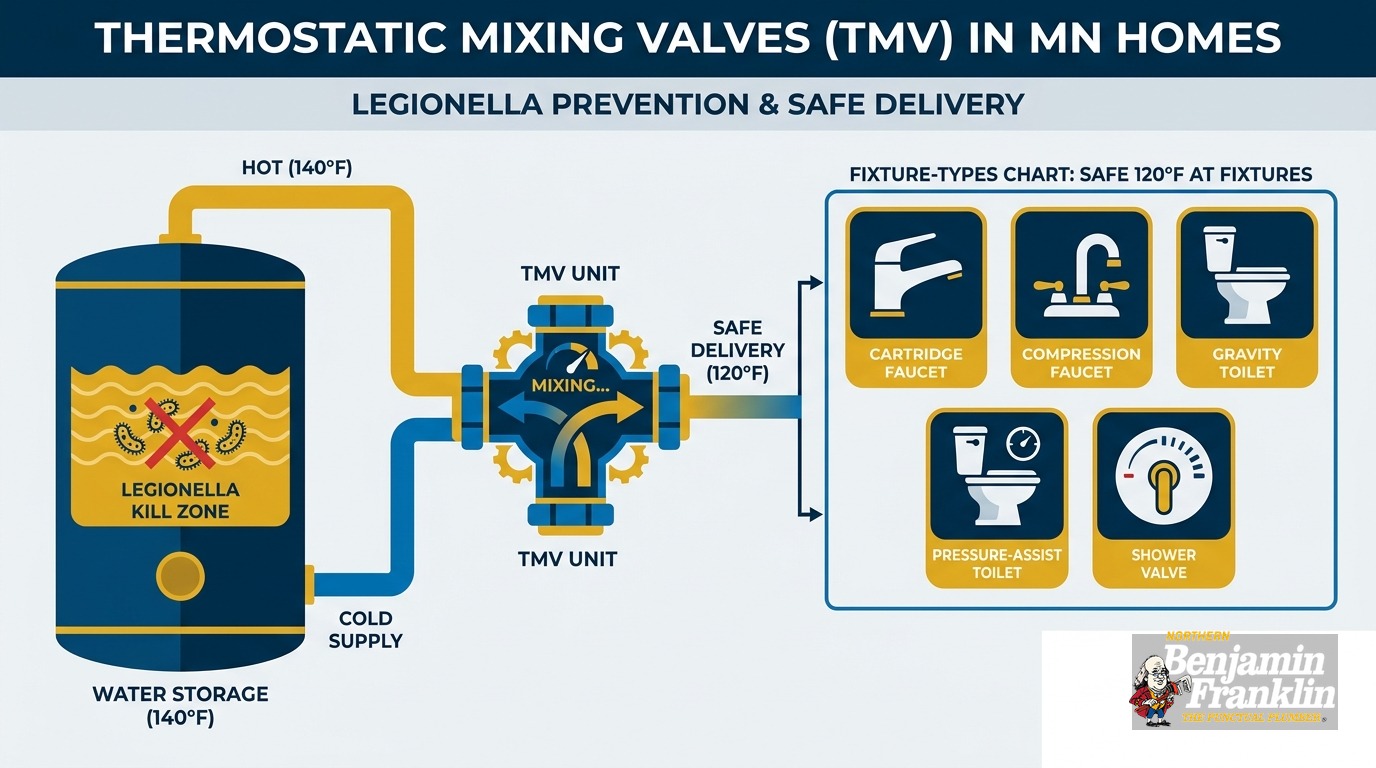
- The fix is the 140/120 strategy: store water at 140°F to inhibit Legionella, then use a thermostatic mixing valve (TMV) at the water heater outlet to deliver safe 120°F water to every fixture.
- Minnesota Plumbing Code, Minn. R. ch. 4715, requires ASSE 1016 or 1017-compliant anti-scald protection on all new shower and tub installations. A permitted bathroom remodel triggers the same requirement.
- Anti-scald valve installation in Minnesota requires a licensed plumber and a DLI permit. The DIY framing in national guides does not apply here.
- Twin Cities hard water deposits mineral scale on the TMV’s wax element. Plan on annual descaling.
- To schedule service, call Northern Benjamin Franklin Plumbing at (763) 296-1844 or book online.
The Problem Most Minnesota Homeowners Don’t Know They Have
Your water heater label recommends 120°F. Many plumbers repeat that number. Appliance guides and government pamphlets echo it. Most homeowners follow that advice and leave it there.
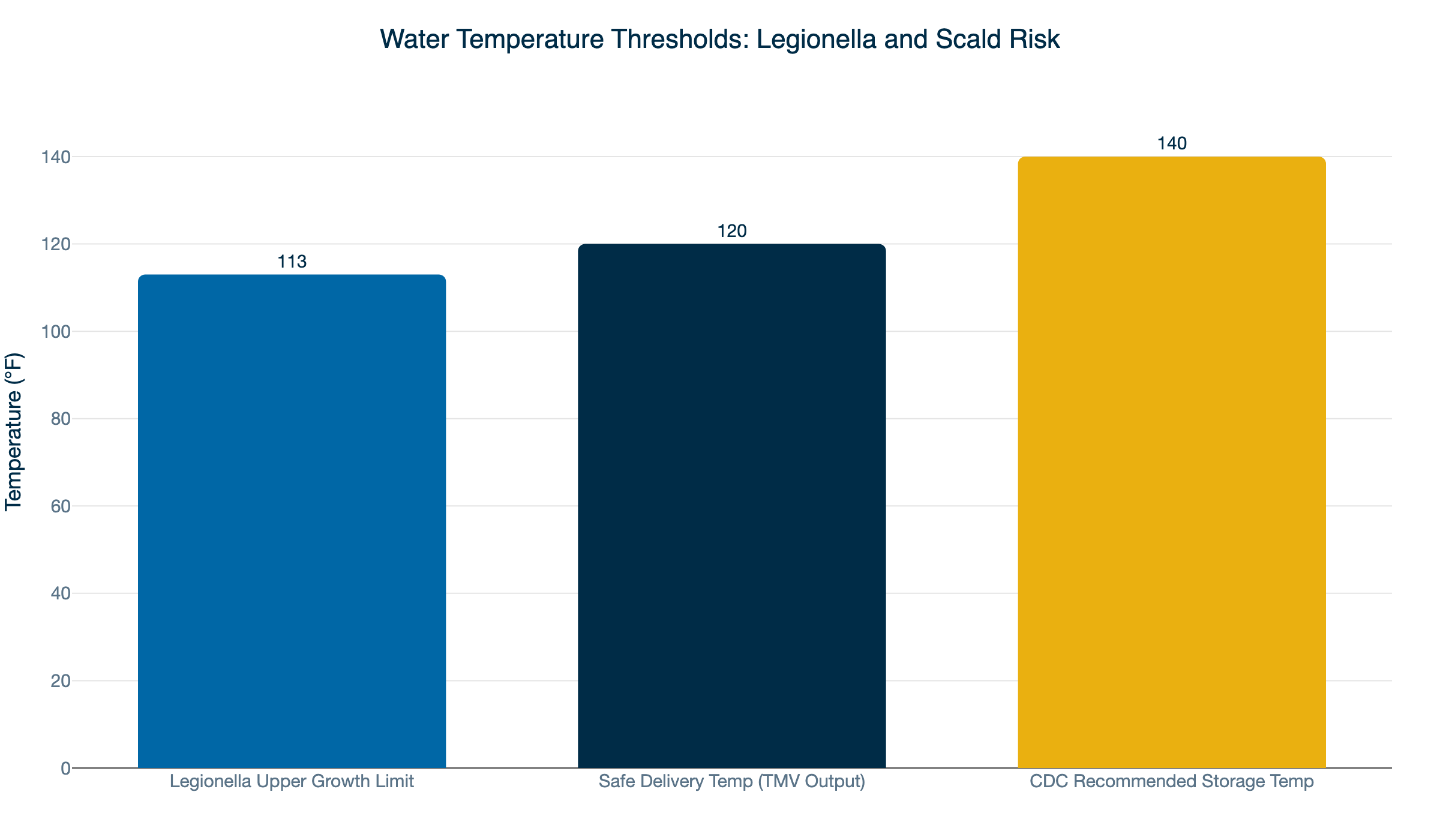
The problem is that 120°F sits near the top of the range where Legionella bacteria multiply fastest. The CDC recommends storing hot water above 140°F, not 120°F. Setting the tank to 120°F addresses scalding but leaves Legionella growth largely unaddressed. Most homeowners do not know that trade-off exists.
The label confusion is understandable. At 120°F, scalding risk is genuinely lower. The Consumer Product Safety Commission has historically pointed to that number as a safe setting. What that guidance does not fully resolve is the Legionella picture. Both concerns are legitimate. A thermostatic mixing valve solves both at once.
Anti-scald valve installation Minnesota homes need is not only about preventing burns. It is about resolving a conflict built into the system: the temperature that limits Legionella growth is high enough to scald, and the temperature safe enough to touch is warm enough for bacteria to thrive.
What Is a Thermostatic Mixing Valve?
A thermostatic mixing valve (TMV) is a device installed at the water heater outlet. It blends hot supply with cold water and delivers a steady, pre-set temperature to every fixture in your home. ASSE 1017-rated whole-house TMVs hold output within ±2 to 3°F of the set point under varying flow conditions.
A TMV is different from the pressure-balancing valve inside your shower handle. That valve, rated under ASSE 1016, reacts to sudden pressure changes at a single fixture. A whole-house TMV works upstream at the water heater. It controls temperature for the entire home from one location.
Both types of anti-scald protection have a role in Minnesota plumbing systems. The Minnesota DLI’s document on water temperature control valves addresses both ASSE 1016 (point-of-use) and ASSE 1017 (whole-house distribution) standards. This post focuses on the ASSE 1017 whole-house TMV at the water heater outlet. That is where the 140/120 strategy is applied.
There are additional ASSE standards worth knowing. ASSE 1070 covers under-sink point-of-use valves at vanity faucets. ASSE 1069 covers multi-head shower installations. If your home has a multi-head shower, a 1069-rated thermostatic valve controls all of them from one adjustment point.
Is Anti-Scald Valve Installation Required by Minnesota Code?
Yes. Minnesota Plumbing Code, Minn. R. ch. 4715, administered by the Minnesota Plumbing Board under the Department of Labor and Industry, requires ASSE 1016 or 1017-compliant anti-scald protection on all new shower and bathtub installations. A permitted bathroom remodel triggers the same requirement.
Existing homes that have not undergone a permitted remodel are not required to retrofit. But the code creates a natural entry point. If you are remodeling a bathroom, you need ASSE-compliant anti-scald protection on every new shower or tub. That is a logical moment to also address the whole-house TMV at the water heater.
Per the DLI’s published guidance, shower and tub anti-scald valves must comply with ASSE 1016/ASME A112.1016/CSA B125.16 or ASME A112.18.1/CSA B125.1. They must also provide scald and thermal shock protection at the rated flow rate of the installed showerhead. The ASSE certification is a hard requirement in Minnesota, not a recommendation.
On a broader scale, ANSI/ASHRAE Standard 188-2021 establishes minimum legionellosis risk management requirements for building water systems. It applies most often to commercial and institutional buildings. But the temperature thresholds it documents apply equally to residential systems.
For more on what a permitted bathroom remodel means for your plumbing, see our guide to bathroom remodel plumbing requirements.
The 140/120 Strategy Explained
The core tension in a water heater system is this: the temperature that kills dangerous bacteria is not a safe delivery temperature at the tap.
Legionella bacteria thrive between 77°F and 113°F and are inhibited above 140°F. The CDC is specific: “Store hot water at temperatures above 140°F (60°C). Ensure hot water in circulation doesn’t fall below 120°F (49°C).” The agency names engineering controls as the solution. These controls mix hot and cold water at or near the point of use. They allow the system to reduce scalding risk while keeping the supply hot enough to limit Legionella growth.
A thermostatic mixing valve is that engineering control.
Here is how the strategy works in a residential water heater system:
- Set your water heater to 140°F.
- Install an ASSE 1017-rated TMV at the water heater outlet.
- The valve blends 140°F supply with cold water and delivers 120°F throughout the house.
- Every fixture receives water at a safe, consistent temperature.
- The tank never drops into the Legionella growth zone.
The CDC’s Controlling Legionella hub notes that maintaining appropriate water temperature is the core strategy for controlling Legionella in building water systems. The 140/120 strategy implements that directly in a residential water heater.
There is a secondary benefit. Running the tank at 140°F lets you draw more usable hot water per tank before it runs cold. The tank holds the same volume. But more of it is hot enough to blend down to 120°F. This expands your effective capacity. The slightly higher energy cost to reach 140°F is partially offset by that expanded usable volume.
The Minnesota Department of Health notes that good maintenance strategies for water systems are the best approach to preventing Legionella infections. Temperature control is the foundation of that strategy. The MDH also tracks Legionellosis as a reportable disease in Minnesota. Most confirmed cases trace to large building water systems. But the bacterial conditions that enable growth can develop in any stagnant, warm residential supply held at 120°F.
For a deeper look at the Legionella risk tied to water heater temperature settings, see our post on water heater temperature and Legionella.
What Makes Twin Cities Homes Different?
Twin Cities water is moderately hard. Minneapolis municipal supply, drawn from the Mississippi River and treated at Fridley, runs approximately 160-200 mg/L hardness. St. Paul’s groundwater supply is harder. Mineral scale deposits on the TMV’s wax element over time. Annual descaling is standard maintenance here, not the multi-year interval most national installation guides suggest.
Most online content on TMV maintenance is written for soft-water regions. That schedule does not apply in Minneapolis or St. Paul. Mineral scale narrows the valve’s internal passages and coats the wax element that senses temperature. A fouled element cannot hold output temperature accurately. The valve drifts, sometimes too hot and sometimes too cold.
In a home with children or older adults, that drift is a safety issue, not a minor inconvenience. Annual descaling keeps the valve within its rated ±2 to 3°F tolerance. A licensed plumber can do it during any other scheduled service call.
For current hardness figures by municipality, see our post on Twin Cities water hardness in Minneapolis and St. Paul.
Minnesota’s older housing stock adds another factor. Many homes in south Minneapolis, St. Paul, and the inner-ring suburbs were built before 1970. They often have longer pipe runs through unconditioned spaces. Stagnant water held at 120°F in those runs sits in the Legionella growth zone for extended periods. The 140/120 strategy reduces that risk throughout the distribution system.
There is also a seasonal variable specific to Minnesota winters. Tap cold water in the Twin Cities can arrive at 38-44°F in deep winter. A TMV handles that range, but it means the valve is working at maximum blending duty from December through February. Verify your output temperature each season. If the tap runs hotter or cooler than expected after a cold snap, schedule a service call before the next hard freeze.
Does TMV Installation in Minnesota Require a Licensed Plumber?
Yes. Water heater modifications in Minnesota require a licensed master plumber, or a journeyman working under licensed supervision, and a plumbing permit issued by the DLI. Homeowners cannot pull their own plumbing permits for water heater work in Minnesota. This is not optional.
Most national content frames TMV installation as a 1-2 hour DIY project. That framing applies in states with different licensing structures. In Minnesota, performing water heater modifications without a license and permit is a violation of Minn. R. ch. 4715.
The permit requirement is not a formality. It ensures the installation is inspected and the valve is correctly set before the heater temperature is raised to 140°F. A TMV installed without inspection and set incorrectly delivers the wrong temperature. If the set point runs high, you have introduced a different scalding risk. If it runs low, the water stays in the Legionella growth zone.
Hiring a licensed plumber for anti-scald valve installation in Minnesota is both the safe approach and the legal one.
Who Is Most at Risk in Minnesota Homes?
Children under 5 and adults over 65 face the greatest scalding risk. Young skin burns at lower temperatures than adult skin. Older adults with reduced sensation from neuropathy, poor circulation, or medication side effects may not detect temperature spikes in time to pull away. Water at 140°F causes a full-thickness burn in under five seconds.
Minnesota’s suburban and exurban communities skew older than the national median in many areas. The aging-in-place trend across the Twin Cities metro is real. If your household includes older adults, anti-scald protection is a direct injury-prevention measure, not a luxury upgrade.
The Legionella risk is similarly age-weighted. The Minnesota Department of Health notes that adults over 50 and people with weakened immune systems face the highest risk of serious illness from Legionella exposure. A home water system running at 120°F with no TMV carries both the scald risk and the Legionella risk at the same time.
Anti-scald valve installation in Minnesota addresses both with one licensed, permitted installation.
What Does Anti-Scald Valve Installation Look Like in Minnesota?
A licensed plumber installs the ASSE 1017-rated TMV at the water heater outlet, connecting hot supply, a cold bypass, and a mixed output line. The output is set to 120°F. Then the thermostat is raised to 140°F. Multiple fixtures are verified at the correct temperature before the permit inspection is scheduled.
Here is the sequence:
- Pull the DLI plumbing permit before work begins.
- Shut off the water supply and release system pressure.
- Mount the TMV at the water heater outlet, connecting the hot inlet, cold bypass, and mixed output.
- Set the TMV mixing cartridge to the 120°F output target.
- Raise the water heater thermostat to 140°F.
- Restore supply and measure output temperature at multiple fixtures. Check the fixture farthest from the water heater.
- Schedule and pass the DLI inspection.
After the inspection clears, verify output temperature one more time under normal household load. A TMV calibrated at low flow may perform slightly differently at peak demand. The final check should happen with multiple fixtures running simultaneously. That is the real-world condition the valve needs to handle in a busy household.
Most homes benefit from a layered approach. The whole-house ASSE 1017 TMV handles distribution temperature. An ASSE 1016 pressure-balancing valve at each shower and tub handles sudden pressure changes at the fixture. Together, they address both failure modes that cause scalding.
If you are replacing a water heater at the same time, have the plumber add the TMV during the same service call. That is the most efficient time to do both. Xcel Energy and CenterPoint Energy both offer water heater rebates for qualifying equipment. The amounts and eligibility terms are those utilities’ own programs. Verify current details directly with each provider before factoring them into your decision.
For more on water heater service and replacement options, see our water heater services page.
How Does the ASSE 1017 Standard Differ from ASSE 1016?
ASSE 1016 covers point-of-use pressure-balancing valves, like the one inside your shower handle. ASSE 1017 covers whole-house thermostatic mixing valves installed at the water heater. Both appear in Minnesota Plumbing Code. Most homes need both: an ASSE 1017 TMV at the water heater and ASSE 1016 valves at individual shower and tub fixtures.
The distinction matters when you are planning a project. If a contractor addresses anti-scald risk with a new shower valve, that is ASSE 1016. It protects that fixture from pressure spikes. It does not change the delivery temperature for the rest of the house, and it does not address the Legionella picture.
If a contractor installs a whole-house TMV at the water heater outlet, that is ASSE 1017. It controls delivery temperature for every fixture and enables the 140°F storage strategy.
A complete installation covers both: ASSE 1017 at the water heater, ASSE 1016 at each shower and tub. This configuration satisfies both the water quality goal and the pressure-stability goal.
When Should You Schedule Anti-Scald Valve Installation in Minnesota?
The natural entry point is any permitted plumbing project. A water heater replacement, a bathroom remodel, or any permitted work near the water heater outlet is the right moment. If your home has no anti-scald protection and includes children or older adults, it is worth scheduling as a standalone project.
Specific triggers worth acting on:
- You are replacing a water heater and want to address Legionella and scald risk in one visit.
- You are remodeling a bathroom and a permit is required. Minnesota code requires ASSE-compliant protection on every new shower or tub fixture.
- Your shower runs unpredictably hot when another fixture starts running at the same time. That points to a failing pressure-balancing valve.
- Your water heater is set to 120°F and you are concerned about Legionella risk in a home with older adults or young children.
Older Twin Cities housing stock is a factor here as well. Many inner-ring suburbs, including Richfield, Columbia Heights, Fridley, and South St. Paul, have a high concentration of homes built before 1970. Those homes often have original plumbing that was never brought into compliance with modern anti-scald standards. A licensed plumber can assess what is in place and recommend the right upgrade path, whether that is an ASSE 1016 retrofit on existing shower controls, a whole-house ASSE 1017 TMV, or both.
Schedule Anti-Scald Valve Installation in Minnesota
Northern Benjamin Franklin Plumbing is locally owned and operated in the Twin Cities. Our licensed plumbers handle the permit, the installation, and the DLI inspection from one call. We serve Minneapolis, St. Paul, Blaine, Bloomington, Brooklyn Park, Coon Rapids, Maple Grove, and the rest of the metro.
We stand behind every job with the On-Time Guarantee(R). We arrive in the window you book. If there is any delay, it’s you we pay. Call (763) 296-1844 or book online to schedule your TMV installation or to ask whether your current setup is protecting your household.
Frequently Asked Questions
Does Minnesota require anti-scald valves? +
Can I install a thermostatic mixing valve myself in Minnesota? +
What temperature should I set my water heater at? +
How often should a TMV be descaled in the Twin Cities? +
Need a technician now?