
Water Heater Temperature Setting: 120 or 140°F?
Key Takeaways
- The 120 vs. 140 debate is a false binary. Tank temperature and tap temperature are two different variables.
- Minnesota Plumbing Code (MN Rules 4714) caps tub and shower delivery at 120°F maximum. A thermostat dial alone does not satisfy that requirement.
- A thermostatic mixing valve (TMV) solves both problems at once. Store at 140°F for Legionella control. Deliver 120°F at the tap for code compliance and scalding prevention.
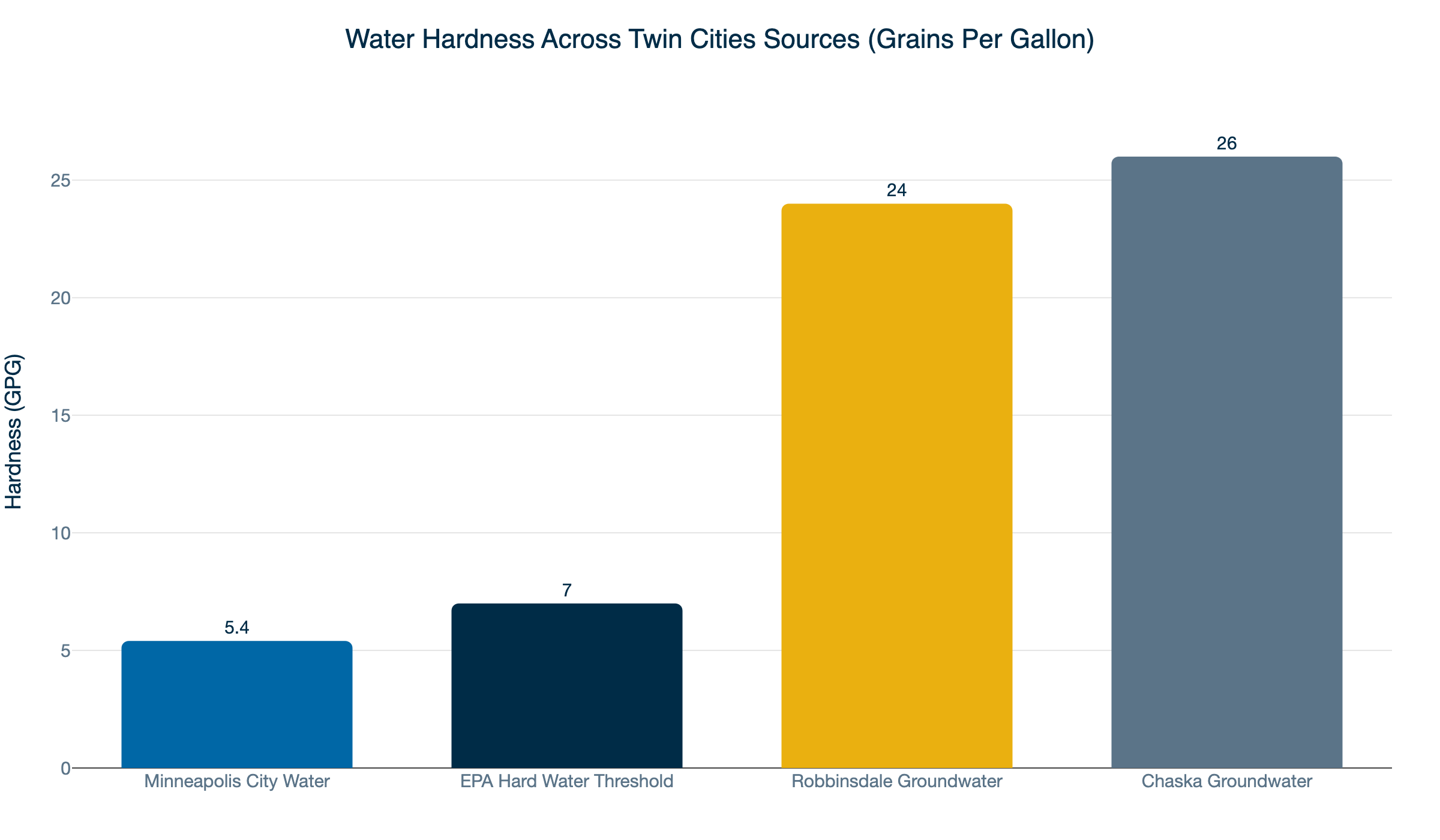
- Local water chemistry matters. Minneapolis city water has an elevated pH of 9.06 that accelerates scale at higher temperatures. Many suburbs draw groundwater at 20 to 26 grains per gallon.
- Dropping from 140°F to 120°F can cut standby heat loss by 4 to 22%, according to the U.S. Department of Energy - roughly $36 to $61 per year.
- Call Northern Benjamin Franklin Plumbing at (763) 296-1844 or book online to have a professional verify your setting and valve setup.
What Is the Right Water Heater Temperature Setting?
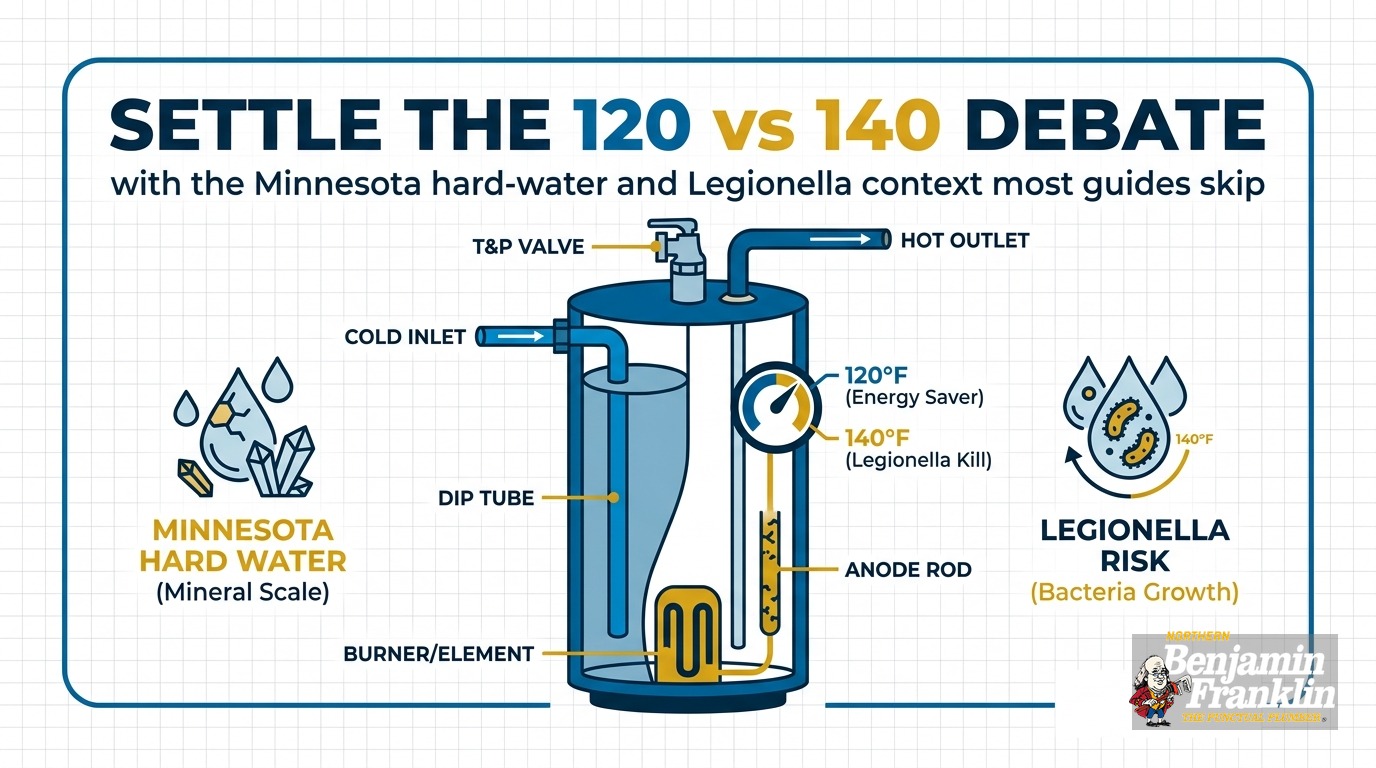
The right setting depends on three factors: your household’s health profile, Minnesota code requirements, and local water chemistry. For most households, 120°F is a sound default. Households with immunocompromised members or elevated Legionella concern may benefit from storing at 140°F, paired with a thermostatic mixing valve that brings tap delivery back to 120°F.
That is the short answer. The longer answer explains why most guides get this wrong and what is different about the Twin Cities specifically.
Why Does the 120 vs. 140 Debate Exist?
Most online guides treat tank temperature and tap temperature as the same number. They are not. The CDC recommends storing water above 140°F and circulating above 120°F to control Legionella. The DOE recommends 120°F for energy savings. These recommendations are compatible. They address different points in a water system.
The debate persists because most guides skip the engineering solution: the thermostatic mixing valve. Instead, they frame the choice as a binary. Legionella safety at 140°F, or energy savings at 120°F. Pick one, accept the tradeoff. That framing is incomplete.
Most of those guides are written for a national audience. They cite the DOE and CDC without reconciling the two recommendations. They do not mention Minnesota code, because they are not written for Minnesota. They do not explain the mixing valve, because that solution leads to a licensed plumber rather than a self-help answer.
Legionella bacteria grow in water between roughly 80°F and 120°F. A storage tank held at or above 140°F stays above that growth range. The EPA notes that scalding risk begins above 117°F. Delivering 140°F water to a showerhead puts children, older adults, and people with reduced temperature sensitivity in real danger.
A thermostatic mixing valve resolves the apparent conflict. The tank holds 140°F. The valve draws from the tank and from the cold supply, blending the two at the outlet. Fixtures receive water at 120°F or below. Legionella risk is controlled in storage. Scalding risk is controlled at the point of use. The CDC guidance and the DOE recommendation coexist in the same system.
Generic guides do not explain mixing valves because they do not explain local code. For Twin Cities homeowners, that is the critical gap.
What Does Minnesota Code Require for Water Temperature?
Minnesota Plumbing Code caps delivery at tubs and showers at 120°F maximum, enforced by a listed valve - not the water heater thermostat. MN Rules 4714.0407 and 4714.0601 require a pressure-balancing or thermostatic mixing valve at tubs, tub-shower combinations, and showers. The thermostat dial is explicitly not a code-compliant anti-scald control.
That distinction has two practical implications.
First, if your tank is set above 120°F and you have no mixing valve on the line, you are likely delivering above-code temperature at the tub or shower. It does not matter what the thermostat dial reads.
Second, if you are selling your home, an inspector who knows the standard will flag a missing or non-functional anti-scald valve. Some lenders require the correction before closing.
Many Twin Cities homes were built before anti-scald valve requirements were consistently enforced at the fixture level. Some existing installations have older pressure-balancing valves that are no longer calibrated correctly. Others have basic shower cartridges that provide limited protection at best.
A licensed plumber can test actual delivery temperature at your fixtures with a thermometer. That reading differs from the thermostat setting. Thermostats drift over time, especially on older tanks. Knowing your actual output temperature is the baseline for any temperature decision.
How Does Twin Cities Water Chemistry Change the Equation?
Higher temperature accelerates scale. Minneapolis city water runs about 5.4 GPG, but its pH of 9.06 causes scale to deposit faster than that hardness number alone suggests. Many suburbs draw groundwater at 20 to 26 GPG. At those levels, scale accumulation at temperatures above 120°F is aggressive.
Minneapolis Water Works data from May 2025 shows finished water hardness at about 92 mg/L (5.4 GPG), alkalinity around 54 ppm as CaCO3, and a pH of 9.06. The city lime-softens its water at two treatment plants before distribution. That removes most hardness minerals.
But pH 9.06 is meaningfully alkaline. Calcium carbonate becomes less soluble as pH rises. At that pH, even moderately hard Minneapolis water deposits scale more readily on hot surfaces than neutral water would. Scale accumulates on tank walls, heating elements, and the pipes immediately downstream. Analysis of Minneapolis water quality data confirms this high-pH effect compounds the scale risk at elevated tank temperatures.
Homeowners who already see mineral deposits on showerheads, faucets, or around the tank base have visual evidence of this chemistry at work. Those white or yellowish deposits are calcium carbonate that did not stay in solution. Each gallon of hot water contributes a small mineral load to every surface it touches.
The suburban picture is sharply different. Robbinsdale groundwater measured about 24 GPG before softening; Chaska draws water at 26 GPG (445 ppm). Homeowners on private wells or suburban groundwater supplies without a water softener face fast, visible scale at any temperature above 120°F.
Scale is an economic argument as much as a chemistry one. A scaled element works harder per gallon. Recovery time slows. Operating cost rises. The tank ages faster. Running at 140°F in a high-hardness household, without a softener, trades long-term equipment life for a short-term thermostat preference.
For a detailed look at water hardness across the metro, our post on water hardness in Minneapolis and St. Paul covers the grains-per-gallon picture by area. If scale is already visible in your home, a water softener conversation should happen alongside any temperature discussion.
What Is Legionella, and When Does It Matter for Your Water Heater?
Legionella is a bacterium that causes Legionnaires’ disease, a serious form of pneumonia. It thrives in water between 80°F and 120°F. The CDC recommends storing water above 140°F to maintain temperatures above the 124°F inhibition threshold throughout the distribution system.
For most healthy households with normal daily hot water use, a 120°F setting carries a lower Legionella risk. Legionella tends to establish in water that stagnates at a favorable temperature. A busy household turns over its hot water daily, which limits the bacteria’s growth window.
Higher-risk situations include:
- Households with immunocompromised members, older adults, or people with chronic lung conditions
- Seasonal cabins, vacation properties, or rental units that sit empty for weeks
- Homes with long pipe runs or large tanks that see low daily demand
It is also worth noting that residential Legionella risk differs from large-building risk. Cooling towers, recirculating hot tubs, and large decorative water features account for a disproportionate share of documented outbreaks. Residential risk is real but context-dependent. Household size, daily water demand, pipe length, and occupant health all shape it.
In households with elevated-risk members, the CDC storage guidance has a genuine clinical basis. The same setup used in hospitals and nursing homes - store at 140°F, deliver at 120°F via a thermostatic mixing valve - is available as a residential installation. It does not require replacing the water heater. It requires adding a listed valve and verifying delivery temperature after installation.
If your household does not include elevated-risk individuals and your home has normal hot water turnover, 120°F is defensible on both energy and health grounds. If your situation puts you in a higher-risk category, consult a plumber about the mixing valve before dialing the thermostat upward.
Does Lowering Your Water Heater Temperature Save Money?
Yes. The U.S. Department of Energy estimates that dropping from 140°F to 120°F cuts standby heat loss by 4 to 22%. That translates to roughly $36 to $61 per year in standby savings alone. The range is wide because tank size, insulation quality, usage patterns, and thermostat accuracy all vary.
Standby loss is heat that bleeds through the tank walls while water waits to be used. A hotter tank loses heat faster to surrounding air. A 120°F tank loses less heat overnight than a 140°F tank, even when no faucet opens.
The dollar savings are modest on their own. But they combine with maintenance state and water chemistry. A clean, unscaled element in a 120°F-set tank outperforms a heavily scaled element in a 140°F-set tank on both cost per gallon and recovery time. Temperature is one variable. Tank condition is another.
The combined argument is strongest in hard-water areas. Lower temperature plus regular maintenance plus a water softener is a combination that measurably extends heater life. Each factor alone is moderate. Together the effect is substantial.
If your tank is eight or more years old and you are revisiting the temperature question, pair that conversation with an anode rod inspection and a flush. Our post on anode rods and water heater life in hard-water homes explains what that maintenance step involves and why it matters, especially in higher-hardness suburban areas.
How a Thermostatic Mixing Valve Solves Both Problems
A thermostatic mixing valve installs on the hot water outlet of the water heater. It draws from the tank and from the cold supply line. It blends the two to reach a target temperature - typically 120°F - before water travels to the rest of the house.
The result: the tank holds 140°F for Legionella control. Every tap, shower, and tub receives water at 120°F or below. Code compliance is maintained at the fixture. Scalding risk is reduced. The CDC storage guidance and the MN Rules 4714 delivery limit work together in the same system.
Some newer water heaters include an integrated mixing valve. Most older tanks do not. A plumber can add a listed TMV to an existing system without replacing the heater. The valve must be a listed device, and delivery temperature should be confirmed with a thermometer test after installation.
A TMV also compensates for thermostat drift. A dial labeled 120°F on an older tank may actually deliver 126°F or higher. The TMV makes delivery temperature independent of thermostat accuracy. That is a meaningful safety benefit on its own, separate from the Legionella and code arguments.
If a mixing valve is already present in your home but has not been adjusted or tested recently, a plumber can verify it is functioning at the correct setpoint. Valves wear, and a drifting TMV can gradually allow higher delivery temperatures without any obvious sign at the fixture.
Signs Your Water Heater May Need More Than a Temperature Adjustment
Sometimes the question about temperature is really a question about the heater’s condition. A failing element or a heavily scaled tank produces inconsistent hot water and slow recovery that can look like a thermostat problem. Watch for these signs:
- Rumbling or popping sounds during heating. Sediment on the tank floor superheats and pops. The tank is overdue for a flush.
- Rust-colored or metallic-tasting hot water. A depleted anode rod and early internal corrosion are the usual cause.
- Hot water that runs out faster than it used to. Reduced capacity usually points to a failing element or significant scale.
- Temperature that varies throughout the day. A worn thermostat or failing element produces uneven output even without a change in demand.
- Moisture or corrosion at the base of the tank. A weeping tank is near the end of its service life.
None of these are solved by adjusting a thermostat. They are maintenance or replacement conversations. Our post on signs your water heater needs service covers the full symptom list and what each one means for repair versus replacement decisions.
When to Call Northern Benjamin Franklin Plumbing
Adjusting the thermostat is something most homeowners can do themselves. Confirming what temperature your fixtures actually receive - and whether your current valve setup satisfies Minnesota code - requires a thermometer test and a trained eye.
A water heater evaluation from our team typically covers:
- Reading actual delivery temperature at the tap, not just the thermostat dial
- Checking whether a listed anti-scald valve is present and functional at tubs and showers
- Inspecting the anode rod, the element, and overall tank condition
- Advising on whether a thermostatic mixing valve fits your household’s situation
If you want to move to a 140°F storage setup with a TMV, that is a licensed plumber job. The valve must be a listed device. The installation must meet MN Rules 4714. A plumber who works regularly in the Twin Cities knows the code and can spec the right valve for your system.
If you are in a higher-hardness suburb and dealing with visible scale, short element life, or faster-than-expected heater failure, a water treatment conversation belongs in that same visit. A whole-home softener changes what is practical at the thermostat. It also extends the life of every fixture and appliance in the house.
Northern Benjamin Franklin Plumbing is locally owned and operated in the Twin Cities. Our technicians know the water chemistry differences between a Minneapolis city-supply home and a suburban home on groundwater. They bring that local knowledge to every water heater call. For the full range of service options, see our water heater repair page.
We show up when we say we will. Our On-Time Guarantee(R) means we arrive in the window we promised. “If there is any delay, it’s you we pay!” - $5 for every minute we are late, up to $300. That commitment is backed by a 100% satisfaction guarantee.
Call (763) 296-1844 or book online to schedule a water heater evaluation.
Frequently Asked Questions
What temperature should I set my water heater? +
Is 140°F required for Legionella control? +
Does Minnesota code specify a water heater temperature? +
How does hard water affect my water heater temperature setting? +
Need a technician now?