
Winterize Lake Cabin Plumbing in Minnesota: Step-by-Step
Key Takeaways
- Drain the whole system. Water left in a pipe, trap, or tank can freeze and crack it.
- P-traps hold a plug of water by design. That makes them the part most likely to split.
- Use only non-toxic antifreeze made for plumbing systems. Never use automotive antifreeze.
- Keep antifreeze, salt, and additives out of a septic system.
- Drain the water heater and the well pressure tank. Turn off power first.
- Call your insurer. An unheated, unoccupied house may not be covered for burst pipes.
- In spring, disinfect a private well and test the water at an accredited lab before drinking it.
How Do You Winterize Lake Cabin Plumbing in Minnesota?
To winterize lake cabin plumbing in Minnesota, shut off the water, drain every line and fixture, empty the water heater, and put non-toxic antifreeze in each trap. Protect the well and septic system separately. Then confirm your insurance terms before you leave. Do it in that order, and you avoid most freeze damage.
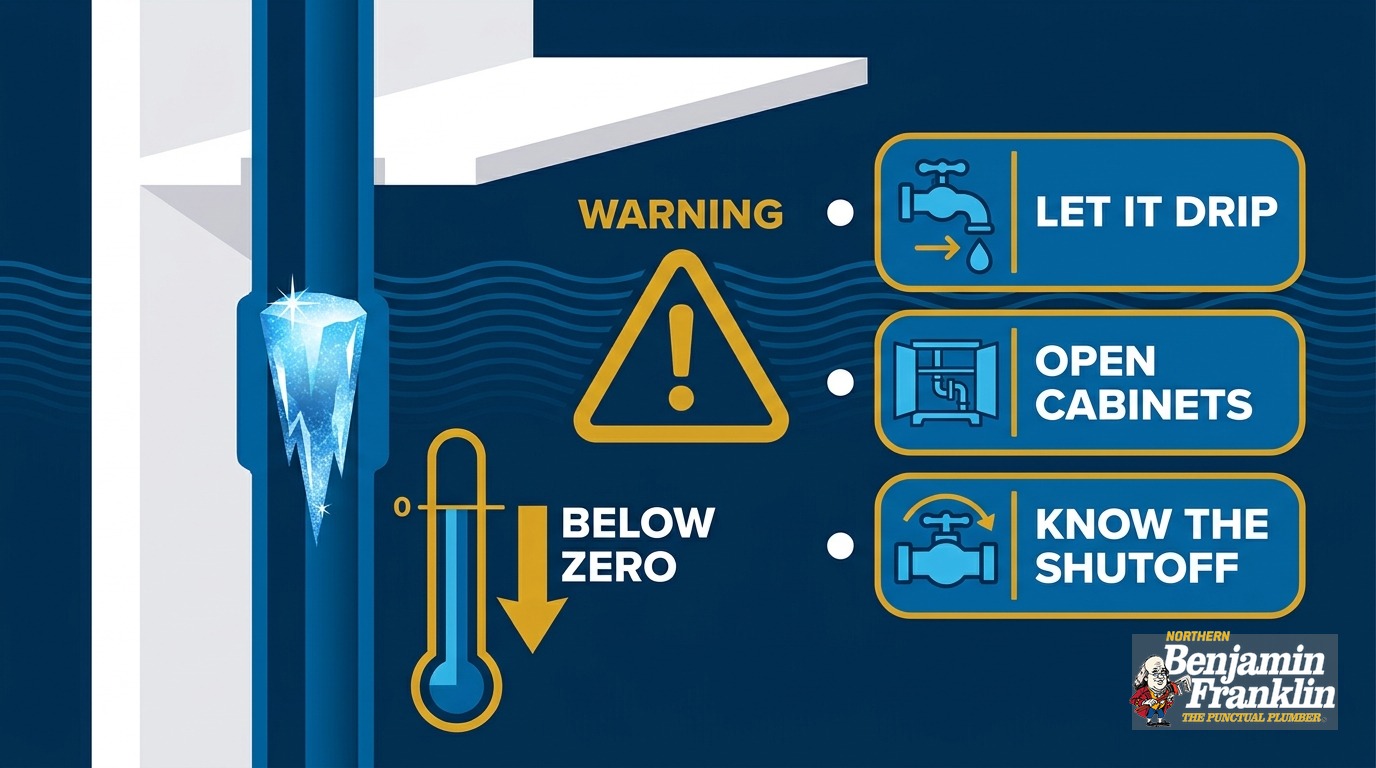
An unheated cabin gets cold fast. No one is there to hear a pipe drip or notice a burst line. Water that stays in a pipe will freeze, expand, and split the metal or plastic around it. You find the damage in April, when the ice melts and the water starts running.
We are Northern Benjamin Franklin Plumbing, a locally owned and operated Twin Cities plumbing company. Many of our customers own a cabin up north. They know how a bad freeze can turn a quiet weekend into a repair bill. Here is how to avoid that.
Why Does Cabin Plumbing Freeze When Nothing Else Does?
Cabin plumbing freezes because no one is there to heat it. A year-round home warms its pipes with the furnace and the daily use of hot water. A closed cabin has neither. Once the building cools to outdoor temperatures, any water left inside is at risk.
Water expands as it turns to ice. The pipe does not give. Pressure builds between the ice and a closed valve, and the weakest point fails. That point is often not where the ice formed.
Three parts of a cabin system fail most often:
- P-traps. The curved pipe under every sink, tub, and shower holds water on purpose. That water blocks sewer gas. It also sits in a thin, exposed bend, so it freezes and cracks first.
- Low points. Water settles at the lowest spot in a line. A sagging run or a dip near the pressure tank can trap a pocket even after you drain the system.
- Fixtures and appliances. Toilet tanks, toilet bowls, washing machines, and dishwashers all hold water that a simple shutoff does not remove.
Buried lines matter too. Minnesota sets a minimum footing depth due to freezing of five feet in Zone I and 3-1/2 feet in Zone II. Zone I is the northern tier of 34 counties. Check which zone your county falls in.
The state plumbing code also covers yard piping. Building supply and yard piping must sit not less than 12 inches below the maximum local frost depth. A shallow line to a dock, boathouse, or outbuilding is a common weak spot.
To see when freezing starts to threaten a pipe, read our guide on what temperature pipes freeze in Minnesota.
What Should You Do Before You Start Draining?
Before you drain anything, gather supplies, check your insurance, and decide how you will handle the well and septic system. Ten minutes of planning prevents the two classic mistakes: running out of antifreeze mid-job and putting the wrong product in the wrong place.
Gather your supplies
- Non-toxic antifreeze labeled safe for potable water systems, sometimes sold for RVs
- A wet-dry vacuum or sponge for toilet tanks and bowls
- A garden hose and a bucket
- Adjustable pliers and a screwdriver
- An air compressor with a regulator, if you plan an air blowout
- Painter’s tape and a marker for labeling valves
- A voltmeter, if you have a well pump
Buy more antifreeze than you think you need. Every trap, toilet, and appliance takes some.
Call your insurer first
Do this before you leave. The Minnesota Department of Commerce says a standard homeowners policy typically covers water damage from burst pipes. It also warns that you may not be covered if you left your house unoccupied without heat.
The page gives no minimum temperature. So ask your agent three things:
- Does my policy cover a burst pipe in a closed, unheated cabin?
- Do I need to drain the system, keep heat on, or have someone check the building?
- What proof does the insurer want if I file a claim?
Write down the answers. If you ever need to file, our post on a burst pipe insurance claim in Minnesota explains how the process works.
Know your wastewater system
Many lake cabins use a septic system, not a city sewer. That changes your antifreeze plan, and the septic section below has the details. For now, find where your tank and drain field sit. Then check what type of well you have.
How Do You Winterize Water Pipes? A Numbered Drain-Down Protocol
To winterize water pipes, shut off the supply, open every faucet, drain the water heater, and clear the low points. Then protect traps with antifreeze. Work from the supply inward and from the top of the cabin down. Open the lowest drain last.
Follow these steps in order. Each one has a reason.
1. Turn off the water at the source. Close the main shutoff where water enters the cabin. If you have a well, turn off the pump breaker. Verify it is dead with a voltmeter. A pump that runs against an open system can burn out. Our guide to finding and testing your main water shutoff valve helps if yours sticks or is hard to find.
2. Turn off the water heater’s power or fuel. Switch off the breaker for an electric unit. Set a gas unit to its off or pilot setting. Never leave an electric element powered in an empty tank. It can burn out in minutes.
3. Open every faucet, hot and cold. Start with the highest fixture in the cabin. Open the tub, shower, kitchen, bathroom, and utility sink faucets. Open outdoor spigots too. Opening the top fixtures lets air in, so water can leave from below.
4. Flush the toilets and empty them. Flush once to drain the tank. Hold the handle down. Then use a sponge or wet-dry vacuum to remove the rest from the tank and bowl. Toilets hold water you cannot see at first glance.
5. Drain the water heater. Connect a hose to the drain valve and run it to a floor drain or outdoors. Open the valve. Open a hot faucet or the relief valve so air can enter. Leave the drain valve open for the winter. For sediment tips, see our post on flushing a water heater tank.
6. Open the lowest drain. Find the lowest valve or fitting on the supply system. Open it last, after the faucets are open. This pulls out water that settled at the low point. Many cabins have a drain valve near the main shutoff for this reason.
7. Clear the remaining water. You have two options. Walk the lines and check each low spot by hand, or use a compressor to blow out the lines. If you blow out the lines, set the regulator low and follow your pipe manufacturer’s limits. Too much pressure can damage fixtures and fittings.
8. Drain appliances. Disconnect and drain the washing machine hoses. Empty the dishwasher and its supply line. Drain the ice maker line and the refrigerator water line if present. Empty any water filter housings and remove the cartridges.
9. Protect every trap and drain. Pour non-toxic antifreeze into each sink, tub, shower, and floor drain. Make sure it fills the trap. Add some to each toilet bowl and tank. The antifreeze rules are in the next section.
10. Label and log. Tape a note on the main shutoff: “Drained for winter, date, open faucets.” Take photos of the open valves.
What Antifreeze Goes in the Drains, and How Much?
Use non-toxic antifreeze made for plumbing and potable water systems. Pour enough into each trap to replace the water that sits in the bend. For a toilet, add it to the bowl and the tank. Never use automotive antifreeze anywhere in the cabin.
Check the product label for approved uses. Plumbing antifreeze is typically pink or another bright color, so you can see it in a trap.
Here is a simple guide to what goes where:
- Sink and tub traps: Pour in a cup or two, or enough to fill the bend. Add a little extra if the drain is long.
- Shower and floor drains: The trap sits lower and can be deeper. Pour until you see the antifreeze at the bottom.
- Toilets: Add antifreeze to the bowl after you remove the water. Some people also add it to the tank.
- Washing machine and dishwasher: Follow the manufacturer’s instructions. A small amount in the drain hose protects the trap.
Why does this work? Antifreeze lowers the freezing point of the liquid in the trap. It also keeps the trap from drying out, which blocks sewer gas and keeps smells in the pipe.
Our post on replacing a P-trap under a bathroom sink shows what the part looks like and why it cracks when frozen.
Floor drains in a basement or crawl space may also need protection. If your cabin has a crawl space, read why crawl space pipes freeze in Minnesota.
What Should You Never Do When Winterizing a Cabin?
Never put antifreeze, salt, or additives into a septic system. Never use automotive antifreeze in plumbing. Never run water nonstop to prevent freezing. Never leave water in a tank, trap, or line you cannot see. Each of these mistakes can cause damage or a health risk.
What not to do
- No antifreeze in the septic tank. The University of Minnesota’s septic program says not to add antifreeze, salt, or additives. Many online guides say to put antifreeze down every drain. If your cabin has a septic system, that advice conflicts with the UMN guidance. We suggest asking a septic professional how to protect your traps without sending product into the tank.
- No automotive antifreeze. It is toxic. It does not belong in any water line, trap, or fixture.
- No continuous running water. The same UMN source says not to run water continuously. Trickling water can overload and freeze a septic system.
- No half-drained systems. One closed valve can trap a pocket of water. Open everything.
- No skipped insurance call. A policy gap costs far more than a phone call.
We could not read both UMN pages in full when we prepared this post. Confirm the current guidance on the UMN septic site before you act.
How do you protect a septic system for winter?
The UMN septic program says an unoccupied cabin can freeze a septic system because no sewage warms it. Its guidance points to three steps:
- Put 8 to 12 inches of loose mulch over the pipes, tank, and treatment area.
- Pump the tank in the fall, before you leave.
- Leave the system free of antifreeze and additives.
Snow is natural insulation, but it may not fall evenly. Mulch gives you cover that does not depend on the weather. Ask your septic pro about the right cover for your site.
How Do You Keep Pipes From Freezing at a Minnesota Cabin?
You keep cabin pipes from freezing in one of two ways. Either drain the system completely, or keep the building heated and watched all winter. Draining is the more reliable choice for a cabin that sits empty. Heat can fail, and no one is there to notice.
Weigh each approach honestly.
Drain-down. If no water is in the pipes, nothing can freeze. This works with no power and no heat. It costs you an afternoon in fall and another in spring.
Heat on. Some owners keep a low heat setting and visit often. This can work for a cabin you use in winter. But a power outage, a furnace failure, or a stuck thermostat can end the plan. A Minnesota cold snap can freeze an unheated cabin in a day or two, and you may not know.
If you use the cabin in winter, the best approach is a hybrid. Keep the heated areas on and drain the rooms, outbuildings, and lines you do not use. Close and drain the water lines to unheated spaces such as a boathouse.
A few extras help, though they do not replace draining:
- Insulate exposed pipes in exterior walls. See our post on pipe insulation for exterior walls.
- Seal gaps and vents that let cold air reach pipes.
- Consider a smart sensor that alerts you to low temperatures or leaks. Our guide to smart whole-house water leak detectors explains the options.
For heating questions, such as furnace service or a backup heat source, our sister Northern brands handle that work. Our team covers the plumbing.
If a pipe does freeze, do not rush it with a torch. Our guide on how to thaw frozen pipes in Minnesota lists safe steps.
How Do You Handle the Well and Pressure Tank?
If your cabin has a private well, turn off the pump breaker, confirm with a voltmeter, and drain the pressure tank and lines. Set bypass valves on any treatment equipment and remove filters. A well adds steps that a city-water cabin does not need.
Here is the sequence:
- Turn off the pump breaker. Verify it is dead with a voltmeter. The Minnesota Department of Health recommends this step on its well disinfection page.
- Open a faucet near the tank. This relieves pressure.
- Drain the pressure tank. Use the drain valve on the tank or on the line next to it.
- Set bypass valves on treatment devices. Remove their filters and empty the housings. Softeners, iron filters, and UV units all hold water.
- Check the pitless adapter and any exposed well piping. Make sure nothing above ground holds water.
A waterlogged or failing tank often shows up in the fall, when you open the system for the last time. If the tank cycles fast or hisses, read our guide on a waterlogged well pressure tank.
If your well water carries iron or manganese, stains in fixtures can build over the winter. Our post on iron and manganese in Minnesota well water explains treatment options.
We did not find a Minnesota Department of Health guide on winterizing a private well for a seasonal cabin. If you need one for your situation, ask a licensed well contractor.
What About Gas Lines, Sump Pumps, and Outdoor Lines?
Gas appliances, sump pumps, and outdoor lines each need their own shutdown. Shut off the gas at the appliance or the main. Empty the sump pump pit or discharge line if it can freeze. Drain every outdoor spigot, irrigation line, and dock supply.
Many cabin checklists skip these.
Gas. A cabin with a propane or gas range, fireplace, or water heater has extra risk. Close the gas shutoff at each appliance, or at the tank or meter, as your setup requires. Do not leave a pilot burning in an empty building. If you smell gas, leave and call your provider. For work on gas piping, see our guide on gas line safety and permits in Minnesota.
Sump pumps. A cabin with a basement may have a pit and pump. If the pit holds water, it can freeze. A frozen discharge line can also back water into the pit in spring. Our post on a sump pump discharge line freezing in Minnesota covers prevention.
Outdoor lines. Close the indoor shutoff for each outdoor faucet. Open the outdoor spigot to drain it. Remove hoses. If your cabin has a sprinkler system or a lake-side water feature, see how to winterize an irrigation system in Minnesota. The same drain-down logic applies.
Frost-free hose bibs. These still fail if a hose stays attached. Remove it, and check for leaks in spring. Our post on frost-free hose bib spring leak checks shows how.
Your Spring Reopening and Well-Disinfection Checklist
Reopen the cabin slowly. Close all drains, turn on the water at the source, and check every joint for leaks before you open fixtures. If you have a well, disinfect it and test the water before you drink it. Do not skip the test.
Step-by-step spring startup
- Walk the cabin. Look for stains, cracks, or dripping that suggest winter damage.
- Close the drain valves. Shut the water heater drain and the low-point drain you left open.
- Close the faucets. Leave one open to release air.
- Turn on the water slowly. Open the main shutoff a little at a time. Listen for hissing or spraying.
- Check every joint and connection. Look under sinks, near the water heater, and at the pressure tank.
- Fill the water heater first. Run a hot faucet until water flows steadily. Then switch on the power or gas.
- Flush the antifreeze. Run each faucet until the color is gone. Flush each toilet several times. Run the washing machine and dishwasher empty.
- Refill traps. Pour clean water into floor drains and little-used fixtures.
- Reinstall filters. Put the cartridges back and reset the bypass valves.
If you find a leak, shut off the water at once. Our team handles burst and frozen pipe repair for homes in our service area.
Well disinfection
The Minnesota Department of Health’s well disinfection guidance gives these targets:
- Mix chlorine solution to reach 50 to 200 ppm in the recirculating water. Do not exceed 200 ppm.
- Let the solution sit a minimum of two hours, preferably six hours, or overnight.
- Flush the system until test strips read 0 ppm chlorine. That can take 30 minutes to 24 hours or more.
- Discharge the flush water away from septic systems.
- Test for total coliform bacteria with an accredited lab before you drink or cook with the water.
- Retest two to four weeks after disinfection.
Turn off the pump breaker and check with a voltmeter before you work on the well. Set bypass valves on treatment devices and remove their filters before you add chlorine.
Chlorine at that strength is not safe to drink or discharge into a septic system. Follow the full MDH page, and wear gloves and eye protection.
Until the lab confirms the water is safe, treat it as unsafe for drinking and cooking. Our page on boil water notices explains what to do while you wait.
When Should You Call a Plumber?
Call a plumber when you find a leak, a cracked trap, a stuck valve, or a system you cannot fully drain. Also call if you want a pro to check the work. A short visit in fall can save a long repair in spring.
Common reasons to call:
- A shutoff valve will not turn. See our post on a stuck shutoff valve.
- You cannot find the low point or the main shutoff.
- The water heater will not drain.
- Water appears in spring from a joint, trap, or wall.
- The line to an outbuilding is shallow or lacks a drain valve.
If your primary home is in the Twin Cities, we can also help you winterize it. Our guide to winterizing your plumbing in the Twin Cities covers your main house. If you have a longer trip planned, the Minnesota frozen pipe season guide tells you what December brings.
We are a locally owned and operated Twin Cities plumbing company. We do not claim that every cabin sits in our service area. Call and ask. If a repair or repipe is bigger than you expected, ask us about financing.
When we book a visit, we show up in the window you choose. Our On-Time Guarantee(R) is simple: “If there is any delay, it’s you we pay!” That means $5 for every minute we are late, up to $300.
Call (763) 296-1844 or book online. We will help you protect your plumbing before the first hard freeze.
Frequently Asked Questions
How do you prepare a cabin for winter up north in Minnesota? +
How do you winterize a summer cottage? +
Need a technician now?