
Whole House Water Leak Detector: Sensor vs. Auto-Shutoff
Key Takeaways
- Point-of-use sensors alert you after water pools. They rarely earn an insurance discount.
- A whole-home flow monitor with automatic shutoff can earn 5-15% off your premium with most carriers, and up to 20% for professionally monitored systems.
- About 28.6% of homeowners insurance claims involve water damage, with an average payout over $11,000.
- In Minneapolis and Saint Paul, homeowners own the water service lateral all the way to the city main. A leak on that stretch is your bill, not the city’s.
- Minnesota frost depth in the Twin Cities can reach 42-60 inches. January and February are peak months for burst-pipe claims nationally.
- Minneapolis water hardness is 5.8 grains per gallon. Hard water accelerates the pipe and appliance wear a flow monitor catches early.
The Problem Most Leak Sensors Don’t Solve
You buy a water sensor at the hardware store. You put one under the kitchen sink, one behind the toilet, one near the water heater. The app connects. It feels like the leak problem is handled.
Then your homeowners insurance renewal arrives. The premium hasn’t changed.
That’s the gap nobody explains at checkout. Sensor-only devices do one thing: they alert you after water has already pooled somewhere it shouldn’t be. They don’t stop the flow. They don’t watch your main supply line. They don’t catch a drip building inside a wall or a leak developing under your yard. And most insurance carriers don’t reward them with a discount.
A whole house water leak detector that actually moves the needle on insurance risk is a different product category entirely. It’s a main-line flow monitor with automatic shutoff - the kind a plumber installs on your supply line before it branches into your home. This post explains the difference, why it matters specifically for Twin Cities homeowners, and what it costs to get the right system installed.
What Is a Whole House Water Leak Detector?
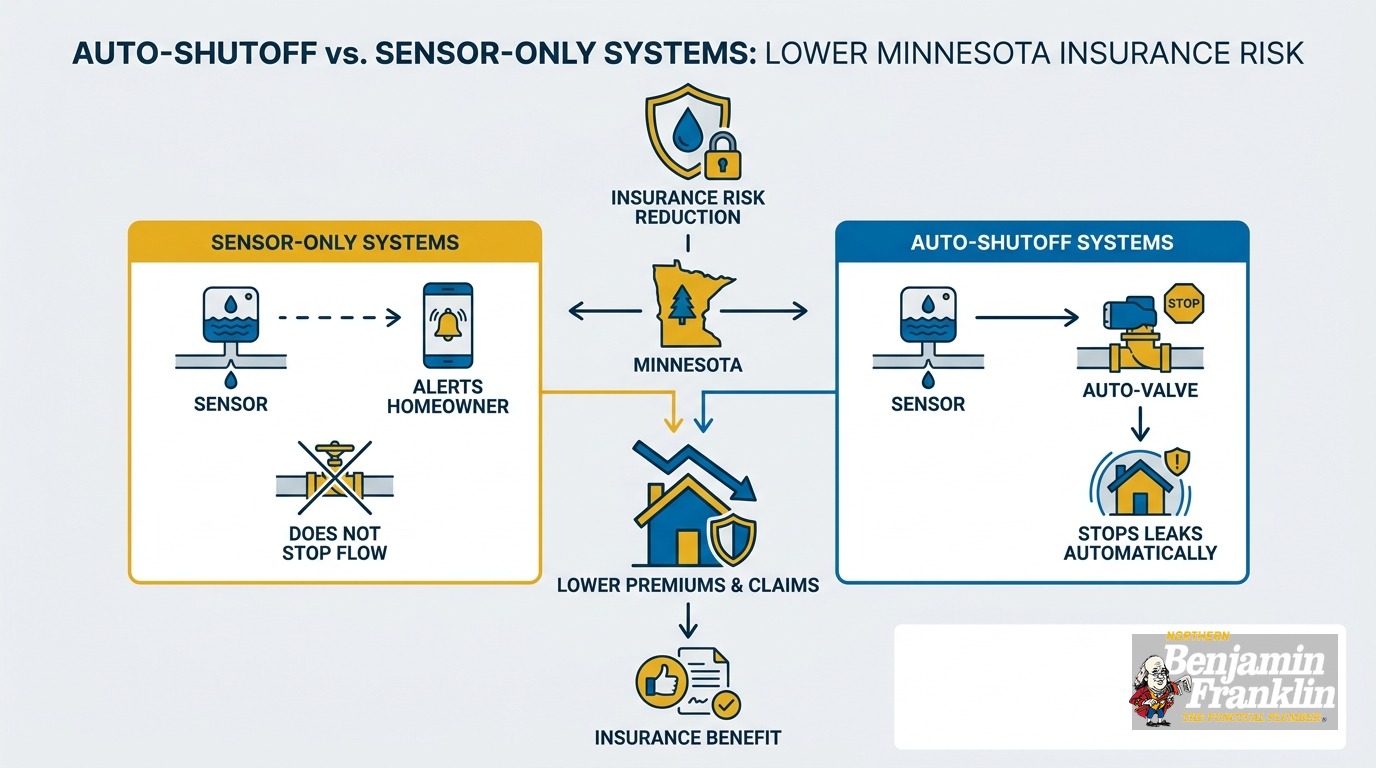
The term “whole house water leak detector” covers two very different product types. On one end: small point sensors that detect pooled water at a single location and send a phone alert. On the other: a main-line flow monitor that watches every gallon moving through your home and can shut off the water supply automatically. The phrase alone doesn’t tell you which one you’re buying.
Knowing the difference before you invest matters. The two tiers protect against different failure types, respond in different ways, and earn very different treatment from insurance carriers.
Point sensors are small moisture-detection pads you place at likely leak locations: under sinks, behind toilets, near water heaters, next to washing machines. When water contacts the probe, your phone gets an alert. That’s the complete action. There’s no valve that closes, no monitoring of how much water moves through your home, and no way to see what’s happening inside a wall or beneath your yard.
Whole-home flow monitors with automatic shutoff install on the main supply line, typically where it enters the home from the service line. These systems watch every gallon your household consumes. They learn your normal usage patterns. When something deviates from that baseline - a slow drip at 3 a.m. when everything should be off, or a burst-pipe surge that dumps hundreds of gallons per hour - the system alerts you, closes the shutoff valve, or both.
That’s a fundamentally different category of protection. One reacts to symptoms after they’re already visible somewhere accessible. The other monitors the source of every gallon continuously.
How Are Sensor-Only and Auto-Shutoff Systems Different?
Sensor-only systems notify you after water has reached a place where a sensor is sitting. Auto-shutoff systems watch the entire water supply line and can intervene before a leak escalates into damage. One is a notification tool. The other is a prevention tool. Insurance carriers treat them differently because the risk reduction is categorically different.
Here’s a scenario that makes the gap concrete. A supply line behind your laundry room wall develops a pinhole from hard-water scale corrosion. It’s small. The water runs down the inside of the wall, into the subfloor, and soaks the framing below. No sensor is near it. The leak continues for weeks. By the time you notice a soft spot in the floor, you’re looking at structural damage and potential mold remediation.
A main-line flow monitor approaches that scenario differently. Your overnight consumption should be zero when every fixture is off and no appliances are running. The system sees a consistent baseline of 0.04 gallons per hour instead of zero. It flags the anomaly. Depending on the system, it alerts your phone or closes the shutoff valve. Either way, you’re scheduling a repair call - not a remediation project.
The shutoff tier also handles the catastrophic events that point sensors can’t reach. A burst pipe in the attic. A failed supply line under the slab. A washing machine hose that splits and dumps its full load in 90 seconds. Flow monitors catch those events by their signature: a sudden, high-volume surge that matches no normal household usage pattern. The valve closes. The damage stops.
Does a Leak Sensor Actually Lower Your Insurance Bill?
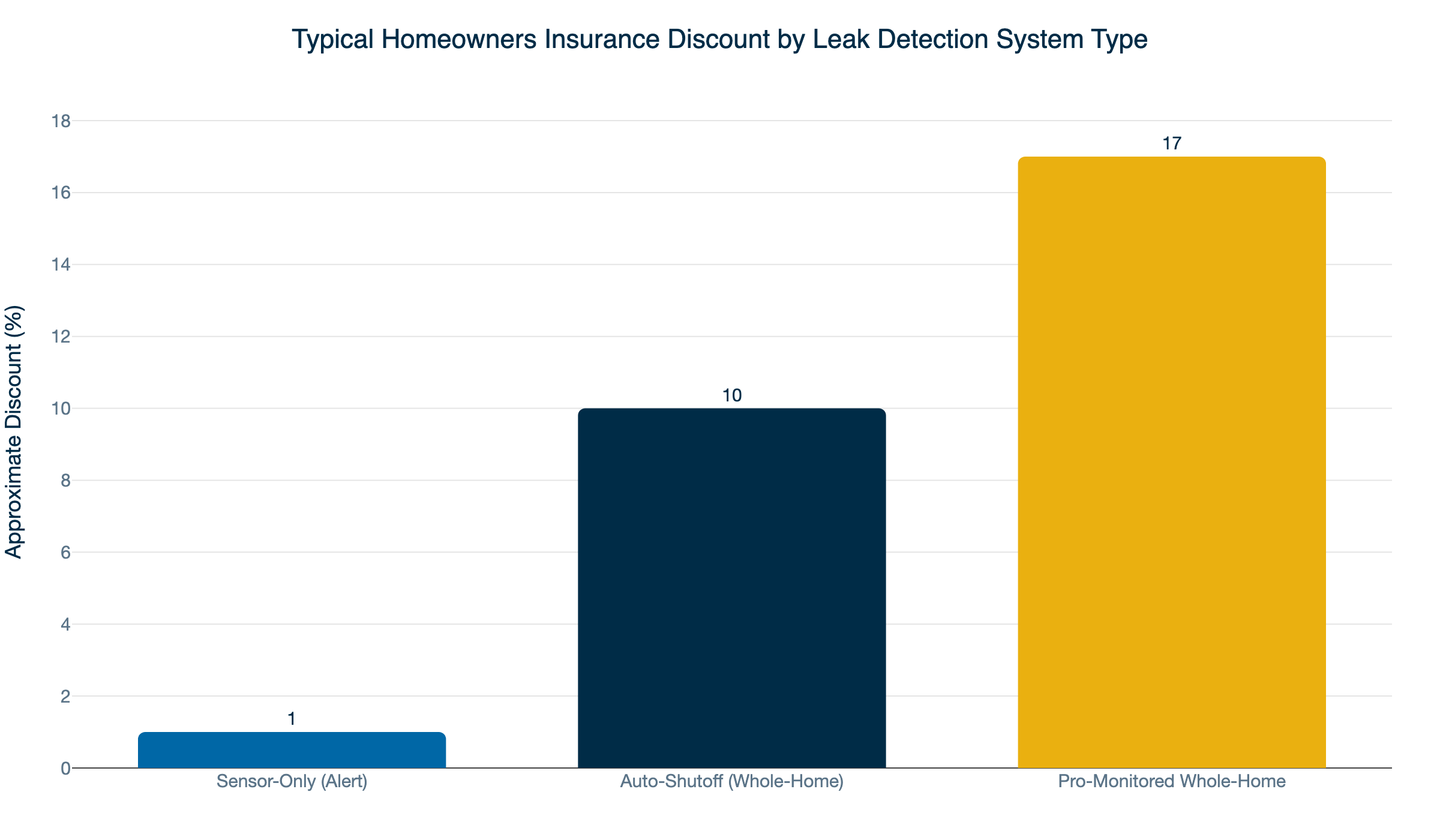
It depends entirely on which type you install. Most carriers give little or no discount for point-of-use alert sensors alone. A whole-home flow monitor with automatic shutoff earns 5-15% premium discounts with most carriers. Professionally monitored whole-home systems can reach up to 20%.
Several carriers specifically document their positions on this:
- Farmers Insurance offers premium discounts for flow-detection shutoff devices, not for alert-only sensors.
- American Family Insurance, a major Minnesota carrier, includes water leak detection systems in its smart home device discounts.
- Amica Insurance maintains a documented water damage mitigation devices discount for policyholders.
- Cincinnati Insurance has a homeowners policy discount specifically for water shutoff devices.
According to insurefill.com, Minnesota homeowners can expect 5-15% in premium discounts with most carriers for whole-home flow monitors and up to 20% for professionally monitored systems.
There’s also a harder line forming at the high-value end of the market. A growing number of carriers that write high-value home policies now require an automatic shutoff valve as a condition of coverage - not an optional upgrade that earns a discount, but a requirement for keeping the policy active. If your home falls into that category, this conversation with your carrier is worth having before your next renewal.
Before you buy anything, call your insurance agent. Ask two specific questions: Do you offer a discount for whole-home flow monitors with automatic shutoff? And is one required for my coverage tier? Those answers tell you exactly which tier you need and whether the install cost pays back in reduced premiums.
Why Minnesota Winters Make This an Urgent Decision
Water damage claims peak nationally in January and February. That timing is not coincidental. Those are the months when pipes freeze and burst - and burst pipes are the single most common cause of water damage, affecting roughly 14,000 U.S. homeowners daily.
Minnesota sits at the severe end of that risk curve. The Twin Cities can see frost depths of 42-60 inches under Minnesota Plumbing Code requirements. For homes with older construction, supply pipes running through unconditioned spaces, or gaps in foundation insulation, a cold enough January is all it takes. The pipe freezes, the water inside expands, and a section splits - usually inside a wall, in a crawlspace, or in an attic. There’s no sensor near it.
A whole-home shutoff catches that event by its signature. When a frozen section of pipe thaws after splitting, flow surges suddenly and severely. The monitor sees a spike that matches no normal usage pattern and closes the valve. Instead of coming home to standing water on your first floor, you get a notification and a plumber visit. That’s a very different problem.
For homes that sit empty during any stretch of Minnesota winter - a household that spends part of the season somewhere warmer, a rental between tenants, a second property - the auto-shutoff tier matters even more. An alert-only sensor can’t help if nobody is home to act on the alert. A shutoff valve closes on its own.
Our post on why December is a turning point for pipe risk in Minnesota covers the mechanics of how cold snaps stress plumbing systems and which homes carry the most vulnerability.
Who Owns the Service Line From the Street?
In Minneapolis and Saint Paul, the homeowner is responsible for the entire water service lateral from the building to the connection at the city main - including the portion that runs under the public right-of-way. A leak anywhere on that stretch is your repair cost, not the city’s.
Minneapolis Public Works is clear about this: property owners own the sanitary lateral from house to city main, including under the sidewalk and boulevard strip. Saint Paul follows the same rule, though the city does offer a 20-year low-interest assessment loan to help with expensive repairs.
Most point sensors will never see the service line. It runs underground: under your yard, under the public right-of-way, and out to the street connection. You can’t place a moisture sensor on a buried pipe and check it every morning.
A main-line flow monitor installed where the service line enters your home watches all of it. A slow leak on the service line - from aging pipe material, frost heave, ground settlement, or root intrusion - shows up as a baseline flow that never drops fully to zero. The system logs that anomaly. You call a plumber before you’ve lost tens of thousands of gallons and received a water bill that reflects it.
This risk is heightened in older Minneapolis and Saint Paul neighborhoods where lead or galvanized service lines are still in place. Our post on lead service line replacement in the Twin Cities covers what older service line materials mean for metro-area homeowners and what replacement looks like when it becomes necessary.
What Does Hard Water Have to Do With Leak Detection?
Hard water accelerates the slow failures that whole-home flow monitors are best at catching. Minneapolis tap water runs at 5.8 grains per gallon (100 ppm). Saint Paul is similar at 5-6 gpg after lime softening treatment. Scale buildup in pipes, water heaters, and appliances creates gradual constrictions, pressure stress, and corrosion - exactly the conditions that produce the hidden leaks a flow monitor catches before they become costly.
The EPA estimates the average household leaks roughly 10,000 gallons per year, and many of those leaks are slow and hidden. A pinhole in a copper supply line behind drywall doesn’t make noise. It doesn’t pool somewhere a sensor would find it. It wicks moisture into the framing around it until you have rot, mold, or a failed wall cavity.
A flow monitor watches your baseline consumption every hour. If overnight usage is consistently 0.03 gallons per hour when every fixture is off, that’s a leak. Not large enough to trip an immediate alarm, but visible to a well-calibrated system and completely invisible to any point sensor. You see the anomaly in the app. You call a plumber about a repair - not a remediation.
This failure pattern is especially common in older Twin Cities homes where copper supply lines have been in contact with moderately hard water for decades. Our post on copper pipe pinhole leaks in Minnesota covers why this failure mode is prevalent in the metro and what your repair options look like.
How Much Does a Whole-Home System Cost to Install?
Hardware and installation for a professionally installed whole-home flow monitor with automatic shutoff runs $1,500-$3,500. A sensor-only setup costs $50-$250 in hardware and is typically self-installed. Both figures come from Latent Insure’s comparison guide. The cost gap is real - but so is the difference in protection and insurance eligibility.
A few variables that affect the installed cost for a Twin Cities home:
- Pipe size and material. Many Minneapolis and Saint Paul homes have 3/4-inch or 1-inch galvanized or copper supply mains. The shutoff valve and flow sensor must match the pipe. A corroded or undersized galvanized section may need replacement before the monitor fits cleanly.
- Access to the main line. The ideal install point is where the supply line enters the home, before it branches to individual fixtures. If that section runs through a finished wall or a cramped mechanical room, labor is higher.
- Permit requirements. Installing a valve on a main supply line requires a plumbing permit in most Minnesota municipalities. Your licensed plumber handles the permit application, but it’s part of the job cost.
- System tier. Entry-level shutoff monitors are simpler to install. Professional-grade systems with flow rate analysis, remote shutoff control, and continuous app monitoring carry higher hardware costs.
The insurance math is worth running before you decide. A 10% discount on a $2,200 annual premium is $220 per year. At that rate, a $2,500 installed system pays back in roughly 11 years in premium savings alone - before you count any claim it prevents. For homes with older pipes, hard water history, or periods of winter vacancy, the payback case is meaningfully stronger.
The only dollar figures that belong to Northern Benjamin Franklin Plumbing are the published On-Time Guarantee(R) amounts: $5 per late minute, up to $300. For a real estimate on your specific home and pipe configuration, the right step is a conversation with one of our plumbers - and that conversation is free.
How to Choose the Right Whole House Water Leak Detector for Your Home
Start with your insurance carrier, not the hardware aisle. Call and ask two specific questions: Do you offer a discount for whole-home flow monitors with automatic shutoff? And is one required for my coverage tier? Those answers tell you which system you actually need and whether the install cost pays back in reduced premiums.
Then think through your home’s specific risk profile:
- Age of the home. Minneapolis and Saint Paul homes built before 1980 are more likely to have aging copper or galvanized supply lines. Those materials fail in ways a flow monitor can catch much earlier than a point sensor can.
- Winter occupancy. If the home sits empty for any stretch of the Minnesota winter, an auto-shutoff is far more valuable than an alert-only system. Nobody is there to act on a notification.
- Service line status. If you don’t know what your service line is made of or when it was last inspected, continuous flow monitoring gives you visibility on that entire underground stretch.
- Hard water history. If your home has hard water that’s gone untreated for years, you’re at higher risk for the slow, hidden failures a flow monitor catches before they reach your drywall.
For the installation, this is not a DIY project if you want it to satisfy your insurance carrier. The shutoff valve installs on the main supply line, must be correctly sized for your pipe, and must be leak-tested under pressure. Most Minnesota municipalities require a permit for that work. A licensed plumber handles all of that in a single visit.
Northern Benjamin Franklin Plumbing is locally owned and operated right here in the Twin Cities. Our leak detection service pairs naturally with main-line shutoff installation. We can assess what your home’s current leak risk looks like before recommending which system makes sense for your house.
We show up in the window we promise. Our On-Time Guarantee(R) means if we’re late, it’s $5 per late minute up to $300. “If there is any delay, it’s you we pay!”
To schedule an assessment or ask about whole house water leak detector installation for your Twin Cities home, call (763) 296-1844 or book online.
Frequently Asked Questions
Does a whole house water leak detector lower homeowners insurance? +
What is the difference between a water leak sensor and a whole-home shutoff system? +
How much does a whole house water leak detector cost to install in Minnesota? +
Are Minneapolis homeowners responsible for the service line from the street? +
Need a technician now?