
How to Read Your Water Meter for Leaks Before the Bill Spikes
Key Takeaways
- Twin Cities water meters live indoors - almost always in the basement or utility room - because Minnesota frost depth would freeze an outdoor meter every winter.
- The two-hour test is the most reliable DIY leak check: record the meter, stop all water use for two hours, read again. Any movement means water is flowing when none should be.
- The leak indicator triangle on the register face is more sensitive than the main sweep hand. Check it first - it catches slow drips the two-hour window may miss.
- In most Twin Cities municipalities, sewer charges are calculated as a percentage of water consumed. A silent leak inflates both the water line and the sewer line at once.
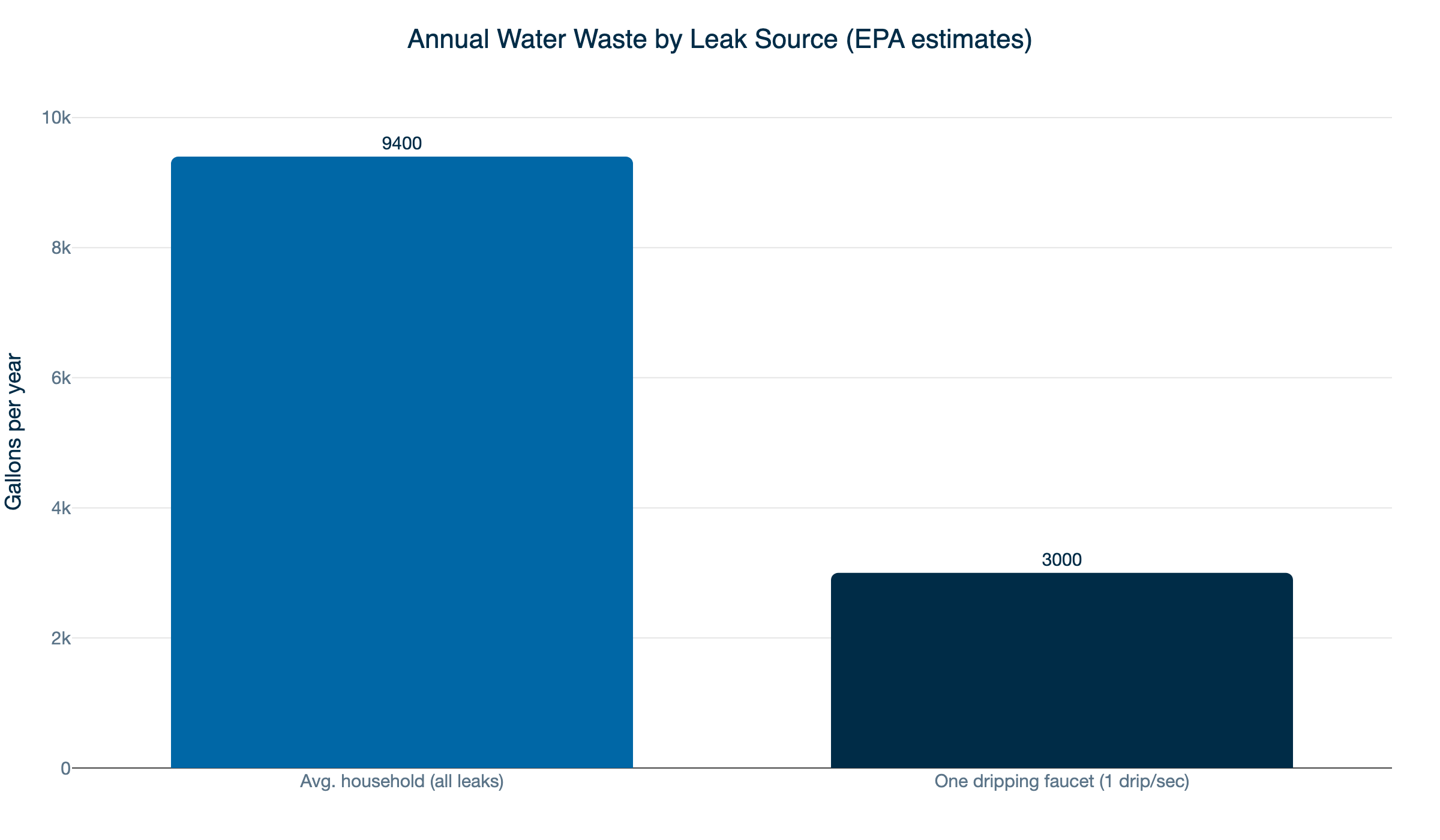
- According to the EPA, the average household wastes 9,400 gallons per year from leaks. Fixing them saves roughly 10% on water costs.
- A monthly meter log - one photograph, one date - is the simplest proactive step to catch a developing leak before the bill reflects it.
- Any repair beyond swapping a toilet flapper or cleaning an aerator requires a licensed plumber and a permit under Minnesota Plumbing Code.
Where Is My Water Meter in a Twin Cities Home?
Most Twin Cities meters are indoors, in the basement or utility room, near where the main supply line enters the foundation. This differs from the curb-box placement common in southern and western guides, where frost is not a factor.
Minnesota’s frost depth runs 42 to 48 inches in a typical winter. A meter installed in a shallow outdoor pit would freeze solid from December through February. So in Minneapolis, St. Paul, Blaine, Maple Grove, and the rest of the metro, utilities install meters inside where temperatures stay above freezing year-round.
Look for a silver or black cylindrical body mounted on a copper or PEX supply line. The register face is either a dial type or a digital LCD. Dial meters have a large sweep hand that moves continuously as water flows and a row of odometer-style digits that track cumulative use. Digital meters show a rolling number on a flat display. Both types are read the same way: the odometer digits show total flow over time, and the sweep hand or low-flow indicator shows whether anything is moving right now.
Minneapolis Utility Billing offers scheduled Water Meter-Reading Appointments if you have trouble locating or accessing yours. Even before you need it in an emergency, take a few minutes to find your meter and photograph it. Knowing exactly where it is saves critical time when you smell water behind a wall at 10 p.m.
How to Read Your Water Meter for Leaks: The Two-Hour Test
Stop all water use, record the meter reading with a timestamp, wait two hours, and read it again. Any increase means water moved through the meter while none should have. That is a leak.
This protocol comes directly from the EPA’s WaterSense program. It requires no tools and works for any residential meter type.
Step 1: Shut off every water source in the house.
Close all faucets. Pause the dishwasher and washing machine. Turn off the automatic ice maker or close its supply line. The test requires true zero flow. Even a single ice-maker fill cycle during the window can produce a reading that mimics a small leak.
Step 2: Read the meter and record it with a timestamp.
For a dial meter, note the exact position of the sweep hand and copy every digit from the odometer. For a digital meter, photograph the display. Make sure the time is captured alongside the number. Your phone’s photo metadata handles this automatically.
Step 3: Wait two full hours without using any water.
Leave the house if possible. Extending the window to three or four hours makes faint, slow leaks easier to detect. A drip that adds half a gallon per hour moves the meter only 1 gallon in two hours. That is detectable, but barely.
Step 4: Compare the readings.
Any increase - even a fraction of a cubic foot or a couple of gallons - means water passed through the meter while you used none. That is a leak, and it is worth tracking down before it runs another 30 days.
One benchmark to keep in mind: a family of four that consistently exceeds 12,000 gallons per month likely has a significant leak somewhere in the system. That figure is worth comparing against your actual monthly bill.
What Does the Leak Indicator Triangle Do?
The small triangle or star on the meter register face is a low-flow detector. It spins when water moves at rates too slow to visibly advance the sweep hand in a short window - making it your first and most sensitive leak signal.
Check the indicator before you run the two-hour test. With all water off, watch it for 30 seconds. If it is spinning or twitching at all, water is flowing. You do not need the full two-hour window to confirm a leak is present.
This indicator is especially useful for catching a slow toilet flapper - the single most common residential leak source. A deteriorating flapper can allow a steady seep from the tank into the bowl without ever producing the running sound that usually prompts a homeowner to investigate. The EPA recommends replacing toilet flappers at least every five years. A worn flapper can silently waste thousands of gallons per year.
Confirming a flapper leak takes no tools. Drop a few drops of food coloring into the toilet tank. Do not flush. If the color appears in the bowl within ten minutes, the flapper is passing water between flushes. Our post on toilet flapper replacement walks through the fix. The flapper itself costs a few dollars and the repair takes about 20 minutes.
Dripping faucets register in the same sensitive range. A faucet dripping at one drop per second wastes more than 3,000 gallons per year. That number compounds across every faucet in the house.
Does a Slow Leak Really Inflate My Sewer Bill Too?
Yes. In most Twin Cities municipalities, sewer charges are calculated as a percentage of water that passes through your meter. A silent leak inflates both the water line and the sewer line at the same time - which is why a moderate drip can produce a bill that feels catastrophically large.
This is the detail absent from most national leak guides, and it matters more in the Twin Cities than in markets without combined utility billing.
The Metropolitan Council’s Sewer Availability Charge is tied directly to water consumption volume. When the meter records flow - whether from a running dishwasher, a shower, or a leaking toilet flapper draining into the bowl - the sewer rate applies to that volume. The utility has no mechanism to separate water that was genuinely used from water that leaked away through a bad flapper.
The practical result: a leak that adds 2,000 gallons to your monthly meter read does not add 2,000 gallons’ worth of water charges alone. It adds 2,000 gallons’ worth of water charges plus 2,000 gallons’ worth of sewer charges on top. Both line items move together.
A slow silent leak that starts in November can run through two complete billing cycles - November and December, or December and January - before the homeowner notices a pattern. The meter log described in the next section closes that gap before the second billing cycle closes.
How to Build a Monthly Meter Baseline
The two-hour test answers “is there a leak right now?” A monthly log answers the more useful question: is a slow one developing?
Setup takes two minutes per month:
- Choose a consistent date. The first of the month works well. It lines up with billing cycles for both Minneapolis and St. Paul, which both bill monthly.
- Go to your meter and photograph the register display. Your phone’s photo metadata captures the timestamp automatically.
- Record the reading somewhere you will find it next month. A note in your phone, a simple spreadsheet, or the caption on the photograph all work.
Month to month, a stable usage pattern confirms the system is holding. A reading that climbs 400 to 600 gallons above your baseline - without a clear explanation like a full load of laundry every day or filling a large container - is a flag that warrants the full two-hour test.
According to EPA WaterSense data, nationwide household leaks total roughly 900 billion gallons per year - equal to the annual water use of more than 11 million homes. The average family wastes 180 gallons per week from leaks alone. A monthly meter log is the simplest tool for catching your household’s share of that early.
For homeowners who want continuous coverage between manual checks, smart whole-house leak detectors can alert within minutes of unusual flow anywhere in the system.
Which Leaks Are Hiding Behind Your Walls?
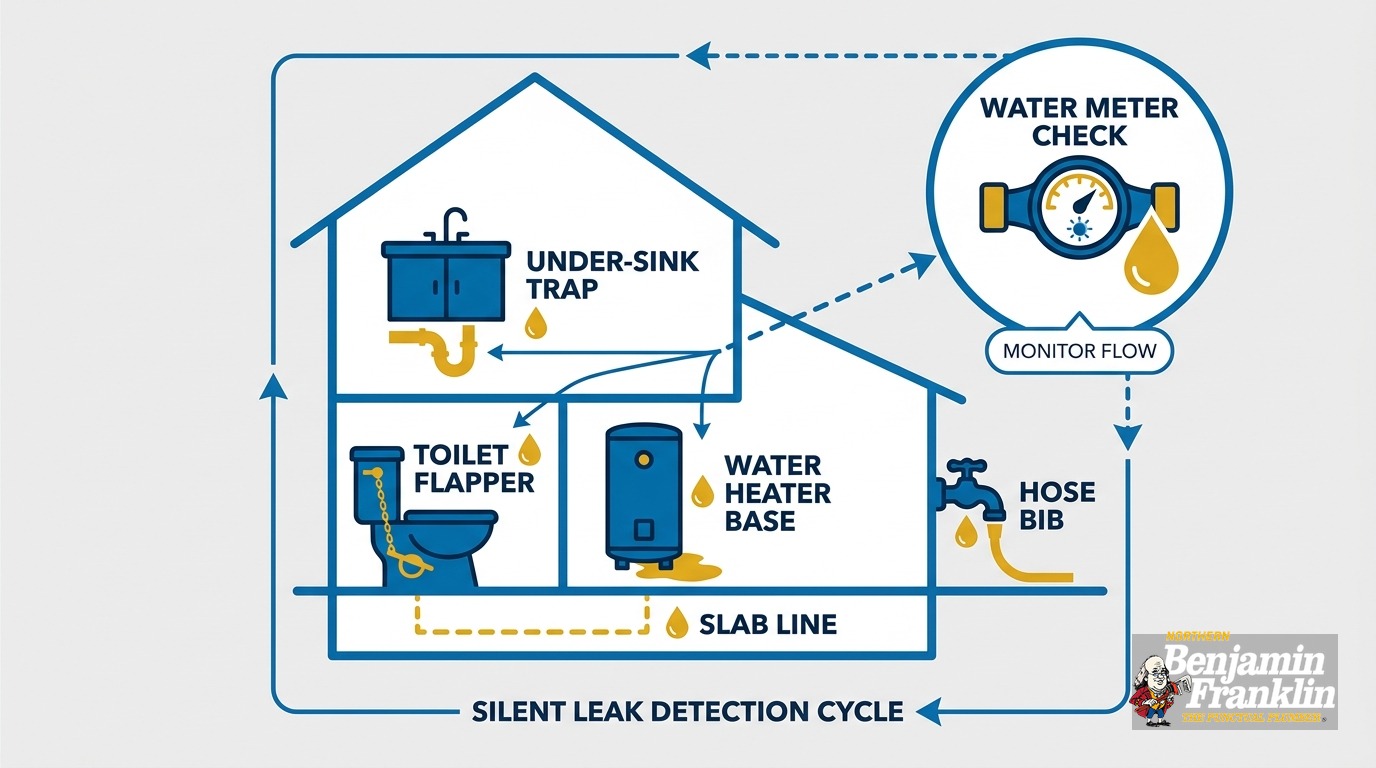
If the two-hour test shows a leak and no faucet is visibly dripping, check toilet flappers, under-sink supply lines, the water heater, and outdoor hose bibs. Most positive tests trace back to one of these four sources - and all four are accessible without cutting into any wall.
Work through the list before calling a plumber. Many leaks turn out to be reachable and fixable without tools.
- Toilet flappers. Every toilet in the house. Run the food-coloring dye test on each tank. A bad flapper is responsible for more residential water waste than any other single source.
- Under-sink supply lines. Open every cabinet beneath a bathroom or kitchen sink. Look for mineral staining on the cabinet floor, soft or darkened wood at the base, or white corrosion deposits at the compression fittings where the braided hose meets the shutoff valve. Minneapolis and St. Paul both have moderately hard water, and hard water accelerates wear at these connections.
- Water heater connections. Inspect the base for corrosion, the temperature and pressure relief valve discharge pipe, and the inlet and outlet connections at the top. A slow weep at a threaded fitting can add hundreds of gallons per month before it creates a visible puddle.
- Outdoor hose bibs and frost-free spigots. If the exterior spigot drips from the handle when the water is off, the stem packing is worn. If it drips from the wall or behind the siding, the supply line behind it may have cracked during a freeze-thaw cycle.
- Refrigerator water line. A compression fitting at the supply connection behind the refrigerator can loosen gradually. Pull the appliance away from the wall and check the floor and the fitting for moisture.
For older Twin Cities homes with original copper plumbing - common in construction from the 1950s through the 1980s - pinhole corrosion leaks are a separate category. They often go unnoticed until a finished ceiling or wall develops a stain. If the meter test shows unexplained loss and none of the accessible sources above accounts for it, that is worth a professional evaluation before the damage spreads inside a wall.
What Are the Winter Leak Risks Specific to Minnesota?
Minnesota’s freeze-thaw cycle creates a specific category of slow, hidden leaks that southern guides never address. Frost-damaged hose bibs, improperly winterized irrigation lines, and supply lines in uninsulated rim joists can all develop slow weeps in fall that don’t appear in the meter readings until January or February.
Consider the timeline. A frost-free hose bib that was not fully drained before the first hard freeze develops a small crack in the supply line behind it. The leak is not dramatic enough to create a puddle at the exterior. But it adds 50 to 100 gallons per week to the meter, invisibly, through three consecutive billing cycles. By February, the homeowner opens a bill that is 30% higher than expected with no obvious explanation.
A similar sequence plays out with supply lines that run through uninsulated exterior walls or across a cold crawl space. The freeze-thaw stress from a Twin Cities winter is enough to loosen a compression fitting that was tight the previous spring. The fitting weeps slowly inside a wall cavity where no one sees it for weeks.
Irrigation systems are a third source. A section of underground line that retained water and then froze can split below grade. The leak shows up in meter readings the following spring, but the damage was done months earlier during the fall blow-out.
The monthly meter log is your best defense against all three scenarios. Three consecutive months of readings that run 400 to 600 gallons above your late-summer baseline - with no change in indoor habits - points to a slow outdoor or subsurface source building quietly through the winter. Our post on what winter may have done to your pipes covers the most common entry points to check when the ground thaws.
When Should I Stop DIY and Call a Licensed Plumber?
Swap a flapper, clean an aerator, tighten a loose supply hose fitting - those are homeowner repairs. The moment the repair involves a shutoff valve, a pipe behind a wall, a supply line under a slab, or any work on the meter itself, it requires a licensed plumber and a permit under Minnesota code.
The line between homeowner territory and licensed-plumber territory is clear under Minnesota Plumbing Code (MN Rule 4714). Repairs that go beyond minor maintenance - valve replacement, any line work behind finished surfaces, underground pipe repair, or anything involving the meter or the main supply segment - require both a licensed plumber and a building permit from the local building official.
This is not a technicality. Uninspected repairs can create disclosure problems at resale. In an older Twin Cities home, a supply line repair done without a permit can surface during a buyer’s inspection and stall or kill a sale. The permit requirement also ensures the repair is done to a standard built for Minnesota’s specific conditions - hard water, deep frost, and the aging pipe materials common in metro housing stock from the mid-20th century.
When to call:
- A shutoff valve that needs replacement or is stuck and will not close fully
- Any supply line running through a wall, under a slab, or underground
- A leak that cannot be traced to a visible, accessible fitting or fixture after the checks above
- Any pipe that requires cutting into drywall, tile, or flooring to reach
- The meter or the supply line between the meter and the main shutoff
Northern Benjamin Franklin Plumbing is locally owned and operated, serving Minneapolis, St. Paul, and communities across the Twin Cities metro. Our licensed plumbers handle the permit process and carry the equipment for non-invasive leak detection when a source is not visible from a walkthrough. We back every visit with the On-Time Guarantee(R). We arrive in the window you choose, or we pay you $5 for every minute we are late, up to $300. “If there is any delay, it’s you we pay!”
Call (763) 296-1844 or book online. If the meter test came back positive and the flappers checked out, we can find it.
Frequently Asked Questions
How do I check my water meter for leaks? +
Where is my water meter in a Minneapolis or St. Paul home? +
Can a silent leak really inflate my sewer bill too? +
How often should I read my water meter to check for leaks? +
Need a technician now?